

Dalmatian
Also known as Dal, Dalmation, and Firehouse Dog
The Dalmatian is an energetic, athletic breed famous for its unmistakable spotted coat and its history as a loyal carriage and coaching dog.
- Size
- Large
- Lifespan
- 11–13 years
- Origin
- Croatia
- Temperament
- Energetic
- Standard colors
- Black, White, and Liver
- Popularity
- No. 48 of 201
Characteristics
Coat and grooming
How the Dalmatian coat is built, and what that means when you groom it.
- Coat layers
- Single coat
- Coat texture
- Smooth
- Coat length
- Short
- Shedding
- Heavy shedding
Registry Recognition
Fédération Cynologique Internationale
- Scent Hounds and Related Breeds
American Kennel Club
- Hound Group
Canadian Kennel Club
- Hound Group
United Pet Club
- Scent Hounds and Related BreedsPrimary
Dalmatian colors and patterns
What each club's breed standard says about every Dalmatian color and pattern. Point at a ruling to see the club's own wording.
Breed standards describe the Dalmatian in Black, White, and Liver. Standard patterns: Piebald and Spotted.
| Color or pattern | FCI | AKC | UKC | KC | KUSA |
|---|---|---|---|---|---|
| Black | Standard (“Black spotted variety with black spots”) | Standard (“White & Black”) | Standard (“In black-spotted dogs, the spots are dense black”) | Standard (“Black spotted having dense black spots”) | Standard (“Black-spotted dogs having dense black spots”) |
| White | Standard (“The ground colour is pure white”) | Standard (“White & Black”) | Standard (“The ground color is pure white”) | Standard (“Ground colour pure white”) | Standard (“Ground colour pure white”) |
| Liver | Standard (“liver spotted variety with brown spots”) | Standard (“White & Liver Brown”) | Standard (“In liver-spotted dogs, the spots are liver brown”) | Standard (“liver spotted, liver brown spots”) | Standard (“liver-spotted dogs, liver brown spots”) |
| Albino | Not recognized | Disqualifying | Disqualifying (“Albinism”) | Not recognized | Not recognized |
| Blue | Disqualifying (“blue spots”) | Disqualifying | Disqualifying | Not recognized | Not recognized |
| Tan | Not recognized | Disqualifying (“White Black & Tan”) | Disqualifying (“Tri-color”) | Not recognized (“Tricolours and spotting other than black or liver unacceptable”) | Not recognized (“Tricolours and spotting other than black or liver unacceptable”) |
| Orange | Disqualifying (“orange coloured spots”) | Disqualifying (“White & Orange”) | Disqualifying (“Any color markings other than black or liver”) | Not recognized (“White with Orange Spots”) | Not recognized (“spotting other than black or liver unacceptable”) |
| Lemon | Disqualifying (“lemon coloured spots”) | Disqualifying (“White & Lemon”) | Disqualifying (“Lemon-colored spots”) | Not recognized (“White with Lemon Spots”) | Not recognized (“spotting other than black or liver unacceptable”) |
| Patterns | |||||
| Piebald | Disqualifying (“Monocle (patching around one or both eyes) or patching elsewhere”) | Disqualifying (“Patches are a disqualification”) | Standard (“Some limited patching around the eyes (monocle) and on or around ears is acceptable but not preferred”) | Standard (“Some patching on ears or head not to be penalised”) | Standard (“Some patching on ears or head not to be penalised”) |
| Spotted | Standard (“distinctively spotted”) | Standard (“a distinctively spotted dog”) | Standard (“a distinctively spotted short coat”) | Standard (“A distinctively spotted dog”) | Standard (“A distinctively spotted dog”) |
| Solid | Disqualifying (“pure white colour without spots”) | No ruling | No ruling | Not recognized | Not recognized |
| Tricolor | Disqualifying (“Tricolour (black and brown spots on the same dog)”) | Disqualifying (“Tri-color”) | Disqualifying (“Tri-color”) | Not recognized (“Tricolours and spotting other than black or liver unacceptable”) | Not recognized (“Tricolours and spotting other than black or liver unacceptable”) |
| Brindle | Disqualifying (“brindle coloured spots”) | No ruling | No ruling | Not recognized | Not recognized |
| Tan point | No ruling | Disqualifying (“tan markings found on the head, neck, chest, leg or tail”) | No ruling | Not recognized | Not recognized |
| Reverse brindle | Disqualifying (“brindle coloured spots”) | No ruling | No ruling | Not recognized | Not recognized |


| Color or pattern | FCI | AKC | UKC | KC | KUSA |
|---|---|---|---|---|---|
| Blue | Disqualifying (“blue eyes”) | Standard (“Eye color is brown or blue, or any combination thereof”) | Disqualifying (“Blue eyes”) | No ruling | No ruling |
| Brown | No ruling | Standard (“Eye color is brown or blue, or any combination thereof”) | No ruling | No ruling | No ruling |
| Dark brown | No ruling | Standard (“the darker the better”) | Standard (“dark brown in black spotted”) | Standard (“dark brown in black spotted”) | Standard (“dark brown in black-spotted”) |
| Light brown | No ruling | No ruling | Standard (“light brown to amber in liver spotted dogs”) | No ruling | No ruling |
| Amber | No ruling | No ruling | Standard (“light brown to amber in liver spotted dogs”) | Standard (“amber in liver spotted”) | Standard (“amber in liver-spotted”) |
| Patterns | |||||
| Odd-eyed | Disqualifying (“eyes of different colours (heterochromia)”) | Standard (“Eye color is brown or blue, or any combination thereof”) | Disqualifying (“Eyes of two different colors”) | No ruling | No ruling |
| Sectoral | Disqualifying (“partially blue coloured iris”) | Standard (“Eye color is brown or blue, or any combination thereof”) | No ruling | No ruling | No ruling |


| Color or pattern | FCI | AKC | UKC | KC | KUSA |
|---|---|---|---|---|---|
| Black | Standard (“The colour must be in accordance to the colour of the spotting”) | Standard (“black in black-spotted dogs”) | Standard (“black in black-spotted dogs”) | Standard (“Nose in black-spotted variety always black”) | Standard (“Nose in black-spotted variety always black”) |
| Liver | Standard (“The colour must be in accordance to the colour of the spotting”) | Standard (“brown in liver-spotted dogs”) | Standard (“brown in liver-spotted dogs”) | Standard (“in liver variety always brown”) | Standard (“in liver variety always brown”) |
| Pink | Disqualifying (“Lack of nose pigment”) | No ruling | No ruling | No ruling | No ruling |
| Patterns | |||||
| Butterfly nose | No ruling | Fault (“Incomplete nose pigmentation is a major fault”) | Fault (“Incomplete nose pigmentation”) | No ruling | No ruling |

What the rulings mean
- Standard
- Described by the club's breed standard.
- Fault
- Named by the club's breed standard as a fault: the animal can be shown but is penalized.
- Disqualifying
- The club's breed standard disqualifies an animal of this color or pattern.
- Not recognized
- The club does not accept this color or pattern for the breed.
Color changes
How a Dalmatian's colors can change over its life.
Blackchanges toRust
Coat · With body condition · can change back
Blackchanges toGray
Coat · Progressive
Blackchanges toBrown
Coat · In the sun · can change back
Blackchanges toBrown
Coat · In the sun · can change back
Whitechanges toRoan
Coat · With age · from 2 weeks
Whitechanges toSpotted
Coat · With age · from 2 weeks
Bluechanges toDark brown
Eyes · With age · from 2 weeks
Bluechanges toBrown
Eyes · With age · from 2 weeks
Bluechanges toLight brown
Eyes · With age · from 2 weeks
Bluechanges toAmber
Eyes · With age · from 2 weeks
Bluechanges toHazel
Eyes · With age · from 2 weeks
Bluechanges toYellow
Eyes · With age · from 2 weeks
Blackchanges toSnow nose
Nose · With the season · can change back
Blackchanges toPink
Nose · With the season · can change back


Sources
Each ruling comes from the club's published breed standard or color list.
Health
Conditions recorded as more common in the Dalmatian than in its species as a whole. A higher risk is not a diagnosis: many never develop any of them, and your vet can say which screening tests are worth doing.
High risk
- Ears & hearing
Hereditary congenital deafness
Strong evidenceHereditaryInheritance: Complex / multifactorial - Urinary system
Hyperuricosuria
Also called Urate stones
Strong evidenceHereditaryInheritance: Autosomal recessive
This content is for educational purposes and is not a substitute for professional veterinary advice. If you are worried about your pet, contact your veterinarian.
All health conditionsMeet some of our Dalmatian
A few of the Dalmatian profiles members have added to United Pet Club.



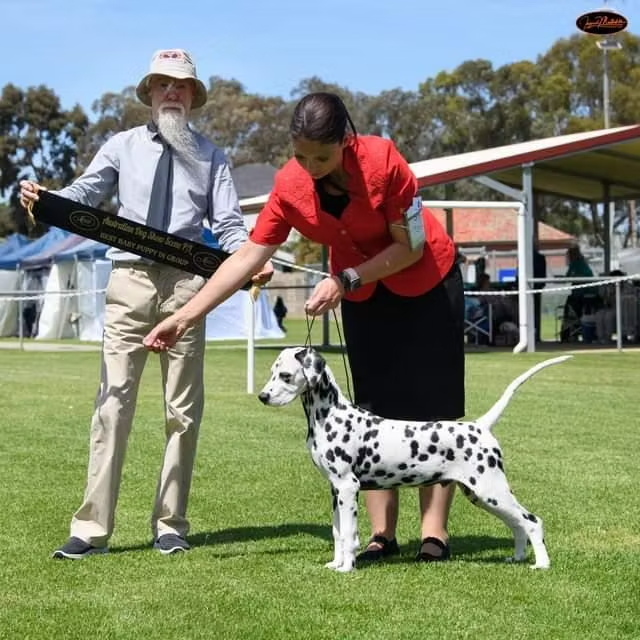



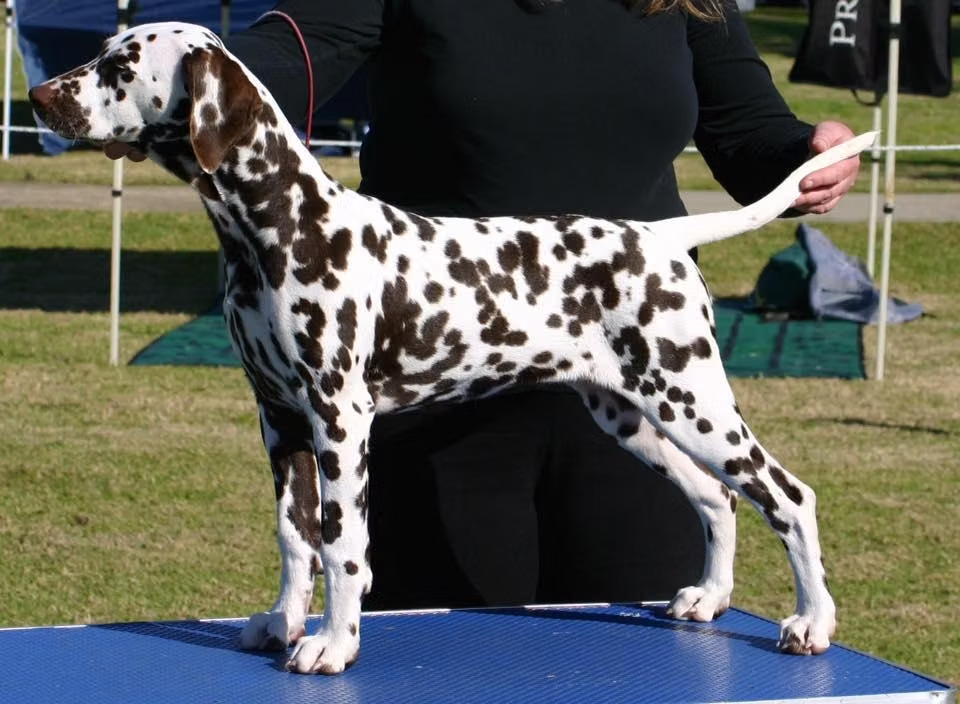

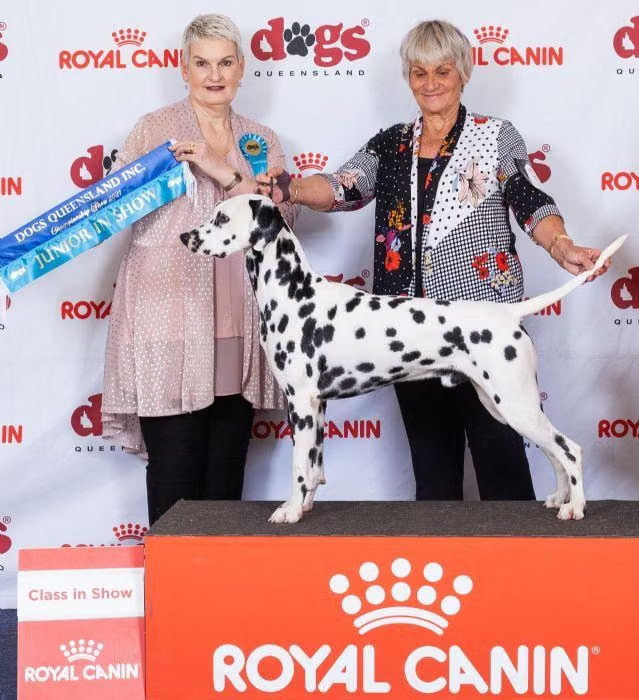

About the Dalmatian
The Dalmatian is a large, athletic dog known for its white coat marked with distinct black or liver spots and a long history working alongside horse-drawn carriages.
The Dalmatian is a medium-to-large dog recognized worldwide by its short white coat covered in round black or liver spots. Adults typically stand 19 to 24 inches at the shoulder and weigh 45 to 70 pounds, with a lean, muscular frame built for distance running. The breed traces its modern identity to the historical region of Dalmatia in present-day Croatia.
This is an energetic and alert dog that forms strong attachments to its family. Dalmatians were bred to trot beside carriages for many miles, and that endurance still defines the breed. A Dalmatian that does not get enough daily activity often becomes restless and may develop unwanted habits.
The breed is friendly and loyal with people it knows, and it can be reserved around strangers. With early socialization, most Dalmatians live well with children and other dogs. They suit owners who have time for daily exercise and consistent training.
| Attribute | Detail |
|---|---|
| Origin | Dalmatia (modern Croatia) |
| Size | Large (45 to 70 lb) |
| Lifespan | 11 to 13 years |
| Group / role | Companion and historic carriage dog |
| Good with | Families, older children, other dogs with socialization |
Who it suits
The Dalmatian fits active households that can provide an hour or more of vigorous exercise every day. Runners, hikers, and people who enjoy dog sports tend to do well with the breed. It is a poor match for owners who are away for long stretches or who want a low-energy housemate.
History and origin
The Dalmatian takes its name from the historical region of Dalmatia and became known across Europe as a coaching dog that ran alongside horse-drawn carriages.
The breed is named for Dalmatia, a coastal region along the eastern Adriatic in what is now Croatia. Spotted dogs resembling the modern Dalmatian appear in European artwork and records from the 1600s and 1700s, though the exact early development of the breed is not fully documented.
The Dalmatian gained its lasting reputation as a coaching dog. It trotted alongside or beneath horse-drawn carriages, guarding the horses and the contents during travel and at rest. This work demanded stamina, an even temperament around horses, and a natural affinity for the road, traits the breed still carries.
In the 1800s the Dalmatian became closely tied to firefighting in some countries. When fire engines were pulled by horses, the dogs ran ahead to help clear the way and stayed with the horses at the scene. That association is why the breed remains a familiar mascot at fire stations.
The Dalmatian was recognized by major kennel organizations as breed standards took shape in the late 1800s and early 1900s. Over time it shifted from a working road dog to a companion and show dog, while keeping the high energy and endurance of its coaching past.
Appearance
The Dalmatian is a clean, muscular dog with a short white coat marked by clearly defined black or liver spots distributed across the body.
The Dalmatian has a balanced, athletic build with a deep chest, level back, and a long tail that tapers to a point. The head is clean and the ears are set fairly high and carried close to the head. Overall the dog gives an impression of strength and endurance without bulk.
| Trait | Detail |
|---|---|
| Height | 19 to 24 inches at the shoulder |
| Weight | 45 to 70 pounds |
| Coat | Short, dense, fine, and smooth |
| Colors | White with black spots or white with liver (brown) spots |
| Eyes | Round, dark brown in black-spotted dogs and amber in liver-spotted dogs |
Coat and colors
The defining feature is the spotting pattern. Puppies are born pure white, and the spots develop over the first few weeks of life. Spots are round, well defined, and range roughly from the size of a coin to about two inches across, with smaller spots on the head, legs, and tail. The two recognized varieties are black-spotted and liver-spotted; the two colors do not appear together on the same dog. The short coat sheds steadily throughout the year.
Temperament and personality
Dalmatians are friendly, loyal, and high-energy dogs that bond closely with their families and stay alert to their surroundings.
The Dalmatian is an outgoing and people-oriented dog. It thrives on being part of family activity and does not like long periods alone. With its own household the breed is affectionate and playful, and it often stays physically close to favorite people.
Around strangers a Dalmatian is typically alert and somewhat reserved at first, which makes it a capable watchdog. It is not usually aggressive, but it will notice and announce anything out of the ordinary. Early, consistent socialization helps the dog stay confident rather than wary.
With children the breed is generally good-natured, though its size and energy mean it suits homes with older children who can handle an active dog. Around other dogs most Dalmatians are sociable when raised together or introduced properly. The breed is intelligent and independent, which can read as stubbornness without firm, patient guidance.
| Trait | Rating |
|---|---|
| Affection | 5 |
| Energy | 5 |
| Trainability | 3 |
| Vocalness | 3 |
| Shedding | 4 |
Care and grooming
Dalmatians need substantial daily exercise and steady coat maintenance to manage their year-round shedding.
Grooming
- Brush once or twice a week with a rubber curry brush or grooming mitt to remove loose hair
- Expect steady shedding all year, with heavier periods in spring and fall
- Bathe only when needed, since the coat carries little odor
- Trim nails every few weeks and check ears for wax buildup
- Brush teeth several times a week
Exercise
- Provide at least 60 to 90 minutes of vigorous activity daily
- Running, jogging alongside a bike, and long hikes suit the breed well
- Include mental work such as training games or scent activities
- A securely fenced area lets the dog run safely off leash
Environment
The Dalmatian adapts to house or apartment life only if its exercise needs are met. It is an indoor dog that wants to be with its family and does not tolerate being left outside or alone for long. The short coat offers little insulation, so the dog needs protection from cold weather.
Nutrition and feeding
Dalmatians do well on a complete, balanced diet, and owners should give special attention to managing urinary health through hydration and food choices.
Feed a complete and balanced diet formulated for the dog's life stage and activity level. Active adult Dalmatians burn a lot of energy, so portion to maintain a lean body condition where the ribs are easy to feel but not visible. Divide the daily amount into two meals to support steady energy and reduce the risk of bloat.
| Life stage | Amount per day | Meals |
|---|---|---|
| Puppy (2 to 6 months) | Per puppy food label, divided | 3 to 4 |
| Puppy (6 to 12 months) | Per puppy food label, divided | 2 to 3 |
| Adult | About 1.5 to 2.5 cups dry food | 2 |
| Senior / less active | Reduced to hold lean weight | 2 |
Treats and supplements
Keep treats to about 10 percent of daily calories. Most Dalmatians on a complete commercial diet do not need supplements, but a veterinarian may recommend specific support for urinary health. Plenty of fresh water at all times is important for this breed.
Health and lifespan
Dalmatians typically live 11 to 13 years and are generally hardy, though the breed is prone to congenital deafness and urinary stones.
The Dalmatian is generally a robust, long-lived breed with a typical lifespan of 11 to 13 years. Responsible breeding and routine veterinary care reduce the impact of the conditions known in the breed. Two health concerns are closely linked to the breed: congenital deafness and a tendency toward urinary stones.
| Condition | Signs | Note |
|---|---|---|
| Congenital deafness | No response to sound, in one or both ears | Common in the breed; puppies can be hearing tested (BAER) early |
| Urinary (urate) stones | Straining to urinate, blood in urine, frequent attempts | Linked to the breed's uric acid metabolism; needs prompt vet care |
| Hip dysplasia | Stiffness, reduced activity, difficulty rising | Screen breeding dogs; keep weight controlled |
| Skin allergies | Itching, redness, recurring irritation | Manage with vet guidance and diet review |
Preventive care
- Keep vaccinations and parasite prevention current
- Test puppies for hearing where possible
- Provide constant fresh water and monitor urination to catch stone problems early
- Maintain a lean weight to protect joints
- Schedule annual checkups, with more frequent visits for senior dogs
Training
Dalmatians are intelligent and capable learners that respond best to patient, reward-based training and early socialization.
The Dalmatian is smart and quick to learn, but it also has an independent streak that can make training feel like a negotiation. Sessions work best when they are short, varied, and engaging, since a bored Dalmatian loses focus. Consistency from everyone in the household matters, because the breed notices and exploits mixed signals. Deaf Dalmatians can be trained successfully using hand signals and vibration-based cues.
Basics
- Start socialization early, exposing the puppy to people, dogs, and new places
- Teach core cues such as sit, stay, come, and leash manners from a young age
- Use clear, consistent signals, and add hand signals especially for deaf dogs
- Keep sessions short and end on a success
- Channel the breed's energy into structured activities like running, agility, or scent work
Breeding
Dalmatian breeding centers on health screening, particularly hearing testing and selection to reduce inherited deafness and urinary problems.
Dalmatians reach sexual maturity around 6 to 12 months, but responsible breeders wait until a dog is physically and mentally mature, usually around two years, before breeding. Females typically come into season about twice a year. After a successful mating, gestation lasts roughly 63 days.
Litters are often large, commonly ranging from about 6 to 9 puppies, though larger litters occur. Puppies are born white, with their spots appearing over the following weeks. Newborns depend fully on the mother for warmth and nutrition in the first weeks, and weaning generally begins around 3 to 4 weeks of age, with puppies ready to go to new homes from about 8 weeks.
Because congenital deafness and urate stones run in the breed, ethical breeding involves hearing testing of breeding stock and puppies, along with attention to lines with healthier urinary and joint histories. Raising the young includes early handling and gentle socialization to support stable temperaments.
| Metric | Value |
|---|---|
| Sexual maturity | 6 to 12 months |
| Recommended breeding age | Around 2 years |
| Gestation | About 63 days |
| Typical litter size | 6 to 9 puppies |
| Weaning | About 6 to 8 weeks |
Registering your Dalmatian and its microchip
Register your Dalmatian free for life with United Pet Club, and put its microchip number on a record American shelters can actually find.
How to register a Dalmatian in the United States
Shelters across the US scan every dog that comes through the door, and what happens next depends on paperwork. A scan that ends at a current record gets your Dalmatian home; a scan that ends nowhere starts a holding period. Register your dog with United Pet Club and that record exists, free, for the rest of your dog's life.
The microchip needs its own registration. A vet implants the chip, but the number stays anonymous until you file it, and an anonymous chip cannot point anyone at you. Register the microchip with United Pet Club on the free lifetime plan: every brand a US vet implants qualifies, updates cost nothing after a move, and the record shows up in the AAHA universal lookup American shelters check first. Create your free account and finish both steps in one sitting.
How do I register my Dalmatian in the United States?
Open a free United Pet Club account, enter your Dalmatian's name, birth date, and a photo, and save. The profile is free for life, works with or without a microchip, and you can attach a chip number later.
How do I register my Dalmatian's microchip?
Type the 15-digit chip number into your free United Pet Club account together with your current phone number and address. The lifetime plan is free, covers every future update, and accepts any chip brand a US vet implants.
Does my Dalmatian have to be microchipped in the United States?
No federal law says a Dalmatian must carry a chip, but plenty of city and county licensing rules do, and shelters routinely chip before adoption. What the law never does is register the chip for you; that part is yours.
How much does it cost to register a Dalmatian?
Nothing. United Pet Club's lifetime plan covers the dog's profile, the microchip registration, and every update at no charge, with no renewal fees.
Frequently asked questions
Common questions about the Dalmatian cover its size, temperament, exercise needs, lifespan, and suitability for different homes.
How big does a Dalmatian get?
Dalmatians are a large breed, standing about 19 to 24 inches at the shoulder and weighing roughly 45 to 70 pounds when fully grown.
What is the Dalmatian's temperament like?
Dalmatians are friendly, loyal, and energetic. They bond closely with their families, stay alert around strangers, and are generally good with children and other dogs when socialized early.
Are Dalmatians hard to care for?
They are moderately demanding. The grooming is simple, but the breed needs a lot of daily exercise and consistent training, and it sheds heavily year round, so it suits active, committed owners.
How long do Dalmatians live?
A healthy Dalmatian typically lives 11 to 13 years. Routine veterinary care, a lean weight, and attention to hearing and urinary health support a full lifespan.
Are Dalmatians good family dogs?
Yes, for active families. They do best in homes with older children, plenty of exercise, and people who are around often, since they dislike being left alone for long.
Why are some Dalmatians deaf?
Congenital deafness is common in the breed and is linked to the genetics behind their coat pattern. Puppies can be hearing tested early, and deaf dogs can still live full lives with hand-signal training.
Where can I get a Dalmatian?
Dalmatians are available through reputable breeders who health and hearing test their dogs, as well as through breed-specific rescues and shelters.
From the community
Ask about the DalmatianNo questions about the Dalmatian yet. Be the first to ask.
Browse Dog breeds