
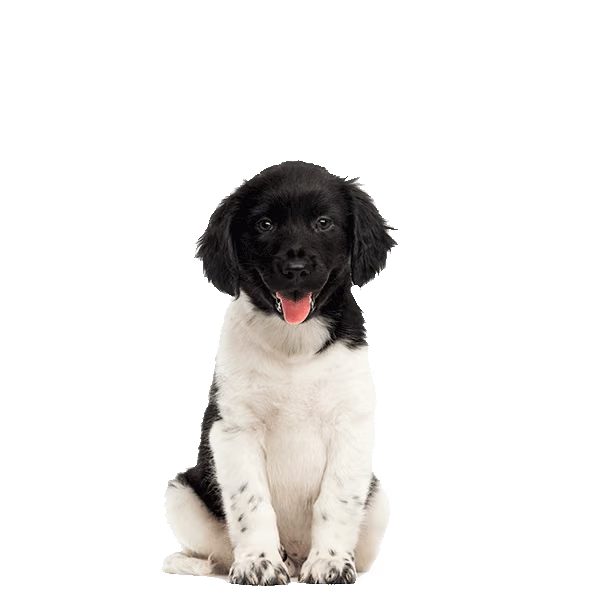
Stabyhoun
The Stabyhoun is a friendly, gentle Dutch farm dog known for its versatility as a pointer, retriever, and devoted companion.
- Size
- Medium
- Lifespan
- 13–14 years
- Origin
- Netherlands
- Temperament
- Friendly
- Standard colors
- Black, White, Brown, and Orange
Characteristics
Coat and grooming
How the Stabyhoun coat is built, and what that means when you groom it.
- Coat layers
- Single coat
- Coat texture
- Silky
- Coat length
- Medium
- Shedding
- Moderate shedding
Grooming guidance
Caution: A Stabyhoun coat mats easily.
Fine or long hair tangles at the base of the coat, out of sight, where the mats tighten and pull on the skin. Brushing has to reach right down to the roots in sections, not just skim the surface.
Registry Recognition
Fédération Cynologique Internationale
- Pointers and Setters
American Kennel Club
- Sporting Group
Canadian Kennel Club
- Sporting Group
United Pet Club
- Pointers and SettersPrimary
Stabyhoun colors and patterns
What each club's breed standard says about every Stabyhoun color and pattern. Point at a ruling to see the club's own wording.
Breed standards describe the Stabyhoun in Black, White, Brown, and Orange. Standard patterns: Piebald, Roan, and Spotted.
| Color or pattern | FCI | AKC | UKC | KUSA |
|---|---|---|---|---|
| Black | Standard (“black”) | Standard (“Black & White”) | Standard (“Black”) | Standard (“black”) |
| White | Standard (“with white markings”) | Standard (“Black & White”) | Standard (“with white markings”) | Standard (“with white markings”) |
| Brown | Standard (“brown”) | Standard (“Brown & White”) | Standard (“brown”) | Standard (“brown”) |
| Orange | Disqualifying | Disqualifying (“Orange & White”) | Standard (“orange”) | Disqualifying |
| Patterns | ||||
| Piebald | Standard (“a pied dog in black or brown with white markings”) | Standard (“a pied dog in black or brown with white markings”) | Standard (“Black, brown or orange, with white markings”) | Standard (“a pied dog in black or brown with white markings”) |
| Roan | Standard (“black or brown roans are accepted”) | Standard (“Roan”) | Standard (“Ticking or roaning in the white is permissible”) | Standard (“black or brown roans are also accepted”) |
| Spotted | No ruling | Standard (“Spotted”) | No ruling | No ruling |
| Solid | Disqualifying (“the absence of white colour”) | Disqualifying (“the absence of white colour”) | No ruling | Disqualifying (“the absence of white colour”) |
| Tricolor | Disqualifying (“Tan marking or tricolor is disqualifying”) | Disqualifying (“Tan marking or tricolor is disqualifying”) | No ruling | Disqualifying (“Tan marking or tri-colour is disqualifying”) |
| Tan point | Disqualifying (“Tan marking or tricolor is disqualifying”) | Disqualifying (“Tan marking or tricolor is disqualifying”) | No ruling | Disqualifying (“Tan marking or tri-colour is disqualifying”) |


| Color or pattern | FCI | AKC | UKC | KUSA |
|---|---|---|---|---|
| Brown | No ruling | No ruling | Standard (“brown in brown or orange dogs”) | No ruling |
| Dark brown | Standard (“dark brown for dogs with black and white coat”) | Standard (“dark brown for dogs with black and white coat”) | Standard (“dark brown in black dogs”) | Standard (“dark brown for dogs with black and white coat”) |
| Light brown | Standard (“a lighter brown colour for dogs with a brown and white coat colour”) | Standard (“a lighter brown colour for dogs with a brown and white coat colour”) | No ruling | Standard (“a lighter brown colour for dogs with a brown and white coat colour”) |
| Yellow | No ruling | No ruling | Fault (“Yellow eyes”) | No ruling |
| Color or pattern | FCI | AKC | UKC | KUSA |
|---|---|---|---|---|
| Black | Standard (“Black in dogs with a black and white coat colour”) | Standard (“Black in dogs with a black and white coat colour”) | Standard (“black or brown in color, depending on the color of the coat”) | Standard (“Black in dogs with a black and white coat colour”) |
| Liver | Standard (“Brown in dogs with a brown and white coat colour”) | Standard (“Brown in dogs with a brown and white coat colour”) | Standard (“black or brown in color, depending on the color of the coat”) | Standard (“Brown in dogs with a brown and white coat colour”) |
What the rulings mean
- Standard
- Described by the club's breed standard.
- Fault
- Named by the club's breed standard as a fault: the animal can be shown but is penalized.
- Disqualifying
- The club's breed standard disqualifies an animal of this color or pattern.
Color changes
How a Stabyhoun's colors can change over its life.
Blackchanges toRust
Coat · With body condition · can change back
Blackchanges toGray
Coat · Progressive
Blackchanges toBrown
Coat · In the sun · can change back
Whitechanges toRoan
Coat · With age · from 2 weeks
Blackchanges toSnow nose
Nose · With the season · can change back
Blackchanges toPink
Nose · With the season · can change back

Sources
Each ruling comes from the club's published breed standard or color list.
About the Stabyhoun
The Stabyhoun is a friendly, gentle Dutch farm dog from the province of Friesland, valued as a versatile pointer, retriever, and family companion.
The Stabyhoun is a medium-sized dog that originated on the small farms of Friesland in the northern Netherlands. For generations it worked as an all-purpose farm dog, pointing and retrieving game for hunters, controlling vermin around the barn, and guarding the home. The name comes from the Frisian phrase often translated as "stand by me dog," which reflects the breed's attachment to its people.
This is one of the rarer dog breeds in the world, with a relatively small population concentrated in the Netherlands and a smaller number kept elsewhere. The breed is known for being soft-natured and even-tempered. It works closely with people rather than independently, which suits both field work and home life.
Stabyhouns are friendly, affectionate, and gentle. They are trainable and adaptable, comfortable switching between an active day outdoors and a quiet evening indoors. Their versatility is the trait owners mention most often.
| Attribute | Detail |
|---|---|
| Origin | Netherlands (Friesland) |
| Size | Medium |
| Lifespan | 13 to 14 years |
| Group / role | Pointing and retrieving farm dog, companion |
| Good with | Families, children, and other dogs when socialized |
Who this breed suits
The Stabyhoun fits active households that can give it daily exercise and regular company. It bonds closely and does not do well left alone for long stretches. Owners who enjoy outdoor activity, dog sports, or fieldwork tend to match well with the breed's energy and willingness to work. First-time owners can manage a Stabyhoun if they commit to consistent training and socialization from puppyhood.
History and origin
The Stabyhoun developed over centuries as a farm and hunting dog in Friesland, Netherlands, and was formally recognized in the Dutch breed registry in 1942.
The Stabyhoun comes from the Frisian woodland region of the Netherlands, an area of small mixed farms in the provinces of Friesland and parts of Drenthe. Written references to dogs of this type appear in Dutch literature from the nineteenth century, and the breed is generally considered to have existed in the region well before that. Farmers kept these dogs as economical, do-everything workers rather than specialized hunting hounds.
On the farm the Stabyhoun pointed and retrieved birds and small game, hunted moles and polecats for their pelts, killed rats and other vermin, and watched over the property. Families could not afford separate dogs for separate jobs, so the breed was selected for general usefulness and a cooperative temperament.
For part of its history the Stabyhoun was bred and worked alongside the Wetterhoun, another Frisian breed, and the two were sometimes crossed. Dutch breed enthusiasts later worked to keep the two populations distinct. The Stabyhoun gained official recognition from the Dutch kennel authority in 1942.
The breed has remained rare throughout its history, with breeding closely managed to protect a limited gene pool. Dedicated breed associations in the Netherlands maintain records and coordinate breeding to keep the population healthy. Numbers outside the Netherlands stay small, and the Stabyhoun is still considered one of the less common breeds worldwide.
Appearance and breed standard
The Stabyhoun is a medium-sized, sturdy dog with a moderately long coat, most commonly black and white, and a feathered tail.
The Stabyhoun is a well-proportioned, medium-sized dog built slightly longer than it is tall. It has a sturdy but not heavy frame, giving it the stamina for a full day of field work without looking bulky. The head is dry and carries a friendly expression, with ears set fairly low and hanging close to the cheeks. The tail is long, reaches to about the hock, and is well feathered.
| Trait | Standard |
|---|---|
| Height | Males about 53 cm (21 in); females about 50 cm (20 in) |
| Weight | About 18 to 23 kg (40 to 50 lb) |
| Coat | Moderately long, sleek, with feathering on legs and tail |
| Colors | Black and white most common; also brown and white or orange and white |
| Eyes | Round, dark brown in black dogs; lighter brown in brown dogs |
Coat and colors
The coat lies fairly close to the body and is smooth over most of the dog, with longer feathering on the back of the legs, the tail, and the rump. The texture should not be curly, though a slight wave along the spine is acceptable. The most familiar pattern is black and white. Brown and white occurs, and orange and white is seen less often. Ticking or roan flecks of color in the white areas are common and accepted in the breed. The combination of a clear ground color and feathered furnishings gives the Stabyhoun a tidy, balanced outline rather than a heavily coated look.
Temperament and personality
The Stabyhoun is friendly, gentle, and devoted to its family, generally good with children and other dogs, and reserved rather than aggressive with strangers.
The Stabyhoun has a soft, even temperament and forms strong attachments to its household. It is patient and gentle, which makes it well suited to family life and generally reliable around children when raised with them. The breed wants to be involved in what the family is doing and prefers company to long periods alone.
With strangers the Stabyhoun tends to be polite but reserved at first, warming up once it takes the measure of a new person. It is not a sharp or aggressive guard dog, though it will alert to visitors. With other dogs it is usually sociable, and early socialization helps it settle comfortably in mixed-pet homes. Its hunting background means it may chase small animals, so introductions to cats and other small pets should be careful and supervised.
The breed has an independent streak inherited from its working past and can be sensitive, so harsh handling tends to backfire. A patient, consistent approach brings out its cooperative side.
| Trait | Rating |
|---|---|
| Affection | 5 |
| Energy | 4 |
| Trainability | 4 |
| Vocalness | 2 |
| Shedding | 3 |
Care and grooming
The Stabyhoun needs moderate grooming, daily exercise, and regular company, and it adapts to most homes that can meet those needs.
The Stabyhoun is a fairly low-maintenance breed for its coat type, but it has real exercise and companionship needs that owners should plan for.
Grooming
- Brush the coat about once a week to remove loose hair and prevent tangles in the feathering.
- Increase brushing during seasonal shedding periods, which usually happen twice a year.
- Check and clean the hanging ears regularly to reduce the risk of infection.
- Bathe only when needed; the coat sheds dirt well and does not require frequent washing.
- Trim nails every few weeks and check teeth and feet during grooming.
Exercise
- Provide at least 60 minutes of activity per day across walks, free running, and play.
- Add mental work such as scent games, retrieving, or training sessions to use the breed's working drive.
- Dog sports like agility, obedience, and field trials suit the breed well.
- Build up stamina gradually in young dogs to protect growing joints.
Environment
The Stabyhoun does well in houses with access to a secure yard and adapts to a range of climates thanks to its weatherproof coat. It can live in smaller homes if its exercise needs are met, but it is not suited to being left alone for long workdays. A home where someone is around for much of the day, or where the dog can come along to activities, fits the breed best.
Nutrition and feeding
Feed the Stabyhoun a balanced complete diet matched to its life stage and activity level, split into two meals a day for adults.
A medium-sized active breed, the Stabyhoun does well on a complete and balanced diet formulated for its life stage. Working or sporting dogs may need more calories than a pet kept at a moderate activity level. Adjust portions to keep the dog lean, since extra weight adds strain to the joints. Fresh water should always be available.
| Life stage | Amount per day | Meals |
|---|---|---|
| Puppy (2 to 6 months) | Per puppy-food label, by weight and age | 3 to 4 |
| Junior (6 to 12 months) | Transitioning toward adult portions | 2 to 3 |
| Adult (1 to 7 years) | About 200 to 300 g of quality dry food | 2 |
| Senior (8 years and older) | Slightly reduced calories, monitor weight | 2 |
Treats and supplements
Keep treats to no more than about 10 percent of daily calories and use them for training rewards. Most Stabyhouns on a complete commercial diet need no extra supplements. If you are considering joint support or other additions, or feeding a home-prepared or raw diet, consult a veterinarian to keep the diet balanced and appropriate for the dog's age and workload.
Health and common conditions
The Stabyhoun is a generally healthy breed with a lifespan of 13 to 14 years, though responsible breeding and routine veterinary care help manage the conditions seen in the population.
The Stabyhoun is regarded as a robust, generally healthy breed, helped by careful population management within the breed associations. The typical lifespan is 13 to 14 years. Because the gene pool is small, breeders screen carefully and coordinate matings to limit inherited problems. As with any breed, individual dogs can still develop the conditions listed below.
| Condition | Signs | Note |
|---|---|---|
| Hip dysplasia | Stiffness, limping, reluctance to jump | Screening of breeding stock helps reduce risk |
| Epilepsy | Seizures, often appearing in young adults | Managed with veterinary care; affected dogs not bred |
| Patent ductus arteriosus | Heart murmur, poor growth, fatigue | A congenital heart defect detected by a vet |
| Cerebral dysfunction | Neurological signs in puppies | A rare inherited condition tracked by breeders |
Preventive care
- Keep vaccinations and parasite control up to date on a veterinarian's schedule.
- Choose puppies from breeders who screen for hip dysplasia and follow breed-association guidelines.
- Maintain a healthy weight and provide regular, joint-friendly exercise.
- Clean and check the ears routinely to prevent infections.
- Schedule annual veterinary exams, moving to twice yearly for senior dogs.
Training and socialization
The Stabyhoun is intelligent and willing but sensitive, so it responds best to patient, consistent, reward-based training started early.
The Stabyhoun is intelligent and eager to work with its handler, which makes it trainable across obedience, fieldwork, and dog sports. It does carry an independent streak from its farm-dog past, so it can be slow to mature and may test boundaries. The breed is sensitive and responds poorly to harsh corrections; calm, consistent guidance produces far better results. Keep sessions short, varied, and rewarding to hold the dog's attention.
Basics
- Start socialization in puppyhood, exposing the dog to people, other animals, and new environments.
- Teach core cues such as sit, stay, recall, and loose-lead walking using rewards.
- Practice a reliable recall early, since the breed's hunting instinct can pull it toward small animals.
- Build alone-time tolerance gradually to prevent separation problems.
- Add scent work, retrieving, or a dog sport to channel the breed's working drive.
Breeding
Stabyhoun breeding is closely coordinated by breed associations to protect a small gene pool, with litters of around seven puppies raised by attentive dams.
Breeding the Stabyhoun is carefully managed because the worldwide population is small and the gene pool limited. Breed associations in the Netherlands set guidelines that include health screening and rules to avoid mating closely related dogs, which helps maintain genetic diversity. Prospective breeders are expected to follow these programs rather than breed independently.
Dogs should reach physical and behavioral maturity before breeding, generally around two years of age, and pass the relevant health checks first. After a successful mating, gestation lasts about nine weeks. Litter sizes vary but average around seven puppies. The breed generally makes a calm, attentive mother, and puppies stay with the dam and litter through the early weeks to support healthy social development before going to new homes, typically at about eight weeks. Early handling and socialization during this period are important for the breed's temperament.
| Metric | Value |
|---|---|
| Sexual maturity | Around 1 to 2 years; breed at maturity |
| Gestation | About 63 days (9 weeks) |
| Average litter size | About 7 puppies |
| Weaning age | About 6 to 8 weeks |
| Go-home age | About 8 weeks |
Registering your Stabyhoun and its microchip
Register your Stabyhoun free for life with United Pet Club, and put its microchip number on a record American shelters can actually find.
How to register a Stabyhoun in the United States
Start with the profile. Add your Stabyhoun's name, birth date, and a clear photo, attach your phone number and email, and save. That is the whole job, and it costs nothing for life. Dog registration works with or without a microchip, so there is no reason to wait for a vet visit.
Chipped already? The implant is half the job. Until the 15-digit number sits in a registry with your name beside it, a scanner reads digits that lead nowhere. Microchip registration is free for life at United Pet Club, takes any manufacturer's chip, and keeps the record searchable through the AAHA lookup shelters rely on. Sign up free, and both records are done tonight.
How do I register my Stabyhoun in the United States?
Open a free United Pet Club account, enter your Stabyhoun's name, birth date, and a photo, and save. The profile is free for life, works with or without a microchip, and you can attach a chip number later.
How do I register my Stabyhoun's microchip?
Type the 15-digit chip number into your free United Pet Club account together with your current phone number and address. The lifetime plan is free, covers every future update, and accepts any chip brand a US vet implants.
Does my Stabyhoun have to be microchipped in the United States?
No federal law says a Stabyhoun must carry a chip, but plenty of city and county licensing rules do, and shelters routinely chip before adoption. What the law never does is register the chip for you; that part is yours.
How much does it cost to register a Stabyhoun?
Nothing. United Pet Club's lifetime plan covers the dog's profile, the microchip registration, and every update at no charge, with no renewal fees.
Frequently asked questions
Common questions about the Stabyhoun's size, temperament, care needs, lifespan, suitability, and availability.
How big does a Stabyhoun get?
The Stabyhoun is a medium-sized dog. Males stand about 53 cm (21 in) at the shoulder and females about 50 cm (20 in), with weights generally between 18 and 23 kg (40 to 50 lb).
Is the Stabyhoun good with families and children?
Yes. The breed is friendly, gentle, and affectionate, and it is generally reliable with children when raised and socialized with them. It bonds closely with its household and likes to be involved in family life.
Is the Stabyhoun hard to care for?
Care is moderate. The coat needs only about weekly brushing, but the dog needs at least an hour of daily exercise, mental stimulation, and regular company. It is not suited to being left alone for long periods.
How long do Stabyhouns live?
The typical lifespan is 13 to 14 years. The breed is generally healthy, and routine veterinary care plus a healthy weight support a long life.
Is the Stabyhoun a good first dog?
It can be, for an active owner willing to commit to early socialization and consistent, reward-based training. The breed is sensitive and can mature slowly, so patience helps.
Are Stabyhouns easy to find?
No. The Stabyhoun is one of the rarer breeds, with most dogs in the Netherlands and a small number elsewhere. Buyers often join a waiting list through a recognized breed association.
Do Stabyhouns shed a lot?
Shedding is moderate, with heavier seasonal sheds usually twice a year. Weekly brushing, increased during those periods, keeps loose hair under control.
From the community
Ask about the StabyhounNo questions about the Stabyhoun yet. Be the first to ask.
Browse Dog breeds