The Skye Terrier is a dignified, devoted Scottish breed with a long flowing coat, famed for its loyalty and reserved elegance.
How the Skye Terrier coat is built, and what that means when you groom it.
Caution: A Skye Terrier coat mats easily.
Fine or long hair tangles at the base of the coat, out of sight, where the mats tighten and pull on the skin. Brushing has to reach right down to the roots in sections, not just skim the surface.
A few of the Skye Terrier profiles members have added to United Pet Club.
The Skye Terrier is a small, long-bodied Scottish terrier with a long flowing coat, known for deep loyalty to one person and a reserved manner with strangers.
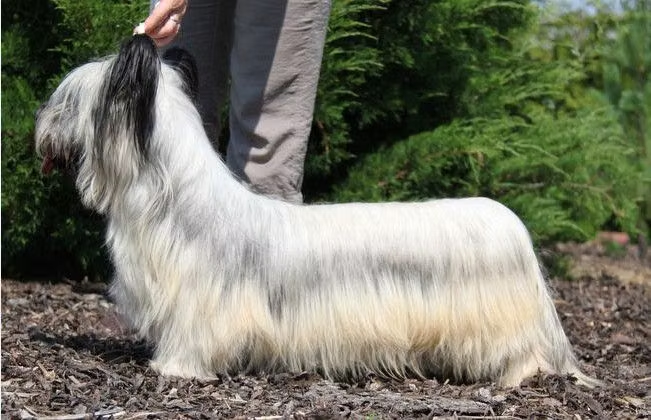
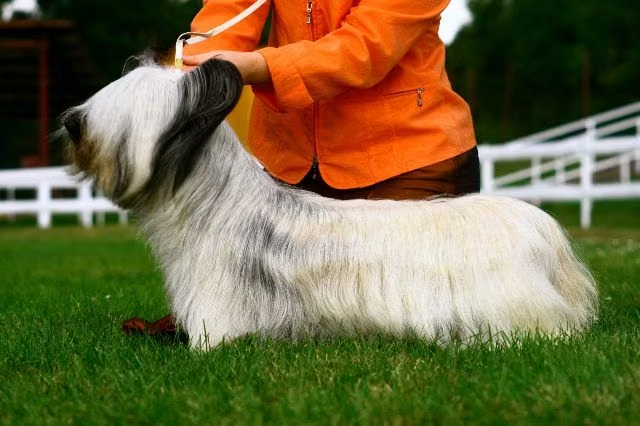
The Skye Terrier is a small dog built long and low, with a profuse coat that hangs in a parted curtain along each side of the body. It comes from the Isle of Skye and the surrounding Western Isles of Scotland, where it was bred to dig out fox, badger, and otter from rocky dens and burrows. The body is roughly twice as long as the dog is tall, a shape that let it follow quarry into tight spaces.
In temperament the breed is devoted and loyal to its own household and reserved, sometimes aloof, with people it does not know. A Skye bonds closely, often to one person, and watches new situations carefully before warming up. The traits most associated with the breed are devotion, loyalty, reserve, a dignified bearing, and alertness.
Despite the show-ring look of the long coat, this is still a working terrier underneath: independent, courageous for its size, and willing to stand its ground. Owners describe a dog that is calm indoors but quick to notice anything out of the ordinary.
| Attribute | Detail |
|---|---|
| Origin | Scotland (Isle of Skye) |
| Size | Small |
| Lifespan | 12 to 14 years |
| Group / role | Terrier; den-hunting dog of fox, badger, and otter |
| Good with | One devoted owner or a quiet family; better with respectful older children than toddlers |
The Skye Terrier fits a person or household that wants a steady, attached companion and does not mind a dog that is cool toward strangers. It does well in a house or an apartment because its exercise needs are moderate, but it needs an owner willing to keep up with coat care and to socialise it patiently. Early, gentle exposure to people, dogs, and noise helps offset the breed's natural caution.
The Skye Terrier developed on the Isle of Skye and nearby Scottish islands as a working terrier for fox, badger, and otter, and later became a fashionable companion in Victorian Britain.
The breed takes its name from the Isle of Skye in the Inner Hebrides off the west coast of Scotland. Terriers of its general type worked across the Western Isles for centuries, sent into rock cairns and earth dens to bolt or hold fox, badger, and otter. The long low body and dense protective coat suited that work, letting the dog move through narrow underground passages and shrug off bites and rough ground.
Written descriptions of small Scottish terriers go back several hundred years, and by the 1800s the Skye had become a recognised distinct type. It is one of the oldest of the Scottish terrier breeds.
The breed gained wide popularity in the nineteenth century, when Queen Victoria kept and favoured Skye Terriers. Royal interest made the dog fashionable among British society, and it moved from a purely working animal toward a prized companion and show dog.
The Skye Terrier is also tied to the story of Greyfriars Bobby in Edinburgh, a dog said to have kept watch at its owner's grave for years. The tale, widely retold from the later nineteenth century onward, helped fix the breed's reputation for loyalty. Today the Skye is far less common than it once was and is listed among the more vulnerable native breeds in Britain.
The Skye Terrier is a small, long, low dog with a hard outer coat that falls straight down each side and a feathered head, carrying ears that may be prick or drop.
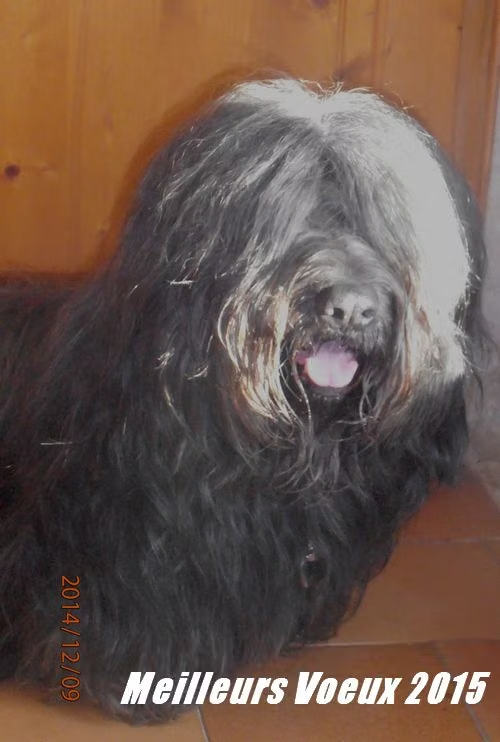
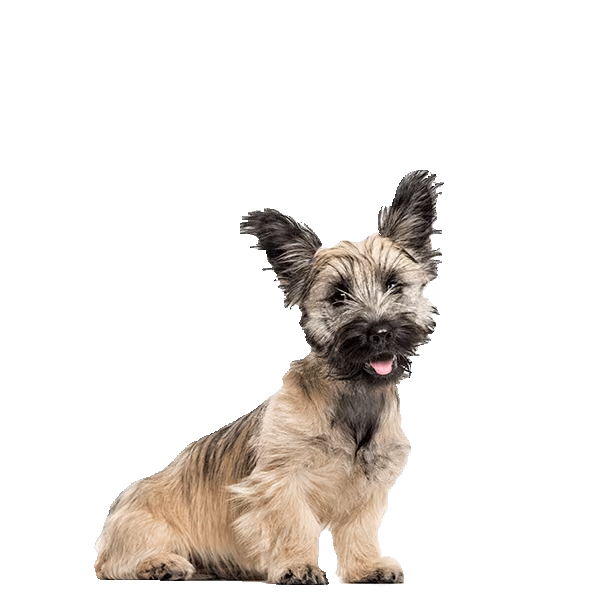
The Skye Terrier's outline is long and close to the ground, with the length of body roughly twice the height at the shoulder. The head is long and powerful for the size of the dog, carried with a marked feathering of hair over the eyes and forehead. Ears may be carried erect (prick) or hanging flat against the head (drop); both forms are accepted, with prick ears more common in the show ring.
The coat is the breed's defining feature: a long, hard, straight outer coat over a short, soft, woolly undercoat. The outer hair parts down the spine and hangs to either side, with a fringe across the brow that often covers the eyes.
| Feature | Standard |
|---|---|
| Height | About 25 to 26 cm (10 inches) at the shoulder |
| Weight | About 16 to 18 kg (35 to 40 lb) |
| Coat | Long, hard, straight outer coat over short soft undercoat; parted along the back |
| Colors | Black, blue, dark or light grey, fawn, and cream, usually with black points (ears, muzzle, tip of tail) |
| Eyes | Brown, set close, medium size; dark hazel preferred |
Acceptable colours include black, the various greys and blues, fawn, and cream. Whatever the body colour, the ears, muzzle, and tip of the tail should be black, giving the dog dark points. Puppies often change shade as they mature, and a single litter can hold several colours. The coat needs to reach a good length to show the breed's characteristic curtain, so the full adult look takes time to develop.
The Skye Terrier is devoted and loyal to its own people, reserved and watchful with strangers, and carries itself with a calm, dignified independence.
The Skye Terrier forms a strong attachment to its household and often to one person in particular. With its own family it is affectionate, steady, and companionable, content to stay close. With strangers it is reserved and slow to trust, watching and assessing before it accepts a new person. This caution makes it an alert house dog that notices and announces visitors.
With children the breed does best with older, considerate ones who understand how to handle a dog calmly; it is less suited to homes with very young children who may pull at the long coat or crowd it. With other pets, a Skye can live alongside dogs and cats it has grown up with, but its terrier background means it may chase small animals and can be assertive toward unfamiliar dogs.
The overall character is dignified and independent rather than bouncy or eager to please at any cost. A Skye is brave for its size and will stand firm. Early and ongoing socialisation is the main tool for keeping the natural reserve from tipping into shyness or suspicion.
| Trait | Rating |
|---|---|
| Affection (with own people) | 5 |
| Energy | 3 |
| Trainability | 3 |
| Vocalness | 3 |
| Shedding | 2 |
The Skye Terrier's long coat needs regular brushing to stay free of mats, and the dog needs moderate daily exercise plus careful handling of its long back.
The Skye Terrier adapts to a house or an apartment as long as it gets its walks and time with its person. It is happiest indoors with the family rather than left alone for long stretches, which can lead to barking or stress in such an attached breed. Provide ramps or steps to favourite furniture to reduce strain on the spine.
The Skye Terrier does well on a complete diet suited to its size and life stage, fed in measured meals to avoid the weight gain that strains its long back.
Feed a complete, balanced dog food appropriate to the Skye Terrier's age, size, and activity level. Because the breed is long-bodied and prone to carrying extra weight if overfed, portion control matters more than with many dogs: surplus weight puts added load on the back and joints. Use the feeding guide on the food as a starting point and adjust to keep the dog in lean condition, where the ribs can be felt easily under the coat.
Divide the daily amount into two meals rather than one to support steady digestion. Fresh water should always be available.
| Life stage | Amount per day | Meals |
|---|---|---|
| Puppy (2 to 6 months) | Per puppy food label, divided | 3 to 4 |
| Junior (6 to 12 months) | Per label, transitioning to adult | 2 to 3 |
| Adult | About 150 to 250 g of quality dry food | 2 |
| Senior | Adjusted down for lower activity | 2 |
Keep treats to a small share of daily calories and account for them in the total ration to avoid creeping weight gain. Most healthy Skye Terriers on a complete diet do not need extra supplements; introduce any supplement only on the advice of a veterinarian, who can judge whether it is needed for a particular dog.
The Skye Terrier typically lives 12 to 14 years and is generally hardy, though its long back and breed-linked conditions call for watchful, preventive care.
The Skye Terrier is generally a sturdy breed with a typical lifespan of 12 to 14 years. Its distinctive long, low build is also the source of some of its main health concerns, since the long spine is more exposed to disc problems than that of a compact dog. Responsible breeders screen breeding stock and avoid pairings that exaggerate the conditions known in the breed.
| Condition | Signs | Note |
|---|---|---|
| Intervertebral disc disease | Back pain, reluctance to move or jump, weakness in the hind legs | Linked to the long-backed build; avoid high-impact jumping |
| Mammary and other cancers | Lumps, swelling, changes in appetite or energy | Reported in the breed; early veterinary checks of any lump matter |
| Hip and joint problems | Stiffness, lameness, difficulty rising | Keeping the dog lean reduces joint load |
| Eye conditions | Cloudiness, vision changes, rubbing at the eyes | Periodic eye checks help with early detection |
The Skye Terrier is intelligent but independent and proud, so it responds best to short, consistent, reward-based training that respects its dignity.
The Skye Terrier is clever and capable of learning well, but it has the independent, self-assured streak common to terriers. It is not a dog that lives to obey; it weighs whether a request is worth doing. Harsh or repetitive drilling tends to make it shut down or dig in. Training works best when it is patient, consistent, and framed as something rewarding for the dog. The breed's reserve with strangers also means socialisation should run alongside obedience from puppyhood so the dog grows up confident rather than wary.
Skye Terriers usually have small litters and need careful, health-screened breeding given the long-backed build and the breed's small population.
Breeding Skye Terriers calls for care because the breed is uncommon and its long, low conformation carries health considerations that should not be exaggerated. Bitches reach physical maturity at one to two years, and responsible breeders wait until a dam is fully grown and health-screened before a first litter rather than breeding at the first season. Mating, pregnancy, and whelping follow the general pattern for small to medium dogs.
Gestation runs about 63 days. Litters tend to be small, commonly around three to five puppies. Newborn coat colour often differs from the adult shade and changes as the puppy grows.
Raising young Skyes means gentle, early handling and socialisation, since the breed's adult reserve is shaped in part by what puppies meet in their first weeks and months. Care should be taken to protect young, still-developing backs from heavy jumping. Because the breed is small in number, breeding decisions should weigh genetic diversity and health alongside type, ideally guided by breed-club advice and screening of the parents.
| Metric | Value |
|---|---|
| Breeding maturity | About 1 to 2 years |
| Gestation | About 63 days |
| Typical litter size | Around 3 to 5 puppies |
| Weaning | About 6 to 8 weeks |
| Adult coat colour | Often differs from puppy colour and develops with age |
Register your Skye Terrier free for life with United Pet Club, and put its microchip number on a record American shelters can actually find.
Start with the profile. Add your Skye Terrier's name, birth date, and a clear photo, attach your phone number and email, and save. That is the whole job, and it costs nothing for life. Dog registration works with or without a microchip, so there is no reason to wait for a vet visit.
Chipped already? The implant is half the job. Until the 15-digit number sits in a registry with your name beside it, a scanner reads digits that lead nowhere. Microchip registration is free for life at United Pet Club, takes any manufacturer's chip, and keeps the record searchable through the AAHA lookup shelters rely on. Sign up free, and both records are done tonight.
Open a free United Pet Club account, enter your Skye Terrier's name, birth date, and a photo, and save. The profile is free for life, works with or without a microchip, and you can attach a chip number later.
Type the 15-digit chip number into your free United Pet Club account together with your current phone number and address. The lifetime plan is free, covers every future update, and accepts any chip brand a US vet implants.
No federal law says a Skye Terrier must carry a chip, but plenty of city and county licensing rules do, and shelters routinely chip before adoption. What the law never does is register the chip for you; that part is yours.
Nothing. United Pet Club's lifetime plan covers the dog's profile, the microchip registration, and every update at no charge, with no renewal fees.
Common questions about the Skye Terrier's size, temperament, care needs, lifespan, suitability, and availability.
It is a small breed standing about 25 to 26 cm (10 inches) at the shoulder, but it is long and solidly built, weighing roughly 16 to 18 kg (35 to 40 lb).
It is devoted and loyal to its own people, often bonding closely to one person, and reserved and watchful with strangers. It is dignified, alert, and independent rather than openly outgoing.
The main demand is coat care: the long coat needs brushing to the skin two to three times a week to prevent mats. Exercise needs are moderate, and the long back needs protection from heavy jumping, but otherwise it is manageable for an attentive owner.
Most live about 12 to 14 years with good care, a lean weight, and regular veterinary attention.
It suits a quiet family or a devoted individual and does best with older, considerate children. Its reserve with strangers and dislike of rough handling make it less ideal for homes with very young children.
No. The Skye Terrier is now one of the less common native British breeds, so puppies can be scarce and may require a wait through a recognised breeder or breed club.
They are alert and will announce visitors or unusual events, but they are not extreme barkers. Early training and enough company help keep barking in check.