
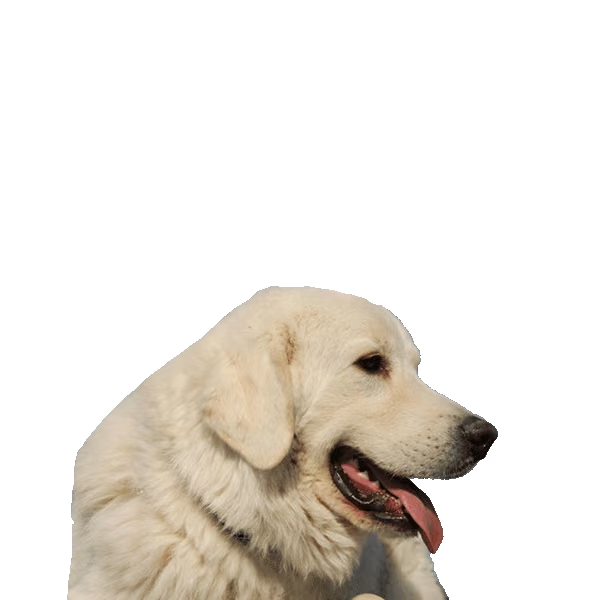
Pyrenean Mastiff
The Pyrenean Mastiff is a calm, gentle giant bred to guard flocks, devoted and protective yet remarkably serene at home.
- Size
- Giant
- Lifespan
- 10–12 years
- Origin
- Spain
- Temperament
- Calm
- Standard colors
- Black, White, and Gray and 5 more
Characteristics
Coat and grooming
How the Pyrenean Mastiff coat is built, and what that means when you groom it.
- Coat layers
- Double coat
- Coat texture
- Rough
- Coat length
- Long
- Shedding
- Seasonal shedding
Grooming guidance
Critical: A Pyrenean Mastiff should not be shaved.
The undercoat keeps heat out as well as in, and the outer coat shields the skin from sun and insect bites. Clipping the whole coat off removes both. It often grows back patchy, soft or a different colour, and in some animals the guard hairs never return properly. Brush the undercoat out instead of cutting it off.
Caution: A Pyrenean Mastiff coat mats easily.
Fine or long hair tangles at the base of the coat, out of sight, where the mats tighten and pull on the skin. Brushing has to reach right down to the roots in sections, not just skim the surface.
Information: A Pyrenean Mastiff drops its undercoat in heavy bursts.
The undercoat comes out in heavy bursts over a few weeks. An undercoat rake, or a bath followed by a proper blow-dry, clears it far faster than daily brushing. Clipping the coat down is not a shortcut for this.
Registry Recognition
Fédération Cynologique Internationale
- Pinscher and Schnauzer / Molossoid / Swiss Mountain
American Kennel Club
- Working Group
Canadian Kennel Club
- Working Group
United Pet Club
- Pinscher and Schnauzer / Molossoid / Swiss MountainPrimary
Pyrenean Mastiff colors and patterns
What each club's breed standard says about every Pyrenean Mastiff color and pattern. Point at a ruling to see the club's own wording.
Breed standards describe the Pyrenean Mastiff in Black, White, Gray, Silver, Brown, Gold, Beige, and Sandy. Standard patterns: Tricolor, Brindle, Merle, Piebald, Roan, Sable, Agouti, and Reverse brindle.
| Color or pattern | FCI | AKC | UKC | KC |
|---|---|---|---|---|
| Black | Standard (“black”) | Standard (“White & Black”) | Standard (“black”) | Standard (“black”) |
| White | Standard (“Basic colour white”) | Standard (“White”) | Standard (“Basically white”) | Standard (“Base colour pure white”) |
| Gray | Standard (“medium grey”) | No ruling | Standard (“medium grey”) | Standard (“medium grey”) |
| Silver | Standard (“grey-silver”) | No ruling | Standard (“grey-silver”) | Standard (“grey silver”) |
| Brown | Standard (“brown”) | Standard (“White & Brown”) | Standard (“brown”) | Standard (“brown”) |
| Gold | Standard (“intensive golden yellow”) | Standard (“White & Gold”) | Standard (“intensive golden yellow”) | Standard (“intense golden yellow”) |
| Beige | Standard (“light beige”) | No ruling | Standard (“light beige”) | Standard (“light beige”) |
| Sandy | Standard (“sandy”) | No ruling | Standard (“sandy”) | Standard (“sandy”) |
| Tan | Fault (“Tricolour or pure white dogs are undesirable”) | Fault (“Tan point patches”) | Fault (“Tri-color or pure white dogs without markings are undesirable”) | Fault (“Tricolour or pure white dogs undesirable”) |
| Red | Fault (“Undesirable are red patches”) | No ruling | Fault (“Undesirable are a yellow-white base coat and/or red patches”) | Fault (“Red patches and yellowish-white base colour undesirable”) |
| Cream | Fault (“yellowish-white basic colour”) | Fault (“a yellowish-white base color”) | Fault (“a yellow-white base coat”) | Fault (“yellowish-white base colour undesirable”) |
| Patterns | ||||
| Tricolor | Fault (“Tricolour or pure white dogs are undesirable”) | Standard (“Tri-Colored”) | Fault (“Tri-color or pure white dogs without markings are undesirable”) | Fault (“Tricolour or pure white dogs undesirable”) |
| Brindle | No ruling | Standard (“Brindle Markings”) | Disqualifying | Not recognized |
| Merle | Standard (“marbled”) | No ruling | Standard (“marbled”) | Standard (“marbled”) |
| Piebald | Standard (“irregularly distributed distinctly outlined patches”) | Standard (“always piebald”) | Standard (“irregularly distributed, clearly outlined patches”) | Standard (“Irregularly distributed, distinctly-outlined patches”) |
| Roan | No ruling | Standard (“light flecking the same color as the patches”) | Disqualifying | Not recognized |
| Sable | No ruling | Standard (“White & Sable”) | Disqualifying | Not recognized |
| Agouti | No ruling | Standard (“Agouti & White”) | Disqualifying | Not recognized |
| Reverse brindle | No ruling | Standard (“Brindle Markings”) | Disqualifying | Not recognized |
| Solid | Fault (“pure white dogs are undesirable”) | Disqualifying (“Solid white coat color”) | Fault (“pure white dogs without markings are undesirable”) | Fault (“pure white dogs undesirable”) |
| Tan point | No ruling | Fault (“Tan point patches”) | Disqualifying | Not recognized |
| Double merle | No ruling | No ruling | Disqualifying | Not recognized |


| Color or pattern | FCI | AKC | UKC | KC |
|---|---|---|---|---|
| Brown | No ruling | Standard (“hazel or brown color that range from light to dark”) | No ruling | No ruling |
| Hazel | Standard (“hazel colour”) | Standard (“hazel or brown color that range from light to dark”) | Standard (“hazel in color, the darker shades preferred”) | Standard (“hazel in colour”) |
| Blue | No ruling | Disqualifying (“Blue eyes”) | No ruling | No ruling |
| Color or pattern | FCI | AKC | UKC | KC |
|---|---|---|---|---|
| Black | Standard (“Black”) | Standard (“Black pigment only”) | Standard (“Large, broad and black”) | Standard (“Nose black”) |
| Pink | Disqualifying (“Lack of pigment in noseleather”) | Disqualifying (“Missing pigment on the nose leather”) | Disqualifying (“Nose any color other than black”) | No ruling |
What the rulings mean
- Standard
- Described by the club's breed standard.
- Fault
- Named by the club's breed standard as a fault: the animal can be shown but is penalized.
- Disqualifying
- The club's breed standard disqualifies an animal of this color or pattern.
- Not recognized
- The club does not accept this color or pattern for the breed.
Color changes
How a Pyrenean Mastiff's colors can change over its life.
Blackchanges toRust
Coat · With body condition · can change back
Blackchanges toGray
Coat · Progressive
Blackchanges toBrown
Coat · In the sun · can change back
Whitechanges toRoan
Coat · With age · from 2 weeks
Tan pointchanges toSaddle
Coat · With age · from 6 to 156 weeks
Blackchanges toSnow nose
Nose · With the season · can change back
Blackchanges toPink
Nose · With the season · can change back


Sources
Each ruling comes from the club's published breed standard or color list.
Meet some of our Pyrenean Mastiff
A few of the Pyrenean Mastiff profiles members have added to United Pet Club.


About the Pyrenean Mastiff
The Pyrenean Mastiff is a giant livestock guardian from Spain, calm and devoted at home yet protective of family and flock.
The Pyrenean Mastiff is a giant working breed from the Aragonese Pyrenees of northern Spain. For centuries it walked beside shepherds on seasonal migrations, guarding sheep from wolves and bears. The dog is built for that job: heavy bone, a deep chest, and a thick double coat that handles cold mountain nights.
Despite the size, the temperament is steady. A well-raised Pyrenean Mastiff is quiet indoors, slow to anger, and patient with the people and animals it considers its own. It watches more than it reacts, and it tends to bark only when something warrants attention.
This is a serious commitment. Adults commonly reach 70 to 100 kilograms, eat accordingly, and need confident, consistent handling from an early age. The breed suits people who want a calm guardian rather than an active sporting companion.
| Attribute | Detail |
|---|---|
| Origin | Spain (Aragonese Pyrenees) |
| Size | Giant |
| Lifespan | 10 to 12 years |
| Group/role | Livestock guardian, working dog |
| Good with | Family, children, and other animals it is raised with |
Who it suits
This breed fits households with space, a secure yard, and time for early socialization. It does best with owners who understand guardian breeds and can provide firm, fair leadership. It is less suited to apartment living, first-time dog owners, or anyone wanting a high-energy exercise partner. Families with children often do well with it, provided the dog is supervised around small children simply because of its weight.
History and origin
The Pyrenean Mastiff developed in northern Spain as a flock guardian and was rebuilt from a small population after near-extinction in the twentieth century.
The breed comes from the Pyrenees mountains of Aragon in northern Spain, where large guardian dogs accompanied flocks of sheep. These dogs protected livestock during the transhumance, the seasonal movement of herds between high summer pastures and lower winter grazing. Their role was defensive: deter and fight off wolves and bears rather than herd the sheep.
Many guardians of this type wore a carlanca, a spiked iron collar that protected the throat during fights with predators. The dogs worked in loose groups and lived alongside the flock day and night, which shaped the calm, self-reliant temperament still seen today.
The decline of large predators and changes in farming reduced the need for guardian dogs through the twentieth century. By the years after the Spanish Civil War the population had fallen sharply and the breed was close to disappearing. Beginning in the 1970s, breed enthusiasts in Spain gathered the surviving dogs and started a structured recovery effort.
That work established a formal breed standard and a studbook, and the Pyrenean Mastiff was recognized internationally by the Federation Cynologique Internationale. The breed remains uncommon outside Spain and is kept today both as a working guardian and as a family companion.
Appearance and breed standard
The Pyrenean Mastiff is a large, well-proportioned dog with a thick medium-length coat, usually white with a darker mask and patches.
The Pyrenean Mastiff is large and powerfully built without looking heavy or clumsy. The body is slightly longer than tall, the chest is broad and deep, and the head is large with a broad skull and a defined stop. The lips are fairly loose and the breed typically has double dewclaws on the hind legs. A defining feature is the dewlap, the loose skin under the throat.
| Trait | Standard |
|---|---|
| Height | Males from about 77 cm; females from about 72 cm (taller preferred) |
| Weight | Roughly 70 to 100 kg, females lighter |
| Coat | Thick, medium length, double coat |
| Colors | White base with grey, black, brown, golden, or tan markings |
| Eyes | Small, dark, almond shaped, with an attentive expression |
Coat and colors
The coat is dense and weather resistant, longer around the neck, the backs of the legs, and the tail. The base color is white. Most dogs have a well-defined mask and ears in a darker shade, along with patches across the body. Accepted patch colors include grey, black, golden, brown, beige, sandy, and marbled tones. Solid white and heavily patched dogs are both possible, though a clean white body with a defined mask is common. The tail is thick at the base, carried low at rest and raised in a curve when the dog is alert.
Temperament and personality
The Pyrenean Mastiff is calm, gentle, and devoted with its family, naturally protective and watchful but not aggressive without cause.
The Pyrenean Mastiff is known for a composed, even temperament. At home it is quiet and affectionate, often content to rest near the family and observe. It forms strong bonds with the people it lives with and is gentle with children, though its size means supervision is sensible around toddlers.
With strangers the dog is reserved rather than nervous or hostile. It assesses new people calmly and warms up once it judges them to be no threat. Its protective instinct is real: it will place itself between the family and a perceived danger, and it uses a deep bark as a first warning. Early socialization helps the dog distinguish normal visitors from genuine threats.
With other animals the breed is usually tolerant, especially livestock and pets it has grown up alongside, which reflects its guardian heritage. Confident, independent thinking is part of the package, so the dog may weigh a command before obeying rather than respond instantly.
| Trait | Rating |
|---|---|
| Affection | 4 |
| Energy | 2 |
| Trainability | 3 |
| Vocalness | 3 |
| Shedding | 4 |
Care and grooming
The Pyrenean Mastiff needs regular brushing, moderate exercise, and space, with attention to its heavy coat during seasonal shedding.
Day to day care centers on coat maintenance, moderate activity, and an environment that suits a giant dog.
Grooming
- Brush once or twice a week, and daily during the heavy seasonal sheds in spring and autumn
- Use a slicker brush and an undercoat rake to reach the dense undercoat
- Bathe only when needed, every couple of months or after the dog gets very dirty
- Check and clean the ears regularly and keep the throat folds and dewlap dry
- Trim nails every few weeks, including the hind dewclaws
Exercise
- One or two daily walks at a relaxed pace, around 30 to 60 minutes total
- Access to a secure, fenced yard for free movement
- Avoid hard or repetitive exercise while puppies are still growing, to protect developing joints
- Limit strenuous activity in hot weather, since the heavy coat makes overheating a risk
Environment
This breed needs room. It is best suited to a house with a securely fenced yard rather than an apartment. It tolerates cold well thanks to its coat but struggles in heat, so shade and cool resting spots matter in summer. The dog prefers to be near its family and should not be left isolated for long periods, despite its independent nature.
Nutrition and feeding
The Pyrenean Mastiff needs a balanced large-breed diet fed in measured meals, with controlled puppy growth to protect the joints.
Feed a complete, balanced diet formulated for large or giant breeds. Puppies in particular benefit from a large-breed growth formula with controlled calcium and energy, because slow, steady growth lowers the risk of joint problems later. Adults do well on a quality diet with adequate protein and moderate fat. Because the breed is prone to bloat, meals are usually split across the day rather than fed as one large portion.
| Life stage | Amount per day | Meals |
|---|---|---|
| Puppy (2 to 6 months) | Per large-breed puppy formula, by weight | 3 to 4 |
| Adolescent (6 to 18 months) | Gradually adjusted toward adult amount | 2 to 3 |
| Adult | Roughly 4 to 8 cups depending on size and activity | 2 |
| Senior | Slightly reduced calories, monitor weight | 2 |
Treats and supplements
Keep treats to about 10 percent of daily calories to avoid weight gain, which strains the joints of a heavy dog. Fresh water should always be available. Some owners use joint supplements such as glucosamine and chondroitin for large breeds, but introduce any supplement only after consulting a veterinarian.
Health and common conditions
The Pyrenean Mastiff lives about 10 to 12 years and, like many giant breeds, is prone to joint problems and bloat.
The Pyrenean Mastiff is generally a sound working breed, but its size brings the health concerns common to giant dogs. The typical lifespan is 10 to 12 years. Responsible breeders screen breeding stock for hip and elbow problems, and prospective owners should ask to see those results.
| Condition | Signs | Note |
|---|---|---|
| Hip and elbow dysplasia | Stiffness, limping, reluctance to rise | Common in giant breeds; screening helps |
| Gastric dilatation-volvulus (bloat) | Swollen abdomen, retching, restlessness | A medical emergency; split meals and avoid exercise right after eating |
| Osteochondritis dissecans | Lameness in a young, growing dog | Linked to fast growth; controlled diet helps |
| Entropion (eyelid rolls inward) | Squinting, tearing, eye irritation | May need minor surgery |
| Heart disease | Tiring easily, cough, weakness | Periodic checks in older dogs |
Preventive care
- Keep vaccinations and parasite control current
- Schedule annual checkups, and twice yearly for senior dogs
- Maintain a lean body weight to reduce joint strain
- Feed measured meals split across the day to lower bloat risk
- Brush teeth regularly and monitor for dental disease
- Use joint-screened breeding stock when sourcing a puppy
Training and socialization
The Pyrenean Mastiff is intelligent but independent, so it responds best to early, consistent, reward-based training started young.
The Pyrenean Mastiff is smart and capable of learning, but it was bred to work alone and make its own decisions. That independence means it does not aim to please the way some breeds do. It learns well when training is consistent, calm, and started early, while the dog is still a manageable size. Harsh methods tend to backfire with a guardian breed and can damage trust. Socialization is the most important part of raising this dog: introduce it to many people, places, and other animals during puppyhood so it grows into a stable, discerning adult.
Basics
- Begin socialization and gentle handling as soon as the puppy comes home
- Teach a reliable recall and loose-leash walking before the dog reaches full weight
- Establish clear, consistent house rules that every family member follows
- Reward calm behavior around visitors to channel the protective instinct
- Keep sessions short, positive, and frequent rather than long and forceful
Breeding
The Pyrenean Mastiff is a slow-maturing giant breed with large litters that need careful early management for joint health.
Giant breeds mature slowly, and the Pyrenean Mastiff is no exception. Females are generally not bred until they are physically mature, usually around two years of age, once growth has finished and health screening is complete. Responsible breeding pairs dogs that have been cleared for hip and elbow problems and have stable, sound temperaments, since both traits matter in a large guardian.
Gestation runs about 63 days, as in all dogs. Litters tend to be large, and the puppies are big, so whelping should be supervised and a veterinarian kept on call. Newborns grow quickly and need a controlled diet to avoid pushing growth too fast, which strains developing joints. Early handling and socialization from the breeder lay the groundwork for the calm adult temperament the breed is known for. Because this breed is uncommon outside Spain, finding a litter often means contacting breed clubs and waiting for a planned mating.
| Metric | Value |
|---|---|
| Sexual maturity | Around 1 to 2 years (breeding usually delayed to about 2) |
| Gestation | About 63 days |
| Average litter size | Roughly 6 to 8 puppies |
| Weaning age | About 6 to 8 weeks |
| Adult weight reached | Around 18 to 24 months |
Registering your Pyrenean Mastiff and its microchip
Register your Pyrenean Mastiff free for life with United Pet Club, and put its microchip number on a record American shelters can actually find.
How to register a Pyrenean Mastiff in the United States
Start with the profile. Add your Pyrenean Mastiff's name, birth date, and a clear photo, attach your phone number and email, and save. That is the whole job, and it costs nothing for life. Dog registration works with or without a microchip, so there is no reason to wait for a vet visit.
Chipped already? The implant is half the job. Until the 15-digit number sits in a registry with your name beside it, a scanner reads digits that lead nowhere. Microchip registration is free for life at United Pet Club, takes any manufacturer's chip, and keeps the record searchable through the AAHA lookup shelters rely on. Sign up free, and both records are done tonight.
How do I register my Pyrenean Mastiff in the United States?
Open a free United Pet Club account, enter your Pyrenean Mastiff's name, birth date, and a photo, and save. The profile is free for life, works with or without a microchip, and you can attach a chip number later.
How do I register my Pyrenean Mastiff's microchip?
Type the 15-digit chip number into your free United Pet Club account together with your current phone number and address. The lifetime plan is free, covers every future update, and accepts any chip brand a US vet implants.
Does my Pyrenean Mastiff have to be microchipped in the United States?
No federal law says a Pyrenean Mastiff must carry a chip, but plenty of city and county licensing rules do, and shelters routinely chip before adoption. What the law never does is register the chip for you; that part is yours.
How much does it cost to register a Pyrenean Mastiff?
Nothing. United Pet Club's lifetime plan covers the dog's profile, the microchip registration, and every update at no charge, with no renewal fees.
Frequently asked questions
Common questions about the Pyrenean Mastiff cover its size, temperament, care needs, lifespan, suitability, and availability.
How big does a Pyrenean Mastiff get?
It is a giant breed. Males stand from about 77 cm at the shoulder and females from about 72 cm, with adults commonly weighing between 70 and 100 kilograms.
Is the Pyrenean Mastiff a good family dog?
Yes, for the right household. It is calm, affectionate, and gentle with family and children, though its size means it should be supervised around small children. It needs space and early socialization.
Are they hard to care for?
Care is moderate but the scale is large. The thick coat needs regular brushing and daily attention during heavy sheds, exercise needs are modest, and feeding a giant dog is a real cost. The bigger demand is consistent, early training and socialization.
How long do Pyrenean Mastiffs live?
Most live about 10 to 12 years, which is typical for a giant breed. Keeping the dog lean and screening for joint and heart issues supports a healthy lifespan.
Is this breed good for first-time owners?
It is generally not the easiest first dog. Its size, independence, and guardian instinct are better matched to owners who have experience with large or protective breeds and can provide firm, fair handling.
Do they bark a lot?
They are watchful and will bark to warn of something unusual, but they are not constant barkers. A well-socialized dog uses its deep bark as an alert rather than barking without reason.
Where can I find a Pyrenean Mastiff?
The breed is uncommon outside Spain. Finding a puppy usually means contacting breed clubs or registered breeders and being prepared to wait for a planned litter.
From the community
Ask about the Pyrenean MastiffNo questions about the Pyrenean Mastiff yet. Be the first to ask.
Browse Dog breeds