

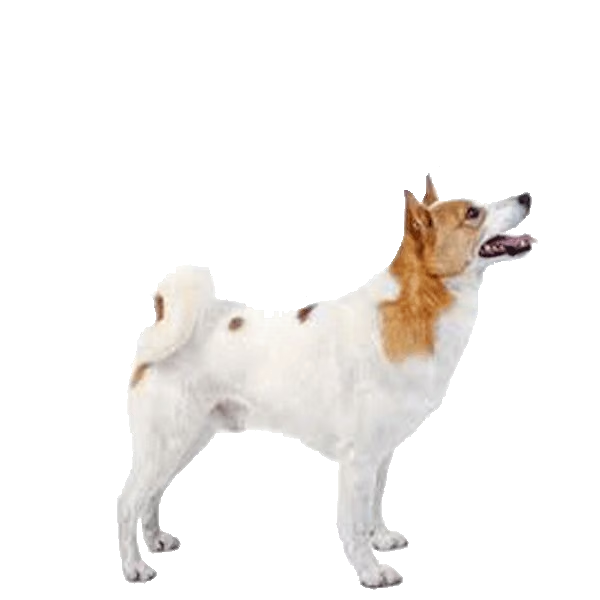
Norrbottenspets
The Norrbottenspets is an alert, energetic Swedish hunting spitz known for its keen nose, friendly nature, and lively bark.
- Size
- Medium
- Lifespan
- 12–15 years
- Origin
- Sweden
- Temperament
- Alert
- Standard colors
- Black, White, and Tan and 5 more
Characteristics
Coat and grooming
How the Norrbottenspets coat is built, and what that means when you groom it.
- Coat layers
- Double coat
- Coat texture
- Plush
- Coat length
- Medium
- Shedding
- Seasonal shedding
Grooming guidance
Critical: A Norrbottenspets should not be shaved.
The undercoat keeps heat out as well as in, and the outer coat shields the skin from sun and insect bites. Clipping the whole coat off removes both. It often grows back patchy, soft or a different colour, and in some animals the guard hairs never return properly. Brush the undercoat out instead of cutting it off.
Information: A Norrbottenspets drops its undercoat in heavy bursts.
The undercoat comes out in heavy bursts over a few weeks. An undercoat rake, or a bath followed by a proper blow-dry, clears it far faster than daily brushing. Clipping the coat down is not a shortcut for this.
Registry Recognition
Fédération Cynologique Internationale
- Spitz and Primitive Types
American Kennel Club
- Non-Sporting Group
Canadian Kennel Club
- Non-Sporting Group
United Pet Club
- Spitz and Primitive TypesPrimary
Norrbottenspets colors and patterns
What each club's breed standard says about every Norrbottenspets color and pattern. Point at a ruling to see the club's own wording.
Breed standards describe the Norrbottenspets in Black, White, Tan, Red, Orange, Yellow, Cream, and Fawn. Standard patterns: Piebald, Sable, and Agouti.
| Color or pattern | FCI | AKC |
|---|---|---|
| Black | Alternate (“Patches in black ... are tolerated”) | Standard (“Black Mask”) |
| White | Standard (“Pure white”) | Standard (“White”) |
| Tan | Fault (“Tan-markings”) | Standard (“Tan Patches”) |
| Red | Standard (“the ideal colour that is in all nuances of red and yellow”) | Standard (“Red Patched”) |
| Orange | Standard (“in all nuances of red and yellow”) | Standard (“Orange Markings”) |
| Yellow | Standard (“the ideal colour that is in all nuances of red and yellow”) | Standard (“The ideal overlay color is any nuance of red or yellow”) |
| Cream | Standard (“in all nuances of red and yellow”) | Standard (“Cream Markings”) |
| Fawn | Standard (“any nuance of fawn ... tolerated”) | Standard (“Fawn Markings”) |
| Patterns | ||
| Piebald | Standard (“Pure white, always with well defined and well distributed patches”) | Standard (“a base color of pure white overlaid with ... well-defined and well-distributed body patches”) |
| Sable | No ruling | Standard (“Sable”) |
| Agouti | Standard (“Patches in ... agouti are tolerated”) | No ruling |
| Roan | Fault (“Roaning or ticking”) | No ruling |
| Tan point | Fault (“Tan-markings”) | No ruling |
| Solid | Not recognized (“Pure white, always with well defined and well distributed patches”) | No ruling |


| Color or pattern | FCI | AKC |
|---|---|---|
| Dark brown | Standard (“Colour dark brown”) | Standard (“Irises are dark brown”) |
What the rulings mean
- Standard
- Described by the club's breed standard.
- Alternate
- Registrable with the club but not described by its breed standard, such as an AKC alternate color.
- Fault
- Named by the club's breed standard as a fault: the animal can be shown but is penalized.
- Not recognized
- The club does not accept this color or pattern for the breed.
Color changes
How a Norrbottenspets's colors can change over its life.
Blackchanges toRust
Coat · With body condition · can change back
Blackchanges toGray
Coat · Progressive
Blackchanges toBrown
Coat · In the sun · can change back
Whitechanges toRoan
Coat · With age · from 2 weeks
Tan pointchanges toSaddle
Coat · With age · from 6 to 156 weeks
Blackchanges toSnow nose
Nose · With the season · can change back
Blackchanges toPink
Nose · With the season · can change back


Sources
Each ruling comes from the club's published breed standard or color list.
Norrbottenspets breed standard
What each club's standard asks of the Norrbottenspets: size, build and forms. A club speaks only for itself, and a figure no club published is left out.
Measurements


Conformation
Stop
Slight
“Stop: Evident but only slightly marked.”
Muzzle shape
Tapered
“Clearly tapering towards tip of nose, but never snipy.”
Muzzle shape
SnipyFault
“but never snipy”
Bite
Scissors bite
“Well developed jaws and teeth, scissors bite.”
Dentition
Missing teethFault
“SEVERE FAULTS: Missing teeth, except P1.”
Eye shape
Almond
“Medium sized, almond-shaped and obliquely set.”
Ear carriage
Erect (prick)
“High set, erect, slightly over medium size”
Ear set
High
“High set, erect”
Topline
Level
“Back: Short, level, strong, muscular and springy.”
Tail length
StumpyDisqualifying
“DISQUALIFYING FAULTS: Stumpy tail.”
Tail set
High
“Rather high set, carried in a high curve”


Parts of the body


About the Norrbottenspets
The Norrbottenspets is a medium-sized Swedish hunting spitz with a keen nose, friendly temperament, and a lively bark. It lives about 12 to 15 years.
The Norrbottenspets is a medium-sized spitz that originated in the Norrbotten region of northern Sweden. It was developed as a hunting dog and is still used to locate and bark at game, especially birds such as capercaillie and black grouse. The breed combines a compact, athletic build with a sharp sense of smell and a strong drive to work in cold forest terrain.
This is an alert and curious dog with a friendly disposition toward people. Owners describe it as energetic and attentive, quick to notice changes in its surroundings and ready to vocalize about them. The same traits that make it a capable hunting partner also make it an engaged companion for active households.
The Norrbottenspets remains uncommon outside the Nordic countries. It tends to bond closely with its family while staying tolerant and outgoing with strangers once introduced.
| Attribute | Detail |
|---|---|
| Origin | Sweden |
| Size | Medium |
| Lifespan | 12 to 15 years |
| Group / role | Spitz, hunting and bark-pointing |
| Good with | Active families, experienced owners, other dogs with proper introductions |
Who it suits
The Norrbottenspets fits owners who can provide daily exercise and mental work. It does well with people who hunt, hike, or train in dog sports, and who do not mind a vocal dog. Households that value a quiet pet, or that cannot meet the breed's activity needs, may find it a poor match.
History and origin
The Norrbottenspets comes from northern Sweden and Finland, where small spitz dogs hunted forest game for centuries. The Swedish breed nearly disappeared in the mid-20th century before being re-established.
Small spitz-type hunting dogs have worked across the forests of northern Scandinavia for hundreds of years. The Norrbottenspets takes its name from Norrbotten, the northernmost county of Sweden, and shares close roots with related spitz populations in neighboring Finland. These dogs were kept by farmers and hunters who needed a hardy worker able to find game and signal its location with a bark.
Through the early 20th century the type was valued for its nose and stamina rather than for a fixed appearance. As firearms and hunting practices changed, demand for the small barking spitz declined, and the population in Sweden fell sharply.
By the mid-1900s the Swedish Kennel Club considered the breed close to lost and at one point treated it as extinct. Interest revived when surviving dogs of the old type were located in rural areas and used to rebuild the population. The breed standard was reinstated, and careful breeding restored a recognizable Norrbottenspets.
Today the breed is recognized by Nordic kennel clubs and is still bred primarily as a working hunting dog. Numbers remain modest, and most dogs are found in Sweden and Finland.
What does a Norrbottenspets look like?
A small to medium spitz with a nearly square body, erect ears, a high-set curled tail and a short double coat. The FCI and CKC give an ideal of 45 cm for males and 42 cm for females; the AKC and FCI disqualify a stumpy tail.
The Norrbottenspets is a small to medium spitz with a compact, nearly square body, a wedge-shaped head, erect ears set high and a tail that curls over the back. The short to medium double coat is most often white with defined yellow, red or tan patches. The Fédération Cynologique Internationale (FCI) gives an ideal height of 45 cm for males and 42 cm for females.
Size and weight by club
Three clubs give a height for the Norrbottenspets, and all three split it by sex. The FCI and the Canadian Kennel Club (CKC) give the same ideal, 45 cm for males and 42 cm for females. The American Kennel Club (AKC) gives a range in inches instead. None of these clubs gives a weight; most adults weigh about 11 to 15 kg.
| Club | Males | Females |
|---|---|---|
| FCI | Ideal 45 cm; 43 to 47 cm with tolerance | Ideal 42 cm; 40 to 44 cm with tolerance |
| CKC | Ideal 45 cm (17.75 in) | Ideal 42 cm (16.5 in) |
| AKC | 17 to 18½ in (43.2 to 47 cm) | 15½ to 17½ in (39.4 to 44.5 cm) |
The three clubs agree to within a centimeter or two. The FCI allows 2 cm either way of its ideal, which lands almost exactly on the AKC's range of 43.2 to 47 cm for males and 39.4 to 44.5 cm for females. None of the three sets a disqualifying height. To see every ruling in one place, compare the clubs side by side.
Head, body and tail
The body is nearly square and the topline level in the AKC and FCI standards. The muzzle is tapered, with a slight stop in the FCI and AKC and a moderate one in the CKC. The eyes are almond-shaped and the ears are erect and set high. The tail is set high and curls over the back.
The tail is where the clubs differ most. A stumpy tail disqualifies in the AKC and FCI, and the AKC also disqualifies a docked tail. The CKC does not recognize a natural bobtail. The AKC treats front dewclaws as standard and wants none on the hind legs.
Coat, colors and markings
The double coat is medium in length with a plush texture, and it sheds seasonally. The FCI and AKC both accept piebald, white, red, orange, yellow, cream and fawn. Black is standard in the AKC and an alternate in the FCI, meaning accepted but not preferred. The AKC also accepts sable and tan, while the FCI accepts agouti. In the FCI, tan, tan point and roan are faults, and a solid pattern is not recognized. The color guide shows how these compare across breeds.
Eyes should be dark brown and the nose black in the FCI and AKC. Liver and pink noses are faults in both.
What the show standards penalize
Faults and disqualifications are show-ring judgements, not health verdicts.
- Tail: a stumpy tail disqualifies in the AKC and FCI. Docking disqualifies in the AKC.
- Muzzle and teeth: a snipy muzzle and missing teeth are faults in the AKC and FCI.
- Nose: liver and pink noses are faults in the AKC and FCI.
- Coat: roan, tan and tan point are faults in the FCI.
What the Norrbottenspets standard says, club by club
Height at the withers for the Norrbottenspets: AKC 43.2-47 cm; CKC 45 cm; FCI 45 cm.
Each club words the Norrbottenspets standard its own way, so the figures below are listed per club: AKC, CKC, FCI.
Size
- Height at the withers, male: AKC 43.2-47 cm; CKC 45 cm; FCI 45 cm
- Height at the withers, female: AKC 39.4-44.5 cm; CKC 42 cm; FCI 42 cm
Build and forms
At least one club accepts each of these:
- Stop: Slight, Moderate
- Muzzle shape: Tapered
- Bite: Scissors bite
- Eye shape: Almond
- Ear carriage: Erect (prick)
- Ear set: High
- Topline: Level
- Tuck-up: Moderate
- Front dewclaws: Present
- Rear dewclaws: None
Forms the clubs penalize
A fault or a disqualification is a judgment under a show standard. It can affect placings and, at some clubs, registration.
- Disqualifying: Tail length: Stumpy (AKC, FCI)
- Fault: Muzzle shape: Snipy (AKC, FCI); Dentition: Missing teeth (AKC, FCI)
Cropping, docking and other procedures
- Tail docking: Disqualifying (AKC)
This is each club's stance in the show ring, not the law. The law on these procedures differs by country.
See every point side by side: compare the clubs.
Rulings come from each club's published breed standard, and clubs revise their standards. Before a show or a registration, check the current text with the club.
What does each club give for Height at the withers in the Norrbottenspets?
Height at the withers, male: AKC 43.2-47 cm; CKC 45 cm; FCI 45 cm; Height at the withers, female: AKC 39.4-44.5 cm; CKC 42 cm; FCI 42 cm.
Which forms do clubs penalize in the Norrbottenspets?
Disqualifying: Tail length: Stumpy (AKC, FCI). Fault: Muzzle shape: Snipy (AKC, FCI); Dentition: Missing teeth (AKC, FCI).
Which Norrbottenspets colors the clubs accept
Every club we track accepts Black, White, Red, Orange, Yellow, Cream for the Norrbottenspets.
Clubs compared for the Norrbottenspets: AKC, FCI. All of them accept Black, White, Red, Orange, Yellow, Cream.
Patterns listed as standard for the Norrbottenspets: Piebald, Sable, Agouti.
Where the clubs split
At least one club accepts each of these, and at least one other penalizes or refuses it.
- Tan: Standard (AKC); Fault (FCI)
Colors penalized in the show ring
A fault or a disqualification is a judgment under a show standard. It can affect placings and, at some clubs, registration.
- Fault: Roan (FCI), Tan point (FCI), Tan (FCI)
Beyond the main color
Standards rule on more than the main color. These are listed as standard:
- Eyes: Dark brown
- Nose: Black
Rulings come from each club's published breed standard, and clubs revise their standards. Before a show or a registration, check the current text with the club.
Which Norrbottenspets colors do all the clubs accept?
All of these clubs accept Black, White, Red, Orange, Yellow, Cream: AKC, FCI.
Do clubs disagree about Norrbottenspets colors?
Yes. Clubs rule differently on Tan.
Which Norrbottenspets colors are faults or disqualifications?
Fault: Roan (FCI), Tan point (FCI), Tan (FCI).
Temperament and personality
The Norrbottenspets is friendly, curious, and energetic, with a strong alert instinct and a tendency to bark. It bonds closely with its family and is generally sociable with people and other dogs.
The Norrbottenspets is an outgoing, lively dog that stays interested in its surroundings. With family it is affectionate and people-oriented, and it usually greets visitors with curiosity rather than aggression. Early socialization helps it settle quickly with new people.
The breed is alert and quick to vocalize. Barking is part of its working heritage, since it was bred to find game and bark to mark the spot, so a Norrbottenspets will often announce arrivals, sounds, and movement. This makes it a useful watchdog but means it is not a quiet breed.
With other dogs it is generally social, especially when raised together. Its hunting background gives it a strong prey drive, so small pets and free-roaming cats may trigger chasing. Secure fencing and reliable recall training are important because the breed will follow its nose.
| Trait | Rating |
|---|---|
| Affection | 4 |
| Energy | 5 |
| Trainability | 3 |
| Vocalness | 5 |
| Shedding | 3 |
Care and grooming
The Norrbottenspets has modest grooming needs but high exercise requirements. It suits active homes with secure outdoor space and benefits from regular mental work.
Grooming
- Brush the double coat once or twice a week to remove loose hair.
- Increase brushing during seasonal sheds, when the undercoat blows out.
- Bathe only when needed, since the coat resists dirt well.
- Check and trim nails regularly and inspect ears for debris.
- Brush teeth several times a week to support dental health.
Exercise
- Provide at least one to two hours of activity each day.
- Include off-lead running in safe, enclosed areas where possible.
- Use scent games, tracking, or hunting work to satisfy the nose.
- Add training sessions or dog sports such as agility for mental load.
- A bored Norrbottenspets may bark more and become restless.
Environment
The breed tolerates cold well thanks to its double coat and suits rural or suburban homes with outdoor space. It can live in town if its exercise and mental needs are met, but its barking should be considered in close housing. Secure fencing is important given the strong prey drive and tendency to roam after a scent.
Grooming a Norrbottenspets
The Norrbottenspets coat: Double coat, Plush, Medium, Seasonal shedding. Main grooming rule: Do not shave.
Grooming a Norrbottenspets comes down to its coat, so start there.
- Coat layers: Double coat
- Coat texture: Plush
- Coat length: Medium
- Shedding: Seasonal shedding
What this coat asks of you
- A double coat has a soft undercoat beneath longer guard hairs. Brush right down to the undercoat, because that is the layer that packs down and traps loose hair.
- A plush coat is dense and soft, so a gentle brush that reaches the base of the hair works better than a stiff one.
- Medium-length hair starts to tangle wherever it rubs, so pay attention to those spots.
- Seasonal shedding arrives in bursts when the coat changes, and brushing more often during those weeks keeps it manageable.
What to tell a groomer
Mention these when you book. The coat notes on this page explain each one.
- Do not shave
- Needs seasonal de-shedding
A groomer who knows the breed can adapt all of this to the individual animal. Sore skin, mats pressed against the skin or a sudden change in the coat are worth showing to a vet.
What kind of coat does a Norrbottenspets have?
On our records: Coat layers: Double coat; Coat texture: Plush; Coat length: Medium; Shedding: Seasonal shedding.
How much does a Norrbottenspets shed?
Seasonal shedding arrives in bursts when the coat changes, and brushing more often during those weeks keeps it manageable.
What should a groomer know about a Norrbottenspets?
These grooming rules apply: Do not shave, Needs seasonal de-shedding.
Nutrition and feeding
The Norrbottenspets does well on a complete, balanced diet matched to its activity level. Active and working dogs need more energy than pets kept at light exercise.
Feed a complete and balanced diet formulated for the dog's life stage. Because the Norrbottenspets is energetic, working or highly active individuals may need more calories than the bag's general guidance suggests, while less active pets need less to avoid weight gain. Adjust amounts based on body condition, keeping the waist visible and the ribs easy to feel.
Divide the daily ration into meals rather than feeding once a day, and keep fresh water available at all times. Sudden diet changes should be made gradually over about a week.
| Life stage | Amount per day | Meals |
|---|---|---|
| Puppy (2 to 6 months) | Per product guidance for growth | 3 to 4 |
| Junior (6 to 12 months) | Per product guidance, adjust to growth | 2 to 3 |
| Adult | About 150 to 250 g dry food, adjust to activity | 2 |
| Senior | Adult amount reduced if less active | 2 |
Treats and supplements
Keep treats to about 10 percent of daily calories and account for them in the total ration. Most healthy dogs on a complete diet need no supplements. Ask a veterinarian before adding joint, skin, or other supplements, especially for working dogs under heavy load.
Health and lifespan
The Norrbottenspets is a generally hardy breed with a lifespan of 12 to 15 years. Routine veterinary care and attention to weight and joints support a long, healthy life.
The Norrbottenspets is considered a robust, healthy breed, helped by its working background and modest size. The typical lifespan is 12 to 15 years. As with all dogs, individuals can be affected by inherited or age-related conditions, so regular checkups and a sensible weight matter throughout life.
| Condition | Signs | Note |
|---|---|---|
| Patellar luxation | Skipping gait, intermittent lameness | More common in smaller breeds; assess if seen |
| Hip or joint issues | Stiffness, reluctance to jump or run | Keep lean weight to reduce joint stress |
| Ear infections | Head shaking, odor, scratching at ears | Check ears after work in wet or wooded areas |
| Dental disease | Bad breath, tartar, sore gums | Regular brushing and checks help prevent |
Preventive care
- Keep vaccinations and parasite control up to date.
- Schedule annual veterinary exams, more often for seniors.
- Maintain a lean body condition to protect joints.
- Brush teeth regularly and monitor for dental disease.
- Inspect ears, eyes, coat, and feet after hunting or hikes.
Training and socialization
The Norrbottenspets is intelligent and willing but independent, so it responds best to consistent, reward-based training and early socialization.
The Norrbottenspets is a smart, capable learner with the independent streak common to hunting spitz breeds. It can work at a distance and make its own decisions, which is useful in the field but means it will not always wait for instruction. Training works best when it is consistent, motivating, and started early. Keep sessions short and varied to hold attention, and build a reliable recall before allowing off-lead freedom, since the breed will follow scent.
Basics
- Socialize the puppy with people, dogs, and varied environments from an early age.
- Teach name response and attention to build engagement.
- Train a strong recall using high-value rewards in low-distraction settings first.
- Add core cues such as sit, down, stay, and leave it.
- Channel the prey drive into permitted outlets like scent games or tracking.
- Manage barking by rewarding quiet and avoiding accidental reinforcement.
Breeding and raising young
Norrbottenspets dogs reach maturity around one to two years, carry litters for about 63 days, and typically produce small to moderate litters. Health screening of parents supports sound puppies.
Responsible breeding of the Norrbottenspets focuses on health, temperament, and working ability, in line with the breed standard. Dogs reach physical and behavioral maturity around one to two years of age, and breeders generally wait until this point before mating. Both parents should be assessed for temperament and known health concerns before a planned litter.
Gestation lasts roughly 63 days from conception. Litters tend to be small to moderate in size. The dam usually whelps without major difficulty given the breed's natural build, though a quiet, prepared whelping area and veterinary support on standby are advisable.
Newborn puppies depend fully on the dam for warmth and milk in the first weeks. Early handling, gentle exposure to household sounds, and structured socialization help shape confident adults. Puppies are typically weaned and ready to leave for new homes at about eight weeks or later, depending on breeder practice and local guidance.
| Metric | Value |
|---|---|
| Breeding maturity | About 1 to 2 years |
| Gestation | Approximately 63 days |
| Litter size | Small to moderate |
| Weaning age | Around 6 to 8 weeks |
| Leave for new home | About 8 weeks or later |
Registering your Norrbottenspets and its microchip
Register your Norrbottenspets free for life with United Pet Club, and put its microchip number on a record American shelters can actually find.
How to register a Norrbottenspets in the United States
Shelters across the US scan every dog that comes through the door, and what happens next depends on paperwork. A scan that ends at a current record gets your Norrbottenspets home; a scan that ends nowhere starts a holding period. Register your dog with United Pet Club and that record exists, free, for the rest of your dog's life.
The microchip needs its own registration. A vet implants the chip, but the number stays anonymous until you file it, and an anonymous chip cannot point anyone at you. Register the microchip with United Pet Club on the free lifetime plan: every brand a US vet implants qualifies, updates cost nothing after a move, and the record shows up in the AAHA universal lookup American shelters check first. Create your free account and finish both steps in one sitting.
How do I register my Norrbottenspets in the United States?
Open a free United Pet Club account, enter your Norrbottenspets's name, birth date, and a photo, and save. The profile is free for life, works with or without a microchip, and you can attach a chip number later.
How do I register my Norrbottenspets's microchip?
Type the 15-digit chip number into your free United Pet Club account together with your current phone number and address. The lifetime plan is free, covers every future update, and accepts any chip brand a US vet implants.
Does my Norrbottenspets have to be microchipped in the United States?
No federal law says a Norrbottenspets must carry a chip, but plenty of city and county licensing rules do, and shelters routinely chip before adoption. What the law never does is register the chip for you; that part is yours.
How much does it cost to register a Norrbottenspets?
Nothing. United Pet Club's lifetime plan covers the dog's profile, the microchip registration, and every update at no charge, with no renewal fees.
Norrbottenspets questions: size, colors and show-ring rules
Short answers on how big a Norrbottenspets gets, which colors the clubs accept, what disqualifies one in the show ring, and what the breed is like to live with.
How big does a Norrbottenspets get?
It is a small to medium spitz. The FCI and CKC give an ideal of 45 cm for males and 42 cm for females. The AKC gives 17 to 18½ inches for males and 15½ to 17½ inches for females. Most adults weigh about 11 to 15 kg.
Do the kennel clubs agree on the Norrbottenspets's size?
Yes, closely. The FCI and CKC give identical ideals. The FCI allows 2 cm either way, which matches the AKC's range of 43.2 to 47 cm for males and 39.4 to 44.5 cm for females.
What colors does a Norrbottenspets come in?
Mainly white with yellow, red or tan patches. The FCI and AKC both accept piebald, white, red, orange, yellow, cream and fawn. Black is standard in the AKC and an alternate in the FCI. The AKC also accepts sable and tan. The FCI accepts agouti and faults tan, tan point and roan.
What disqualifies a Norrbottenspets in the show ring?
A stumpy tail disqualifies in the AKC and FCI, and the AKC also disqualifies docking. Liver and pink noses, a snipy muzzle and missing teeth are faults, not disqualifications. These are show-ring rulings, not health verdicts.
Does the CKC accept a natural bobtail?
No. The CKC lists a natural bobtail as not recognized. The AKC and FCI disqualify a stumpy tail.
What is the Norrbottenspets like to live with?
It is friendly, curious and energetic, with a strong alert instinct. It bonds closely with its family and is usually sociable, but it barks readily and has a high prey drive.
Is the Norrbottenspets hard to care for?
Grooming is straightforward, though the plush double coat should not be shaved and needs help during seasonal shedding. The bigger demand is a lot of daily exercise and mental work. It suits active owners more than those wanting a quiet pet.
How long does a Norrbottenspets live, and is it a good family dog?
The typical lifespan is 12 to 15 years. It can fit active families that meet its exercise needs and accept a vocal dog. Early socialization and secure fencing matter.
Are Norrbottenspets dogs easy to find?
The breed is uncommon outside the Nordic countries, and most dogs are found in Sweden and Finland. Prospective owners may face waiting lists and limited breeders elsewhere.
From the community
Ask about the NorrbottenspetsNo questions about the Norrbottenspets yet. Be the first to ask.
Browse Dog breeds