
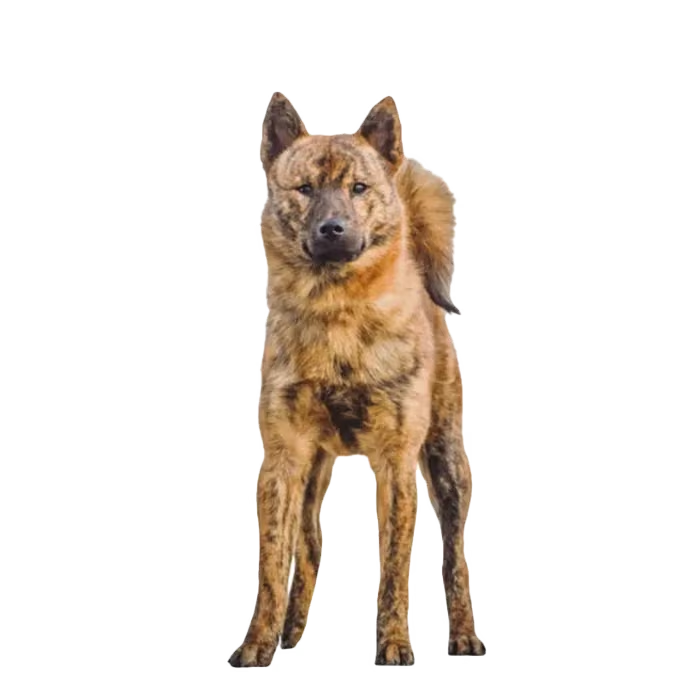
Kai Ken
Also known as Tiger Dog
The Kai Ken is a reserved, intelligent Japanese hunting breed deeply devoted to its owner and a skilled, agile climber.
- Size
- Medium
- Lifespan
- 12–15 years
- Origin
- Japan
- Temperament
- Reserved
- Standard colors
- Black, White, and Red
Characteristics
Coat and grooming
How the Kai Ken coat is built, and what that means when you groom it.
- Coat layers
- Double coat
- Coat texture
- Rough
- Coat length
- Medium
- Shedding
- Seasonal shedding
Grooming guidance
Critical: A Kai Ken should not be shaved.
The undercoat keeps heat out as well as in, and the outer coat shields the skin from sun and insect bites. Clipping the whole coat off removes both. It often grows back patchy, soft or a different colour, and in some animals the guard hairs never return properly. Brush the undercoat out instead of cutting it off.
Information: A Kai Ken drops its undercoat in heavy bursts.
The undercoat comes out in heavy bursts over a few weeks. An undercoat rake, or a bath followed by a proper blow-dry, clears it far faster than daily brushing. Clipping the coat down is not a shortcut for this.
Registry Recognition
Fédération Cynologique Internationale
- Spitz and Primitive Types
American Kennel Club
- Non-Sporting Group
Canadian Kennel Club
- Non-Sporting Group
United Pet Club
- Spitz and Primitive TypesPrimary
Kai Ken colors and patterns
What each club's breed standard says about every Kai Ken color and pattern. Point at a ruling to see the club's own wording.
Breed standards describe the Kai Ken in Black, White, and Red. Standard patterns: Solid, Brindle, and Reverse brindle.
| Color or pattern | FCI | AKC | UKC |
|---|---|---|---|
| Black | Standard (“Black brindle”) | Standard (“Black Brindle”) | Standard (“All brindle colors are equally acceptable”) |
| White | Disqualifying (“Coat with many white spots”) | Standard (“A small white blaze is allowed on the forechest, between the front legs and on the belly”) | Standard (“Some white is allowed on the legs ... on the forechest, between the front legs and on the belly”) |
| Red | Standard (“red brindle”) | Standard (“Red Brindle”) | Standard (“All brindle colors are equally acceptable”) |
| Albino | Not recognized | Not recognized | Disqualifying (“Albinism”) |
| Cream | Not recognized | Disqualifying (“cream”) | No ruling |
| Patterns | |||
| Solid | Standard (“solid colour in puppyhood may turn brindle as the dog grows”) | Disqualifying | No ruling |
| Brindle | Standard (“Black brindle, red brindle and brindle”) | Standard (“Brindle”) | Standard (“All brindle colors are equally acceptable”) |
| Reverse brindle | Standard (“Black brindle, red brindle and brindle”) | Standard (“Brindle”) | Standard (“All brindle colors are equally acceptable”) |
| Piebald | Disqualifying (“Pinto colour”) | Disqualifying (“Pinto”) | No ruling |


| Color or pattern | FCI | AKC | UKC |
|---|---|---|---|
| Dark brown | Standard (“dark brown in colour”) | Standard (“the iris dark brown”) | Standard (“dark brown”) |
| Light brown | Fault (“Light-coloured eyes”) | Fault (“light colored eyes”) | No ruling |
| Yellow | No ruling | No ruling | Fault (“Yellow or bird-of-prey eyes”) |
| Color or pattern | FCI | AKC | UKC |
|---|---|---|---|
| Black | Standard (“Black”) | Standard (“black”) | Standard (“solid black except in red brindles, where it may be brownish black”) |
| Color or pattern | AKC | UKC |
|---|---|---|
| Blue-black | No ruling | Standard (“may be ... blue black”) |
| Pink | No ruling | Standard (“may be pink”) |
| Patterns | ||
| Spotted | Standard (“The mouth and tongue is generally spotted”) | Standard (“The tongue is generally spotted”) |

What the rulings mean
- Standard
- Described by the club's breed standard.
- Fault
- Named by the club's breed standard as a fault: the animal can be shown but is penalized.
- Disqualifying
- The club's breed standard disqualifies an animal of this color or pattern.
- Not recognized
- The club does not accept this color or pattern for the breed.
Color changes
How a Kai Ken's colors can change over its life.
Blackchanges toRust
Coat · With body condition · can change back
Blackchanges toGray
Coat · Progressive
Blackchanges toBrown
Coat · In the sun · can change back
Whitechanges toRoan
Coat · With age · from 2 weeks
Blackchanges toSnow nose
Nose · With the season · can change back
Blackchanges toPink
Nose · With the season · can change back


Sources
Each ruling comes from the club's published breed standard or color list.
About the Kai Ken
The Kai Ken is a medium Japanese hunting breed that is reserved with strangers, deeply devoted to its family, and an agile climber known for tracking game in mountainous terrain.
The Kai Ken is a medium-sized spitz-type dog from Japan, bred to hunt boar and deer in the steep, forested mountains of the Yamanashi region. It is one of six native Japanese breeds and is among the rarest. The breed is sometimes called the Tora Inu, or tiger dog, because of its distinctive brindle coat.
Kai Ken are intelligent and watchful. They bond closely with one family and tend to stay aloof with people they do not know. Unlike some primitive breeds, they are not typically aggressive toward humans, but their reserve and strong prey drive shape how they fit into a household.
The breed is athletic and famously sure-footed. Kai Ken can climb trees and scramble over rocks while pursuing game, a trait that still shows in pet dogs that scale fences and furniture. They need an owner who understands an independent working dog and can give it physical and mental work.
| Attribute | Detail |
|---|---|
| Origin | Japan (Yamanashi region) |
| Size | Medium |
| Lifespan | 12 to 15 years |
| Group/role | Hunting and companion (spitz type) |
| Good with | Devoted family; supervised with small pets due to prey drive |
Who the Kai Ken suits
This breed fits an active owner who values loyalty over constant affection from strangers. Kai Ken do well with people who can provide secure fencing, regular exercise, and early socialization. Households with small animals should plan for the breed's hunting instincts. First-time dog owners may find the breed's independence and reserve challenging without prior research.
History and origin
The Kai Ken developed in the isolated Kai Province (modern Yamanashi) of Japan as a mountain hunting dog and was designated a Japanese natural monument in 1934.
The Kai Ken comes from Kai Province, the historic name for what is now Yamanashi Prefecture in central Japan. The region's steep mountains and dense forests kept the local dog population isolated for generations, which helped the breed stay relatively pure compared with dogs in more accessible areas.
Hunters in the area used these dogs to track and hold boar and deer. The breed worked in rough terrain where its climbing ability and stamina mattered more than speed on open ground. This working background shaped the dog's strong prey drive and independent decision-making.
The Kai Ken was recognized as a protected natural monument of Japan in 1934, the same period in which several other native Japanese breeds were documented and preserved. A breed club, the Kai Ken Aigokai, was formed to maintain the dog's type and records.
The breed remains uncommon even within Japan and is rare elsewhere. Small numbers have been exported to other countries, where dedicated breeders work to keep the population healthy while preserving the original hunting character.
Appearance
The Kai Ken is a medium spitz-type dog with a wedge-shaped head, pricked ears, a curled tail, and a brindle coat that ranges from black to red brindle.
The Kai Ken has a balanced, muscular build typical of spitz dogs. The head is wedge-shaped with a moderate stop, the ears stand upright and tilt slightly forward, and the eyes are dark and set somewhat triangular. The tail is carried curled or curved over the back. The overall impression is of a hardy, agile mountain dog rather than a heavy or flashy one.
| Trait | Standard |
|---|---|
| Height | Around 47 to 53 cm at the shoulder (males larger than females) |
| Weight | About 11 to 18 kg |
| Coat | Double coat: harsh, straight outer coat over a soft, dense undercoat |
| Colors | Black brindle, red brindle, and intermediate brindle |
| Eyes | Dark brown, set roughly triangular |
Coat and colors
The defining feature is the brindle pattern, which gives the breed its tiger-dog nickname. Three brindle shades are recognized: black brindle (kuro-tora), red brindle (aka-tora), and an intermediate brindle (chu-tora). Puppies are often born nearly solid and develop their brindle striping as they mature, sometimes over the first year or more. The double coat sheds seasonally and provides protection in cold mountain weather.
Temperament
The Kai Ken is devoted and protective toward its own family, reserved and aloof with strangers, intelligent, and driven by strong hunting instincts.
Kai Ken form a strong attachment to their owner and household. Within the family they can be affectionate and playful, and many are notably gentle with the people they trust. With strangers they are reserved and watchful rather than friendly, which makes them alert to anything unusual.
The breed is intelligent and observant. It tends to assess situations before acting, a trait inherited from its independent hunting work. This can read as stubbornness during training, but it reflects a dog that thinks for itself.
Prey drive is high. Kai Ken were bred to chase and hold large game, so cats, small dogs, and other small animals can trigger pursuit. Early, ongoing socialization helps, but supervision around small pets remains sensible. Toward other dogs, individuals vary, and same-sex tension can occur.
| Trait | Rating |
|---|---|
| Affection (with family) | 4 |
| Energy | 4 |
| Trainability | 3 |
| Vocalness | 2 |
| Shedding | 3 |
Care and grooming
The Kai Ken needs regular brushing for its double coat, daily vigorous exercise, secure fencing to contain its climbing ability, and consistent mental engagement.
Grooming
- Brush once or twice a week to remove loose hair and keep the double coat healthy
- Increase brushing to several times a week during seasonal shedding, when the undercoat blows out
- Bathe only as needed, since the coat is fairly self-cleaning
- Trim nails regularly and check ears for dirt or moisture after outdoor work
Exercise
- Provide at least an hour of vigorous activity each day, such as hiking, running, or off-lead time in a safe enclosed area
- Offer climbing and problem-solving outlets, since the breed enjoys scrambling and exploring
- Use long-line walks or secure spaces, because the strong prey drive makes off-lead recall unreliable near wildlife
Environment
The Kai Ken adapts to homes with active owners and does best with access to a securely fenced yard. Fencing should be tall and climb-resistant, as these dogs can scale obstacles that would contain most breeds. The double coat suits cool and cold climates; in heat, exercise during cooler parts of the day and provide shade and water.
Nutrition and feeding
The Kai Ken does well on a complete, balanced diet matched to its life stage and activity level, fed in measured meals to maintain its lean, athletic build.
Feed a complete and balanced diet formulated for the dog's life stage. As an active working-type breed, the Kai Ken benefits from food with adequate protein and fat to support muscle and stamina. Keep the dog lean, since excess weight strains joints and reduces the agility the breed is known for. Adjust portions to body condition rather than relying on the bag's guideline alone.
| Life stage | Amount per day | Meals |
|---|---|---|
| Puppy (2 to 6 months) | Per puppy formula on label, divided | 3 to 4 |
| Puppy (6 to 12 months) | Per label, adjusted to growth | 2 to 3 |
| Adult | About 1.5 to 2.5 cups of quality dry food | 2 |
| Senior | Reduced calories for lower activity | 2 |
Treats and supplements
Keep treats to roughly 10 percent of daily calories to protect the breed's lean build. Use small training treats during sessions and reduce the main meal accordingly. Most Kai Ken on a complete diet need no supplements; discuss joint or coat supplements with a veterinarian based on the individual dog's needs. Provide fresh water at all times, especially around exercise.
Health
The Kai Ken is generally a hardy breed with a lifespan of 12 to 15 years and relatively few breed-specific problems, though routine preventive care remains important.
The Kai Ken is considered one of the healthier and more robust dog breeds, partly because of its long isolation and limited human intervention in its development. Typical lifespan is 12 to 15 years. As with any breed, individual dogs can still develop common canine health issues, and responsible breeders screen breeding stock.
| Condition | Signs | Note |
|---|---|---|
| Hip dysplasia | Stiffness, limping, trouble rising | Less common than in many breeds; screening helps |
| Patellar luxation | Skipping gait, intermittent hind-leg lameness | Seen in some small to medium breeds |
| Eye conditions | Cloudiness, vision changes | Routine eye checks recommended |
| Allergies and skin issues | Itching, redness, hair loss | Manage with veterinary guidance |
Preventive care
- Keep vaccinations and parasite prevention up to date
- Schedule annual veterinary check-ups, moving to twice yearly for seniors
- Maintain a healthy weight to protect joints
- Brush teeth regularly and provide dental care
- Keep the dog active to support muscle tone and overall condition
Training
The Kai Ken is intelligent and capable but independent, so it responds best to early, consistent, reward-based training from an owner it trusts.
Kai Ken learn quickly when motivated, but their independent nature means they question commands that seem pointless. They tend to cooperate most readily with an owner they respect and trust. Harsh methods backfire and damage the bond. Short, varied, and rewarding sessions hold their attention better than long, repetitive drills. Recall is the hardest skill to make reliable, because prey drive can override training around wildlife.
Basics
- Start socialization early, exposing the puppy to varied people, places, and sounds
- Build a strong recall on a long line before trusting off-lead freedom
- Teach core cues (sit, down, stay, come) with food and praise rewards
- Practice calm behavior around small animals from a young age
- Keep sessions short and end on a success to maintain motivation
Breeding
Kai Ken reach maturity at around one to two years, produce modest litters, and require careful socialization of puppies given the breed's rarity and reserved nature.
Breeding the Kai Ken calls for attention to health screening and temperament, given how small the global population is. Females generally reach physical and behavioral maturity before they should be bred, often around or after their second year, and breeding decisions should follow veterinary and breed-club guidance. Gestation in dogs runs about 63 days. Litters are typically modest in size.
Early socialization of puppies is especially important in this breed. Because adults are naturally reserved with strangers, exposing pups to gentle handling and varied experiences during their early weeks helps produce confident, stable dogs. Reputable breeders prioritize preserving the breed's hunting character and health while avoiding excessive shyness.
| Metric | Value |
|---|---|
| Sexual maturity | Around 1 to 2 years |
| Gestation | About 63 days |
| Typical litter size | Roughly 3 to 6 puppies |
| Weaning | Around 6 to 8 weeks |
| Population status | Rare worldwide |
Registering your Kai Ken and its microchip
Register your Kai Ken free for life with United Pet Club, and put its microchip number on a record American shelters can actually find.
How to register a Kai Ken in the United States
Shelters across the US scan every dog that comes through the door, and what happens next depends on paperwork. A scan that ends at a current record gets your Kai Ken home; a scan that ends nowhere starts a holding period. Register your dog with United Pet Club and that record exists, free, for the rest of your dog's life.
Chipped already? The implant is half the job. Until the 15-digit number sits in a registry with your name beside it, a scanner reads digits that lead nowhere. Microchip registration is free for life at United Pet Club, takes any manufacturer's chip, and keeps the record searchable through the AAHA lookup shelters rely on. Sign up free, and both records are done tonight.
How do I register my Kai Ken in the United States?
Open a free United Pet Club account, enter your Kai Ken's name, birth date, and a photo, and save. The profile is free for life, works with or without a microchip, and you can attach a chip number later.
How do I register my Kai Ken's microchip?
Type the 15-digit chip number into your free United Pet Club account together with your current phone number and address. The lifetime plan is free, covers every future update, and accepts any chip brand a US vet implants.
Does my Kai Ken have to be microchipped in the United States?
No federal law says a Kai Ken must carry a chip, but plenty of city and county licensing rules do, and shelters routinely chip before adoption. What the law never does is register the chip for you; that part is yours.
How much does it cost to register a Kai Ken?
Nothing. United Pet Club's lifetime plan covers the dog's profile, the microchip registration, and every update at no charge, with no renewal fees.
Frequently asked questions
Common questions about the Kai Ken cover its size, temperament, care needs, lifespan, suitability as a pet, and availability.
How big does a Kai Ken get?
The Kai Ken is a medium breed, standing roughly 47 to 53 cm at the shoulder and weighing about 11 to 18 kg, with males larger than females.
What is the Kai Ken's temperament like?
It is devoted and protective toward its family, reserved and aloof with strangers, intelligent, and driven by a strong hunting instinct. It is alert and watchful rather than openly friendly with people it does not know.
Is the Kai Ken hard to care for?
Care is moderate. The double coat needs regular brushing with heavier shedding seasonally, and the dog needs daily vigorous exercise. The bigger challenge is managing its climbing ability, prey drive, and independent nature with secure fencing and consistent training.
How long does a Kai Ken live?
Typical lifespan is 12 to 15 years. The breed is generally hardy with relatively few breed-specific health problems.
Is the Kai Ken a good family dog?
It can be an excellent companion for an active, committed household. It bonds closely with its family, though its reserve with strangers and strong prey drive mean it suits owners who can provide socialization, exercise, and supervision around small pets.
Are Kai Ken easy to find?
No. The Kai Ken is rare even in Japan and uncommon elsewhere. Finding a puppy usually means working with a dedicated breeder and joining a waiting list.
Can a Kai Ken really climb?
Yes. The breed is famously agile and can scramble up rocks, scale fences, and even climb trees while pursuing game, which is why secure, climb-resistant fencing matters.
From the community
Ask about the Kai KenNo questions about the Kai Ken yet. Be the first to ask.
Browse Dog breeds