The Great Pyrenees is a calm, majestic livestock guardian known for its gentle devotion to family and unwavering protective instincts.
How the Great Pyrenees coat is built, and what that means when you groom it.
Critical: A Great Pyrenees should not be shaved.
The undercoat keeps heat out as well as in, and the outer coat shields the skin from sun and insect bites. Clipping the whole coat off removes both. It often grows back patchy, soft or a different colour, and in some animals the guard hairs never return properly. Brush the undercoat out instead of cutting it off.
Caution: A Great Pyrenees coat mats easily.
Fine or long hair tangles at the base of the coat, out of sight, where the mats tighten and pull on the skin. Brushing has to reach right down to the roots in sections, not just skim the surface.
Information: A Great Pyrenees drops its undercoat in heavy bursts.
The undercoat comes out in heavy bursts over a few weeks. An undercoat rake, or a bath followed by a proper blow-dry, clears it far faster than daily brushing. Clipping the coat down is not a shortcut for this.
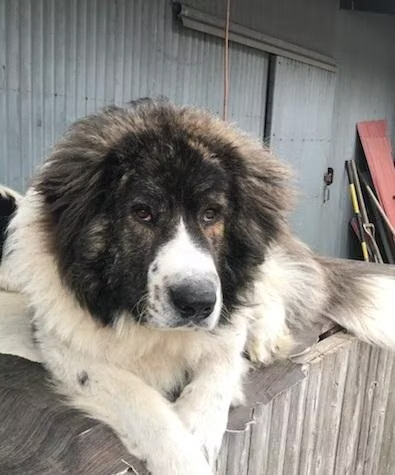
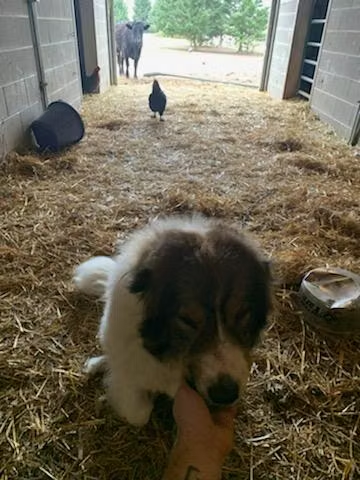
A few of the Great Pyrenees profiles members have added to United Pet Club.
The Great Pyrenees is a giant livestock guardian dog from France, calm and devoted at home while staying alert to anything it sees as a threat.
The Great Pyrenees is a giant working dog developed in the Pyrenees Mountains between France and Spain. For centuries it lived with shepherds and flocks at high altitude, guarding sheep and goats from wolves and bears. That history shaped a dog that is patient and steady most of the time, then decisive when it judges that something is wrong.
Adults stand among the largest of all dog breeds, with a thick white coat built for cold weather. Despite the size, the breed is known for a soft, gentle manner with the people and animals it considers part of its charge. It bonds closely with family and is usually tolerant of children.
The trade-off for that guarding instinct is independence. A Great Pyrenees was bred to make its own decisions on a hillside without a handler nearby, so it tends to think before it obeys. Owners describe a dog that is affectionate and calm indoors but will bark at night and patrol a property on its own schedule.
| Attribute | Detail |
|---|---|
| Origin | France (Pyrenees Mountains) |
| Size | Giant |
| Lifespan | 10 to 12 years |
| Group / role | Working group, livestock guardian |
| Good with | Family, children, livestock; needs supervision with small unfamiliar animals |
This breed fits owners with space, ideally a securely fenced yard or a small farm, who want a calm companion and a natural watchdog. It does best with people who can tolerate heavy shedding, regular barking, and a dog that will not always come when called. It is a poor match for apartment living, off-leash freedom in open areas, or anyone expecting quick, military-style obedience.
The breed comes from the Pyrenees Mountains of France, where it guarded sheep flocks for centuries before becoming a French royal favorite and later a recognized show and working dog.
The Great Pyrenees, called the Chien de Montagne des Pyrénées in France, takes its name from the mountain range that divides France and Spain. Large white guardian dogs of this type are very old. Remains of similar mountain dogs in the region date back thousands of years, and the working breed as it is known today was firmly established by shepherds in the French Pyrenees.
For generations the dogs lived outdoors with the flocks through the year. They worked in pairs or small groups, watching for wolves and bears while the shepherds and herding dogs managed movement. The white coat let shepherds tell their guardian dogs apart from predators at a distance.
In the 17th century the breed gained status beyond the mountains. It became fashionable at the French court, and the dog was named a guardian of the château by the nobility of the period. This royal attention helped spread the breed through France and raised its profile.
The breed reached wider international recognition in the 19th and 20th centuries. Working examples were still guarding livestock in the mountains while show lines developed in parallel. Today the Great Pyrenees is kept both as a companion and, in many regions, still as a working livestock guardian on farms and ranches.
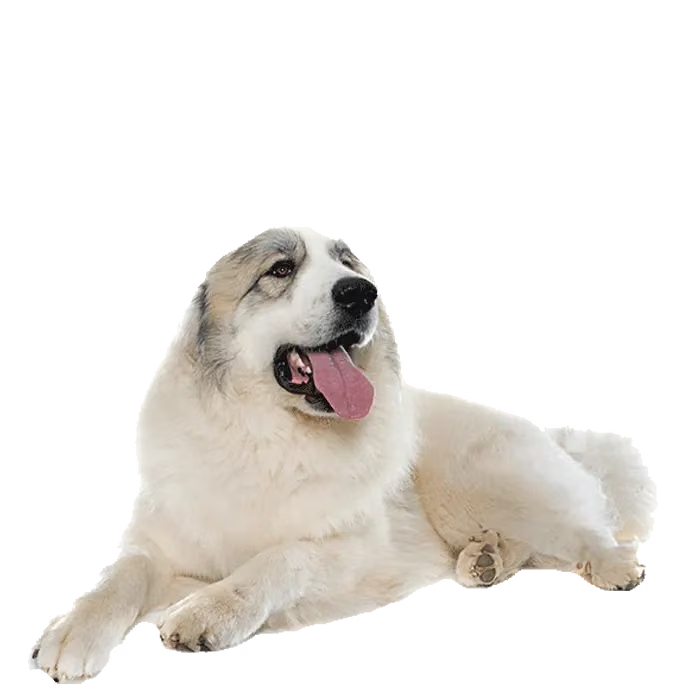
A giant dog with a weatherproof white double coat, the Great Pyrenees has a broad head, dark eyes, and double dewclaws on the hind legs.
The Great Pyrenees is large and powerfully built without looking heavy or clumsy. The body is slightly longer than it is tall, and the dog carries itself with a steady, unhurried gait. The head is wedge-shaped with a slightly rounded crown, medium-sized triangular ears that hang close to the head, and a black nose and lip edges. A clear breed feature is the double dewclaws on each hind leg.
| Trait | Standard |
|---|---|
| Height | Males 27 to 32 in (69 to 81 cm); females 25 to 29 in (63 to 74 cm) |
| Weight | Males 100 lb (45 kg) and up; females 85 lb (39 kg) and up |
| Coat | Thick weatherproof double coat, coarse outer, dense undercoat |
| Colors | White, or white with markings of gray, tan, reddish-brown, or badger |
| Eyes | Medium, almond-shaped, dark brown |
The coat is the most recognizable feature. The outer layer is long, flat, and coarse, while the undercoat is soft and dense for insulation. Males often carry a fuller mane around the neck and shoulders. The base color is white. Markings of gray, tan, reddish-brown, or badger may appear on the head, ears, and at the base of the tail and are acceptable in the standard. The coat resists tangling better than its length suggests, but it sheds heavily, especially during seasonal coat changes.
The Great Pyrenees is calm and affectionate with its family, naturally wary of strangers, and protective, with an independent streak that comes from its guardian background.
At home the Great Pyrenees is calm and quiet, often content to lie near its family and watch the household. It tends to be gentle with children and patient with the animals it has been raised alongside. The breed forms strong attachments and is devoted to the people it guards.
With strangers the dog is reserved rather than friendly. It will assess a new person before accepting them and is naturally suspicious of anyone approaching its property. This makes it an effective watchdog but means early, ongoing socialization matters.
The guarding instinct shapes daily behavior. A Great Pyrenees barks to warn off perceived threats, especially at night, and patrols territory on its own. It is also independent and was bred to act without direction, so it does not always defer to commands. Around small unfamiliar animals it can be predatory or simply wary, so introductions should be supervised.
| Trait | Rating |
|---|---|
| Affection | 5 |
| Energy | 2 |
| Trainability | 2 |
| Vocalness | 5 |
| Shedding | 5 |
A Great Pyrenees needs regular brushing for its heavy coat, moderate daily exercise, and a secure, cool environment with room to patrol.
The Great Pyrenees is built for cold and copes poorly with high heat, so shade, fresh water, and cool resting spots are important in warm climates. It does best with outdoor space to patrol and is not suited to apartments. A secure fence is essential because the breed wanders and may try to expand its territory. Night barking is normal and should be planned for if neighbors are close.
As a giant breed, the Great Pyrenees needs a complete diet with controlled growth in puppyhood and measured portions to protect its joints and avoid bloat.
A Great Pyrenees should eat a complete, balanced diet formulated for large or giant breeds. Despite its size the breed is not highly active, so it needs fewer calories per pound than a working sporting dog and gains weight easily if overfed. Portion size depends on age, weight, and activity, so use the food label as a starting point and adjust to keep the dog lean.
Giant-breed puppies are a special case. They should grow slowly on a large-breed puppy formula with controlled calcium and energy, because growing too fast raises the risk of joint and bone problems. Feeding several smaller meals a day rather than one large meal is recommended.
| Life stage | Amount per day | Meals |
|---|---|---|
| Puppy (2 to 12 months) | Per large-breed puppy formula, controlled growth | 3 to 4 |
| Adult | Roughly 4 to 8 cups depending on weight and activity | 2 |
| Senior | Slightly reduced calories, monitor weight | 2 |
Keep treats to a small share of daily calories to prevent weight gain on a frame already carrying a lot of mass. Many owners and veterinarians consider joint support such as glucosamine for a giant breed, but supplements should be discussed with a vet rather than added on assumption. Always provide constant access to fresh water, particularly in warm weather.
The Great Pyrenees typically lives 10 to 12 years and, like most giant breeds, is prone to hip dysplasia, bloat, and joint problems that preventive care can help manage.
The Great Pyrenees generally lives 10 to 12 years, which is typical for a giant breed. Most are healthy with good care, but the large frame brings risks common to big dogs, especially around the joints and the stomach. Buying from breeders who screen their stock and keeping the dog at a healthy weight both reduce risk.
| Condition | Signs | Note |
|---|---|---|
| Hip and elbow dysplasia | Limping, stiffness, trouble rising | Common in giant breeds; ask about parent screening |
| Bloat (gastric torsion) | Swollen abdomen, retching, distress | Life-threatening emergency; act immediately |
| Patellar luxation | Skipping or hopping on a hind leg | Affects the kneecap; severity varies |
| Bone and joint issues from fast growth | Lameness in young dogs | Controlled puppy diet lowers risk |
The Great Pyrenees is intelligent but independent, so training works best with early socialization, patience, and consistent positive methods rather than repetition drills.
The Great Pyrenees is intelligent but was bred to work alone and make its own decisions, so it does not train like a biddable herding or sporting dog. It may understand a command and still choose whether to act on it. Training takes patience and consistency, and harsh correction tends to make the breed shut down or resist. Early, broad socialization is the single most useful thing an owner can do, because it tempers the natural wariness of strangers.
Recall is a particular weak point. Many Great Pyrenees never become reliable off leash, so secure fencing and on-leash control are safer than trusting a trained recall.
Great Pyrenees breeding involves large litters and giant-breed puppies that need slow, controlled growth and early socialization to develop into stable adults.
Breeding a giant guardian breed is a serious commitment and is best left to experienced breeders who screen for health. Females are usually bred only after they are physically mature, which comes later in giant breeds than in smaller dogs. Responsible breeders test the parents for hip, elbow, and other heritable problems before pairing.
Gestation in dogs runs about 63 days. The Great Pyrenees often produces large litters, and the puppies grow quickly into very large dogs. Because fast growth raises the risk of joint and bone problems, puppies should be raised on a controlled giant-breed diet rather than fed for maximum size.
Early handling and socialization matter a great deal. Guardian puppies that meet many people and situations in their first months are more likely to grow into stable, manageable adults. Puppies typically stay with the litter until at least eight weeks so they learn normal behavior from the dam and littermates.
| Metric | Value |
|---|---|
| Gestation | Approximately 63 days |
| Typical litter size | 6 to 9 puppies |
| Weaning age | Around 6 to 8 weeks |
| Recommended go-home age | 8 weeks or later |
| Maturity | Slow; full growth and breeding maturity reached later than small breeds |
Register your Great Pyrenees free for life with United Pet Club, and put its microchip number on a record American shelters can actually find.
Shelters across the US scan every dog that comes through the door, and what happens next depends on paperwork. A scan that ends at a current record gets your Great Pyrenees home; a scan that ends nowhere starts a holding period. Register your dog with United Pet Club and that record exists, free, for the rest of your dog's life.
The microchip needs its own registration. A vet implants the chip, but the number stays anonymous until you file it, and an anonymous chip cannot point anyone at you. Register the microchip with United Pet Club on the free lifetime plan: every brand a US vet implants qualifies, updates cost nothing after a move, and the record shows up in the AAHA universal lookup American shelters check first. Create your free account and finish both steps in one sitting.
Open a free United Pet Club account, enter your Great Pyrenees's name, birth date, and a photo, and save. The profile is free for life, works with or without a microchip, and you can attach a chip number later.
Type the 15-digit chip number into your free United Pet Club account together with your current phone number and address. The lifetime plan is free, covers every future update, and accepts any chip brand a US vet implants.
No federal law says a Great Pyrenees must carry a chip, but plenty of city and county licensing rules do, and shelters routinely chip before adoption. What the law never does is register the chip for you; that part is yours.
Nothing. United Pet Club's lifetime plan covers the dog's profile, the microchip registration, and every update at no charge, with no renewal fees.
Common questions about the size, temperament, care, lifespan, and suitability of the Great Pyrenees.
It is a giant breed. Males stand about 27 to 32 inches at the shoulder and weigh from 100 pounds upward, while females stand about 25 to 29 inches and weigh from 85 pounds upward.
Yes. The breed is generally calm, gentle, and patient with children and is devoted to its family. As with any large dog, interactions with young children should be supervised.
It is moderately demanding. The heavy coat needs regular brushing and sheds a lot, the dog barks and roams, and recall is unreliable. Exercise needs are moderate, but secure fencing and time for grooming are essential.
Most live about 10 to 12 years, which is typical for a giant breed.
It is an excellent watchdog and livestock guardian by nature. It is alert, protective, and wary of strangers, and it barks to warn off perceived threats, especially at night.
It is not well suited to either. The breed needs space to patrol and a secure yard, and its thick double coat means it copes poorly with high heat. Shade, water, and cool resting areas are important in warm climates.
They are intelligent but independent, so they do not obey as readily as some breeds. Early socialization and patient, positive, consistent training give the best results, and off-leash recall often stays unreliable.