
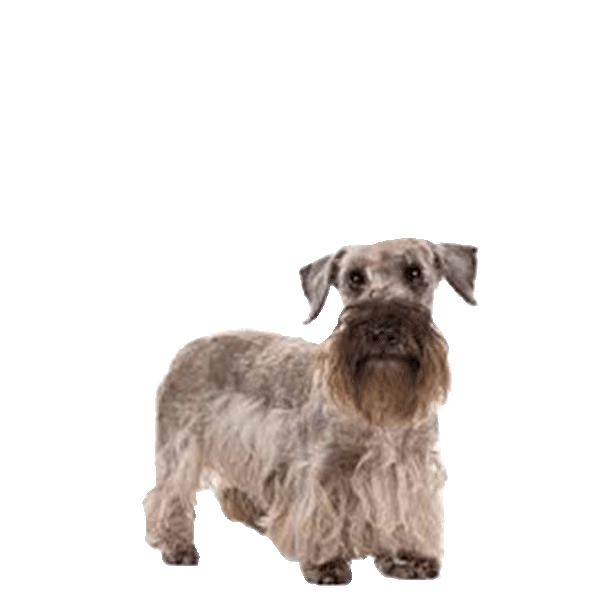
Cesky Terrier
Also known as Bohemian Terrier
The Cesky Terrier is a calm, easygoing Czech terrier known for its silky coat and its gentler, more reserved temperament.
- Size
- Small
- Lifespan
- 12–15 years
- Origin
- Czech Republic
- Temperament
- Calm
- Standard colors
- Black, Blue, and Silver and 3 more
Characteristics
Coat and grooming
How the Cesky Terrier coat is built, and what that means when you groom it.
- Coat layers
- Single coat
- Coat texture
- Silky, Wavy
- Coat length
- Medium
- Shedding
- Low shedding
Grooming guidance
Caution: A Cesky Terrier coat mats easily.
Fine or long hair tangles at the base of the coat, out of sight, where the mats tighten and pull on the skin. Brushing has to reach right down to the roots in sections, not just skim the surface.
Information: A Cesky Terrier needs clipping every few weeks.
This coat keeps growing rather than shedding out, so it has to be trimmed every few weeks. Left to grow it mats down against the skin and traps moisture, dirt and heat.
Registry Recognition
Fédération Cynologique Internationale
- Terriers
American Kennel Club
- Terrier Group
Canadian Kennel Club
- Terrier Group
United Pet Club
- TerriersPrimary
Cesky Terrier colors and patterns
What each club's breed standard says about every Cesky Terrier color and pattern. Point at a ruling to see the club's own wording.
Breed standards describe the Cesky Terrier in Black, Blue, Silver, Brown, Yellow, and Wheaten. Standard patterns: Brindle, Tan point, and Reverse brindle.
| Color or pattern | FCI | AKC | UKC | KC | KUSA |
|---|---|---|---|---|---|
| Black | Standard (“grey-blue (puppies are born black)”) | Standard (“All puppies are born black”) | Standard (“Blue gray dogs are born black”) | Standard (“solid black coat is only acceptable in dogs under two years of age”) | Standard (“grey-blue (puppies are born black)”) |
| Blue | Standard (“grey-blue”) | Standard (“Gray”) | Standard (“blue gray”) | Standard (“Grey-blue”) | Standard (“grey-blue”) |
| Silver | Not recognized | Standard (“any fairly uniform shade of gray ranging from charcoal to platinum gray”) | Not recognized | Standard (“Silver”) | Not recognized |
| Brown | Standard (“light-coffee-brown”) | Standard (“light coffee”) | Standard (“light coffee brown”) | Standard (“light brown”) | Standard (“light coffee-brown”) |
| Yellow | Standard (“yellow, grey or white markings are permitted”) | Standard (“White, brown and yellow markings are permitted”) | Standard (“Yellow, gray and white markings are permissible”) | Standard (“Yellow and grey markings allowed”) | Standard (“yellow, grey, or white markings are permitted”) |
| Wheaten | Not recognized | Not recognized | Not recognized | Standard (“Wheaten”) | Not recognized |
| Albino | Not recognized | Not recognized | Disqualifying (“Albinism”) | Not recognized | Not recognized |
| Patterns | |||||
| Brindle | Disqualifying (“Long brindled coat on dogs older than 2 years”) | Standard (“A brindled or reverse brindled coat is permitted in a dog up to 2 years of age”) | Fault (“A long brindled coat on dogs over two years old”) | Standard (“Striping, (brindling) ... is only acceptable in dogs under two years of age”) | Disqualifying (“Long brindled coat on dogs older than 2 years”) |
| Tan point | Standard (“markings are permitted on the head (beard, cheeks), neck, chest, belly, the limbs”) | Standard (“markings are permitted on the beard, cheeks, neck, chest, limbs, and around the vent”) | Standard (“markings appear on the head, on the cheeks and underside of the muzzle”) | Standard (“Grey & Tan”) | Standard (“markings are permitted on the head (beard and cheeks), neck, chest, belly”) |
| Reverse brindle | Disqualifying (“Long brindled coat on dogs older than 2 years”) | Standard (“A brindled or reverse brindled coat is permitted in a dog up to 2 years of age”) | Fault (“A long brindled coat on dogs over two years old”) | Standard (“Striping, (brindling) ... is only acceptable in dogs under two years of age”) | Disqualifying (“Long brindled coat on dogs older than 2 years”) |


| Color or pattern | FCI | AKC | UKC | KC | KUSA |
|---|---|---|---|---|---|
| Black | No ruling | No ruling | No ruling | Standard (“In blue-grey dogs – black or brown”) | No ruling |
| Brown | Standard (“Brown or dark brown in grey-blue coated dogs”) | Standard (“The color is brown or dark brown”) | Standard (“brown to dark brown in blue-gray dogs”) | Standard (“In blue-grey dogs – black or brown”) | Standard (“Brown or dark brown in grey-blue coated dogs”) |
| Dark brown | Standard (“dark brown in grey-blue coated dogs”) | Standard (“dark brown”) | Standard (“dark brown in blue-gray dogs”) | Standard (“in light brown dogs – light to dark brown”) | Standard (“dark brown in grey-blue coated dogs”) |
| Light brown | Standard (“light brown in light-coffee-brown dogs”) | Standard (“the color being lighter in coffee-colored dogs”) | Standard (“light brown in the light coffee brown dogs”) | Standard (“in light brown dogs – light to dark brown”) | Standard (“light brown in light coffee-brown dogs”) |
| Color or pattern | FCI | AKC | UKC | KC | KUSA |
|---|---|---|---|---|---|
| Black | Standard (“black on Terriers with a grey-blue coat”) | Standard (“black in gray dogs”) | Standard (“Black in the blue-gray dogs”) | Standard (“Nose black in grey-blue dogs”) | Standard (“black on Terriers with a grey-blue coat”) |
| Liver | Standard (“liver-coloured on light-coffee brown Terriers”) | Standard (“liver in coffee colored dogs”) | Standard (“liver in the light coffee brown dogs”) | Standard (“liver in light brown dogs”) | Standard (“liver-coloured on light-coffee brown Terriers”) |
| Patterns | |||||
| Snow nose | Fault (“Temporary loss of nasal pigmentation (snow nose)”) | No ruling | Fault (“Snow nose”) | No ruling | Fault (“Temporary loss of nasal pigmentation (snow nose)”) |

What the rulings mean
- Standard
- Described by the club's breed standard.
- Fault
- Named by the club's breed standard as a fault: the animal can be shown but is penalized.
- Disqualifying
- The club's breed standard disqualifies an animal of this color or pattern.
- Not recognized
- The club does not accept this color or pattern for the breed.
Color changes
How a Cesky Terrier's colors can change over its life.
Blackchanges toRust
Coat · With body condition · can change back
Blackchanges toGray
Coat · Progressive
Blackchanges toBlue
Coat · Progressive · from 0 to 156 weeks
Chocolatechanges toBrown
Coat · Progressive · from 0 to 156 weeks
Blackchanges toBrown
Coat · In the sun · can change back
Tan pointchanges toSaddle
Coat · With age · from 6 to 156 weeks
Blackchanges toSnow nose
Nose · With the season · can change back
Blackchanges toPink
Nose · With the season · can change back

Sources
Each ruling comes from the club's published breed standard or color list.
About the Cesky Terrier
The Cesky Terrier is a small Czech terrier with a silky coat and a calmer, more reserved temperament than most terriers, suited to families who want a steady, manageable companion.
The Cesky Terrier (pronounced "chess-key") is a small hunting terrier from the Czech Republic. It stands low to the ground with short legs, a slightly arched back, and a soft, wavy coat that is clipped rather than stripped. Adults usually weigh between 13 and 24 pounds, which places the breed at the larger end of the small category.
The temperament sets this breed apart from many other terriers. The Cesky is calm and easygoing at home, playful when invited, and loyal to its family. It tends to be reserved with strangers rather than pushy or scrappy, which makes it a more even-tempered choice for households that find typical terrier intensity too much. Alertness remains: the breed notices visitors and will announce them.
The coat comes in shades of grey, from a pale platinum to a darker charcoal slate. Puppies are born black and lighten over the first two to three years. Grooming is regular but straightforward because the coat is clipped to a uniform length.
| Attribute | Detail |
|---|---|
| Origin | Czech Republic |
| Size | Small (13 to 24 lb) |
| Lifespan | 12 to 15 years |
| Group / role | Terrier, originally a hunting breed for fox and vermin |
| Good with | Families, older children, calm households, other pets with introduction |
Who it suits
The Cesky Terrier fits owners who want a small, trainable terrier without the high drive and vocal edge of many earth dogs. It adapts to apartments or houses, copes with moderate daily exercise, and is willing to follow rather than challenge. People who dislike heavy shedding may appreciate the clipped coat, though it needs scheduled grooming. The reserved nature means early, steady socialization helps the dog stay relaxed around new people and animals.
History and origin
The Cesky Terrier was created in the Czech Republic in the 1940s and 1950s by Frantisek Horak, who crossed Sealyham and Scottish Terriers to make a calmer hunting dog.
The Cesky Terrier is one of the newer terrier breeds and has a single, well-documented creator. Frantisek Horak, a Czech geneticist and dog breeder living in Klanovice near Prague, set out to develop a terrier that could hunt fox and other quarry in the forests of Bohemia while being narrow enough to follow game into burrows.
Horak wanted a dog with a calmer, more biddable nature than the working terriers available to him. He crossed the Sealyham Terrier with the Scottish Terrier, beginning the program in 1949. The first litter that met his goals was produced in the early 1950s, and he continued selecting for temperament, conformation, and a coat that could be clipped rather than hand-stripped.
The breed was recognized by the Federation Cynologique Internationale in 1963. Horak kept detailed breeding records throughout his life, which gives the Cesky an unusually clear pedigree history for a terrier. He named the breed for his country, using the Czech word "cesky."
The Cesky remains uncommon outside Central Europe. It reached wider international registries later in the twentieth century, and population numbers stay low compared with older, more established terrier breeds.
Appearance and breed standard
The Cesky Terrier is a small, low-set dog with a soft wavy grey coat clipped to a uniform length, a beard and eyebrows, and a slightly arched topline.
The Cesky Terrier is built long and low, with short legs and a body slightly longer than it is tall. The chest is deep, the topline rises gently over the loin, and the overall outline is rectangular. The head is wedge-shaped with a soft beard, eyebrows, and a moustache that frame the face. Ears fold forward against the cheeks, and the tail is carried low at rest.
| Feature | Standard |
|---|---|
| Height | 10 to 13 in (25 to 33 cm) at the shoulder |
| Weight | 13 to 24 lb (6 to 11 kg) |
| Coat | Soft, fine, slightly wavy; clipped to a uniform length |
| Colors | Shades of grey, from pale platinum to dark charcoal slate; occasional tan, grey, or white markings |
| Eyes | Medium, slightly deep-set; brown to dark grey depending on coat shade |
Coat and colors
The defining feature is the silky, wavy coat, which is clipped rather than stripped. The standard clip leaves the coat short over the back and longer on the legs, belly, chest, and face, producing the breed's characteristic beard and furnishings. Puppies are born black or very dark and lighten over the first two to three years to the adult grey. A small number of dogs carry a coffee-brown coat. Limited white, grey, or tan markings on the head, neck, chest, legs, and tail are accepted.
Temperament and personality
The Cesky Terrier is calm, loyal, and playful at home, reserved with strangers, and generally less scrappy than most terriers, making it an even-tempered family dog.
The Cesky Terrier has a gentler disposition than many earth terriers. At home it is calm and settled, content to rest near its people between bursts of play. It forms strong attachments and prefers company to long stretches alone.
With family the breed is affectionate and patient, and it usually does well with older, considerate children. With strangers the Cesky is reserved rather than friendly or aggressive; it tends to hang back and observe before warming up. Early and ongoing socialization keeps this caution from tipping into shyness.
With other pets the breed is more tolerant than the terrier average, though its hunting background means it may chase small animals outdoors. Introductions to cats and other dogs go best when started young and supervised. The Cesky is alert and will bark to announce visitors, but it is not a persistent or nuisance barker by nature.
| Trait | Rating |
|---|---|
| Affection | 4 |
| Energy | 3 |
| Trainability | 4 |
| Vocalness | 2 |
| Shedding | 2 |
Care and grooming
The Cesky Terrier needs regular clipping every six to eight weeks, daily brushing of its furnishings, and moderate daily exercise, and it adapts well to homes of any size.
Grooming
- Clip the coat every six to eight weeks to keep the standard short-back, longer-furnishings outline
- Brush the beard, legs, and belly every day or two to prevent matting
- Check and clean the folded ears weekly
- Trim nails every three to four weeks
- Bathe as needed, typically every few weeks, and dry the soft coat thoroughly
Exercise
- Provide 30 to 60 minutes of activity each day across one or two outings
- Mix walks with off-lead play in a secure area
- Offer scent games and short training sessions for mental work
- Keep the dog leashed near small animals because of the hunting instinct
Environment
The Cesky Terrier suits apartments and houses alike. Its moderate energy and quiet indoor manner make it manageable in smaller spaces, provided daily exercise is met. A securely fenced yard is useful because the breed will dig and follow scent. The breed prefers to be with its family and does not cope well with being left alone for long periods.
Nutrition and feeding
Feed the Cesky Terrier a complete diet portioned to its small size, usually a half to one and a half cups daily split across two meals, and watch the weight because the breed can gain easily.
The Cesky Terrier does well on a complete, balanced dog food suited to its life stage and small size. Because the breed is long-bodied and prone to weight gain, portion control matters more than the specific format of food. Measure meals rather than free-feeding, and adjust amounts to keep the dog at a lean weight where the ribs are easy to feel but not see.
| Life stage | Amount per day | Meals |
|---|---|---|
| Puppy (2 to 6 months) | 0.5 to 1 cup | 3 to 4 |
| Puppy (6 to 12 months) | 0.75 to 1.25 cups | 2 to 3 |
| Adult | 0.75 to 1.5 cups | 2 |
| Senior | 0.5 to 1.25 cups | 2 |
Treats and supplements
Keep treats to no more than ten percent of daily calories and subtract them from meal portions to avoid weight creep. Most Cesky Terriers on a complete diet need no supplements. Discuss joint support or omega-3 fatty acids with a veterinarian if the dog shows stiffness or coat issues, and always confirm any supplement is safe before adding it.
Health and lifespan
The Cesky Terrier is generally healthy with a lifespan of 12 to 15 years, though it can be affected by Scotty cramp, patellar luxation, and eye conditions that screening helps manage.
The Cesky Terrier is a sturdy, generally healthy breed with a typical lifespan of 12 to 15 years. Its small founding population means responsible breeders test for the conditions known in the breed and select against them. As with any long-backed dog, protecting the spine and keeping a lean weight support a long, comfortable life.
| Condition | Signs | Note |
|---|---|---|
| Scotty cramp | Brief stiffness or difficulty walking after excitement or exercise | Inherited; usually mild and not painful, managed by limiting triggers |
| Patellar luxation | Skipping gait, intermittent hind-leg lameness | Common in small breeds; ranges from mild to surgical |
| Primary lens luxation | Cloudiness, redness, eye discomfort | Inherited eye condition; DNA testing is available |
| Cardiac issues | Reduced stamina, coughing, fainting | Older dogs benefit from periodic heart checks |
Preventive care
- Keep core vaccinations and parasite control current
- Schedule annual veterinary exams, with twice-yearly visits for seniors
- Maintain dental hygiene through brushing and professional cleaning
- Keep the dog lean to reduce strain on joints and the long back
- Use breeders who screen knees, eyes, and heart
Training
The Cesky Terrier is intelligent and willing to please, more biddable than most terriers, and responds best to short, consistent, reward-based training with early socialization.
The Cesky Terrier trains more readily than many terriers because it was bred for a cooperative temperament. It is intelligent and wants to work with its handler, though it keeps an independent streak and can lose interest in repetitive drills. Short, varied sessions that end on success hold its attention. Harsh corrections tend to make the breed shut down; patience and consistency work far better.
Socialization should start early. Because the Cesky is naturally reserved with strangers, regular exposure to new people, places, dogs, and surfaces during the first months builds a confident adult. The hunting background calls for steady recall training and lead manners around small animals.
Basics
- Begin socialization and gentle handling in puppyhood
- Teach name response and focus first
- Build the core cues: sit, down, stay, come
- Practice loose-lead walking before the dog gains strength
- Proof recall in low-distraction settings, then add distractions gradually
- Add scent games or trick training to satisfy the working mind
Breeding
The Cesky Terrier reaches maturity around two years, carries litters of two to four puppies after a roughly 63-day gestation, and benefits from health screening of both parents.
Breeding the Cesky Terrier calls for care because the population is small and the gene pool limited. Responsible breeders prioritize temperament, conformation to the standard, and health clearances, and they avoid close matings to preserve genetic diversity. Bitches are usually bred only after they reach full maturity, generally around two years of age, when health and temperament can be properly assessed.
Gestation runs about 63 days. Litters are typically small, often two to four puppies. Newborns are born black and begin lightening toward the adult grey over the following months. The dam normally manages whelping and early rearing, but a quiet, supervised environment and veterinary support on hand are sensible given the small litter sizes.
Puppies stay with the dam and littermates until at least eight weeks so they learn bite inhibition and social skills. Early gentle handling and exposure during this window shape the calm, confident adult the breed is known for. Prospective breeders should work within breed-club guidance and confirm DNA and orthopedic clearances on both parents before mating.
| Metric | Value |
|---|---|
| Sexual maturity | 6 to 12 months (breeding deferred to ~2 years) |
| Gestation | ~63 days |
| Average litter size | 2 to 4 puppies |
| Birth coat | Black, lightening to grey with age |
| Weaning age | 6 to 8 weeks |
| Recommended go-home age | 8 to 12 weeks |
Registering your Cesky Terrier and its microchip
Register your Cesky Terrier free for life with United Pet Club, and put its microchip number on a record American shelters can actually find.
How to register a Cesky Terrier in the United States
Shelters across the US scan every dog that comes through the door, and what happens next depends on paperwork. A scan that ends at a current record gets your Cesky Terrier home; a scan that ends nowhere starts a holding period. Register your dog with United Pet Club and that record exists, free, for the rest of your dog's life.
The microchip needs its own registration. A vet implants the chip, but the number stays anonymous until you file it, and an anonymous chip cannot point anyone at you. Register the microchip with United Pet Club on the free lifetime plan: every brand a US vet implants qualifies, updates cost nothing after a move, and the record shows up in the AAHA universal lookup American shelters check first. Create your free account and finish both steps in one sitting.
How do I register my Cesky Terrier in the United States?
Open a free United Pet Club account, enter your Cesky Terrier's name, birth date, and a photo, and save. The profile is free for life, works with or without a microchip, and you can attach a chip number later.
How do I register my Cesky Terrier's microchip?
Type the 15-digit chip number into your free United Pet Club account together with your current phone number and address. The lifetime plan is free, covers every future update, and accepts any chip brand a US vet implants.
Does my Cesky Terrier have to be microchipped in the United States?
No federal law says a Cesky Terrier must carry a chip, but plenty of city and county licensing rules do, and shelters routinely chip before adoption. What the law never does is register the chip for you; that part is yours.
How much does it cost to register a Cesky Terrier?
Nothing. United Pet Club's lifetime plan covers the dog's profile, the microchip registration, and every update at no charge, with no renewal fees.
Frequently asked questions
Common questions about the Cesky Terrier cover its size, temperament, grooming needs, lifespan, family suitability, and how hard the breed is to find.
How big does a Cesky Terrier get?
It is a small breed, standing about 10 to 13 inches at the shoulder and weighing roughly 13 to 24 pounds. The body is long and low rather than tall.
Is the Cesky Terrier a good family dog?
Yes. It is calm and affectionate at home and usually patient with older, considerate children. It is reserved with strangers, so early socialization helps it stay relaxed around new people.
Is the Cesky Terrier hard to groom?
Grooming is regular but straightforward. The soft coat is clipped every six to eight weeks, and the beard, legs, and belly need brushing every day or two to prevent matting. Shedding is light.
How long do Cesky Terriers live?
The typical lifespan is 12 to 15 years. Keeping the dog lean and screening for breed health conditions support a long, comfortable life.
Does the Cesky Terrier bark a lot?
Not by nature. It is alert and will announce visitors, but it tends to be quieter than most terriers and is not a persistent barker.
Are Cesky Terriers easy to find?
No. The breed is uncommon outside Central Europe and population numbers are low, so prospective owners often join a waiting list with a breed-club breeder.
Does the Cesky Terrier get along with other pets?
It is more tolerant than the terrier average and can live with other dogs and cats, especially when raised with them. Its hunting instinct means it may chase small animals outdoors, so secure areas and recall training matter.
From the community
Ask about the Cesky TerrierNo questions about the Cesky Terrier yet. Be the first to ask.
Browse Dog breeds