

Cane Corso
Also known as Corso and Italian Mastiff
The Cane Corso is a protective, confident Italian mastiff renowned for its imposing presence and deep devotion to its family.
- Size
- Large
- Lifespan
- 9–12 years
- Origin
- Italy
- Temperament
- Protective
- Standard colors
- Black, Gray, and Slate and 3 more
- Popularity
- No. 14 of 201
Characteristics
Coat and grooming
How the Cane Corso coat is built, and what that means when you groom it.
- Coat layers
- Double coat
- Coat texture
- Smooth
- Coat length
- Short
- Shedding
- Seasonal shedding
Grooming guidance
Critical: A Cane Corso should not be shaved.
The undercoat keeps heat out as well as in, and the outer coat shields the skin from sun and insect bites. Clipping the whole coat off removes both. It often grows back patchy, soft or a different colour, and in some animals the guard hairs never return properly. Brush the undercoat out instead of cutting it off.
Information: A Cane Corso drops its undercoat in heavy bursts.
The undercoat comes out in heavy bursts over a few weeks. An undercoat rake, or a bath followed by a proper blow-dry, clears it far faster than daily brushing. Clipping the coat down is not a shortcut for this.
Registry Recognition
Fédération Cynologique Internationale
- Pinscher and Schnauzer / Molossoid / Swiss Mountain
American Kennel Club
- Working Group
Canadian Kennel Club
- Working Group
United Pet Club
- Pinscher and Schnauzer / Molossoid / Swiss MountainPrimary
- Working Group
- Guard Dogs
Cane Corso colors and patterns
What each club's breed standard says about every Cane Corso color and pattern. Point at a ruling to see the club's own wording.
Breed standards describe the Cane Corso in Black, Gray, Slate, Red, Fawn, and Wheaten. Standard patterns: Solid, Brindle, and Reverse brindle.
| Color or pattern | FCI | AKC | UKC | KUSA |
|---|---|---|---|---|
| Black | Standard (“Black”) | Standard (“Black”) | Standard (“Black”) | Standard (“Black”) |
| Gray | Standard (“lead-grey (blue), slate-grey (blue), light grey (blue)”) | Standard (“Gray”) | Standard (“all shades of grey”) | Standard (“lead-grey (blue), slate-grey (blue), light grey (blue)”) |
| Slate | Standard (“slate-grey (blue)”) | Standard (“lighter and darker shades of gray”) | Standard (“all shades of grey”) | Standard (“slate-grey (blue)”) |
| Red | Standard (“stag red”) | Standard (“Red”) | Standard (“stag red”) | Standard (“stag red”) |
| Fawn | Standard (“light fawn; dark fawn”) | Standard (“Fawn”) | Standard (“all shades of grey and fawn”) | Standard (“Light fawn; dark fawn”) |
| Wheaten | Standard (“dark wheat colour”) | Standard (“lighter and darker shades of fawn”) | Standard (“all shades of grey and fawn”) | Standard (“dark wheat colour”) |
| Albino | Disqualifying | Not recognized | Disqualifying (“Albinism”) | Disqualifying |
| Liver | Disqualifying | Not recognized | No ruling | Disqualifying |
| Isabella | Disqualifying | Not recognized | No ruling | Disqualifying |
| Patterns | ||||
| Solid | Standard (“Black”) | Standard (“Solid fawn and red”) | Standard (“Black”) | Standard (“Black”) |
| Brindle | Standard (“black brindle, grey (blue) brindle”) | Standard (“Black Brindle”) | Standard (“brindle”) | Standard (“black brindle, grey (blue) brindle”) |
| Reverse brindle | Standard (“black brindle, grey (blue) brindle”) | Standard (“Black Brindle”) | Standard (“brindle”) | Standard (“black brindle, grey (blue) brindle”) |
| Piebald | Disqualifying (“large white patches”) | No ruling | Disqualifying (“large white patches”) | Disqualifying (“large white patches”) |
| Tan point | No ruling | Disqualifying (“Any color with tan pattern markings as seen in black-and-tan breeds”) | No ruling | No ruling |


| Color or pattern | FCI | AKC | UKC | KUSA |
|---|---|---|---|---|
| Dark brown | Standard (“as dark as possible but according to the coat colour”) | Standard (“dark brown eyes are preferred”) | Standard (“the iris is as dark as possible, depending on the color of the coat”) | Standard (“as dark as possible, but according to the coat colour”) |
| Light brown | No ruling | Standard (“lighter shades are approved”) | No ruling | No ruling |
| Blue | Disqualifying (“Wall eye (blue flecked)”) | Disqualifying (“blue eyes”) | Disqualifying (“Wall eyes”) | Disqualifying (“Wall eye (blue flecked)”) |
| Yellow | No ruling | Disqualifying (“Yellow bird of prey”) | No ruling | No ruling |
| Patterns | ||||
| Marbled | Disqualifying (“Wall eye (blue flecked)”) | No ruling | No ruling | Disqualifying (“Wall eye (blue flecked)”) |

| Color or pattern | FCI | AKC | UKC | KUSA |
|---|---|---|---|---|
| Black | Standard (“Black”) | Standard (“Dogs with black pigment have black noses”) | Standard (“Large and black”) | Standard (“Black”) |
| Slate | Standard (“A grey mask may have a nose colour of the same nuance”) | Standard (“gray pigmented dogs have gray noses”) | No ruling | Standard (“A grey mask may have a nose colour of the same nuance”) |
| Pink | Disqualifying (“Total depigmentation of the nose”) | No ruling | Disqualifying (“Nose pink, without pigmentation”) | Disqualifying (“Total depigmentation of the nose”) |
| Patterns | ||||
| Butterfly nose | Fault (“Partial depigmentation of the nose”) | No ruling | Fault (“Butterfly nose”) | Fault (“Partial depigmentation of the nose”) |

What the rulings mean
- Standard
- Described by the club's breed standard.
- Fault
- Named by the club's breed standard as a fault: the animal can be shown but is penalized.
- Disqualifying
- The club's breed standard disqualifies an animal of this color or pattern.
- Not recognized
- The club does not accept this color or pattern for the breed.
Color changes
How a Cane Corso's colors can change over its life.
Blackchanges toRust
Coat · With body condition · can change back
Blackchanges toGray
Coat · Progressive
Blackchanges toBrown
Coat · In the sun · can change back
Blackchanges toSnow nose
Nose · With the season · can change back
Blackchanges toPink
Nose · With the season · can change back

Sources
Each ruling comes from the club's published breed standard or color list.
Meet some of our Cane Corso
A few of the Cane Corso profiles members have added to United Pet Club.
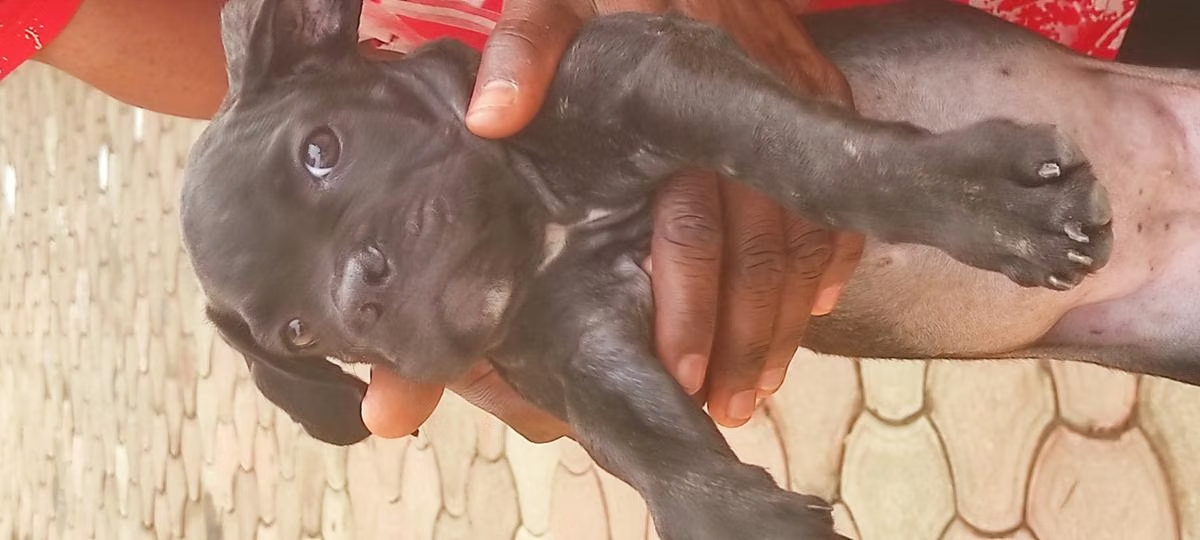
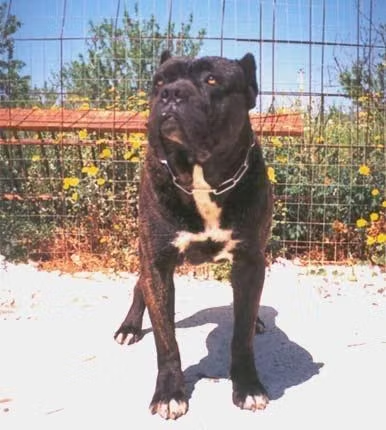
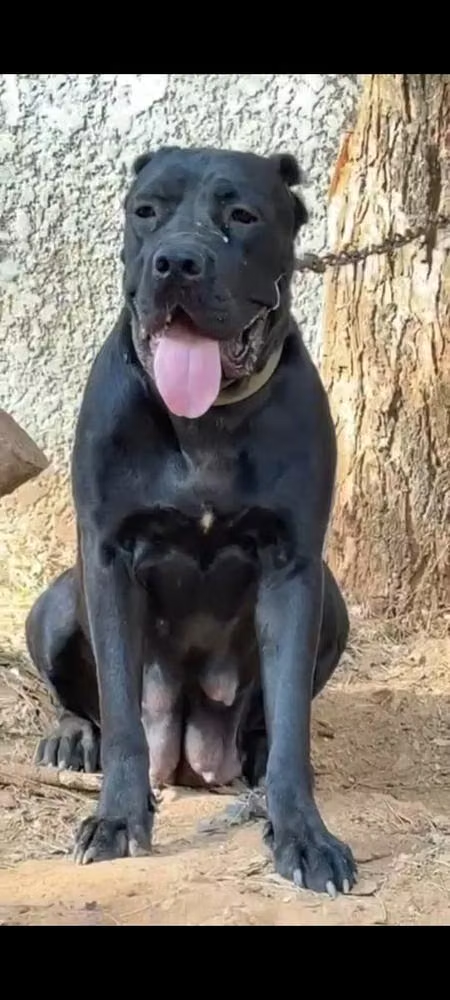




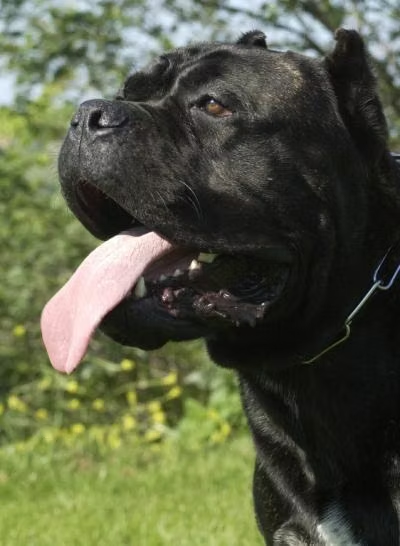
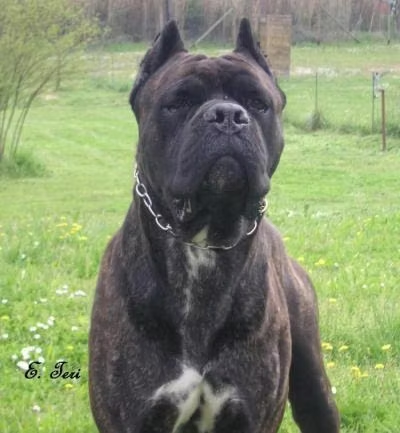

About the Cane Corso
The Cane Corso is a large Italian mastiff bred as a guardian and working dog, known for a powerful build and strong attachment to its family.
The Cane Corso is a large working dog from Italy, one of several mastiff types developed on the Italian peninsula. Males typically stand 25 to 27.5 inches at the shoulder and weigh roughly 100 to 110 pounds, with females somewhat smaller. The breed has a muscular frame, a broad head, and a short, dense coat.
The name comes from the Latin word cohors, meaning guardian or protector. For centuries the breed worked on farms and estates, where it guarded property and livestock and assisted with handling larger animals. That history shows in the modern dog: confident, watchful, and closely bonded to the people it lives with.
A Cane Corso is calm and steady at home but alert to anything out of the ordinary. It is intelligent and trainable, though its size and protective instinct mean it needs an owner who can provide consistent structure and early socialization.
| Attribute | Detail |
|---|---|
| Origin | Italy |
| Size | Large (100 to 110 lb for males) |
| Lifespan | 9 to 12 years |
| Group / role | Working dog, guardian |
| Good with | Its own family and, with early socialization, children; supervision needed with strangers and unfamiliar dogs |
Who it suits
The Cane Corso fits an experienced owner who can commit to daily exercise, ongoing training, and steady leadership. It does best in a home with secure fencing and enough space for a large dog to move. It is less suited to first-time owners or households that cannot supervise interactions with visitors and other animals.
History and origins
The Cane Corso descends from Roman war and working dogs of Italy and was revived from near disappearance by Italian breeders in the late twentieth century.
The Cane Corso traces back to the working mastiffs of ancient Italy. These dogs are generally linked to the canis pugnax used by the Roman military and to the broader family of mastiff types that spread across the Mediterranean. After the Roman period the dogs were adapted to rural life, where they guarded farms, drove livestock, and helped hunt large game such as wild boar.
For centuries the breed remained a regional working animal, most common in southern Italy, particularly Puglia and the surrounding areas. Its survival depended on its usefulness on farms rather than on any formal registry, so it developed as a functional guardian rather than a show breed.
Mechanized agriculture and the disruption of the twentieth century reduced the need for farm guardians, and the Cane Corso declined sharply. By the 1970s the breed was close to disappearing. A group of Italian enthusiasts, including breeders associated with Giovanni Bonatti and the Society Amorati Cane Corso founded in 1983, located surviving dogs and began an organized recovery effort.
The breed was recognized by the Italian kennel club ENCI in 1994 and by the Federation Cynologique Internationale in 2007. The American Kennel Club recognized the Cane Corso in 2010. From a near-extinct farm dog it has become an established breed kept both for guarding and as a companion.
Appearance and breed standard
The Cane Corso is a large, muscular mastiff with a broad head, short dense coat, and colors ranging from black and fawn to brindle and gray.
The Cane Corso is a large, athletic mastiff built for strength rather than bulk. The body is slightly longer than it is tall, with heavy bone, a deep chest, and visible muscle. The head is broad with a pronounced stop, and the muzzle is wide and roughly square. The expression is alert and serious.
Ears are naturally drop ears that fall close to the cheeks. In some regions ears have traditionally been cropped, though this practice is restricted or banned in a number of countries. The tail is set high and is sometimes docked where law allows.
| Trait | Standard |
|---|---|
| Height | Males 25 to 27.5 in; females 23.5 to 26 in at the shoulder |
| Weight | Roughly 100 to 110 lb (males); 88 to 99 lb (females) |
| Coat | Short, dense, stiff, with a light undercoat |
| Colors | Black, fawn, red, gray (blue), and brindle variants |
| Eyes | Medium, oval, dark preferred; shade varies with coat color |
Coat and colors
The coat is short and dense and lies close to the body, with a light undercoat that thickens in cooler weather. Accepted colors include black, various shades of fawn and red, and gray, often called blue. Brindle patterns appear over fawn or gray bases. Fawn and red dogs usually have a dark mask on the muzzle. Small white markings on the chest, throat, toes, or chin are common and generally accepted.
Temperament and behavior
The Cane Corso is loyal, confident, and protective, calm with its family but naturally reserved with strangers and in need of early socialization.
The Cane Corso is devoted to its family and forms a close bond with the people it lives with. Inside the home it is usually calm and quiet, content to stay near its owners. It is highly attentive and tends to keep watch over the household without needing to be told.
With strangers the breed is naturally reserved and watchful. It does not warm up quickly to people it does not know, which makes early and ongoing socialization important so that it can tell a normal visitor from a genuine threat. Around children in its own family it can be gentle and patient, though its size means interactions with young children should be supervised.
With other dogs and animals the Cane Corso can be territorial, and some individuals show same-sex aggression. Raising it alongside other pets and managing introductions carefully reduces conflict. This is a confident, strong-willed breed that needs an owner who sets clear and consistent boundaries.
| Trait | Rating |
|---|---|
| Affection (with family) | 5 |
| Energy | 3 |
| Trainability | 4 |
| Vocalness | 2 |
| Shedding | 3 |
Care and grooming
The Cane Corso needs daily exercise and consistent handling, but its short coat keeps grooming simple, with weekly brushing and routine maintenance.
Grooming
- Brush the short coat once a week with a rubber curry or bristle brush; brush more often during seasonal shedding.
- Bathe every one to two months, or when the dog is dirty.
- Trim nails every three to four weeks.
- Check and clean the ears regularly, especially in dogs with drop ears, to reduce the risk of infection.
- Brush the teeth several times a week.
Exercise
- Provide at least an hour of activity each day, split across walks and play.
- Include structured outlets such as obedience work, scent games, or controlled fetch.
- Use a securely fenced area for off-lead time; this is a large, powerful dog that should not roam.
- Avoid hard, repetitive exercise on growing puppies to protect developing joints.
Environment
The Cane Corso suits a home with secure fencing and room to move. It tolerates moderate climates but the short coat offers limited protection in cold weather and the heavy build makes it prone to overheating, so monitor it in heat. It is closely bonded to its people and does not do well left alone for long stretches.
Nutrition and feeding
The Cane Corso needs a complete diet suited to large breeds, fed in measured meals to support muscle without encouraging excess weight or rapid growth.
Feed a complete, balanced diet formulated for large or giant breeds. Adults generally do well on roughly 4 to 8 cups of quality dry food per day, divided into two meals, with the exact amount depending on age, weight, and activity level. Splitting the daily ration into two meals rather than one large meal is often recommended for deep-chested breeds to help reduce bloat risk.
Puppies should be fed a large-breed puppy formula that supports slow, steady growth. Feeding for rapid growth can strain developing joints and is best avoided. Keep fresh water available at all times, and measure food rather than free-feeding to maintain a lean body condition.
| Life stage | Amount per day | Meals |
|---|---|---|
| Puppy (2 to 6 months) | Per large-breed puppy formula label | 3 to 4 |
| Adolescent (6 to 18 months) | 3 to 6 cups | 2 to 3 |
| Adult | 4 to 8 cups | 2 |
| Senior | Adjusted down for activity | 2 |
Treats and supplements
Keep treats to about ten percent of daily calories to avoid weight gain in this large breed. Some owners use joint supplements such as glucosamine and chondroitin given the breed's tendency toward hip and elbow issues, but introduce any supplement only after consulting a veterinarian.
Health and common conditions
The Cane Corso is generally robust with a 9 to 12 year lifespan, but as a large mastiff it is prone to hip dysplasia, bloat, and certain joint and eye conditions.
The Cane Corso is generally a sound breed, but like most large mastiffs it has a relatively short lifespan of about 9 to 12 years and carries several breed-related health risks. Responsible breeders screen their stock for orthopedic and other heritable conditions, and prospective owners should ask to see health-test results for the parents.
| Condition | Signs | Note |
|---|---|---|
| Hip and elbow dysplasia | Stiffness, limping, reluctance to rise | Confirmed by X-ray; screen breeding stock |
| Gastric dilatation-volvulus (bloat) | Swollen abdomen, retching, restlessness | A medical emergency; act immediately |
| Eyelid disorders (entropion, ectropion, cherry eye) | Irritation, discharge, visible third-eyelid gland | May need surgical correction |
| Heart disease | Tiring easily, coughing, weakness | Detected on veterinary exam |
| Demodectic mange | Patchy hair loss, skin irritation | More common in young dogs |
Preventive care
- Keep vaccinations and parasite control up to date.
- Schedule annual veterinary exams, moving to twice yearly for seniors.
- Maintain a lean weight to reduce strain on joints.
- Feed in measured meals and avoid heavy exercise right after eating to lower bloat risk.
- Buy from breeders who screen for hip, elbow, heart, and eye conditions.
Training
The Cane Corso is intelligent and trainable but strong-willed, so it responds best to consistent, reward-based training started early.
The Cane Corso is intelligent and capable of learning quickly, but it is also independent and confident, so it needs an owner who trains with consistency and clear expectations. It looks for steady leadership and can become difficult to manage if rules are inconsistent. Because of its size and protective nature, training and socialization should begin in puppyhood and continue through adulthood.
Expose the dog early to a wide range of people, places, and other animals so it learns to stay calm in new situations. Keep sessions short and focused, and build reliable responses to basic cues before moving on to more advanced work.
Basics
- Establish a name response and reliable recall.
- Teach sit, down, and stay as foundation cues.
- Train loose-lead walking early, before the dog reaches full weight.
- Practice calm greetings so the dog learns to settle around visitors.
- Add structured tasks or obedience work to keep the mind occupied.
Breeding
Cane Corso breeding centers on health-tested parents, a roughly nine-week gestation, and litters that average around six to eight puppies.
Cane Corsos generally reach physical and behavioral maturity later than smaller breeds, and many breeders wait until a dog is around two years old before breeding so that health screening, including hip and elbow evaluation, can be completed. Both parents should be tested for the breed's known heritable conditions before any mating.
Gestation lasts about 63 days, similar to other dogs. Litters are commonly in the range of six to eight puppies, though larger litters occur. Because the breed is large and the puppies grow quickly, the dam needs good nutrition through pregnancy and nursing, and the breeder should be prepared to assist at whelping.
Early handling and socialization of the puppies is important for a guardian breed. Well-run breeding programs begin gentle exposure to people, sounds, and surfaces in the first weeks and place puppies in homes prepared for a large, protective dog.
| Metric | Value |
|---|---|
| Breeding maturity | Around 2 years (after health testing) |
| Gestation | Approximately 63 days |
| Average litter size | 6 to 8 puppies |
| Weaning | Around 6 to 8 weeks |
| Recommended health screening | Hips, elbows, heart, eyes |
Registering your Cane Corso and its microchip
Register your Cane Corso free for life with United Pet Club, and put its microchip number on a record American shelters can actually find.
How to register a Cane Corso in the United States
Start with the profile. Add your Cane Corso's name, birth date, and a clear photo, attach your phone number and email, and save. That is the whole job, and it costs nothing for life. Dog registration works with or without a microchip, so there is no reason to wait for a vet visit.
Chipped already? The implant is half the job. Until the 15-digit number sits in a registry with your name beside it, a scanner reads digits that lead nowhere. Microchip registration is free for life at United Pet Club, takes any manufacturer's chip, and keeps the record searchable through the AAHA lookup shelters rely on. Sign up free, and both records are done tonight.
How do I register my Cane Corso in the United States?
Open a free United Pet Club account, enter your Cane Corso's name, birth date, and a photo, and save. The profile is free for life, works with or without a microchip, and you can attach a chip number later.
How do I register my Cane Corso's microchip?
Type the 15-digit chip number into your free United Pet Club account together with your current phone number and address. The lifetime plan is free, covers every future update, and accepts any chip brand a US vet implants.
Does my Cane Corso have to be microchipped in the United States?
No federal law says a Cane Corso must carry a chip, but plenty of city and county licensing rules do, and shelters routinely chip before adoption. What the law never does is register the chip for you; that part is yours.
How much does it cost to register a Cane Corso?
Nothing. United Pet Club's lifetime plan covers the dog's profile, the microchip registration, and every update at no charge, with no renewal fees.
Frequently asked questions
Common questions about the Cane Corso, covering size, temperament, care needs, lifespan, suitability, and availability.
How big does a Cane Corso get?
It is a large breed. Males usually stand 25 to 27.5 inches at the shoulder and weigh about 100 to 110 pounds, with females somewhat smaller at roughly 88 to 99 pounds.
Is the Cane Corso a good family dog?
It can be devoted and gentle with its own family, including children, when raised and socialized properly. Its size and protective nature mean interactions with young children and visitors should be supervised.
Is the Cane Corso hard to care for?
Grooming is simple thanks to the short coat, but the breed needs daily exercise, consistent training, and early socialization. It is better suited to experienced owners than to first-time dog owners.
How long does a Cane Corso live?
The typical lifespan is about 9 to 12 years, which is normal for a large mastiff breed.
Does the Cane Corso get along with other pets?
It can be territorial and some individuals show same-sex aggression. Early socialization and careful introductions help, but interactions with other animals should be managed.
Are Cane Corsos easy to find?
The breed is established and recognized by major kennel clubs, so puppies are available from breeders in many countries. Choose a breeder who health-tests the parents for hip, elbow, heart, and eye conditions.
How much exercise does a Cane Corso need?
Plan on at least an hour of activity a day, combining walks with play and training. Mental work such as obedience or scent games helps keep this intelligent breed settled at home.
From the community
Ask about the Cane CorsoNo questions about the Cane Corso yet. Be the first to ask.
Browse Dog breeds