


Boston Terrier
Also known as American Gentleman and Bostie
The Boston Terrier is a friendly, dapper American breed known as the 'American Gentleman' for its tuxedo coat and amiable, playful nature.
- Size
- Small
- Lifespan
- 11–13 years
- Origin
- United States
- Temperament
- Friendly
- Standard colors
- Black, White, Seal, and Mahogany
- Popularity
- No. 23 of 201
Characteristics
Coat and grooming
How the Boston Terrier coat is built, and what that means when you groom it.
- Coat layers
- Single coat
- Coat texture
- Smooth
- Coat length
- Short
- Shedding
- Moderate shedding
Registry Recognition
Fédération Cynologique Internationale
- Companion and Toy Dogs
American Kennel Club
- Toy Group
Canadian Kennel Club
- Toy Group
United Pet Club
- Companion and Toy DogsPrimary
Boston Terrier colors and patterns
What each club's breed standard says about every Boston Terrier color and pattern. Point at a ruling to see the club's own wording.
Breed standards describe the Boston Terrier in Black, White, Seal, and Mahogany. Standard patterns: Bicolor, Brindle, and Reverse brindle.
| Color or pattern | FCI | AKC | UKC | KC | KUSA |
|---|---|---|---|---|---|
| Black | Standard (“black with white markings”) | Standard (“Black & White”) | Standard (“Black, with white markings”) | Standard (“black or seal with white markings acceptable”) | Standard (“black with white markings”) |
| White | Standard (“white markings”) | Standard (“white markings”) | Standard (“white markings”) | Standard (“white markings”) | Standard (“white markings”) |
| Seal | Standard (“seal”) | Standard (“Seal & White”) | Standard (“Seal”) | Standard (“black or seal with white markings acceptable”) | Standard (“seal”) |
| Mahogany | Standard (“Brindle”) | Standard (“Brindle & White”) | Standard (“Brindle”) | Standard (“Mahogany Brindle & White”) | Standard (“Brindle”) |
| Albino | Not recognized | Disqualifying | Disqualifying (“albinism”) | Not recognized | Not recognized |
| Blue | Disqualifying (“Grey or liver colours”) | Disqualifying | Disqualifying (“gray or liver colors”) | Not recognized (“Blue & White”) | Disqualifying (“Grey or liver colours”) |
| Lilac | Not recognized | Disqualifying | No ruling | Not recognized | Not recognized |
| Chocolate | Not recognized | Disqualifying | No ruling | Not recognized | Not recognized |
| Liver | Disqualifying (“Grey or liver colours”) | Disqualifying | Disqualifying (“gray or liver colors”) | Not recognized (“Red & White”) | Disqualifying (“Grey or liver colours”) |
| Red | Not recognized | Disqualifying | No ruling | Not recognized | Not recognized |
| Patterns | |||||
| Bicolor | Standard (“Brindle, seal or black with white markings”) | Standard (“Brindle, seal, or black with white markings”) | Standard (“Brindle, Seal, or Black, with white markings”) | Standard (“with white markings”) | Standard (“Brindle, seal or black with white markings”) |
| Brindle | Standard (“Brindle is preferred”) | Standard (“Brindle & White”) | Standard (“Brindle is preferred”) | Standard (“Brindle: being a mixture of any shade of brown and black”) | Standard (“Brindle is preferred”) |
| Reverse brindle | Standard (“Brindle is preferred”) | Standard (“Brindle & White”) | Standard (“Brindle is preferred”) | Standard (“Brindle: being a mixture of any shade of brown and black”) | Standard (“Brindle is preferred”) |
| Solid | Disqualifying (“Solid black, solid brindle, or solid seal without required white markings”) | Disqualifying (“Solid black, solid brindle or solid seal without required white markings”) | Disqualifying (“Solid seal, black or brindle without the required white markings”) | Not recognized | Disqualifying (“Solid black, solid brindle, or solid seal without required white markings”) |
| Merle | No ruling | No ruling | No ruling | Not recognized | No ruling |
| Double merle | No ruling | No ruling | No ruling | Not recognized | No ruling |


| Color or pattern | FCI | AKC | UKC | KC | KUSA |
|---|---|---|---|---|---|
| Dark brown | Standard (“dark in colour”) | Standard (“dark in color”) | Standard (“dark in color”) | Standard (“dark in colour”) | Standard (“dark in colour”) |
| Blue | Disqualifying (“Eyes blue in colour or any trace of blue”) | Disqualifying (“Eyes blue in color or any trace of blue”) | Disqualifying (“Any trace of blue in eyes”) | No ruling | Disqualifying (“Eyes blue in colour or any trace of blue”) |
| Patterns | |||||
| Sectoral | Disqualifying (“any trace of blue”) | Disqualifying (“any trace of blue”) | Disqualifying (“Any trace of blue in eyes”) | No ruling | Disqualifying (“any trace of blue”) |

| Color or pattern | FCI | AKC | UKC | KC | KUSA |
|---|---|---|---|---|---|
| Black | Standard (“Black and wide”) | Standard (“black and wide”) | Standard (“black and wide”) | Standard (“nose black”) | Standard (“Black and wide”) |
| Dudley | Disqualifying (“Dudley nose”) | Disqualifying (“Dudley nose”) | Disqualifying (“Dudley nose”) | No ruling | Disqualifying (“Dudley nose”) |
What the rulings mean
- Standard
- Described by the club's breed standard.
- Disqualifying
- The club's breed standard disqualifies an animal of this color or pattern.
- Not recognized
- The club does not accept this color or pattern for the breed.
Color changes
How a Boston Terrier's colors can change over its life.
Blackchanges toRust
Coat · With body condition · can change back
Blackchanges toGray
Coat · Progressive
Blackchanges toBrown
Coat · In the sun · can change back
Whitechanges toRoan
Coat · With age · from 2 weeks
Blackchanges toSnow nose
Nose · With the season · can change back
Blackchanges toPink
Nose · With the season · can change back


Sources
Each ruling comes from the club's published breed standard or color list.
Boston Terrier breed standard
What each club's standard asks of the Boston Terrier: size, build and forms. A club speaks only for itself, and a figure no club published is left out.
Measurements


Conformation
Muzzle length
Short
“Muzzle: Short, square, wide and deep”
Muzzle shape
Square
“Muzzle: Short, square, wide and deep”
Bite
Level bite
“The bite is even or sufficiently undershot to square the muzzle”
Bite
UndershotAlternate
“even or sufficiently undershot to square the muzzle”
Bite
Wry mouthFault
“SEVERE FAULTS: Wry mouth”
Eye shape
Round
“Wide apart, large, round and dark in colour”
Eye set
Wide-set
“Wide apart, large, round and dark in colour”
Ear carriage
Erect (prick)
“Small, carried erect, either natural or cropped”
Topline
Level
“Top line: Level”
Chest
Deep
“Chest: Deep with good width”
Feet
Cat foot
“Forefeet: Small, round and compact”
Feet
SplayedFault
“Splay feet”
Tail length
Short
“Set-on low, short, fine and tapering”
Tail set
Low
“TAIL: Set-on low, short, fine and tapering”
Tail carriage
Raised (gay)Fault
“Gaily carried tail”


Markings


Cropping, docking and other procedures
- Ear cropping: Alternate “carried erect, either natural or cropped”
- Tail docking: Disqualifying “Docked tail”
- Dewclaw removal: Alternate “The dewclaws may be removed”
Parts of the body


Health
Conditions recorded as more common in the Boston Terrier than in its species as a whole. A higher risk is not a diagnosis: many never develop any of them, and your vet can say which screening tests are worth doing.
Moderate risk
- Respiratory system
Brachycephalic obstructive airway syndrome
Also called BOAS
Moderate evidenceHereditaryInheritance: Polygenic
This content is for educational purposes and is not a substitute for professional veterinary advice. If you are worried about your pet, contact your veterinarian.
All health conditionsMeet some of our Boston Terrier
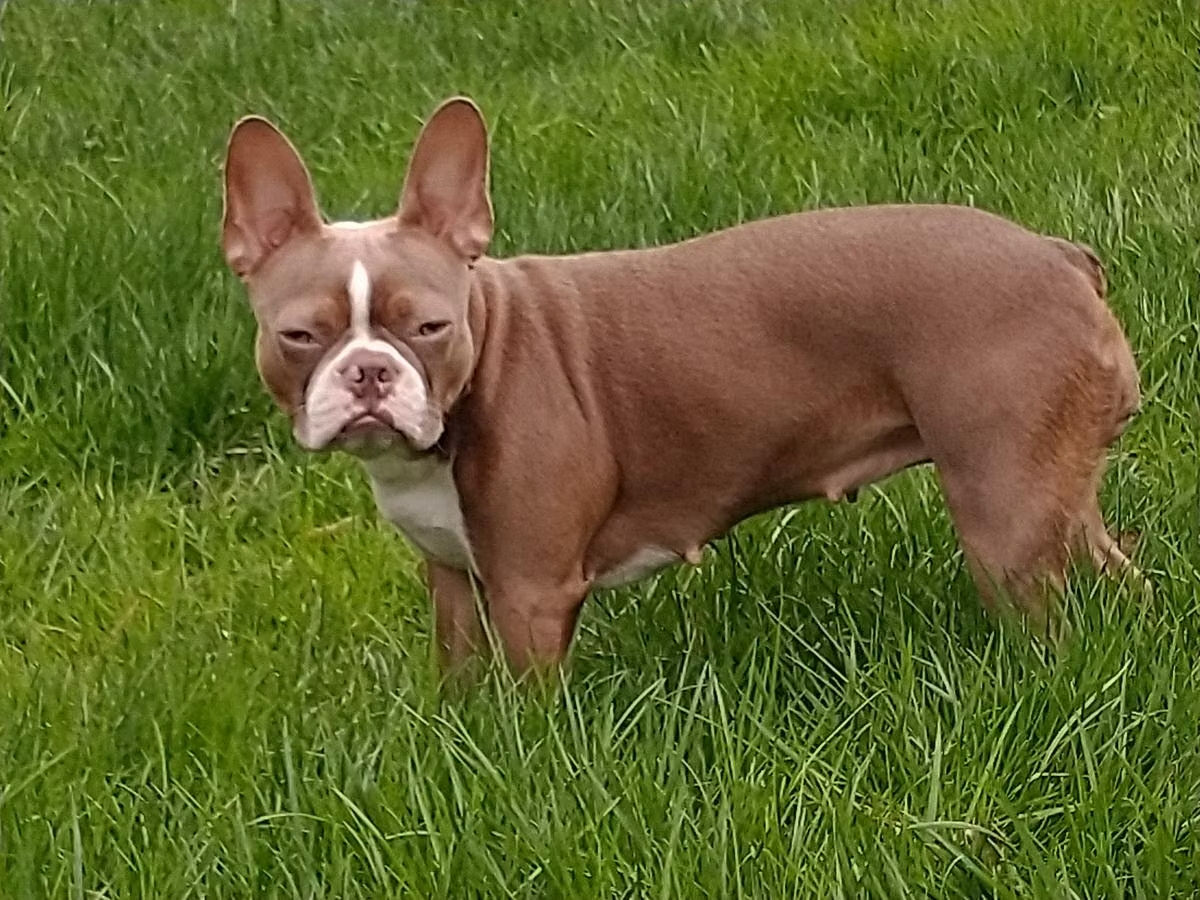
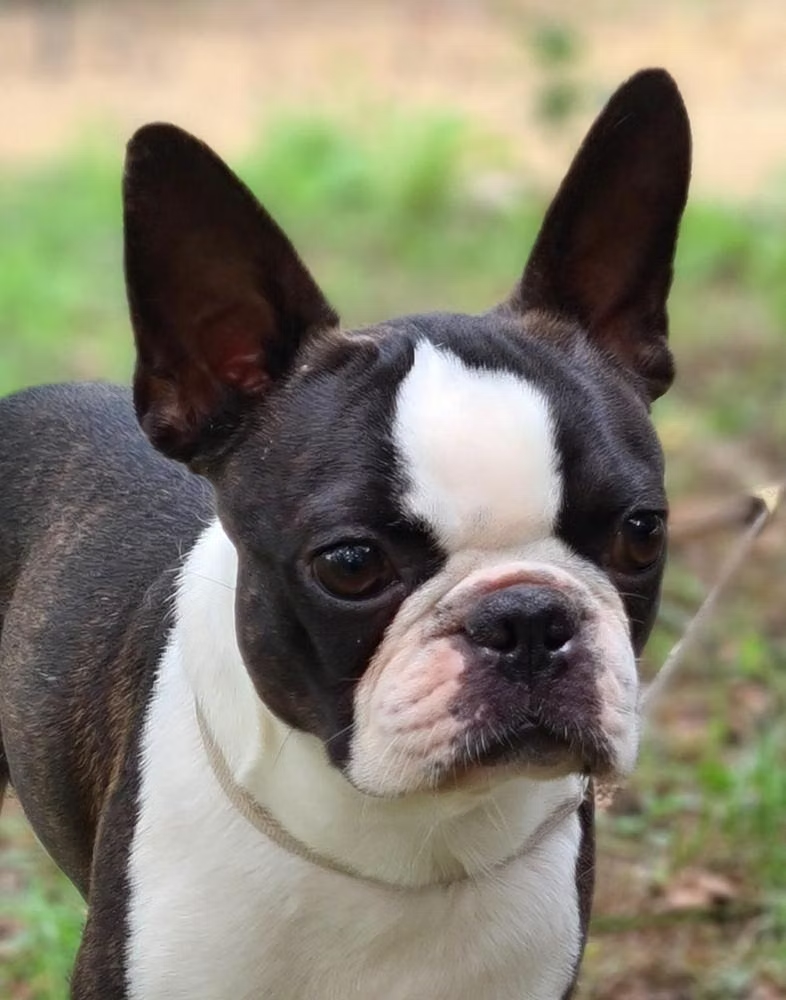
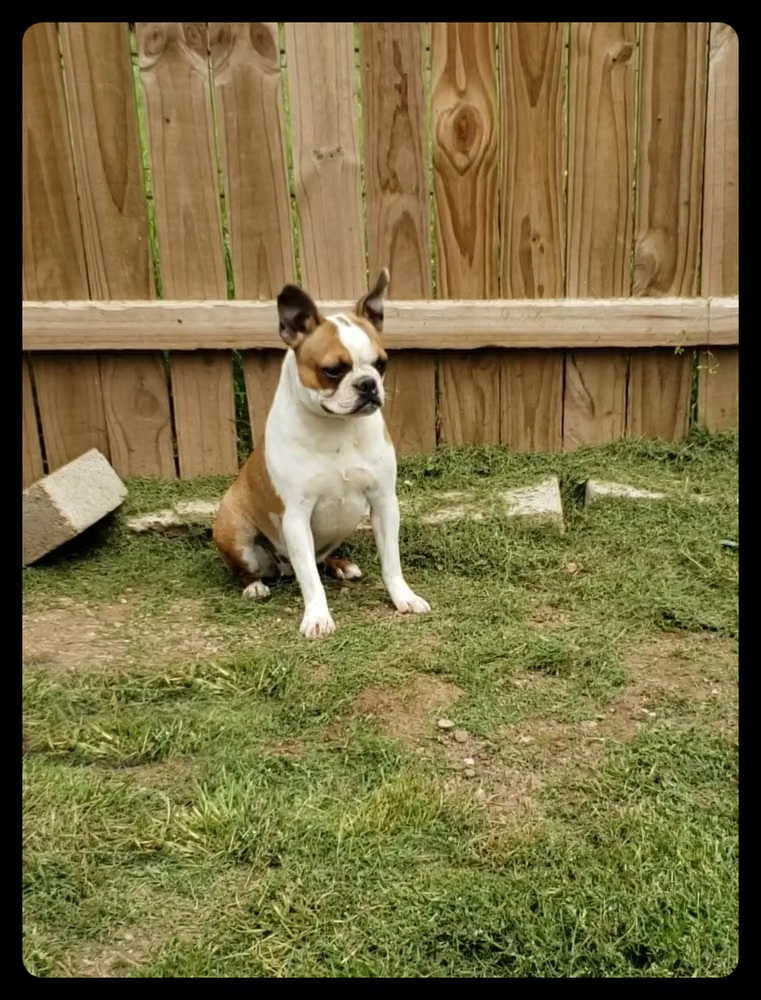
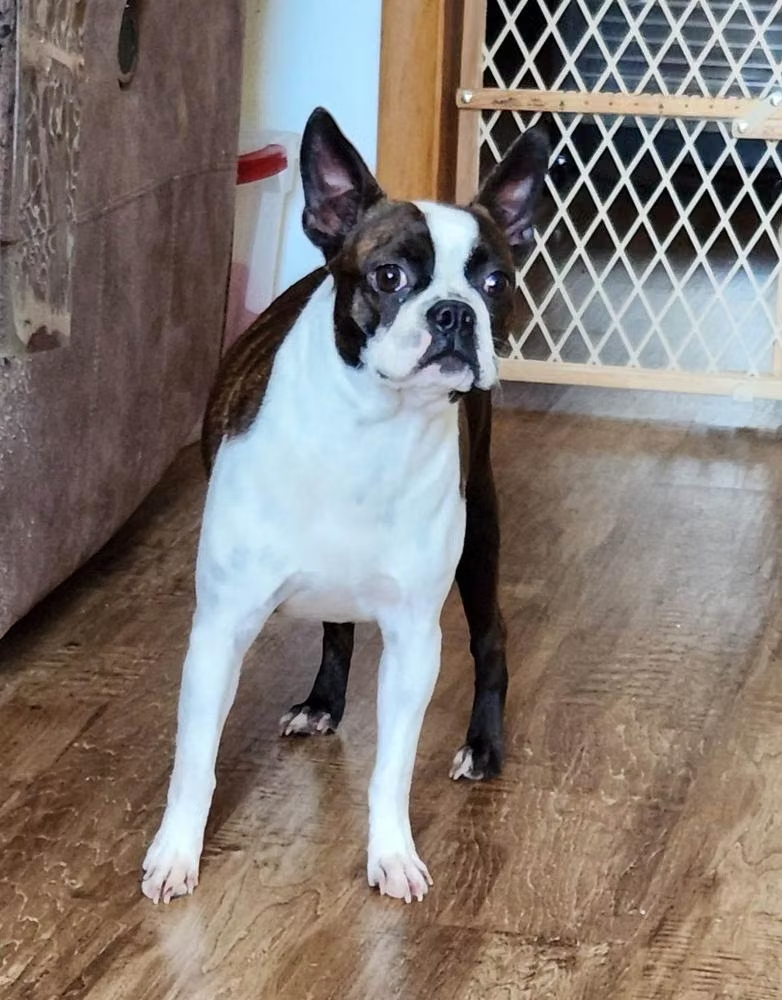
A few of the Boston Terrier profiles members have added to United Pet Club.




About the Boston Terrier
The Boston Terrier is a small, friendly American dog known as the 'American Gentleman' for its tuxedo-patterned coat and affectionate, playful nature.
The Boston Terrier is a small companion dog from the United States, easy to recognize by its short muzzle, large round eyes, and smooth coat marked like a dinner jacket. Adults typically stand 15 to 17 inches at the shoulder and weigh between 12 and 25 pounds. The breed is divided into weight classes, but in temperament the dogs are consistent: friendly, alert, and fond of human company.
The nickname 'American Gentleman' comes from the breed's tuxedo coloring and its generally well-mannered behavior. Boston Terriers were bred as companions rather than working dogs, and they remain happiest indoors near their people. They adapt well to apartments and houses alike, since their exercise needs are moderate and their bark is used in moderation by most individuals.
This is a people-focused breed. A Boston Terrier left alone for long stretches can become bored or anxious, so the dog suits households where someone is home often. The short face means the breed is sensitive to heat and hard exercise in warm weather, a point owners should plan around.
| Attribute | Detail |
|---|---|
| Origin | United States |
| Size | Small (12 to 25 lb) |
| Lifespan | 11 to 13 years |
| Group/role | Companion (non-sporting) |
| Good with | Families, children, other pets, seniors |
Who it suits
The Boston Terrier fits first-time owners, apartment dwellers, families with children, and older adults who want a small, affectionate dog without heavy grooming or exercise demands. It is less suited to people who are away from home all day or who want a dog for endurance sports in hot climates.
History and origin
The Boston Terrier was developed in Boston, Massachusetts in the late 1800s from crosses of the English Bulldog and the now-extinct white English Terrier.
The breed traces to Boston, Massachusetts, around 1870. A dog named Judge, often called Hooper's Judge, is recorded as the common ancestor. Judge was the result of a cross between an English Bulldog and a white English Terrier, a terrier type that no longer exists. He was brought to Boston and bred to a smaller female, beginning the line that local fanciers refined over the following decades.
Early dogs were heavier and more bull-and-terrier in build than the modern breed. Through the 1880s breeders in the Boston area selected for smaller size, a steadier temperament, and the distinctive marked coat. The dogs were first known by names such as Round Heads and Bull Terriers before the breed settled on the name tied to its home city.
The American Kennel Club recognized the Boston Terrier in 1893, making it one of the first breeds developed in the United States to gain recognition. The breed club organized in the same period to set a written standard, which steered the dogs away from the fighting backgrounds of their ancestors and toward the role of companion.
Through the early twentieth century the Boston Terrier became one of the most popular dogs in the country. It remains a recognized symbol of its origin and was named the official state dog of Massachusetts in 1979.
What does a Boston Terrier look like?
The Boston Terrier is a compact, square-built small dog with a short square muzzle, erect ears and a smooth coat in brindle, black or seal with white markings. Clubs cap its weight at about 25 pounds.
The Boston Terrier is a compact, square-built small dog with a short body, a level back and a naturally short, low-set tail. The head is square with a short, square muzzle, large round dark eyes set wide apart, and small erect ears. The short, smooth coat is brindle, black or seal with white markings, the "tuxedo" look. Clubs cap its weight at about 25 pounds.
The expression is open and attentive. The chest is deep, the feet are cat feet and the muzzle is short, no more than about one third of the skull length in every club's standard. Compare the clubs side by side.
Size and weight by club
The clubs give weight, not height, and they agree on the top end. Most dogs stand about 15 to 17 inches at the shoulder, which is a general description rather than any club's figure.
| Club | Weight |
|---|---|
| AKC | Weight classes; the heaviest is 20 lb and not to exceed 25 lb |
| UKC | Under 15 lb up to and including 25 lb |
| FCI | 20 lb and not to exceed 25 lb (9 to 11.35 kg) |
| The Kennel Club (UK) | Not exceeding 11.5 kg (25 lb) |
| CKC | Not exceeding 11.25 kg (25 lb) |
Head, body and tail
All the clubs want a level bite, with an undershot bite accepted but not preferred (Alternate). A wry mouth is a fault with the AKC, UKC and FCI. The topline is level, and a roach back or swayback is a fault with the AKC, CKC and UKC. The tail is short and low-set, straight or screw-shaped. A tail carried raised is a fault with all five clubs, and the UKC disqualifies a tailless dog. Prominent eyes are a fault with the UK club and CKC, and splayed feet are a fault with the FCI, AKC and CKC.
Cosmetic procedures are ruled on too. Ear cropping and dewclaw removal are Alternate, and the FCI, AKC, UKC and CKC all disqualify a docked tail.
Coat, colors and markings
The coat is single, short, smooth and fine, and it sheds moderately. Black, seal, mahogany, brindle and reverse brindle are Standard, and so are bicolor and white, always with white markings. The FCI, AKC, UKC, UK club and KUSA agree. The white markings are a blaze, a collar, a chest patch and socks: the blaze is Standard with the AKC, UK club, FCI and UKC, the collar with the UKC, AKC and UK club, the chest patch with the UK club and AKC, and socks with the AKC, UKC and UK club. Eyes are dark brown and the nose is black. See the colors dogs come in.
What the show standards penalize
A solid coat is disqualifying with the FCI, KUSA, AKC and UKC. Blue and liver coats are disqualifying with the FCI, AKC, UKC and KUSA, and the AKC also disqualifies red, chocolate and lilac. Albino is disqualifying with the AKC and UKC. Blue eyes, sectoral eyes and a dudley nose are disqualifying with the FCI, AKC, UKC and KUSA. These are show-ring judgements, not health verdicts.
What the Boston Terrier standard says, club by club
Weight for the Boston Terrier: AKC under 11.3 kg; CKC under 11.2 kg; FCI under 11.3 kg; KC under 11.5 kg; UKC under 11.3 kg.
Clubs set their own figures for the Boston Terrier. These come from each club's published standard: AKC, CKC, FCI, KC, UKC.
Size
- Weight: AKC under 11.3 kg; CKC under 11.2 kg; FCI under 11.3 kg; KC under 11.5 kg; UKC under 11.3 kg
- Height to length: KC 1
- Skull to muzzle: AKC over 3; CKC over 3; FCI over 3; KC over 3; UKC over 3
Build and forms
At least one club accepts each of these:
- Muzzle length: Short
- Muzzle shape: Square
- Bite: Level bite, Undershot
- Dentition: Full dentition
- Eye shape: Round
- Eye set: Wide-set
- Ear carriage: Erect (prick)
- Topline: Level
- Chest: Deep
- Hocks: Well let down
Forms the clubs penalize
A fault or a disqualification is a judgment under a show standard. It can affect placings and, at some clubs, registration.
- Disqualifying: Tail length: Tailless (UKC)
- Fault: Bite: Wry mouth (AKC, FCI, UKC); Eye set: Prominent (CKC, KC); Topline: Roach (arched) (AKC, CKC, UKC); Topline: Swayback (AKC, CKC, UKC); Feet: Splayed (AKC, CKC, FCI); Tail carriage: Raised (gay) (AKC, CKC, FCI, KC, UKC)
Cropping, docking and other procedures
- Ear cropping: Alternate (AKC, CKC, FCI, UKC)
- Tail docking: Disqualifying (AKC, CKC, FCI, UKC)
- Dewclaw removal: Alternate (AKC, FCI, UKC)
This is each club's stance in the show ring, not the law. The law on these procedures differs by country.
Markings
Each club's ruling on the breed's named marks:
- Blaze: Standard (AKC, FCI, KC, UKC)
- Collar: Standard (AKC, KC, UKC)
- Chest patch: Standard (AKC, KC)
- Socks: Standard (AKC, KC, UKC)
See every point side by side: compare the clubs.
Rulings come from each club's published breed standard, and clubs revise their standards. Before a show or a registration, check the current text with the club.
What does each club give for Weight in the Boston Terrier?
Weight: AKC under 11.3 kg; CKC under 11.2 kg; FCI under 11.3 kg; KC under 11.5 kg; UKC under 11.3 kg.
Which forms do clubs penalize in the Boston Terrier?
Disqualifying: Tail length: Tailless (UKC). Fault: Bite: Wry mouth (AKC, FCI, UKC); Eye set: Prominent (CKC, KC); Topline: Roach (arched) (AKC, CKC, UKC); Topline: Swayback (AKC, CKC, UKC); Feet: Splayed (AKC, CKC, FCI); Tail carriage: Raised (gay) (AKC, CKC, FCI, KC, UKC).
Which Boston Terrier colors the clubs accept
Every club we track accepts Black, White, Seal, Mahogany for the Boston Terrier.
On the Boston Terrier, every club we track agrees on Black, White, Seal, Mahogany. Clubs compared: AKC, FCI, KC, KUSA, UKC.
Patterns listed as standard for the Boston Terrier: Bicolor, Brindle, Reverse brindle.
Colors penalized in the show ring
A fault or a disqualification is a judgment under a show standard. It can affect placings and, at some clubs, registration.
- Disqualifying: Solid (AKC, FCI, KUSA, UKC), Albino (AKC, UKC), Blue (AKC, FCI, KUSA, UKC), Lilac (AKC), Chocolate (AKC), Liver (AKC, FCI, KUSA, UKC), Red (AKC)
Beyond the main color
Standards rule on more than the main color. These are listed as standard:
- Eyes: Dark brown
- Nose: Black
Rulings come from each club's published breed standard, and clubs revise their standards. Before a show or a registration, check the current text with the club.
Which Boston Terrier colors do all the clubs accept?
All of these clubs accept Black, White, Seal, Mahogany: AKC, FCI, KC, KUSA, UKC.
Which Boston Terrier colors are faults or disqualifications?
Disqualifying: Solid (AKC, FCI, KUSA, UKC), Albino (AKC, UKC), Blue (AKC, FCI, KUSA, UKC), Lilac (AKC), Chocolate (AKC), Liver (AKC, FCI, KUSA, UKC), Red (AKC).
Temperament and personality
Boston Terriers are friendly, affectionate, and playful companions that bond closely with their families and usually get along well with children, strangers, and other pets.
The Boston Terrier is a steady, good-natured companion. The breed forms strong attachments to its household and likes to stay near its people, often following them from room to room. With children the dog is patient and playful, and its small but solid build holds up to ordinary family activity better than more fragile toy breeds.
Toward strangers most Boston Terriers are friendly rather than wary. They will alert with a bark when someone arrives, but they are not strong guard dogs and usually warm to visitors quickly. With other dogs and with cats the breed is generally sociable, especially when raised together or introduced young.
The breed is alert and intelligent, with a streak of clownish humor that owners often describe. Boredom and long isolation are the main triggers for problem behavior, since these dogs are bred for company and do poorly when left alone for extended periods. Many individuals are quiet by nature and bark only with reason.
| Trait | Rating |
|---|---|
| Affection | 5 |
| Energy | 3 |
| Trainability | 4 |
| Vocalness | 2 |
| Shedding | 2 |
Care and grooming
The Boston Terrier needs little grooming and moderate daily exercise, but its short face requires care to avoid overheating and to keep facial folds clean.
The Boston Terrier is a low-maintenance breed in most respects. Its short coat and indoor-companion temperament make daily care simple, with the main attention going to the eyes, face, and heat tolerance.
Grooming
- Brush the short coat weekly with a soft brush or grooming mitt to remove loose hair.
- Bathe every few weeks or when the dog is dirty.
- Wipe any facial folds and around the eyes to keep them clean and dry.
- Check the large eyes regularly for redness or debris, since prominent eyes are prone to irritation.
- Trim nails every few weeks and brush teeth several times a week.
Exercise
- Provide one or two short walks a day plus indoor play.
- Aim for roughly 30 to 60 minutes of total activity, split into easy sessions.
- Use games and short training bouts to work the dog's mind.
- Avoid hard exertion in heat or humidity because the short muzzle limits cooling.
Environment
The Boston Terrier is well suited to apartments and houses and prefers to live indoors with its family. It is sensitive to temperature extremes at both ends: the short coat offers little protection from cold, and the flat face raises the risk of overheating in warm weather. Keep the dog in climate-controlled space during very hot or very cold conditions.
Grooming a Boston Terrier
The Boston Terrier coat: Single coat, Smooth, Short, Moderate shedding.
Most of what a Boston Terrier needs from grooming follows from its coat.
- Coat layers: Single coat
- Coat texture: Smooth
- Coat length: Short
- Shedding: Moderate shedding
What this coat asks of you
- A single coat has no dense undercoat, so there is less to brush out and less insulation against the cold.
- A smooth coat lies flat and is the easiest kind to keep. A soft brush or a grooming mitt lifts dust and loose hair.
- Short hair rarely tangles but it still sheds, so regular brushing keeps the loose hair down.
- Moderate shedding goes on through the year, and regular brushing catches most of it before it lands on the furniture.
A groomer who knows the breed can adapt all of this to the individual animal. Sore skin, mats pressed against the skin or a sudden change in the coat are worth showing to a vet.
What kind of coat does a Boston Terrier have?
On our records: Coat layers: Single coat; Coat texture: Smooth; Coat length: Short; Shedding: Moderate shedding.
How much does a Boston Terrier shed?
Moderate shedding goes on through the year, and regular brushing catches most of it before it lands on the furniture.
Nutrition and feeding
Boston Terriers do well on a complete diet for small breeds fed in measured portions, since the breed gains weight easily and extra pounds strain its breathing.
A Boston Terrier needs a complete and balanced dog food appropriate to its life stage. Because the breed is small and prone to weight gain, portion control matters more than the brand. Excess weight adds load to a respiratory system already limited by the short muzzle, so keeping the dog lean is one of the most useful things an owner can do for its health. Daily amounts depend on the dog's weight, age, and activity, so use the figures below as a starting point and adjust to keep ribs easily felt.
| Life stage | Amount per day | Meals |
|---|---|---|
| Puppy (2 to 6 months) | Per product label, by weight | 3 to 4 |
| Puppy (6 to 12 months) | Per product label, by weight | 2 to 3 |
| Adult | About 1 to 1.75 cups | 2 |
| Senior | Adjusted down for lower activity | 2 |
Treats and supplements
Keep treats to no more than about 10 percent of daily calories and count them toward the daily total. A dog on a complete commercial diet usually needs no supplements; add them only on a veterinarian's advice. Provide fresh water at all times, and divide food into measured meals rather than free-feeding to manage weight.
Health and lifespan
Boston Terriers live about 11 to 13 years and are generally healthy, though the short face and prominent eyes bring breed-specific risks owners should monitor.
The Boston Terrier has a typical lifespan of 11 to 13 years. It is a robust small dog overall, but its build carries a few predictable concerns. The flat face places it among the brachycephalic breeds, which affects breathing and heat tolerance, and the large prominent eyes are exposed to injury and disease. Responsible breeders screen for known issues, and routine veterinary care catches most problems early.
| Condition | Signs | Note |
|---|---|---|
| Brachycephalic airway issues | Noisy or labored breathing, snoring, heat intolerance | Keep the dog lean and avoid heat and overexertion |
| Eye problems (corneal ulcers, cataracts) | Cloudiness, redness, squinting, discharge | Prominent eyes are easily injured; check often |
| Patellar luxation | Skipping steps, intermittent hind-leg lameness | Ranges from mild to surgical |
| Allergies and skin sensitivity | Itching, ear infections, paw licking | Manageable with veterinary guidance |
| Deafness | Poor response to sound, often in dogs with much white | Tested by BAER screening in pups |
Preventive care
- Keep current on vaccinations and parasite control.
- Schedule annual veterinary exams, moving to twice yearly for seniors.
- Maintain a lean body weight to protect breathing and joints.
- Brush teeth regularly, since small breeds are prone to dental disease.
- Choose breeding stock with eye, knee, and hearing screening.
Training and socialization
Boston Terriers are intelligent and eager to please, which makes them responsive to consistent, reward-based training and easy to socialize when started young.
The Boston Terrier is bright and attentive, and it wants to be with its owner, which gives training a natural advantage. The breed responds well to short, upbeat sessions and to food and praise as rewards. A mild stubborn streak appears in some dogs, but harsh correction backfires and tends to make a sensitive Boston withdraw. Early socialization with people, places, and other animals helps the breed grow into the friendly adult the standard describes. House-training can take patience, so keep a steady schedule from the start.
Basics
- Start socialization in puppyhood with calm exposure to new people, dogs, and settings.
- Teach name response and a reliable recall first.
- Build the core cues: sit, down, stay, and leave it.
- Set a consistent house-training routine with frequent outings and praise for success.
- Practice short crate sessions to build comfort with alone time and reduce separation anxiety.
- Keep sessions short, around 5 to 10 minutes, and end on a win.
Breeding
Boston Terriers are difficult to breed because their build often requires assisted mating and caesarean delivery, and litters are small, so breeding is best left to experienced, health-testing breeders.
Breeding Boston Terriers calls for care and experience. Females usually reach sexual maturity by around 6 to 12 months, but responsible breeders wait until full maturity, generally about two years, and confirm health clearances before breeding. The breed's narrow hips and the large heads of the puppies make natural mating and natural birth difficult, so artificial insemination is common and many litters are delivered by planned caesarean section.
Gestation runs about 63 days, as in other dogs. Litters are small, often 1 to 4 puppies, which reflects the breed's body type. Because whelping can be high-risk, breeders typically work closely with a veterinarian and plan for surgical delivery.
Newborn puppies are raised with the same attention any breed needs: warmth, frequent nursing, and gradual weaning from about three to four weeks. Early gentle handling and exposure to household sounds support the breed's friendly temperament. Responsible breeders screen parents for eye, knee, and hearing problems and place puppies after they are weaned and started on socialization.
| Metric | Value |
|---|---|
| Sexual maturity | About 6 to 12 months |
| Recommended breeding age | About 2 years, after health clearances |
| Gestation | About 63 days |
| Typical litter size | 1 to 4 puppies |
| Delivery | Often caesarean section |
| Weaning | About 3 to 4 weeks onward |
Registering your Boston Terrier and its microchip
Register your Boston Terrier free for life with United Pet Club, and put its microchip number on a record American shelters can actually find.
How to register a Boston Terrier in the United States
Start with the profile. Add your Boston Terrier's name, birth date, and a clear photo, attach your phone number and email, and save. That is the whole job, and it costs nothing for life. Dog registration works with or without a microchip, so there is no reason to wait for a vet visit.
The microchip needs its own registration. A vet implants the chip, but the number stays anonymous until you file it, and an anonymous chip cannot point anyone at you. Register the microchip with United Pet Club on the free lifetime plan: every brand a US vet implants qualifies, updates cost nothing after a move, and the record shows up in the AAHA universal lookup American shelters check first. Create your free account and finish both steps in one sitting.
How do I register my Boston Terrier in the United States?
Open a free United Pet Club account, enter your Boston Terrier's name, birth date, and a photo, and save. The profile is free for life, works with or without a microchip, and you can attach a chip number later.
How do I register my Boston Terrier's microchip?
Type the 15-digit chip number into your free United Pet Club account together with your current phone number and address. The lifetime plan is free, covers every future update, and accepts any chip brand a US vet implants.
Does my Boston Terrier have to be microchipped in the United States?
No federal law says a Boston Terrier must carry a chip, but plenty of city and county licensing rules do, and shelters routinely chip before adoption. What the law never does is register the chip for you; that part is yours.
How much does it cost to register a Boston Terrier?
Nothing. United Pet Club's lifetime plan covers the dog's profile, the microchip registration, and every update at no charge, with no renewal fees.
Boston Terrier questions: size, colors, show rules and care
How much a Boston Terrier weighs, which colors and markings the clubs accept, what disqualifies one, and how it handles heat, apartments and family life.
How big does a Boston Terrier get?
It is a small breed. The AKC, UKC, UK Kennel Club and CKC all put the upper weight at 25 pounds (11.5 kg for the UK club, 11.25 kg for the CKC). Most dogs stand about 15 to 17 inches at the shoulder.
Do the kennel clubs agree on the Boston Terrier's size?
Yes on weight. All five clubs set a ceiling of about 25 pounds. The AKC and FCI describe a top class of 20 to 25 pounds, and the UKC allows dogs under 15 pounds up to 25. Clubs give no height.
What colors does a Boston Terrier come in?
Brindle, black or seal, each with white markings. The FCI, AKC, UKC, UK club and KUSA all list brindle, black, seal and mahogany as Standard. Seal looks black but shows a red cast in sunlight.
What markings are allowed on a Boston Terrier?
White markings are expected: a blaze, a collar, a chest patch and socks. The AKC and UK club accept all four as Standard. The UKC accepts a blaze, collar and socks, and the FCI accepts a blaze.
What disqualifies a Boston Terrier in the show ring?
A solid coat, blue or liver coat, blue or sectoral eyes and a dudley nose are disqualifying with the FCI, AKC, UKC and KUSA. The FCI, AKC, UKC and CKC also disqualify a docked tail. These are show-ring judgements, not health verdicts.
What is the Boston Terrier's temperament like?
The breed is friendly, affectionate, playful and alert. Boston Terriers bond closely with their families, usually get along with children and other pets, and are typically welcoming to strangers.
Are Boston Terriers easy to care for?
Yes, in most respects. The short coat needs only weekly brushing and exercise needs are moderate. The main extra care involves protecting the dog from heat, watching the prominent eyes and keeping it at a lean weight.
Do Boston Terriers have breathing problems?
Because of the short, flat face, the breed can have brachycephalic airway issues and limited heat tolerance. Avoiding heat and hard exercise and keeping the dog lean reduces the strain.
How long do Boston Terriers live?
The typical lifespan is 11 to 13 years. Good weight management, dental care and routine veterinary visits help many dogs reach the upper end of that range.
Are Boston Terriers good for apartments and first-time owners?
Yes. Their small size, moderate exercise needs and generally quiet, sociable nature suit apartments, families and people new to dog ownership.
From the community
Ask about the Boston TerrierNo questions about the Boston Terrier yet. Be the first to ask.
Browse Dog breeds