
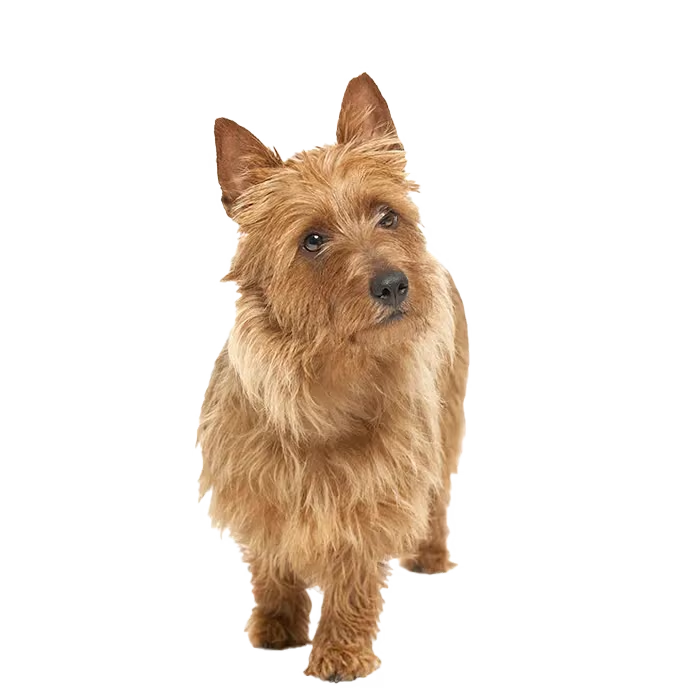
Australian Terrier
The Australian Terrier is a spirited, plucky little working terrier known for its bold confidence and devoted companionship.
- Size
- Small
- Lifespan
- 11–15 years
- Origin
- Australia
- Temperament
- Spirited
- Standard colors
- Blue, Tan, Red, and Sandy
Characteristics
Coat and grooming
How the Australian Terrier coat is built, and what that means when you groom it.
- Coat layers
- Double coat
- Coat texture
- Wire
- Coat length
- Medium
- Shedding
- Low shedding
Grooming guidance
Caution: A Australian Terrier coat should be hand-stripped rather than clipped.
A wire coat is meant to be pulled out at the root once the hair is ready to release. Clippers cut it off part way instead, leaving the soft undercoat behind. The result is a coat that grows back limp and faded, and the weatherproof texture only returns after the hair is stripped out again.
Registry Recognition
Fédération Cynologique Internationale
- Terriers
American Kennel Club
- Terrier Group
Canadian Kennel Club
- Terrier Group
United Pet Club
- TerriersPrimary
Australian Terrier colors and patterns
What each club's breed standard says about every Australian Terrier color and pattern. Point at a ruling to see the club's own wording.
Breed standards describe the Australian Terrier in Blue, Tan, Red, and Sandy. Standard patterns: Solid and Tan point.
| Color or pattern | FCI | AKC | UKC | KC | KUSA |
|---|---|---|---|---|---|
| Blue | Standard (“Blue, steel blue or dark grey blue”) | Standard (“Blue & Tan”) | Standard (“dark blue, steel blue, dark gray blue or silver blue”) | Standard (“Blue, steel blue or dark grey blue”) | Standard (“Blue, steel blue, or dark grey-blue”) |
| Tan | Standard (“rich tan (not sandy)”) | Standard (“Blue & Tan”) | Standard (“The tan markings are as rich as possible”) | Standard (“rich tan (not sandy)”) | Standard (“rich tan (not sandy)”) |
| Red | Standard (“red”) | Standard (“Red”) | Standard (“solid red”) | Standard (“red”) | Standard (“red”) |
| Sandy | Standard (“Clear sandy”) | Standard (“Sandy”) | Standard (“any shade of solid sandy”) | Standard (“Clear sandy”) | Standard (“Clear sandy”) |
| Black | Not recognized | Fault (“All black body coat in the adult dog”) | Fault (“All black coat (except in puppies)”) | Not recognized | Not recognized |
| Albino | Not recognized | Not recognized | Disqualifying (“Albinism”) | Not recognized | Not recognized |
| Patterns | |||||
| Solid | Standard (“Clear sandy or red”) | Standard (“solid sandy and solid red”) | Standard (“solid sandy or solid red”) | Standard (“Clear sandy or red”) | Standard (“Clear sandy or red”) |
| Tan point | Standard (“with rich tan (not sandy) on face, ears, under body, lower legs and feet”) | Standard (“Blue & Tan”) | Standard (“tan markings ... on the face, ears, underbody, lower legs and feet”) | Standard (“with rich tan (not sandy) on face, ears, under body, lower legs and feet”) | Standard (“with rich tan (not sandy) on face, ears, under body, lower legs, feet”) |
| Sable | Fault (“any smuttiness or dark shadings objectionable”) | Fault (“dark smut in sandy/red coated dogs”) | Fault (“Dark smut in Sandy or Red dogs”) | Fault (“smuttiness or dark shading undesirable”) | Fault (“any smuttiness or dark shadings objectionable”) |


| Color or pattern | FCI | AKC | UKC | KC | KUSA |
|---|---|---|---|---|---|
| Black | No ruling | Standard (“dark brown to black (the darker the better)”) | No ruling | No ruling | No ruling |
| Dark brown | Standard (“dark brown”) | Standard (“dark brown to black (the darker the better)”) | Standard (“dark brown”) | Standard (“dark brown”) | Standard (“dark brown”) |
| Light brown | No ruling | Fault (“Light-colored ... eyes”) | No ruling | No ruling | No ruling |
What the rulings mean
- Standard
- Described by the club's breed standard.
- Fault
- Named by the club's breed standard as a fault: the animal can be shown but is penalized.
- Disqualifying
- The club's breed standard disqualifies an animal of this color or pattern.
- Not recognized
- The club does not accept this color or pattern for the breed.
Color changes
How a Australian Terrier's colors can change over its life.
Blackchanges toRust
Coat · With body condition · can change back
Blackchanges toGray
Coat · Progressive
Blackchanges toBlue
Coat · Progressive
Blackchanges toBrown
Coat · In the sun · can change back
Tan pointchanges toSaddle
Coat · With age · from 6 to 156 weeks
Blackchanges toSnow nose
Nose · With the season · can change back
Blackchanges toPink
Nose · With the season · can change back


Sources
Each ruling comes from the club's published breed standard or color list.
Meet some of our Australian Terrier
A few of the Australian Terrier profiles members have added to United Pet Club.


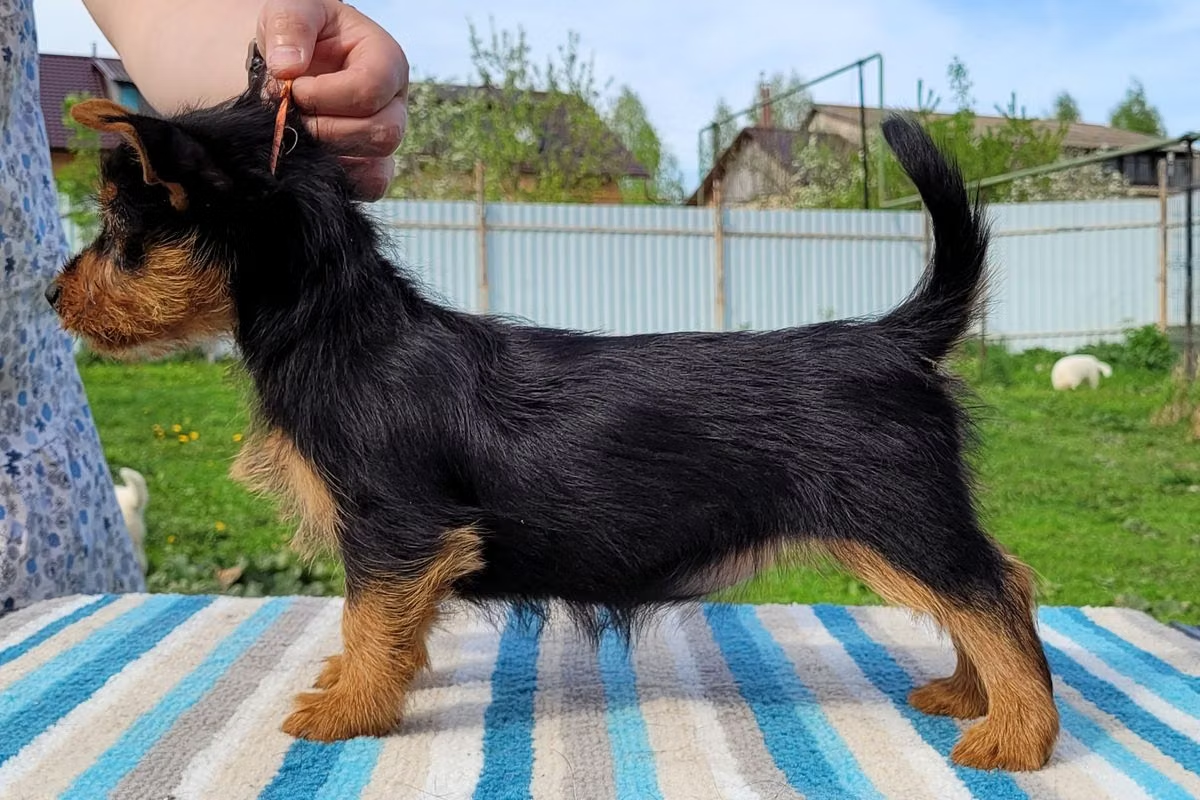

About the Australian Terrier
The Australian Terrier is a small working terrier from Australia, prized for bold confidence, alertness, and close attachment to its owners.
The Australian Terrier is one of the smallest working terriers, standing about 25 to 28 cm at the shoulder and weighing roughly 5 to 7 kg. It was developed in Australia to control rats and snakes around homes, farms, and mines, and to act as a watchdog and companion. The result is a sturdy, low-set dog with a harsh weather-resistant coat and a great deal of self-assurance packed into a compact frame.
Despite its size, this is a true terrier in temperament. It is spirited, courageous, and quick to react to anything new in its territory. At the same time it forms a strong bond with its family and tends to attach closely to one or two people, following them from room to room and staying alert to their movements.
The breed suits owners who want a small dog with a big personality and who appreciate an active, watchful companion rather than a placid lap dog. It adapts well to apartments or houses as long as it gets daily activity and company.
| Attribute | Detail |
|---|---|
| Origin | Australia |
| Size | Small (about 5 to 7 kg) |
| Lifespan | 11 to 15 years |
| Group/role | Terrier; ratter, watchdog, companion |
| Good with | Families and committed single owners; older children; tolerant of other dogs with socialization |
Who it suits
This breed fits people who are home often or can take the dog along, since it dislikes long stretches of isolation. It rewards owners who provide consistent structure and daily mental work. Households with small pets such as rodents or rabbits should be cautious, because the terrier's prey drive remains strong.
History and origin
The Australian Terrier was developed in 19th-century Australia from imported rough-coated British terriers and was the first native Australian breed to gain formal recognition.
The breed traces to the early 1800s, when settlers brought a range of rough-coated terriers from Britain to Australia. These working dogs were crossed and selected for the practical demands of colonial life: killing rats and snakes, guarding stores and homesteads, and tending sheep camps in harsh country.
Several British terrier types contributed to the breed's makeup, including small rough-coated terriers from the highland and northern regions of Britain. Breeders favored a hardy, low-set dog with a harsh coat that shed dirt and resisted weather, along with the courage to confront vermin much larger than itself.
The breed was first shown in Australia in the late 19th century, exhibited under names that referenced its rough coat and broken hair. It was the first breed developed in Australia to be recognized and shown there, and it later gained recognition with kennel clubs in Britain and the United States during the 20th century.
The closely related Australian Silky Terrier shares part of this ancestry but was bred toward a longer, silkier coat and a companion role, while the Australian Terrier kept its rougher coat and working character.
Appearance and breed standard
The Australian Terrier is a small, low-set, sturdy dog with a harsh straight coat, a soft topknot, and erect ears, built longer than it is tall.
The Australian Terrier is longer in body than it is tall, giving it a low, ground-covering outline. The head is long with small erect ears and dark oval eyes that give an alert, keen expression. A distinctive softer topknot of hair covers the skull and contrasts with the harsh body coat. The tail was traditionally docked in some regions but is often left natural where docking is restricted.
| Trait | Standard |
|---|---|
| Height | About 25 to 28 cm at the withers |
| Weight | About 5 to 7 kg |
| Coat | Harsh, straight outer coat about 6 cm long with a short soft undercoat; softer topknot |
| Colors | Blue and tan, solid sandy, or solid red |
| Eyes | Small, oval, dark brown |
Coat and colors
The outer coat is harsh and straight and lies close to the body, with a short softer undercoat for insulation. Recognized colors are blue and tan, where the blue can range to dark steel or silver-blue with tan markings on the face, legs, and underparts, plus solid sandy and solid red. The topknot is usually lighter and softer than the body coat. The harsh texture is functional, helping the coat shed dirt and resist wet weather.
Temperament and behavior
The Australian Terrier is confident, loyal, and alert, devoted to its family while remaining a determined watchdog and an instinctive hunter of small animals.
This is a self-assured, spirited dog that bonds closely with its household. It tends to be affectionate and people-oriented at home, often attaching most strongly to one person and seeking to stay near them. With children who treat it respectfully it is usually playful and patient, though its size means interactions with very young children should be supervised.
Toward strangers the breed is alert and watchful. It will announce visitors and unfamiliar sounds readily, which makes it a capable small watchdog, but it is not typically aggressive once introductions are made. Early socialization helps it settle quickly around new people.
With other dogs it can be sociable, though some individuals show the terrier tendency toward boldness with same-sex dogs. Its hunting instinct stays strong, so small pets such as rodents, rabbits, and sometimes cats can trigger chasing. It is intelligent and quick to learn, but also independent enough to test boundaries.
| Trait | Rating |
|---|---|
| Affection | 4 |
| Energy | 4 |
| Trainability | 4 |
| Vocalness | 4 |
| Shedding | 2 |
Care and grooming
The Australian Terrier needs modest coat care, daily exercise, and regular company, and adapts to both apartments and houses when its activity needs are met.
The harsh coat is relatively low-maintenance and sheds little, but it benefits from routine attention to keep its texture and to remove dead hair.
Grooming
- Brush once or twice a week to remove loose hair and prevent mats
- Hand-strip the coat a few times a year to maintain its harsh texture; clipping softens it over time
- Bathe only when needed, since frequent washing softens the coat and strips protective oils
- Trim nails every few weeks and check ears for debris
- Brush teeth several times a week to support dental health
Exercise
- Provide 30 to 60 minutes of activity daily through walks and play
- Offer a securely fenced area for off-leash running, since the breed will chase and dig
- Include scent games, fetch, and digging-permitted spots to satisfy terrier instincts
- Use a leash near roads and small animals because prey drive overrides recall
Environment
The breed lives happily in apartments or houses as long as it gets daily exercise and is not left alone for long periods. It tolerates a range of climates thanks to its weather-resistant coat, but it should live indoors as a family dog rather than outside.
Nutrition and feeding
The Australian Terrier does well on a complete diet suited to small active dogs, fed in measured meals to prevent the weight gain it is prone to.
A complete, balanced diet formulated for small breeds suits the Australian Terrier. Because it is a small, active dog, portion control matters: this breed can gain weight easily if overfed or given too many treats. Choose a food appropriate to the dog's life stage and adjust amounts based on body condition and activity rather than feeding to a fixed figure. Fresh water should always be available.
| Life stage | Amount per day | Meals |
|---|---|---|
| Puppy (2 to 6 months) | About 80 to 130 g, by weight and food type | 3 to 4 |
| Junior (6 to 12 months) | About 90 to 130 g | 2 to 3 |
| Adult | About 75 to 110 g | 2 |
| Senior | About 65 to 95 g, adjusted for activity | 2 |
Treats and supplements
Keep treats to no more than about 10 percent of daily calories and account for them in the total ration. Most dogs on a complete diet need no supplements; discuss joint, skin, or coat supplements with a veterinarian before adding them, particularly for older dogs.
Health and lifespan
The Australian Terrier is generally hardy with a lifespan of 11 to 15 years, though it can be prone to certain joint, endocrine, and eye conditions.
The Australian Terrier is a robust breed with a typical lifespan of 11 to 15 years. Most individuals stay healthy with routine veterinary care, good nutrition, and weight control. As with many small breeds, a few inherited and age-related conditions appear more often than in the general dog population, so awareness and screening help.
| Condition | Signs | Note |
|---|---|---|
| Patellar luxation | Skipping gait, intermittent hind-leg lameness | Common in small breeds; ranges from mild to surgical |
| Legg-Calve-Perthes disease | Hind-limb lameness and pain in young dogs | Affects the hip joint; often needs surgery |
| Diabetes mellitus | Increased thirst, urination, and appetite with weight loss | Manageable with diet and insulin; needs ongoing care |
| Allergic skin disease | Itching, recurrent skin or ear infections | Triggers may be environmental or dietary |
| Cataracts and other eye issues | Cloudy eye, reduced vision | Periodic eye checks help with early detection |
Preventive care
- Keep vaccinations and parasite prevention current
- Maintain a lean body condition to protect joints and reduce diabetes risk
- Schedule annual veterinary exams, with more frequent visits for senior dogs
- Keep up dental care to prevent periodontal disease
- Ask breeders about screening of parents for patella, hip, and eye conditions
Training
The Australian Terrier is intelligent and eager to please but independent, so it responds best to consistent, reward-based training started early.
This breed is quick-witted and learns readily, which makes it capable in obedience and dog sports such as agility and earthdog trials. Its independent terrier streak means it can be stubborn and easily bored by repetition, so sessions should be short, varied, and motivating. Early socialization with people, dogs, and everyday situations helps temper its alert, reactive nature. Because prey drive is strong, recall around small animals is difficult and should not be relied on near roads or wildlife.
Basics
- Start socialization and handling in puppyhood, exposing the dog to varied people, places, and sounds
- Teach a reliable name response and attention cue first
- Build core commands such as sit, down, stay, and come in short daily sessions
- Practice leash manners early, since the breed pulls toward interesting scents
- Address excessive barking and digging by redirecting to acceptable outlets
- Proof commands gradually in busier environments with more distraction
Breeding
The Australian Terrier reaches breeding maturity in its first year or two and produces small litters that need careful socialization from an early age.
Responsible breeding of the Australian Terrier focuses on temperament, coat quality, and health screening of the parents. Females are generally bred only after reaching full physical and behavioral maturity, often after the first year and once health clearances are in hand. As with all small breeds, breeding should aim to reduce the joint, endocrine, and eye conditions seen in the breed rather than to maximize litter numbers.
Gestation runs about 63 days. Litters are small, commonly around three to five puppies, in keeping with the breed's size. The dam typically whelps and raises the litter with little intervention, but breeders monitor for whelping difficulties given the small frame.
Puppies need early, careful socialization. The breed's alert and bold nature means that exposure to varied people, handling, sounds, and gentle new experiences during the early weeks shapes a confident, stable adult. Puppies usually go to new homes after about eight weeks, weaned and started on vaccinations and parasite control.
| Metric | Value |
|---|---|
| Sexual maturity | About 6 to 12 months |
| Recommended first breeding | After full maturity, often after 12 months |
| Gestation | About 63 days |
| Typical litter size | 3 to 5 puppies |
| Weaning age | About 6 to 8 weeks |
| Age to new home | About 8 weeks or later |
Registering your Australian Terrier and its microchip
Register your Australian Terrier free for life with United Pet Club, and put its microchip number on a record American shelters can actually find.
How to register an Australian Terrier in the United States
Start with the profile. Add your Australian Terrier's name, birth date, and a clear photo, attach your phone number and email, and save. That is the whole job, and it costs nothing for life. Dog registration works with or without a microchip, so there is no reason to wait for a vet visit.
The microchip needs its own registration. A vet implants the chip, but the number stays anonymous until you file it, and an anonymous chip cannot point anyone at you. Register the microchip with United Pet Club on the free lifetime plan: every brand a US vet implants qualifies, updates cost nothing after a move, and the record shows up in the AAHA universal lookup American shelters check first. Create your free account and finish both steps in one sitting.
How do I register my Australian Terrier in the United States?
Open a free United Pet Club account, enter your Australian Terrier's name, birth date, and a photo, and save. The profile is free for life, works with or without a microchip, and you can attach a chip number later.
How do I register my Australian Terrier's microchip?
Type the 15-digit chip number into your free United Pet Club account together with your current phone number and address. The lifetime plan is free, covers every future update, and accepts any chip brand a US vet implants.
Does my Australian Terrier have to be microchipped in the United States?
No federal law says an Australian Terrier must carry a chip, but plenty of city and county licensing rules do, and shelters routinely chip before adoption. What the law never does is register the chip for you; that part is yours.
How much does it cost to register an Australian Terrier?
Nothing. United Pet Club's lifetime plan covers the dog's profile, the microchip registration, and every update at no charge, with no renewal fees.
Frequently asked questions
Common questions about the Australian Terrier's size, temperament, care, lifespan, suitability, and availability.
How big does an Australian Terrier get?
It is a small breed, standing about 25 to 28 cm at the shoulder and weighing roughly 5 to 7 kg, with a body that is slightly longer than it is tall.
What is the Australian Terrier's temperament like?
It is loyal, spirited, alert, and confident. It bonds closely with its family and makes a good small watchdog, while keeping a strong instinct to chase small animals.
Is the Australian Terrier easy to care for?
Care is moderate. The harsh coat sheds little and needs brushing once or twice a week plus occasional hand-stripping, and the dog needs 30 to 60 minutes of daily exercise and regular company.
How long do Australian Terriers live?
Most live 11 to 15 years. Keeping the dog lean, maintaining dental and veterinary care, and choosing a breeder who screens for health conditions all support a long life.
Is the Australian Terrier good for apartments and families?
Yes, it adapts to apartments or houses as long as it gets daily activity and is not left alone for long periods. It suits families with respectful older children and committed single owners.
Does it get along with other pets?
It can live with other dogs when socialized, but its hunting drive makes it likely to chase rodents, rabbits, and sometimes cats, so small pets need careful management.
Is the Australian Terrier a rare breed?
It is recognized by major kennel clubs but is less common than many popular small breeds, so finding a reputable breeder may take patience and a waiting list.
From the community
Ask about the Australian TerrierNo questions about the Australian Terrier yet. Be the first to ask.
Browse Dog breeds