

Australian Shepherd
Also known as Aussie
The Australian Shepherd is an intelligent, energetic herding dog known for its versatility, drive, and loyal devotion.
- Size
- Medium
- Lifespan
- 12–15 years
- Origin
- United States
- Temperament
- Intelligent
- Standard colors
- Black, White, and Blue and 2 more
- Popularity
- No. 6 of 10
Characteristics
Coat and grooming
How the Australian Shepherd coat is built, and what that means when you groom it.
- Coat layers
- Double coat
- Coat texture
- Wavy
- Coat length
- Medium
- Shedding
- Seasonal shedding
Grooming guidance
Critical: A Australian Shepherd should not be shaved.
The undercoat keeps heat out as well as in, and the outer coat shields the skin from sun and insect bites. Clipping the whole coat off removes both. It often grows back patchy, soft or a different colour, and in some animals the guard hairs never return properly. Brush the undercoat out instead of cutting it off.
Caution: A Australian Shepherd coat mats easily.
Fine or long hair tangles at the base of the coat, out of sight, where the mats tighten and pull on the skin. Brushing has to reach right down to the roots in sections, not just skim the surface.
Information: A Australian Shepherd drops its undercoat in heavy bursts.
The undercoat comes out in heavy bursts over a few weeks. An undercoat rake, or a bath followed by a proper blow-dry, clears it far faster than daily brushing. Clipping the coat down is not a shortcut for this.
Registry Recognition
Fédération Cynologique Internationale
- Sheepdogs and Cattledogs
American Kennel Club
- Herding Group
Canadian Kennel Club
- Herding Group
United Pet Club
- Sheepdogs and CattledogsPrimary
Australian Shepherd colors and patterns
What each club's breed standard says about every Australian Shepherd color and pattern. Point at a ruling to see the club's own wording.
Breed standards describe the Australian Shepherd in Black, White, Blue, Tan, and Red. Standard patterns: Solid, Bicolor, Tricolor, Merle, and Tan point.
| Color or pattern | FCI | AKC | UKC | KC | KUSA |
|---|---|---|---|---|---|
| Black | Standard (“black”) | Standard (“Black”) | Standard (“solid black”) | Standard (“black”) | Standard (“black”) |
| White | Standard (“with or without white markings”) | Standard (“with or without white markings”) | Standard (“with or without white markings”) | Standard (“may have white as follows”) | Standard (“with or without white markings”) |
| Blue | Standard (“blue merle”) | Standard (“Blue Merle”) | Standard (“blue merle”) | Standard (“blue merle”) | Standard (“blue merle”) |
| Tan | Standard (“tan markings”) | Standard (“tan (copper) points”) | Standard (“tan (copper) points”) | Standard (“tan points”) | Standard (“tan markings”) |
| Red | Standard (“red merle, red”) | Standard (“Red”) | Standard (“red merle, solid red”) | Standard (“red merle, red”) | Standard (“red merle, red”) |
| Albino | Not recognized | Not recognized | Disqualifying (“albinism”) | Not recognized | Not recognized |
| Patterns | |||||
| Solid | Standard (“black, red - all with or without white markings and/or tan markings”) | Standard (“Black”) | Standard (“solid black and solid red”) | Standard (“all with or without tan points”) | Standard (“all with or without white markings and/or tan markings”) |
| Bicolor | Standard (“with white markings”) | Standard (“White Markings”) | Standard (“with white markings”) | Standard (“Black With White Trim”) | Standard (“with white markings”) |
| Tricolor | Standard (“with white markings and/or tan markings”) | Standard (“White Markings, Tan Points”) | Standard (“with white markings and/or tan (copper) points”) | Standard (“Black Tricolour”) | Standard (“with white markings and/or tan markings”) |
| Merle | Standard (“blue merle, red merle”) | Standard (“Blue Merle”) | Standard (“blue merle, red merle”) | Standard (“blue merle, red merle”) | Standard (“blue merle, red merle”) |
| Tan point | Standard (“tan markings”) | Standard (“Tan Points”) | Standard (“tan (copper) points”) | Standard (“with tan points”) | Standard (“tan markings”) |
| Double merle | No ruling | No ruling | No ruling | No ruling | No ruling |


| Color or pattern | FCI | AKC | UKC | KC | KUSA |
|---|---|---|---|---|---|
| Blue | Standard (“blue”) | Standard (“blue”) | Standard (“blue”) | Standard (“blue”) | Standard (“blue”) |
| Brown | Standard (“brown”) | Standard (“brown”) | Standard (“brown”) | Standard (“brown”) | Standard (“brown”) |
| Amber | Standard (“amber”) | Standard (“amber”) | Standard (“amber”) | Standard (“amber”) | Standard (“amber”) |
| Patterns | |||||
| Marbled | Standard (“marbling”) | Standard (“marbling”) | Standard (“marbling”) | Standard (“marbling”) | Standard (“marbling”) |
| Odd-eyed | Standard (“any variation or combination thereof”) | Standard (“any variation or combination thereof”) | Standard (“any variation or combination”) | Standard (“or combination”) | Standard (“any variation or combination thereof”) |
| Sectoral | Standard (“including flecks”) | Standard (“including flecks”) | Standard (“including flecks”) | Standard (“including flecks”) | Standard (“including flecks”) |


| Color or pattern | FCI | AKC | UKC | KC | KUSA |
|---|---|---|---|---|---|
| Black | Standard (“blue merles and blacks have black pigmentation on the nose”) | Standard (“blue merles and blacks have black pigmentation on the nose”) | Standard (“the blue merle and black have black pigmentation on nose”) | Standard (“black in blue merles and blacks”) | Standard (“blue merles and blacks have black pigmentation on the nose”) |
| Liver | Standard (“red merles and reds have liver (brown) pigmentation on the nose”) | Standard (“red merles and reds have liver (brown) pigmentation on the nose”) | No ruling | Standard (“shades of brown in red merles and reds”) | Standard (“red merles and reds have liver (brown) pigmentation on the nose”) |
| Dudley | No ruling | No ruling | Disqualifying (“Dudley nose”) | No ruling | No ruling |
| Patterns | |||||
| Butterfly nose | Standard (“on the merles it is permissible to have small pink spots”) | Standard (“on the merles it is permissible to have small pink spots”) | Standard (“butterfly nose should not be faulted under one year of age”) | Fault (“poor pigmentation undesirable over one year of age”) | Standard (“on the merles it is permissible to have small pink spots”) |

What the rulings mean
- Standard
- Described by the club's breed standard.
- Fault
- Named by the club's breed standard as a fault: the animal can be shown but is penalized.
- Disqualifying
- The club's breed standard disqualifies an animal of this color or pattern.
- Not recognized
- The club does not accept this color or pattern for the breed.
Color changes
How a Australian Shepherd's colors can change over its life.
Blackchanges toRust
Coat · With body condition · can change back
Blackchanges toGray
Coat · Progressive
Blackchanges toBrown
Coat · In the sun · can change back
Whitechanges toRoan
Coat · With age · from 2 weeks
Tan pointchanges toSaddle
Coat · With age · from 6 to 156 weeks
Bluechanges toDark brown
Eyes · With age · from 2 weeks
Bluechanges toBrown
Eyes · With age · from 2 weeks
Bluechanges toLight brown
Eyes · With age · from 2 weeks
Bluechanges toAmber
Eyes · With age · from 2 weeks
Bluechanges toHazel
Eyes · With age · from 2 weeks
Bluechanges toYellow
Eyes · With age · from 2 weeks
Blackchanges toSnow nose
Nose · With the season · can change back
Blackchanges toPink
Nose · With the season · can change back


Sources
Each ruling comes from the club's published breed standard or color list.
Health
Conditions recorded as more common in the Australian Shepherd than in its species as a whole. A higher risk is not a diagnosis: many never develop any of them, and your vet can say which screening tests are worth doing.
Moderate risk
- Nervous system
MDR1 (ABCB1) drug sensitivity
Also called Multidrug sensitivity
Strong evidenceHereditaryInheritance: Autosomal recessiveGene: ABCB1OMIA entry
This content is for educational purposes and is not a substitute for professional veterinary advice. If you are worried about your pet, contact your veterinarian.
All health conditionsMeet some of our Australian Shepherd
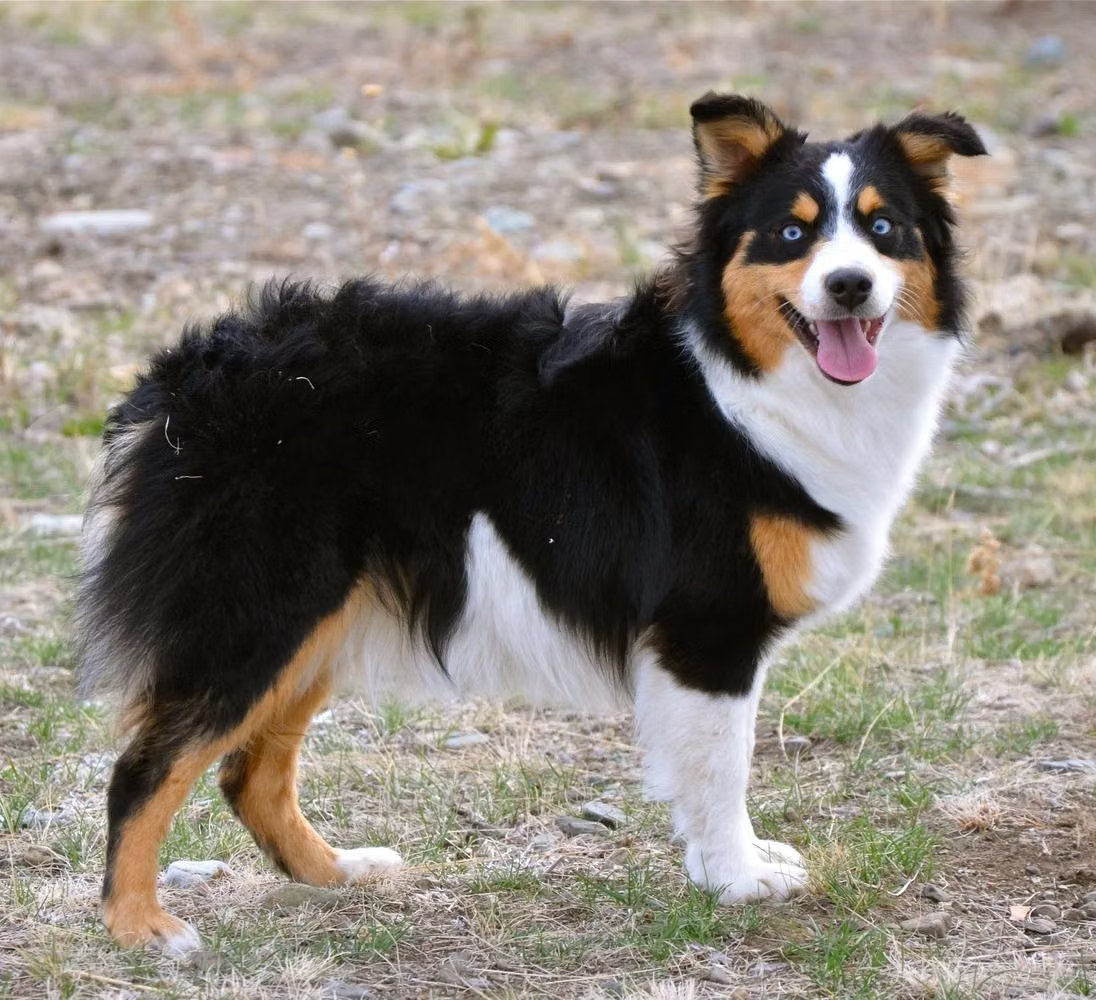
A few of the Australian Shepherd profiles members have added to United Pet Club.





About the Australian Shepherd
The Australian Shepherd is a medium-sized herding dog from the United States, valued for its intelligence, drive, and close bond with its handler.
The Australian Shepherd is a medium-sized working dog bred to move livestock across open range. Despite the name, the breed was developed in the western United States, not Australia. It stands as one of the most capable herding dogs available to ranchers and remains popular in dog sports today.
The breed is built for stamina rather than bulk. A typical adult weighs between 18 and 32 kilograms and carries a weather-resistant double coat. The Aussie is alert, quick to learn, and happiest when given a job to do, whether that job is herding, agility, search work, or daily structured exercise with its owner.
This is a dog that forms strong attachments to its family. It tends to bond closely with one household and can be reserved with strangers until it has assessed them. Owners describe the breed as devoted, tireless, and highly responsive to training.
| Attribute | Detail |
|---|---|
| Origin | United States |
| Size | Medium |
| Lifespan | 12 to 15 years |
| Group / role | Herding dog |
| Good with | Active families, experienced owners, other dogs when socialized |
Who suits this breed
The Australian Shepherd fits people who can provide daily physical exercise and mental work. It does well with runners, hikers, farmers, and households committed to training and sport. It is a poor match for sedentary homes or owners who are away for long stretches, since an under-exercised Aussie often develops destructive or anxious behavior.
History and origin
The Australian Shepherd was developed by ranchers in the western United States during the 19th and 20th centuries, with the breed standard formalized in the second half of the 20th century.
The breed's name is misleading. The Australian Shepherd was developed in the western United States, and its working ancestry traces through a mix of European herding dogs brought west by shepherds and stockmen during the 1800s.
One common account links the name to flocks of sheep imported to North America from Australia in the 19th century. Dogs that worked alongside those flocks picked up the association, and the label stuck even though the breed itself took its modern form on American ranches.
Through the early and mid-20th century, ranchers in California and the western states bred these dogs for working ability rather than appearance. Stamina, biddability, and herding instinct were the traits that mattered. The breed gained wider public attention after World War II, helped by rodeo performers and the spread of western horse culture.
Breed clubs were organized in the United States in the 1950s and later, and the Australian Shepherd was recognized by the American Kennel Club in 1991. Many lines today still descend from proven working stock, which is why drive and herding instinct remain strong across the breed.
Appearance
The Australian Shepherd is a medium-sized, well-balanced dog with a weather-resistant double coat that comes in black, blue merle, red, and red merle, often with white and tan markings.
The Australian Shepherd is slightly longer than it is tall, with a level topline and a body built for agility and endurance. The head is clean-cut and strong, the ears are triangular and set high, and the expression is alert. Some Aussies are born with a natural bobtail, while others have a full tail.
The coat is medium in length, weather-resistant, and double-layered, with a coarser outer coat over a softer undercoat. Hair is shorter on the head and front of the legs and longer behind the legs and around the neck.
| Trait | Detail |
|---|---|
| Height | Males 51 to 58 cm; females 46 to 53 cm at the shoulder |
| Weight | Males 23 to 32 kg; females 18 to 25 kg |
| Coat | Medium-length, weather-resistant double coat |
| Colors | Black, blue merle, red, red merle, often with white and tan |
| Eyes | Brown, blue, amber, or any combination, including marbled eyes |
Coat and colors
The four recognized base colors are black, blue merle, red, and red merle. White markings and copper or tan points may appear on any of them. The merle pattern produces mottled patches over a lighter background. Two merle dogs should not be bred together, because the double merle combination is linked to hearing and vision defects. Eye color varies widely, and a single dog may have two different colored eyes.
Temperament and personality
The Australian Shepherd is loyal, intelligent, and energetic, devoted to its family but often reserved with strangers and inclined to herd.
The Australian Shepherd is a thinking dog. It learns quickly, reads its handler closely, and looks for tasks to complete. With its own family it is affectionate and steady. With unfamiliar people it is often watchful and may hold back until it decides the situation is safe, which makes early socialization important.
The herding instinct stays active even in pet homes. An Aussie may try to gather running children, other dogs, or moving objects by circling and nudging. This is normal behavior and can be redirected with training. The breed generally gets along with other dogs and with pets it grows up alongside, though its drive means small animals can trigger chasing.
This is a high-energy breed. Boredom is the main cause of problem behavior. An Aussie that does not get enough exercise and mental work may bark, dig, chew, or become anxious. Given a job and consistent leadership, it is calm, reliable, and deeply bonded to its people.
| Trait | Rating |
|---|---|
| Affection | 5 |
| Energy | 5 |
| Trainability | 5 |
| Vocalness | 3 |
| Shedding | 4 |
Care and grooming
The Australian Shepherd needs regular brushing for its double coat and a high level of daily exercise and mental work to stay balanced.
Grooming
- Brush the coat at least once or twice a week, and daily during seasonal shedding
- Expect heavier coat blows in spring and autumn when the undercoat sheds out
- Bathe only when needed, roughly every one to three months, to protect coat oils
- Trim nails every few weeks and check ears for dirt or moisture
- Brush teeth several times a week to support dental health
Exercise
- Provide at least 1 to 2 hours of activity per day
- Combine physical exercise with mental work such as training drills, scent games, or puzzle feeders
- Suitable outlets include herding, agility, flyball, long hikes, and fetch
- Avoid leaving the dog idle for long periods, which leads to problem behavior
Environment
The Australian Shepherd does best in a home with secure outdoor space and an active household. It can adapt to smaller living spaces only if its exercise needs are fully met. The weather-resistant coat handles cold well, but the dog should still have shade and water in heat.
Nutrition and feeding
The Australian Shepherd needs a balanced diet matched to its high activity level, with portions adjusted by life stage and workload.
The Australian Shepherd is an active breed, and its diet should support sustained energy without excess weight. A complete dog food with quality animal protein suits most Aussies. Working dogs and dogs in heavy training need more calories than pets with light activity, so portions should track actual workload rather than a fixed figure.
Feed adults twice a day rather than one large meal. Split feeding supports steady energy and reduces the risk of bloat in deep-chested dogs. Keep fresh water available at all times, especially after exercise.
| Life stage | Amount per day | Meals |
|---|---|---|
| Puppy (2 to 6 months) | Per product guide, adjusted for growth | 3 to 4 |
| Adolescent (6 to 12 months) | About 250 to 350 g dry food | 2 to 3 |
| Adult (1 year and over) | About 200 to 350 g dry food | 2 |
| Senior | Slightly reduced, watch weight | 2 |
Treats and supplements
Use treats in moderation and count them toward daily calories to prevent weight gain. Most Australian Shepherds on a complete diet do not need supplements. Owners of working dogs sometimes add omega-3 oils for coat and joint support, but supplements should be discussed with a veterinarian first.
Health and common conditions
The Australian Shepherd is generally healthy with a lifespan of 12 to 15 years, though it is prone to hip dysplasia, eye disorders, and drug sensitivity linked to the MDR1 gene.
The Australian Shepherd is a hardy breed that typically lives 12 to 15 years. Responsible breeding and health screening have kept most lines sound, but the breed does carry several inherited risks that owners should understand. A notable concern is the MDR1 gene mutation, which makes some Aussies sensitive to certain common medications. Genetic testing identifies affected dogs so vets can adjust drug choices.
| Condition | Signs | Note |
|---|---|---|
| Hip dysplasia | Stiffness, limping, reluctance to jump | Screen breeding stock; manage weight |
| Collie eye anomaly | Often none; found on eye exam | Inherited; test before breeding |
| Cataracts | Cloudy eye, reduced vision | May need surgery |
| Epilepsy | Seizures | Manageable with veterinary care |
| MDR1 drug sensitivity | Severe reaction to certain drugs | Genetic test; inform every vet |
Preventive care
- Keep vaccinations and parasite control current
- Schedule annual veterinary check-ups, more often for seniors
- Maintain a healthy weight to protect joints
- Test for the MDR1 mutation and share results with your vet
- Choose breeders who screen for hip and eye conditions
Training
The Australian Shepherd is one of the most trainable breeds, learning quickly and excelling in obedience, herding, and dog sports when given consistent, reward-based work.
The Australian Shepherd ranks among the easiest breeds to train. It learns commands fast, retains them well, and enjoys the process. That intelligence cuts both ways: an untrained or bored Aussie will invent its own activities, often destructive ones. Consistent training from puppyhood channels the breed's drive into useful behavior.
Early socialization matters because the breed can be wary of strangers. Expose puppies to new people, places, and other animals while they are young. Address the herding instinct early by teaching the dog what it may and may not chase or gather.
Basics
- Start with name recognition and a reliable recall
- Teach sit, down, and stay with short daily sessions
- Socialize the puppy widely with people and animals
- Introduce leash manners before the dog grows strong
- Add advanced work such as agility, herding, or trick training to use the dog's mind
- Redirect herding behavior toward toys or structured tasks
Breeding
Australian Shepherds reach breeding maturity at one to two years, carry litters of about six to seven puppies after a roughly nine-week gestation, and require genetic screening before mating.
Responsible breeding of Australian Shepherds depends on health testing and careful pairing. Females are usually not bred until they are physically and mentally mature, generally after the first or second year. Breeding stock should be screened for hip dysplasia, eye conditions, and the MDR1 mutation.
A central rule for the breed is to avoid merle-to-merle pairings. Crossing two merle dogs produces double merle offspring with a high risk of deafness and blindness. Pairing a merle with a solid-colored dog avoids this outcome.
Gestation lasts about 63 days. Litters commonly contain six to seven puppies, though size varies. Puppies are weaned at around seven to eight weeks, and early handling and socialization during this window shape adult temperament. Some puppies are born with natural bobtails, which is normal for the breed.
| Metric | Value |
|---|---|
| Breeding maturity | 1 to 2 years |
| Gestation | About 63 days |
| Average litter size | 6 to 7 puppies |
| Weaning age | 7 to 8 weeks |
| Key rule | Never breed merle to merle |
Registering your Australian Shepherd and its microchip
Register your Australian Shepherd free for life with United Pet Club, and put its microchip number on a record American shelters can actually find.
How to register an Australian Shepherd in the United States
Start with the profile. Add your Australian Shepherd's name, birth date, and a clear photo, attach your phone number and email, and save. That is the whole job, and it costs nothing for life. Dog registration works with or without a microchip, so there is no reason to wait for a vet visit.
The microchip needs its own registration. A vet implants the chip, but the number stays anonymous until you file it, and an anonymous chip cannot point anyone at you. Register the microchip with United Pet Club on the free lifetime plan: every brand a US vet implants qualifies, updates cost nothing after a move, and the record shows up in the AAHA universal lookup American shelters check first. Create your free account and finish both steps in one sitting.
How do I register my Australian Shepherd in the United States?
Open a free United Pet Club account, enter your Australian Shepherd's name, birth date, and a photo, and save. The profile is free for life, works with or without a microchip, and you can attach a chip number later.
How do I register my Australian Shepherd's microchip?
Type the 15-digit chip number into your free United Pet Club account together with your current phone number and address. The lifetime plan is free, covers every future update, and accepts any chip brand a US vet implants.
Does my Australian Shepherd have to be microchipped in the United States?
No federal law says an Australian Shepherd must carry a chip, but plenty of city and county licensing rules do, and shelters routinely chip before adoption. What the law never does is register the chip for you; that part is yours.
How much does it cost to register an Australian Shepherd?
Nothing. United Pet Club's lifetime plan covers the dog's profile, the microchip registration, and every update at no charge, with no renewal fees.
Frequently asked questions
Common questions about the Australian Shepherd cover its size, temperament, care needs, lifespan, suitability, and availability.
How big does an Australian Shepherd get?
It is a medium-sized dog. Males stand about 51 to 58 cm at the shoulder and weigh 23 to 32 kg, while females stand 46 to 53 cm and weigh 18 to 25 kg.
What is the temperament of an Australian Shepherd?
Aussies are loyal, intelligent, and energetic. They bond closely with their family, are often reserved with strangers, and have a strong herding instinct that needs an outlet.
Are Australian Shepherds hard to care for?
They are demanding in exercise and stimulation rather than grooming. They need 1 to 2 hours of activity plus mental work each day, along with weekly brushing. They are not suited to inactive homes.
How long do Australian Shepherds live?
The typical lifespan is 12 to 15 years with good care, regular veterinary check-ups, and a healthy weight.
Are Australian Shepherds good family dogs?
Yes, in active families that can meet their exercise needs. They are affectionate and trainable, though their herding instinct may lead them to gather young children, which training can manage.
Do Australian Shepherds shed a lot?
Yes. The double coat sheds year-round and heavily during seasonal coat blows in spring and autumn. Regular brushing keeps shedding under control.
Are Australian Shepherds easy to find?
They are a popular breed and widely available from reputable breeders and rescues. Choose breeders who health-test for hip, eye, and MDR1 conditions.
From the community
Ask about the Australian ShepherdNo questions about the Australian Shepherd yet. Be the first to ask.
Browse Dog breeds