
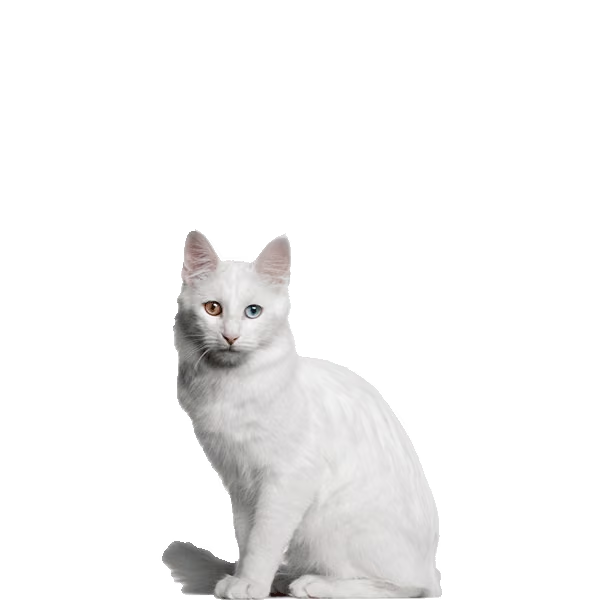
Turkish Angora
Also known as Angora
The Turkish Angora is an elegant, silky-coated breed admired for its playful, affectionate personality and graceful intelligence.
- Size
- Medium
- Lifespan
- 12–18 years
- Origin
- Turkey
- Temperament
- Playful
- Standard colors
- Black, White, and Blue and 9 more
Characteristics
Coat and grooming
How the Turkish Angora coat is built, and what that means when you groom it.
- Coat layers
- Single coat
- Coat texture
- Silky
- Coat length
- Long
- Shedding
- Seasonal shedding
Grooming guidance
Caution: A Turkish Angora coat mats easily.
Fine or long hair tangles at the base of the coat, out of sight, where the mats tighten and pull on the skin. Brushing has to reach right down to the roots in sections, not just skim the surface.
Information: A Turkish Angora drops its undercoat in heavy bursts.
The undercoat comes out in heavy bursts over a few weeks. An undercoat rake, or a bath followed by a proper blow-dry, clears it far faster than daily brushing. Clipping the coat down is not a shortcut for this.
Registry Recognition
The International Cat Association
- Longhair Cats
Cat Fanciers’ Association
- Longhair Cats
United Pet Club
- Longhair CatsPrimary
Turkish Angora colors and patterns
What each club's breed standard says about every Turkish Angora color and pattern. Point at a ruling to see the club's own wording.
Breed standards describe the Turkish Angora in Black, White, Blue, Lilac, Silver, Brown, Chocolate, Cinnamon, Red, Gold, Cream, and Fawn. Standard patterns: Solid, Bicolor, Harlequin, Tabby, Mackerel tabby, Classic tabby, Spotted tabby, Ticked tabby, Tortoiseshell, Calico, Torbie, Van, Smoke, Shaded, Chinchilla, and Caliby.
| Color or pattern | TICA | CFA | FIFE |
|---|---|---|---|
| Black | Standard | Standard (“Black”) | Standard (“black”) |
| White | Standard | Standard (“White”) | Standard (“white”) |
| Blue | Standard | Standard (“Blue”) | Standard (“blue”) |
| Lilac | Standard | Disqualifying (“lilac”) | Not recognized (“lilac”) |
| Silver | No ruling | Standard (“Silver”) | Standard (“silver”) |
| Brown | No ruling | Standard (“Brown Tabby”) | Standard (“black tabby”) |
| Chocolate | Standard | Disqualifying (“chocolate”) | Not recognized (“chocolate”) |
| Cinnamon | Standard | Standard | Not recognized (“cinnamon”) |
| Red | Standard | Standard (“Red”) | Standard (“red”) |
| Gold | No ruling | No ruling | Standard (“golden”) |
| Cream | Standard | Standard (“Cream”) | Standard (“cream”) |
| Fawn | Standard | Standard | Not recognized (“fawn”) |
| Patterns | |||
| Solid | No ruling | Standard (“Other Solid Colors”) | Standard (“solid”) |
| Bicolor | No ruling | Standard (“Bi-Color”) | Standard (“bicolour”) |
| Harlequin | No ruling | No ruling | Standard (“harlequin”) |
| Tabby | No ruling | No ruling | Standard (“tabby”) |
| Mackerel tabby | No ruling | Standard (“Mackerel Tabby”) | Standard (“mackerel”) |
| Classic tabby | No ruling | Standard (“Classic Tabby”) | Standard (“blotched”) |
| Spotted tabby | No ruling | Standard (“Spotted Tabby”) | Standard (“spotted”) |
| Ticked tabby | No ruling | Standard (“Ticked Tabby”) | Standard (“ticked”) |
| Tortoiseshell | No ruling | Standard (“Tortoiseshell”) | Standard (“tortie”) |
| Calico | No ruling | Standard (“Calico”) | Standard (“tortie with white”) |
| Torbie | No ruling | Standard (“Patched Tabby”) | Standard (“tortie tabby”) |
| Van | No ruling | Standard (“van patterns”) | Standard (“van”) |
| Smoke | No ruling | Standard (“Smoke”) | Standard (“smoke”) |
| Shaded | No ruling | Standard (“Shaded”) | Standard (“shaded”) |
| Chinchilla | No ruling | No ruling | Standard (“shell”) |
| Caliby | No ruling | Standard (“Calico”) | Standard (“tortie with white”) |
| Pointed | Not recognized | Disqualifying (“point pattern”) | Not recognized (“pointed patterns”) |
| Mink | Not recognized | No ruling | No ruling |
| Sepia | Not recognized | No ruling | No ruling |


| Color or pattern | CFA | FIFE |
|---|---|---|
| Blue | Standard (“blue”) | Standard (“deep blue”) |
| Orange | No ruling | Standard (“copper or deep orange”) |
| Copper | Standard (“amber”) | Standard (“copper or deep orange”) |
| Amber | Standard (“amber”) | No ruling |
| Gold | Standard (“green-gold”) | No ruling |
| Green | Standard (“green”) | Standard (“green”) |
| Patterns | ||
| Odd-eyed | Standard (“odd-eyed”) | Standard (“odd eyed”) |

What the rulings mean
- Standard
- Described by the club's breed standard.
- Disqualifying
- The club's breed standard disqualifies an animal of this color or pattern.
- Not recognized
- The club does not accept this color or pattern for the breed.
Color changes
How a Turkish Angora's colors can change over its life.
Brownchanges toCopal
Coat · With age · from 0 to 52 weeks
Blackchanges toRusset
Coat · Progressive
Tabbychanges toSolid
Coat · With age · from 0 to 39 weeks
Whitechanges toShaded
Coat · With age
Whitechanges toChinchilla
Coat · With age
Tabbychanges toShaded
Coat · With age · from 0 to 6 weeks
Tabbychanges toChinchilla
Coat · With age · from 0 to 6 weeks
Bluechanges toTortoiseshell
Coat · With age
Blackchanges toBrown
Coat · With body condition · can change back
Blackchanges toBrown
Coat · In the sun · can change back
Blackchanges toBrown
Coat · Progressive
Whitechanges toPointed
Coat · With age · from 1 to 52 weeks
Solidchanges toSmoke
Coat · With age · from 3 to 104 weeks
Bluechanges toGreen
Eyes · With age · from 4 to 17 weeks
Bluechanges toYellow
Eyes · With age · from 4 to 17 weeks
Bluechanges toGold
Eyes · With age · from 4 to 17 weeks
Bluechanges toCopper
Eyes · With age · from 4 to 17 weeks
Bluechanges toOrange
Eyes · With age · from 4 to 17 weeks
Bluechanges toHazel
Eyes · With age · from 4 to 17 weeks
Bluechanges toAmber
Eyes · With age · from 4 to 17 weeks
Pinkchanges toSeal
Nose · With age · from 1 to 52 weeks
Pinkchanges toBlue
Nose · With age · from 1 to 52 weeks
Pinkchanges toChocolate
Nose · With age · from 1 to 52 weeks
Pinkchanges toLilac
Nose · With age · from 1 to 52 weeks
Pinkchanges toSeal
Paw pads · With age · from 1 to 52 weeks
Pinkchanges toBlue
Paw pads · With age · from 1 to 52 weeks
Pinkchanges toChocolate
Paw pads · With age · from 1 to 52 weeks
Pinkchanges toLilac
Paw pads · With age · from 1 to 52 weeks
Sources
Each ruling comes from the club's published breed standard or color list.
About the Turkish Angora
The Turkish Angora is a medium-sized cat from Turkey known for its silky single coat, playful nature, and strong attachment to people.
The Turkish Angora is a medium-sized domestic cat with a slim, long body, fine bones, and a soft single coat that lacks a heavy undercoat. The breed comes from Turkey, where long-haired cats have lived around the city of Ankara for centuries. Adults usually weigh between 2.5 and 5 kilograms, with males larger than females.
These cats are active and people-oriented. They tend to stay close to their owners, follow them between rooms, and look for interaction throughout the day. Many keep a kitten-like level of play well into adulthood, and they often climb to high perches to watch the household.
The coat is easier to manage than that of many other long-haired breeds because it has little undercoat and resists matting. Coat colors vary, and the white form with blue, amber, or odd eyes is the most widely recognized.
| Attribute | Detail |
|---|---|
| Origin | Turkey |
| Size | Medium (2.5 to 5 kg) |
| Lifespan | 12 to 18 years |
| Group / role | Companion cat |
| Good with | Families, older children, other cats, cat-friendly dogs |
Who it suits
The Turkish Angora fits households that can give it daily attention and play. It does well with active families, single owners who are home often, and homes that already keep other pets. People who want a quiet, independent cat that stays out of the way may find this breed too demanding of company.
History of the breed
Long-haired cats from the region around Ankara in Turkey are the ancestors of the Turkish Angora, a breed later refined through a Turkish preservation program and Western breeding.
Long-haired cats have lived in central Turkey for a long time, centered on the city of Ankara, which was historically called Angora. The breed takes its name from that city. European travelers recorded long-haired cats from the region by the 1600s and 1700s, and some were brought to France and England, where they were prized as exotic companions.
During the 1800s and early 1900s the Turkish Angora became less distinct in the West as it was crossed with other long-haired cats, including the type that developed into the modern Persian. For a period the original Angora line was largely absorbed into other breeds outside Turkey.
To protect the cats within their home country, the Ankara Zoo ran a breeding program focused on the white Angora, including cats with odd eyes. This program is widely credited with preserving the breed through the middle of the twentieth century.
In the 1950s and 1960s, cats from the Ankara Zoo were imported to North America, and breeders worked to reestablish the line abroad. Cat registries recognized the breed over the following decades, at first mainly in white and later in a wider range of colors and patterns.
Appearance and coat
The Turkish Angora is a slender, fine-boned cat with a long silky single coat, a plumed tail, and eyes that may be blue, amber, green, or odd-colored.
The Turkish Angora has a long, lithe body with fine bones and firm muscle. The head is a small to medium wedge, the ears are large, upright, and set high, and the eyes are large and almond-shaped. The legs are long, with the hind legs slightly longer than the front, and the tail is long and tapered with a full plume of hair. The overall impression is of a light, balanced, graceful cat rather than a heavy one.
| Trait | Description |
|---|---|
| Height | About 23 to 30 cm at the shoulder |
| Weight | 2.5 to 5 kg, males larger than females |
| Coat | Long, fine, silky, single coat with little undercoat |
| Colors | White plus many colors and patterns including black, blue, red, cream, tabby, and tortoiseshell |
| Eyes | Blue, amber, green, or odd-eyed (one blue, one amber or green) |
Coat and colors
The coat is medium to long, fine, and soft, with a silky texture that drapes close to the body. It is longest at the ruff, the belly, and the tail. Because the coat carries little undercoat, it moves and shimmers easily and tangles less than denser long coats. White was the original recognized color and remains the most associated with the breed, but registries now accept a broad range of solid colors, tabby patterns, and tortoiseshell. White cats with one blue eye and one amber or green eye are a well-known form of the breed.
Temperament and personality
Turkish Angoras are affectionate, playful, and intelligent cats that bond closely with their people and stay active well into adulthood.
The Turkish Angora is an outgoing, people-oriented cat. It tends to attach to its household and often picks a favorite person whom it follows from room to room. Many owners describe the breed as a participant in daily life rather than a bystander, since these cats like to sit nearby, supervise activity, and join in where they can.
With family members the breed is affectionate and interactive. With strangers most Angoras are curious and confident rather than shy, though individuals vary. They generally get along with other cats and with cat-friendly dogs, especially when introduced gradually.
These cats are intelligent and playful. They learn quickly, enjoy puzzle toys and fetch, and keep a kitten-like energy for years. They are climbers and jumpers that seek out high vantage points. Angoras are usually moderate in voice, communicating with soft, chirpy sounds rather than loud or constant calling. Left alone for long stretches without company or stimulation, they can become bored and restless.
| Trait | Rating |
|---|---|
| Affection | 5 |
| Energy | 5 |
| Trainability | 4 |
| Vocalness | 3 |
| Shedding | 3 |
Care and grooming
The Turkish Angora needs regular but light coat care, daily play to use its energy, and an indoor home with places to climb.
The Turkish Angora is a moderate-maintenance breed. Its single coat resists matting, so grooming is simpler than for many long-haired cats, but it still benefits from routine attention. Daily interaction matters as much as coat care, because this is an active cat that needs an outlet for its energy.
Grooming
- Comb the coat once or twice a week with a wide-tooth comb to remove loose hair and prevent tangles.
- Increase combing during seasonal shedding, when more hair is lost.
- Check and gently clean the ears as needed, and trim the nails every few weeks.
- Brush the teeth regularly with a cat-safe toothpaste to support dental health.
Exercise
- Provide at least two play sessions a day using wand toys, balls, or fetch.
- Offer puzzle feeders and rotating toys to keep the mind occupied.
- Give vertical space such as a tall cat tree or shelves for climbing and perching.
Environment
The breed is best kept as an indoor cat, which protects it from traffic, theft, and disease. It adapts to apartments and houses alike as long as it has room to run, climb, and play. A sociable household or a feline companion helps prevent boredom when owners are away.
Nutrition and feeding
Turkish Angoras do well on a complete, meat-based cat food fed in measured daily portions, with fresh water always available.
Cats are obligate carnivores, so the Turkish Angora needs a diet built around animal protein with adequate fat and the amino acid taurine. Choose a complete and balanced commercial cat food appropriate to the cat's life stage. Many owners feed a mix of wet and dry food, since wet food adds moisture that supports urinary health. Keep fresh water available at all times. Because this is an active breed, portion to maintain a lean body, and adjust amounts based on weight and activity.
| Life stage | Amount per day | Meals |
|---|---|---|
| Kitten (up to 12 months) | Per package guidance, fed to appetite | 3 to 4 |
| Adult (1 to 7 years) | About 200 to 300 kcal | 2 |
| Senior (7 years and older) | Adjusted to weight and activity | 2 |
Treats and supplements
Keep treats to no more than about 10 percent of daily calories so the main diet stays balanced. A cat on a complete commercial food does not usually need supplements; add them only on a veterinarian's advice. Hairball-control products or extra combing can help active long-haired cats that swallow hair during grooming.
Health and lifespan
The Turkish Angora is generally healthy and lives about 12 to 18 years, though some lines carry inherited deafness, a heart condition, and a movement disorder.
The Turkish Angora is a generally hardy breed with a typical lifespan of 12 to 18 years. Most live long, healthy lives with routine veterinary care, a balanced diet, and an indoor home. As with any breed, a few inherited conditions appear more often and are worth knowing about, especially when choosing a kitten from a breeder.
| Condition | Signs | Note |
|---|---|---|
| Congenital deafness | No response to sound, especially in white blue-eyed cats | Linked to the white coat and blue eyes; can affect one or both ears |
| Hypertrophic cardiomyopathy (HCM) | Lethargy, fast or labored breathing, weakness | A heart-muscle disease seen in many cat breeds; screening helps detect it |
| Hereditary ataxia | Tremors, unsteady movement in young kittens | A rare, serious neurological condition affecting some kittens |
Preventive care
- Schedule annual veterinary checkups, with more frequent visits for senior cats.
- Keep core vaccinations and parasite control up to date.
- Maintain dental care through brushing and professional cleanings as advised.
- Feed to keep the cat lean and weigh it periodically to catch changes early.
- For white kittens, ask the breeder about hearing test results.
Training and enrichment
Turkish Angoras are intelligent and quick to learn, responding well to short reward-based sessions for tricks, recall, and good litter habits.
The Turkish Angora is intelligent and motivated by interaction, which makes it one of the more trainable cats. Many learn to play fetch, come when called, and perform simple tricks. Training also channels the breed's energy and curiosity into useful outlets, which reduces boredom-driven behavior such as knocking objects off shelves. Keep sessions short, a few minutes at a time, and end while the cat is still interested.
Basics
- Establish litter-box habits early by placing clean boxes in quiet, accessible spots.
- Introduce a scratching post and reward the cat for using it to protect furniture.
- Use a clicker or a marker word paired with a treat to teach simple cues such as sit or come.
- Build recall by calling the cat at mealtimes and rewarding it for approaching.
- Add puzzle feeders and trick training to keep the mind engaged between sessions.
Breeding and kittens
Turkish Angora queens carry litters of around four kittens for roughly two months, with white blue-eyed lines needing careful screening for deafness.
Turkish Angoras reach sexual maturity at a few months of age, though responsible breeders wait until cats are physically mature before mating, usually after the first year. Gestation lasts about 63 to 67 days, and litters average around four kittens. Kittens are born with shorter coats that lengthen as they grow, and the full adult coat develops over the first couple of years.
Queens generally raise their kittens with little intervention, nursing and weaning them over the first weeks before solid food is gradually introduced. Kittens should stay with the mother and littermates until about twelve weeks of age so they are weaned, socialized, and ready for vaccination. Because deafness is linked to the white coat and blue eyes, breeders working with white lines often hearing-test kittens and plan pairings to manage the trait. Genetic screening for the heart and neurological conditions seen in the breed supports healthier litters.
| Metric | Value |
|---|---|
| Breeding maturity | After about 12 months (physical maturity) |
| Gestation | About 63 to 67 days |
| Average litter size | Around 4 kittens |
| Weaning age | About 6 to 8 weeks |
| Recommended rehoming age | About 12 weeks |
Registering your Turkish Angora and its microchip
A free lifetime United Pet Club record for your Turkish Angora, plus microchip registration that stays current through every move.
Registering a Turkish Angora in the United States
An indoor Turkish Angora is one propped door away from being a stray, and shelters meet those cats every day. A free United Pet Club profile stands between the two: your contact details, your cat's photo, and its chip number if it has one, all on one record a clinic can find. Registering your cat takes minutes and never costs anything.
A scanner can read your Turkish Angora's chip in two seconds; the question is whether the number leads anywhere. Registration is what makes it lead to you. It is free for life at United Pet Club, accepts chips from every manufacturer, and stays searchable through the AAHA lookup after every address change. Register the chip, then create your account if you have not yet.
How do I register my Turkish Angora in the United States?
Sign up free with United Pet Club, add your Turkish Angora's name, coloring, and a photo, and save. The profile lasts the cat's lifetime at no charge, indoor or outdoor, chip or no chip.
How do I register my Turkish Angora's microchip?
Add the 15-digit number from the implant paperwork to your free United Pet Club account and check that your phone number is current. The lifetime plan is free, accepts every chip brand, and never charges for updates.
Does an indoor Turkish Angora really need to be registered?
Yes. Escapes are exactly how indoor cats end up in shelters, and a shelter can only call the number a registry hands it. A free profile, with or without a chip, is what makes that call possible.
How much does it cost to register a Turkish Angora?
Zero. Profile, microchip registration, and unlimited updates are all covered by United Pet Club's free lifetime plan.
Frequently asked questions
Common questions about the Turkish Angora cover its size, temperament, grooming needs, lifespan, suitability, and availability.
How big does a Turkish Angora get?
It is a medium-sized cat. Most adults weigh between 2.5 and 5 kilograms, with males larger than females, and the body is long and slender rather than heavy.
What is the Turkish Angora's temperament like?
Affectionate, playful, and intelligent. The breed bonds closely with its people, often follows a favorite person around, and stays active and curious well into adulthood.
Is the Turkish Angora hard to care for?
No. The single coat resists matting and needs only one or two combings a week. The bigger commitment is time and play, since this active cat needs daily attention and enrichment.
How long do Turkish Angoras live?
They typically live 12 to 18 years with routine veterinary care, a balanced diet, and an indoor home.
Is the Turkish Angora a good family pet?
Yes, for households that can give it company and play. It does well with families, older children, other cats, and cat-friendly dogs, but it may be too demanding for owners who want a low-interaction cat.
Are all Turkish Angoras white, and are white ones deaf?
White was the original recognized color, but the breed now comes in many colors and patterns. Deafness is linked to the white coat with blue eyes and does not affect every cat; reputable breeders hearing-test white kittens.
How easy is it to find a Turkish Angora?
The breed is recognized by major cat registries but is less common than some breeds. Kittens are usually obtained from dedicated breeders, and rescues occasionally have cats of this type available.
From the community
Ask about the Turkish AngoraNo questions about the Turkish Angora yet. Be the first to ask.
Browse Cat breeds