

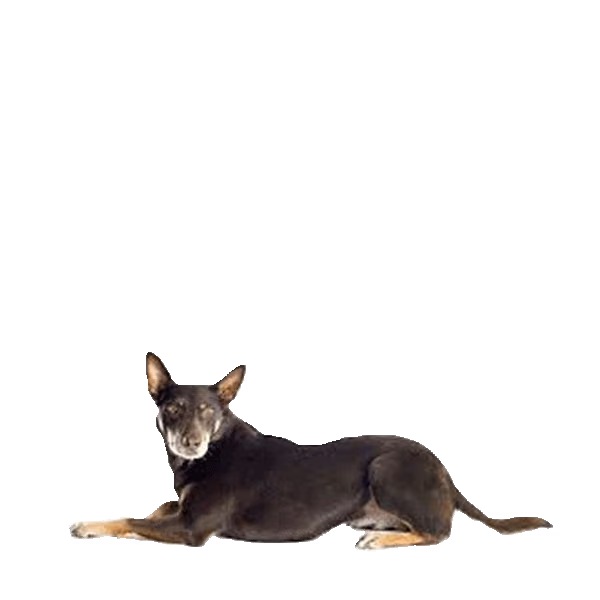
Working Kelpie
The Working Kelpie is a tireless, intelligent Australian herding dog renowned for its drive and stamina with livestock.
- Size
- Medium
- Lifespan
- 12–15 years
- Origin
- Australia
- Temperament
- Intelligent
- Standard colours
- Black, Blue and Tan and 2 more
Characteristics
Coat and grooming
How the Working Kelpie coat is built, and what that means when you groom it.
- Coat layers
- Double coat
- Coat texture
- Smooth
- Coat length
- Short
- Shedding
- Seasonal shedding
Grooming guidance
Critical: A Working Kelpie should not be shaved.
The undercoat keeps heat out as well as in, and the outer coat shields the skin from sun and insect bites. Clipping the whole coat off removes both. It often grows back patchy, soft or a different colour, and in some animals the guard hairs never return properly. Brush the undercoat out instead of cutting it off.
Information: A Working Kelpie drops its undercoat in heavy bursts.
The undercoat comes out in heavy bursts over a few weeks. An undercoat rake, or a bath followed by a proper blow-dry, clears it far faster than daily brushing. Clipping the coat down is not a shortcut for this.
Working Kelpie colours and patterns
What each club's breed standard says about every Working Kelpie colour and pattern. Point at a ruling to see the club's own wording.
Breed standards describe the Working Kelpie in Black, Blue, Tan, Red and Fawn. Standard patterns: Solid and Tan point.


What the rulings mean
- Standard
- Described by the club's breed standard.
Colour changes
How a Working Kelpie's colours can change over its life.
Blackchanges toRust
Coat · With body condition · can change back
Blackchanges toGrey
Coat · Progressive
Blackchanges toBrown
Coat · In the sun · can change back
Tan pointchanges toSaddle
Coat · With age · from 6 to 156 weeks

Sources
Each ruling comes from the club's published breed standard or colour list.
About the Working Kelpie
The Working Kelpie is a medium-sized Australian herding dog built for stamina, and in Singapore it needs far more space and outdoor time than a typical flat allows.
The Working Kelpie is a medium-sized herding dog from Australia, bred to move sheep across long distances of tough, open country. It works on ability rather than looks, and its type is judged on how well it handles stock, not on how it stands in a ring. A Kelpie can run for hours in heat and dust and often figures out a task with very little guidance from its handler.
The breed is a cousin of the Australian Kelpie kept as a companion and show dog, but the working line is selected almost entirely for what it can do on a property. Farmers and station hands pick for a strong herding instinct, willingness to take direction, and the stamina to work a full day mustering livestock. One trained dog can move hundreds of sheep with a single handler calling the shots.
This is a working breed through and through, and that matters a great deal in a place like Singapore. Between the year-round heat and humidity and the limited outdoor space most households have, a Kelpie without a real job or a serious daily exercise routine tends to become restless, noisy, and hard to live with. Owners who commit to a landed property with a secure garden, or who take the dog into a structured sport, get the best out of this breed.
| Attribute | Detail |
|---|---|
| Origin | Australia |
| Size | Medium |
| Lifespan | 12 to 15 years |
| Group / role | Herding and droving dog |
| Good with | Experienced, active owners with space for daily work, plus livestock or working outlets |
Who it suits
The Working Kelpie suits people who can offer a genuine job and several hours of activity a day. It fits farmers, graziers, and dog sport handlers well. It is a poor match for most Singapore households, since HDB flats are not approved for a dog this size and even landed homes need a secure, shaded yard given the heat. Owners who are out at work all day with no plan for exercise or company usually end up with a dog that digs, barks, or tries to escape.
History and origin
The Working Kelpie was developed in Australia in the late 1800s from imported British collie-type dogs, selected purely for stamina and herding ability on sheep stations.
The Working Kelpie goes back to Australia in the second half of the 1800s. As wool farming spread across large inland properties, station owners needed dogs that could muster sheep over huge distances in heat and dust. Collie-type herding dogs brought over from Britain formed the base stock.
The breed takes its name from a bitch called Kelpie, bred in the early 1870s from imported collie-type parents. Her offspring turned out to be excellent workers, and the name eventually came to describe the whole type. Working ability came first, so early Kelpies varied quite a bit in coat and colour while sharing a strong herding drive and real endurance.
Through the late 1800s and into the 1900s, breeders kept selecting for what mattered on a working property: a strong eye on stock, willingness to take direction, the toughness to put in long hours, and a good read on livestock. Some Kelpies developed the habit of running across the backs of sheep packed into yards, a trick still seen and valued today.
Two streams eventually split off. One was bred and registered toward a fixed look for the show ring and companion homes. The other, the Working Kelpie, kept being bred mainly for stock work, with performance on livestock as the real test of quality. Working Kelpies are still common on Australian farms and stations, and breeders in other grazing countries import them for the same reason.
Appearance
The Working Kelpie is a lean, athletic, medium-sized dog with a weatherproof double coat and pricked ears, built for long days of herding rather than a show ring look.
The Working Kelpie has a lean, balanced, athletic body built for speed and stamina rather than bulk. The head is slightly rounded with a clear stop, the muzzle tapers toward the nose, and the ears usually stand up and alert. The overall picture is of a fit, agile dog able to run, turn, and pull up quickly. Since the working line is bred purely for function, appearance varies more than in show lines.
| Trait | Typical range |
|---|---|
| Height | 43 to 51 cm at the shoulder |
| Weight | 11 to 20 kg |
| Coat | Short to medium double coat, weather resistant |
| Colours | Black, red, chocolate, fawn, blue, cream, often with tan points |
| Eyes | Almond shaped, brown, alert expression |
Coat and colours
The coat is a double coat, with a short, dense undercoat and a flatter, harder outer coat that sheds dirt and rain easily. Length runs from short to medium, sometimes with a touch more feathering on the legs and tail. Colours include black, red, chocolate, fawn, blue (a grey shade), and cream, and many dogs carry tan points on the face, legs, and chest. Since the breed is chosen for its work, colour is purely cosmetic and does not affect how a dog is valued.
Which Working Kelpie colours the clubs accept
AKC lists Black, Blue, Tan, Red, Fawn as standard for the Working Kelpie.
AKC is the only club we track for the Working Kelpie so far, and it accepts Black, Blue, Tan, Red, Fawn.
Patterns listed as standard for the Working Kelpie: Solid, Tan point.
Rulings come from each club's published breed standard, and clubs revise their standards. Before a show or a registration, check the current text with the club.
Temperament
The Working Kelpie is intelligent, focused, and driven to work, bonding closely with its handler while needing a clear job, firm structure, and consistent training.
The Working Kelpie is intelligent, highly energetic, and strongly driven to work. It bonds closely with its handler and tends to watch for direction, which makes it quick to learn, and just as quick to invent its own entertainment when left with nothing to do. Most Kelpies stay alert to their surroundings, so they make decent watchdogs, though they are working dogs first and not guard dogs.
With family, a well socialised Kelpie is affectionate and loyal. It is often reserved with strangers at first and can take a while to warm up. The herding instinct runs deep, so some Kelpies try to gather or nip at running children, other pets, or anything moving quickly, including cyclists along a park connector. Early training and clear boundaries help redirect this. Around other dogs and livestock the breed usually does fine when raised with them, though its drive means it needs supervision around small animals until it proves reliable.
This is a dog that thinks constantly. Without enough exercise and mental work, a Kelpie can turn anxious, destructive, or noisy, which is a real concern in the close quarters of most Singapore housing. Given a proper job and consistent handling, it settles well indoors and stays steady out in the field.
| Trait | Rating |
|---|---|
| Affection | 4 |
| Energy | 5 |
| Trainability | 5 |
| Vocalness | 3 |
| Shedding | 3 |
Care and grooming
The Working Kelpie is low maintenance to groom but needs a heavy daily dose of exercise and mental work to stay settled in Singapore's climate and housing.
The Working Kelpie is simple to keep clean but demanding to exercise. Its short to medium double coat needs little upkeep, while its energy and intelligence call for a large daily outlet, ideally before the worst of the midday heat.
Grooming
- Brush once a week to clear loose hair and dirt, more often when the coat blows during a seasonal moult.
- Bathe only when needed, since frequent washing strips the weatherproof coat.
- Check ears for dirt and moisture after work in long grass, drains, or water, which matters in Singapore's humidity.
- Trim nails every few weeks if they do not wear down on their own.
- Brush teeth several times a week to support dental health.
Exercise
- Plan for at least one to two hours of active exercise a day, ideally early morning or evening to avoid the midday sun.
- Mix physical work such as running, herding, or fetch with thinking tasks like training, scent games, or puzzle feeders.
- Try dog sports such as herding trials, agility, flyball, or canicross when there is no livestock work available, since several clubs run these locally.
- Avoid leaving the dog alone for long stretches with no way to burn off energy.
Environment
The Working Kelpie suits a farm, a large landed property, or an active home with a secure, shaded yard far better than a typical Singapore flat. HDB rules do not approve a dog of this size for flat living, and even a private home needs strong fencing and shade, since a bored Kelpie in the heat will dig, climb, or jump to get out. Shaded rest areas, aircon access, and constant water matter more here than in a cooler climate.
Grooming a Working Kelpie
The Working Kelpie coat: Double coat, Smooth, Short, Seasonal shedding. Main grooming rule: Do not shave.
Grooming a Working Kelpie comes down to its coat, so start there.
- Coat layers: Double coat
- Coat texture: Smooth
- Coat length: Short
- Shedding: Seasonal shedding
What this coat asks of you
- A double coat has a soft undercoat beneath longer guard hairs. Brush right down to the undercoat, because that is the layer that packs down and traps loose hair.
- A smooth coat lies flat and is the easiest kind to keep. A soft brush or a grooming mitt lifts dust and loose hair.
- Short hair rarely tangles but it still sheds, so regular brushing keeps the loose hair down.
- Seasonal shedding arrives in bursts when the coat changes, and brushing more often during those weeks keeps it manageable.
What to tell a groomer
Mention these when you book. The coat notes on this page explain each one.
- Do not shave
- Needs seasonal de-shedding
A groomer who knows the breed can adapt all of this to the individual animal. Sore skin, mats pressed against the skin or a sudden change in the coat are worth showing to a vet.
What kind of coat does a Working Kelpie have?
On our records: Coat layers: Double coat; Coat texture: Smooth; Coat length: Short; Shedding: Seasonal shedding.
How much does a Working Kelpie shed?
Seasonal shedding arrives in bursts when the coat changes, and brushing more often during those weeks keeps it manageable.
What should a groomer know about a Working Kelpie?
These grooming rules apply: Do not shave, Needs seasonal de-shedding.
Nutrition and feeding
The Working Kelpie needs a complete, protein-rich diet matched to its workload, with active dogs needing noticeably more food than a companion dog of the same weight.
The Working Kelpie does best on a complete, balanced diet built for an active dog. A dog working hard on a property needs more calories than a pet that only gets light exercise, so portions should track the dog's actual workload, body condition, and age rather than a fixed number. Choose a quality food with enough protein and fat to fuel sustained activity, and adjust the amount to keep the dog lean, not heavy.
| Life stage | Amount per day | Meals |
|---|---|---|
| Puppy (2 to 6 months) | Per product guide for age and weight | 3 to 4 |
| Adolescent (6 to 12 months) | Slightly above adult maintenance | 2 to 3 |
| Adult, active working | Roughly 250 to 400 g dry food, adjusted to workload | 2 |
| Adult, light activity | Roughly 180 to 280 g dry food | 2 |
| Senior (8+ years) | Reduce to match lower activity | 2 |
Treats and supplements
Keep treats to a small share of daily calories and save them for training rewards. Provide constant access to fresh water, especially after work in the heat, since a Kelpie can lose fluid fast outdoors here. Most healthy dogs on a complete diet do not need supplements. Check with a vet before adding any, including joint support for older or heavily worked dogs.
Health and lifespan
The Working Kelpie is generally hardy with a lifespan of 12 to 15 years, though inherited eye conditions, hip dysplasia, and some neurological disorders occur in the breed.
The Working Kelpie is generally a hardy, robust breed, helped along by decades of selection for fitness and function. Typical lifespan runs 12 to 15 years. As with any breed, some inherited conditions turn up, and responsible breeders screen their stock to cut the risk of passing them on. Working lines tend to be sound overall, but a buyer should still ask to see health testing results.
| Condition | Signs | Note |
|---|---|---|
| Progressive retinal atrophy | Night blindness, declining vision | Inherited eye disease; DNA testing available in some lines |
| Hip dysplasia | Stiffness, limping, difficulty getting up | Reduced by hip scoring of breeding stock |
| Cerebellar abiotrophy | Loss of coordination, tremors in young dogs | Inherited neurological disorder; check pedigrees |
| Collie eye anomaly | Often no visible signs; found on eye exam | Inherited; picked up by veterinary eye screening |
Preventive care
- Keep vaccinations and parasite control (fleas, ticks, worms) up to date, since Singapore's climate suits parasites year round.
- Book annual vet checks, more often for senior dogs.
- Keep the dog lean to protect the joints.
- Arrange eye and hip screening before any breeding.
- Look after teeth with regular brushing and dental checks.
Training
The Working Kelpie is one of the most trainable herding breeds, quick to learn and capable of working well off the handler, though early and consistent training matters.
The Working Kelpie is highly trainable and picks things up fast. It reads its handler closely and takes direction well even at a distance, which is how it manages stock on subtle commands alone. That same intelligence means it gets bored with repetition and will test the rules if training is inconsistent. Start early, keep sessions varied and purposeful, and set clear, fair rules. Socialise puppies widely, including to crowds, traffic, and unfamiliar noises, so the natural reserve around strangers does not turn into wariness.
Basics
- Socialise the puppy to people, places, sounds, and other animals from an early age.
- Teach core obedience: name response, sit, down, recall, and a reliable stay.
- Build a strong recall and a stop command, both essential for safe stock work.
- Channel the herding instinct into approved outlets and discourage chasing or nipping at people.
- Add complexity gradually with distance work, directional commands, and dog sports.
Breeding
Working Kelpies are usually bred for proven stock ability, with litters of about four to seven puppies born after roughly 63 days of gestation.
Working Kelpies are bred mainly for working ability, so reputable breeders choose parents that have shown sound temperament, stamina, and skill on livestock. Bitches reach physical maturity by around 18 to 24 months, and responsible breeders usually wait until then for a first litter so the dam is fully grown and health tested. Mating follows the female's heat cycle, which usually comes around twice a year.
Gestation runs about 63 days. Litter size commonly sits at four to seven puppies, though it can run smaller or larger. The dam raises the pups in the early weeks, and breeders start gentle socialisation and handling from a few weeks of age. Puppies stay with the litter until at least eight weeks, during which exposure to handling, sounds, and everyday farm activity helps shape steady working dogs. Health screening of breeding stock, including eye and hip checks, cuts the risk of passing on inherited conditions.
| Metric | Value |
|---|---|
| Female maturity for breeding | About 18 to 24 months |
| Heat cycle frequency | Roughly twice a year |
| Gestation | Around 63 days |
| Typical litter size | 4 to 7 puppies |
| Weaning age | About 6 to 8 weeks |
| Earliest rehoming | 8 weeks or later |
Licensing done? Now register your Working Kelpie and its chip
AVS handles the licence; United Pet Club keeps a free, searchable record behind your Working Kelpie's microchip for life.
Registering a Working Kelpie in Singapore
An AVS licence satisfies the rules; it does not tell a finder in another country how to reach you. Your Working Kelpie's free United Pet Club profile does exactly that, pairing your mobile with his photo and chip number for life. Register your dog once and the record follows him anywhere.
The AVS listing and a searchable contact record are two different things, and the second one is yours to set up. Register the microchip on the free lifetime plan: any chip brand a local vet implants qualifies, updates after a move between flats stay free, and the record can be pulled up 24 hours a day from anywhere. Create your free account and settle it tonight.
How do I register my Working Kelpie in Singapore?
Set up a free United Pet Club account, key in your Working Kelpie's details and a photo, and save. The lifetime plan keeps the profile live at no cost for as long as he is with you, alongside whatever AVS requires.
How do I register my Working Kelpie's microchip?
Key the 15-digit chip number into your free account together with your address, mobile, and email. The lifetime plan covers the registration and every update free, whichever brand the clinic used.
Is a microchip compulsory for a Working Kelpie in Singapore?
Yes. AVS requires dogs to be licensed and microchipped by three months of age. The licence is the legal part; a registered, searchable record with your current mobile is the part that gets a lost Working Kelpie home, and that part is free.
How much does it cost to register a Working Kelpie?
Nothing. United Pet Club's lifetime plan covers the profile, the chip record, and unlimited updates, with no renewal, ever.
Frequently asked questions
Common questions about the Working Kelpie cover its size, temperament, exercise needs, lifespan, suitability as a pet, and where to find one in Singapore.
How big does a Working Kelpie get?
It is a medium-sized dog, usually 43 to 51 cm at the shoulder and about 11 to 20 kg, with a lean, athletic build.
What is the Working Kelpie's temperament like?
It is intelligent, focused, and intensely driven to work. It bonds closely with its handler, is often reserved with strangers, and needs a job to stay calm and content.
Is the Working Kelpie hard to care for?
Grooming is simple, but the breed is demanding on exercise and mental stimulation. It needs one to two hours of active work a day and does not suit a low activity home or a typical HDB flat.
How long do Working Kelpies live?
Most live 12 to 15 years. They are generally hardy, though some lines carry inherited eye, hip, or neurological conditions, so health tested parents matter.
Does a Working Kelpie make a good family pet?
It can suit an active family that provides daily exercise and training. The strong herding instinct means it may try to gather or nip at running children, so early training and supervision matter.
Can I keep a Working Kelpie in an HDB flat in Singapore?
It is a poor fit for flat living, and larger working breeds like this one are not on the approved list for HDB flats. It does best on a landed property or a farm with a secure, shaded yard.
Where can I find a Working Kelpie in Singapore?
They are uncommon here, since most are bred and kept on farms and stations in Australia. A buyer in Singapore would typically need to import through a working dog breeder abroad, check the import and quarantine rules with AVS, and confirm the breeder proves working ability and health tests their stock.
From the community
Ask about the Working KelpieNo questions about the Working Kelpie yet. Be the first to ask.
Browse Dog breeds