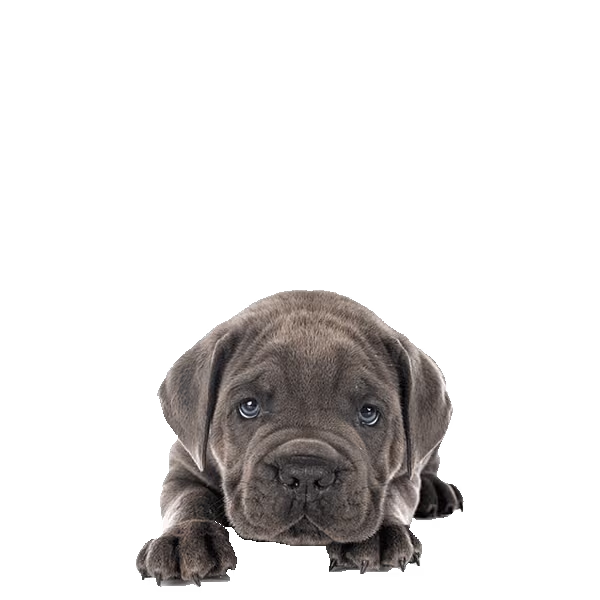
The Neapolitan Mastiff is a powerful, protective Italian guardian known for its imposing wrinkled appearance and steadfast devotion to its family.
How the Neapolitan Mastiff coat is built, and what that means when you groom it.
A few of the Neapolitan Mastiff profiles members have added to United Pet Club.
The Neapolitan Mastiff is a giant Italian guard dog with deep skin folds and a calm, devoted temperament, though its size and heat sensitivity make it a demanding choice in Singapore.
The Neapolitan Mastiff is a giant working breed from Italy. It is built heavy and low, with loose skin, deep facial wrinkles, and a slow, rolling gait. Males commonly weigh 59 to 70 kg and stand around 66 to 79 cm at the shoulder, which places the breed among the largest dogs kept as companions.
Despite the intimidating look, the breed is steady and undramatic at home. Neapolitan Mastiffs bond closely with the people they live with and tend to stay quietly near them rather than roam. With strangers they are reserved and watchful, a trait the breed was selected for over many generations as a property and personal guardian.
This is not a dog for every household. The size, the drool, the short lifespan of 7 to 9 years, and the firm but patient handling the breed needs all ask a lot of an owner. In Singapore, the heat and the housing rules add further hurdles for such a large, wrinkled breed. Those who can meet the demands get a loyal, affectionate guardian in return.
| Attribute | Detail |
|---|---|
| Origin | Italy |
| Size | Giant |
| Lifespan | 7 to 9 years |
| Group/role | Working guardian |
| Good with | Its own family, including children it is raised with, when well socialised |
The Neapolitan Mastiff fits an experienced owner with space, a secure yard, and time for early socialisation and training. Because of its size it is not suited to HDB flats, so it realistically needs landed or larger private housing with reliable cooling. It is a poor match for first-time owners or anyone bothered by heavy drool and shedding. The Singapore Kennel Club recognises the breed within its working group.
The Neapolitan Mastiff descends from large guard and war dogs of the ancient Mediterranean and was developed into its modern form near Naples in southern Italy.
The breed traces back to the large mastiff-type dogs used across the ancient Mediterranean for guarding, war, and the arena. Roman writers described heavy molosser dogs of this kind, and the type spread through the Italian peninsula over many centuries.
The modern breed took shape in the region around Naples in southern Italy, which gives the breed its name. Farmers and householders there kept these dogs to guard property and stock, valuing size, a deterring appearance, and a steady guarding instinct over speed or flash.
The Neapolitan Mastiff was brought to wider attention in the mid twentieth century. Italian breeders, including the writer Piero Scanziani, worked to set a consistent type, and the first breed standard was drawn up in the late 1940s. The breed was recognised by the Italian kennel authority and later by the Federation Cynologique Internationale.
From Italy the breed spread to other countries through the second half of the twentieth century. In Singapore it is a rare breed kept mainly by enthusiasts with suitable housing who can manage its size, heat sensitivity, and care needs.
The Neapolitan Mastiff is a massive, heavy-boned dog with abundant loose skin, deep facial wrinkles, a broad head, and a short coat in solid colours such as blue, black, and mahogany.
The Neapolitan Mastiff is large, broad, and powerfully built, with a heavy frame carried close to the ground. The most recognisable feature is the loose, abundant skin, which forms deep wrinkles on the head and a pronounced dewlap of hanging skin under the throat. The head is large and wide, the muzzle is deep, and the upper lips hang well below the jaw.
| Trait | Description |
|---|---|
| Height | Males about 66 to 79 cm, females about 61 to 74 cm |
| Weight | Males about 59 to 70 kg, females about 50 to 59 kg |
| Coat | Short, dense, and smooth |
| Colours | Solid blue (grey), black, mahogany, and tawny; brindle of these colours permitted |
| Eyes | Set deep, in a shade that matches the coat |
The coat is short, dense, and lies flat, which makes brushing simple but does not stop shedding. The standard recognised colours are solid blue, which is a grey shade, along with black, mahogany, and tawny. Brindle patterns of these colours are accepted. A small white patch on the chest or toes is allowed in many standards. The skin folds and the loose throat skin are part of the breed type and need routine cleaning to stay healthy, which is essential given Singapore's constant humidity.
The Neapolitan Mastiff is calm and deeply devoted to its family while reserved and watchful toward strangers, making early socialisation essential.
At home the Neapolitan Mastiff is calm, steady, and affectionate with its family. It forms a strong attachment to its people and prefers to stay near them. The breed is not hyperactive and spends much of the day resting, though it stays alert to what happens around the property.
With strangers the breed is reserved and naturally protective. It tends to watch and assess rather than react quickly, but its guarding instinct is strong, so early and ongoing socialisation is important to teach it to read situations calmly. With children in its own family it is usually patient and gentle, although its sheer size means young children should always be supervised around it.
Around other pets, behaviour depends on upbringing. A Neapolitan Mastiff raised with other animals can live peacefully with them, but some dogs, particularly males, may not tolerate unfamiliar dogs of the same sex. Firm, consistent handling and clear boundaries from puppyhood help the breed become a reliable companion.
| Trait | Rating |
|---|---|
| Affection | 5 |
| Energy | 2 |
| Trainability | 3 |
| Vocalness | 2 |
| Shedding | 3 |
Neapolitan Mastiff care centres on cleaning the skin folds, managing drool, providing moderate low-impact exercise, and keeping the dog cool in Singapore's heat and humidity.
The short coat is easy to brush, but the loose skin and deep wrinkles need regular attention. Owners should plan time for fold care and for managing the drool the breed is known for. In the local humidity, fold hygiene becomes a daily necessity.
This breed needs indoor space to move and reliable air conditioning. It is very sensitive to heat because of its mass and skin folds, so cooling, shade, fresh water, and a cool floor are genuine welfare needs in the tropics, not extras. It is happiest living indoors close to its family rather than left outside in the heat.
A Neapolitan Mastiff needs a complete diet sized to its giant frame, fed in measured meals to support steady growth and protect its joints and stomach.
Feed a complete, balanced diet suited to a giant breed. Large and giant breeds benefit from controlled growth as puppies, so a formula designed for large-breed puppies, fed to a lean body condition, helps protect developing joints. Adults do well on a quality adult food measured to maintain a healthy weight, since excess weight adds strain to the joints and heart. Exact amounts vary with age, activity, and the specific food, so use the product guidelines and a veterinarian's advice as a starting point.
| Life stage | Amount per day | Meals |
|---|---|---|
| Puppy (2 to 6 months) | Per large-breed puppy formula, to a lean condition | 3 to 4 |
| Junior (6 to 18 months) | Adjusted as growth slows | 2 to 3 |
| Adult | About 6 to 10 cups of dry food, split across meals | 2 |
| Senior | Reduced to match lower activity | 2 |
Keep treats to a small share of daily calories to avoid weight gain. Feeding two measured meals a day, rather than one large meal, and avoiding hard exercise right after eating may help lower the risk of bloat in deep-chested dogs. In the heat, always keep fresh, cool water available. Discuss any joint or other supplements with a veterinarian before adding them.
The Neapolitan Mastiff lives about 7 to 9 years and is prone to giant-breed issues such as joint disease, bloat, heart problems, and skin and eye conditions, with heat stress a further concern in Singapore.
The Neapolitan Mastiff is a giant breed, and like most giant dogs it has a shorter lifespan than smaller breeds, generally 7 to 9 years. Its size, deep chest, and skin folds bring a number of health concerns, and in Singapore's climate heat stress is an everyday risk. Buying from a breeder who screens parent dogs and keeping the dog at a healthy weight both improve the odds of a sound, comfortable life.
| Condition | Signs | Note |
|---|---|---|
| Hip and elbow dysplasia | Stiffness, limping, trouble rising | Common in giant breeds; ask about parent screening |
| Gastric dilatation-volvulus (bloat) | Swollen belly, retching, restlessness, distress | A life-threatening emergency; seek a vet at once |
| Heat stress and heatstroke | Heavy panting, drooling, weakness, collapse | A constant risk in the tropics for a heavy short-faced breed |
| Cherry eye and other eye issues | Red mass at the inner eye, irritation | Loose facial skin contributes to eyelid problems |
| Skin-fold dermatitis | Redness, odour, or sores in the wrinkles | Prevented by routine fold cleaning; worse in humidity |
The Neapolitan Mastiff is intelligent but independent, so it responds best to calm, consistent training and early socialisation rather than force or repetition.
The Neapolitan Mastiff is intelligent and capable but also independent and slow to act, so training takes patience. The breed reads the handler closely and works best with a calm, confident owner who sets clear and consistent rules. Harsh methods tend to make the breed shut down or resist, while fair, steady guidance earns its cooperation. Because of the breed's size and strong guarding instinct, early socialisation with many people, places, and other animals is one of the most important parts of raising one.
Neapolitan Mastiff breeding requires health-screened parents, careful whelping support, and attention to large litters and the breed's size-related risks.
Breeding a giant guardian breed responsibly takes planning and veterinary involvement. Dogs reach physical and behavioural maturity slowly, and breeders generally wait until adults are fully grown and have passed health screening before mating. Hips, elbows, heart, and temperament are the main areas to evaluate in breeding stock, since these affect both the parents and the puppies.
Gestation lasts roughly nine weeks. The breed often produces large litters, and because of the size of the dam and pups, whelping can need close supervision and sometimes veterinary assistance. Some bitches require a caesarean section. Newborn puppies grow quickly, so the dam needs a high-quality diet through pregnancy and nursing, and a cool, clean whelping area matters in the local climate.
Raising the litter well means early handling, gentle exposure to household sights and sounds, and steady socialisation before the puppies go to new homes. Given the breed's guarding nature, that early groundwork shapes how confident and stable the adult dogs become.
| Metric | Value |
|---|---|
| Sexual maturity | Around 18 to 24 months (breeding usually waits for full maturity) |
| Gestation | About 63 days |
| Average litter size | Roughly 6 to 8 puppies, sometimes more |
| Weaning age | About 6 to 8 weeks |
| Recommended placement age | 8 weeks or older, after early socialisation |
AVS handles the licence; United Pet Club keeps a free, searchable record behind your Neapolitan Mastiff's microchip for life.
An AVS licence satisfies the rules; it does not tell a finder in another country how to reach you. Your Neapolitan Mastiff's free United Pet Club profile does exactly that, pairing your mobile with his photo and chip number for life. Register your dog once and the record follows him anywhere.
The AVS listing and a searchable contact record are two different things, and the second one is yours to set up. Register the microchip on the free lifetime plan: any chip brand a local vet implants qualifies, updates after a move between flats stay free, and the record can be pulled up 24 hours a day from anywhere. Create your free account and settle it tonight.
Set up a free United Pet Club account, key in your Neapolitan Mastiff's details and a photo, and save. The lifetime plan keeps the profile live at no cost for as long as he is with you, alongside whatever AVS requires.
Key the 15-digit chip number into your free account together with your address, mobile, and email. The lifetime plan covers the registration and every update free, whichever brand the clinic used.
Yes. AVS requires dogs to be licensed and microchipped by three months of age. The licence is the legal part; a registered, searchable record with your current mobile is the part that gets a lost Neapolitan Mastiff home, and that part is free.
Nothing. United Pet Club's lifetime plan covers the profile, the chip record, and unlimited updates, with no renewal, ever.
Common questions about the Neapolitan Mastiff cover its size, temperament, care needs, lifespan, suitability, and availability.
It is a giant breed. Males typically weigh about 59 to 70 kg and stand 66 to 79 cm at the shoulder, with females somewhat smaller.
No. The breed far exceeds HDB size limits and is not suited to flat living. It realistically needs landed or larger private housing with reliable air conditioning.
Only with real care. As a heavy, wrinkled, short-faced breed it overheats easily, so air conditioning, shade, cool water, and walks only in the cool hours are essential.
They take more work than many breeds. Owners must clean the skin folds daily in the humidity, manage heavy drool, guard against heat, and commit to early socialisation and training.
The typical lifespan is about 7 to 9 years, which is normal for a giant breed.
It can be, with the right owner. It is gentle and patient with its own family, including children it is raised with, but its size and guarding nature suit experienced owners and supervised households.
It is a rare breed here. Finding a puppy usually means contacting dedicated breeders and joining a waiting list rather than buying on short notice.



