

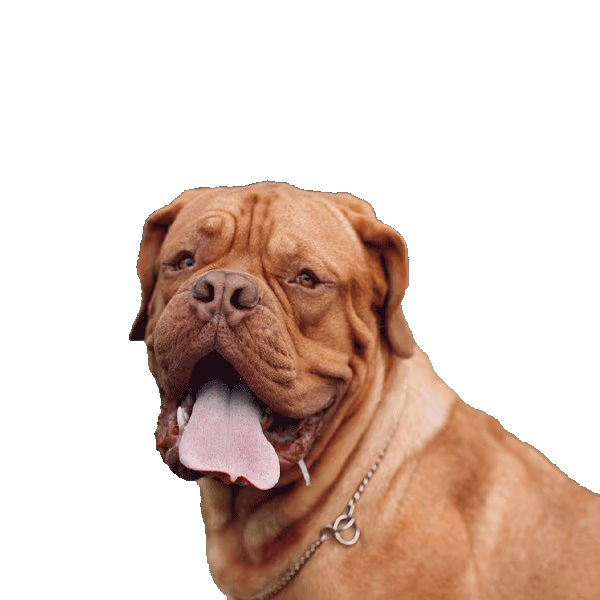
Mastiff
The Mastiff is a dignified, massive guardian known for its calm temperament, courage, and deep devotion to its family.
- Size
- Giant
- Lifespan
- 6–10 years
- Origin
- England
- Temperament
- Dignified
- Standard colours
- Fawn and Apricot
Characteristics
Coat and grooming
How the Mastiff coat is built, and what that means when you groom it.
- Coat layers
- Double coat
- Coat texture
- Smooth
- Coat length
- Short
- Shedding
- Moderate shedding
Grooming guidance
Critical: A Mastiff should not be shaved.
The undercoat keeps heat out as well as in, and the outer coat shields the skin from sun and insect bites. Clipping the whole coat off removes both. It often grows back patchy, soft or a different colour, and in some animals the guard hairs never return properly. Brush the undercoat out instead of cutting it off.
Mastiff colours and patterns
What each club's breed standard says about every Mastiff colour and pattern. Point at a ruling to see the club's own wording.
Breed standards describe the Mastiff in Fawn and Apricot. Standard patterns: Brindle and Reverse brindle.
| Colour or pattern | FCI | AKC | UKC | KC | KUSA |
|---|---|---|---|---|---|
| Fawn | Standard (“fawn”) | Standard (“Fawn”) | Standard (“silver fawn”) | Standard (“fawn”) | Standard (“fawn”) |
| Apricot | Standard (“Apricot”) | Standard (“Apricot”) | Standard (“apricot”) | Standard (“Apricot”) | Standard (“Apricot”) |
| Albino | Not recognised | Not recognised | Disqualifying (“Albinism”) | Not recognised | Not recognised |
| Patterns | |||||
| Brindle | Standard (“brindle”) | Standard (“Brindle”) | Standard (“dark fawn-brindle”) | Standard (“brindle”) | Standard (“brindle”) |
| Reverse brindle | Standard (“brindle”) | Standard (“Brindle”) | Standard (“dark fawn-brindle”) | Standard (“brindle”) | Standard (“brindle”) |


| Colour or pattern | FCI | AKC | UKC | KC | KUSA |
|---|---|---|---|---|---|
| Brown | No ruling | Standard (“brown, the darker the better”) | Standard (“brown in color”) | No ruling | No ruling |
| Dark brown | Standard (“darker the better”) | Standard (“the darker the better”) | Standard (“the darker being preferred”) | Standard (“darker the better”) | Standard (“the darker the better”) |
| Hazel | Standard (“hazel brown, darker the better”) | No ruling | No ruling | Standard (“hazel brown, darker the better”) | Standard (“hazel brown, the darker the better”) |
| Colour or pattern | FCI | AKC | UKC | KC | KUSA |
|---|---|---|---|---|---|
| Black | Standard (“Black”) | Standard (“always dark in color, the blacker the better”) | Standard (“always dark, the blacker the better”) | Standard (“muzzle, ears and nose should be black”) | Standard (“Black”) |
| Pink | No ruling | Fault (“Mask, ears, or nose lacking dark pigment”) | No ruling | No ruling | No ruling |
What the rulings mean
- Standard
- Described by the club's breed standard.
- Fault
- Named by the club's breed standard as a fault: the animal can be shown but is penalised.
- Disqualifying
- The club's breed standard disqualifies an animal of this colour or pattern.
- Not recognised
- The club does not accept this colour or pattern for the breed.
Colour changes
How a Mastiff's colours can change over its life.
Blackchanges toSnow nose
Nose · With the season · can change back
Blackchanges toPink
Nose · With the season · can change back

Sources
Each ruling comes from the club's published breed standard or colour list.
Mastiff breed standard
What each club's standard asks of the Mastiff: size, build and forms. A club speaks only for itself, and a figure no club published is left out.
Conformation
Head shape
Square
“giving a square appearance when viewed from any point”
Muzzle length
Short
“Muzzle: Short, broad under eyes”
Muzzle shape
Blunt
“truncated, i.e. blunt and cut off squarely”
Muzzle shape
Square
“blunt and cut off squarely”
Bite
Level bite
“Incisors level (pincer bite, edge to edge)”
Bite
Reverse scissors biteAlternate
“lower projecting beyond upper (reversed scissor bite)”
Eye set
Wide-set
“Moderate size, wide apart”
Ear carriage
Drop (pendant)
“lying flat and close to cheeks when in repose”
Ear set
High
“set on at highest points of sides of skull”
Ear size
Small
“EARS: Small, thin to touch”
Topline
Level
“Topline: Level”
Chest
Broad
“Chest: Wide, deep and well let down between forelegs”
Chest
Deep
“Chest: Wide, deep and well let down between forelegs”
Hocks
Cow-hockedFault
“cow hocks in mature adults is highly undesirable”
Feet
Cat foot
“Large, round and tight. Toes well arched”
Tail length
Long
“reaching to hocks, or a little below them”
Tail set
High
“Set on high, and reaching to hocks”
Tail carriage
Low (hanging)
“hanging straight in repose”
Tail carriage
Curled over the backFault
“end pointing upwards, but not over back, when dog is excited”


Markings


Parts of the body


Meet some of our Mastiff
A few of the Mastiff profiles members have added to United Pet Club.




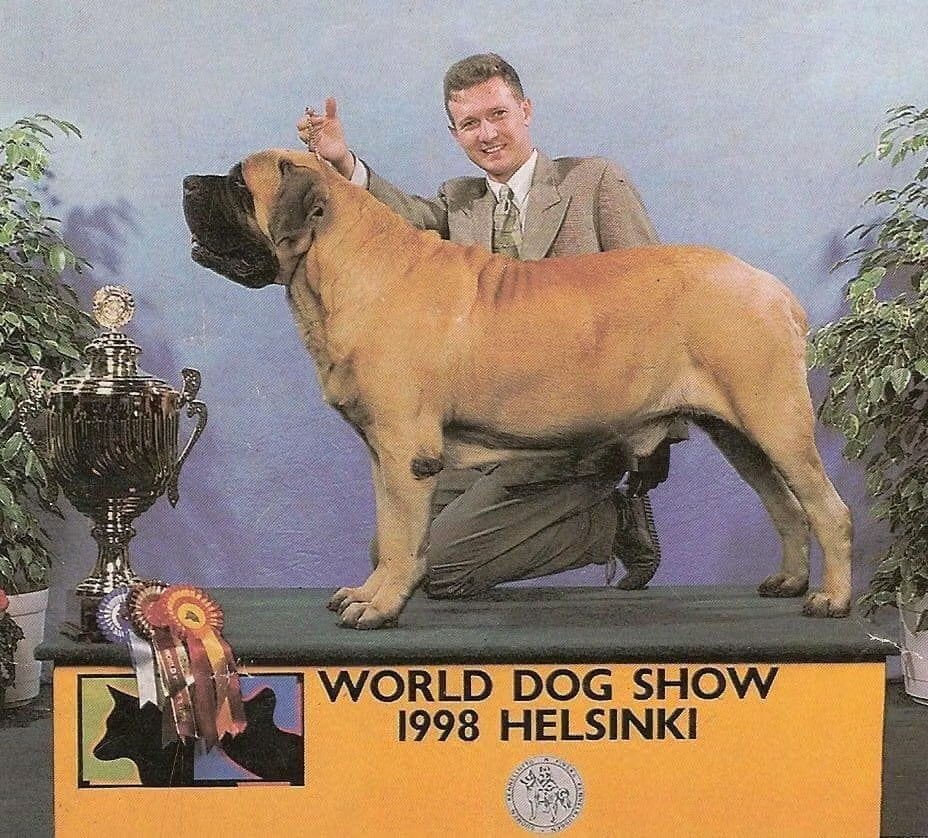


About the Mastiff
The Mastiff is a giant guardian breed from England known for its calm temperament, strong devotion to family, and quiet, dignified nature.
The Mastiff, also known as the English Mastiff or Old English Mastiff, is among the heaviest dog breeds by body mass. An adult male commonly weighs between 70 and 100 kg (150 to 220 lb), and the breed pairs enormous size with a settled, even-tempered nature. It was developed in England to guard homes and livestock, and it still carries those watchful, protective instincts.
Despite its imposing build, the Mastiff is gentle and patient at home. It tends to be quiet, slow to anger, and strongly attached to the people it lives with. The breed is naturally wary of strangers and will place itself between its family and anything it senses as a threat, usually relying on size and presence rather than aggression.
A Mastiff is a serious commitment. Its size means higher food costs, bigger equipment, and a shorter average lifespan than smaller dogs. Owners who accept these trade-offs gain a calm, loyal companion that asks for only moderate exercise but plenty of company.
| Attribute | Detail |
|---|---|
| Origin | England |
| Size | Giant |
| Lifespan | 6 to 10 years |
| Group / role | Working group, guardian dog |
| Good with | Family members and children when supervised; needs early socialisation with strangers and other dogs |
Who the Mastiff suits
The Mastiff suits owners with space, a settled routine, and time at home. It does best in a house with room to move about, and an owner able to manage a very large, powerful dog with a calm hand. It is not a good match for first-time owners after a high-energy exercise partner, for small flats, or for households often away for long stretches. In Singapore, keeping a dog this size in an HDB flat typically requires approval from HDB and the town council, given local size and space restrictions. Budget too for large-breed food, veterinary care, and equipment sized for a 70 kg dog.
History and origin
The Mastiff traces back to large guardian dogs kept in Britain for centuries, refined in England and rebuilt after near-collapse during the World Wars.
Large mastiff-type dogs have been part of life in Britain for a very long time. Roman writers described powerful war and guard dogs among the British tribes, and broad-headed guardian dogs of similar build turn up in English records right through the medieval period. These dogs guarded property and livestock and were used to control or bait large game, work that rewarded size, strength, and steadiness of nerve.
Over the centuries the type was kept on English estates as a guard and gamekeeper's dog. By the nineteenth century, English breeders had begun standardising the Mastiff into something close to today's form, selecting for the heavy head, broad muzzle, and large frame. Early breed clubs and dog shows in Victorian England helped fix the type and keep records of pedigree.
The two World Wars brought the breed to the brink of extinction in Britain. Food shortages made keeping such large dogs difficult, and breeding stock fell to very low numbers. After the Second World War, English breeders rebuilt the Mastiff, drawing partly on dogs that had earlier been exported to North America and elsewhere.
Today the Mastiff is kept mainly as a companion and guardian rather than a working estate dog. It is recognised by the major national kennel clubs, and in Singapore, dogs of the breed are registered through the Singapore Kennel Club, the country's national registry. Its role now centres on family guardianship and the show ring.
Appearance
The Mastiff is a giant, heavily built dog with a broad head, deep muzzle, and a short coat in fawn, apricot, or brindle with a dark mask.
The Mastiff is built for mass and substance. Its body is long, deep through the chest, and powerfully muscled, set on heavy, straight legs. The head is one of the breed's defining features: large and broad, with a short, blunt muzzle, a pronounced stop, and loose skin that falls into folds and a degree of dewlap. The expression reads calm and watchful rather than sharp.
| Trait | Standard |
|---|---|
| Height | Males from about 76 cm (30 in), females from about 70 cm (27.5 in) at the shoulder |
| Weight | Males 70 to 100 kg (150 to 220 lb), females 54 to 77 kg (120 to 170 lb) |
| Coat | Short, dense double coat with a coarse outer layer |
| Colours | Fawn, apricot, and brindle |
| Eyes | Medium-sized, dark hazel, set wide apart |
Coat and colours
The coat is short and lies close to the body, with a coarse outer layer over a finer undercoat. Recognised colours are fawn, apricot, and brindle, where brindle shows fawn or apricot as the base colour carrying dark stripes. A black mask across the muzzle and around the eyes is standard on every colour, and the ears and nose are dark as well. The short coat is easy to maintain, but the breed sheds steadily, with heavier shedding at seasonal coat changes.
What the Mastiff standard says, club by club
Height at the withers for the Mastiff: AKC over 76.2 cm; CKC over 76.2 cm; UKC over 76.2 cm.
Clubs set their own figures for the Mastiff. These come from each club's published standard: AKC, CKC, FCI, KC, UKC.
Size
- Height at the withers, male: AKC over 76.2 cm; CKC over 76.2 cm; UKC over 76.2 cm
- Height at the withers, female: AKC over 69.9 cm; CKC over 69.8 cm; UKC over 69.9 cm
- Skull to muzzle: AKC 2; CKC 2
Sizes that count against it
- Height at the withers, male: Fault: AKC under 76.2 cm
- Height at the withers, female: Fault: AKC under 69.9 cm
Build and forms
At least one club accepts each of these:
- Head shape: Square
- Muzzle length: Short
- Muzzle shape: Blunt, Square
- Bite: Scissors bite, Level bite, Reverse scissors bite, Undershot
- Dentition: Full dentition
- Eye set: Wide-set
- Ear carriage: Drop (pendant)
- Ear set: High
- Ear size: Small
- Neck length: Medium
Forms the clubs penalise
A fault or a disqualification is a judgment under a show standard. It can affect placings and, at some clubs, registration.
- Fault: Muzzle shape: Snipy (AKC); Hocks: Cow-hocked (FCI, KC); Tail carriage: Curled over the back (AKC, CKC, FCI, KC, UKC)
Markings
Each club's ruling on the breed's named marks:
- Chest patch: Alternate (AKC); Fault (FCI, KC)
- Socks: Fault (FCI, KC)
See every point side by side: compare the clubs.
Rulings come from each club's published breed standard, and clubs revise their standards. Before a show or a registration, check the current text with the club.
What does each club give for Height at the withers in the Mastiff?
Height at the withers, male: AKC over 76.2 cm; CKC over 76.2 cm; UKC over 76.2 cm; Height at the withers, female: AKC over 69.9 cm; CKC over 69.8 cm; UKC over 69.9 cm.
Which forms do clubs penalise in the Mastiff?
Fault: Muzzle shape: Snipy (AKC); Hocks: Cow-hocked (FCI, KC); Tail carriage: Curled over the back (AKC, CKC, FCI, KC, UKC).
Which Mastiff colours the clubs accept
Every club we track accepts Fawn, Apricot for the Mastiff.
On the Mastiff, every club we track agrees on Fawn, Apricot. Clubs compared: AKC, FCI, KC, KUSA, UKC.
Patterns listed as standard for the Mastiff: Brindle, Reverse brindle.
Colours penalised in the show ring
A fault or a disqualification is a judgment under a show standard. It can affect placings and, at some clubs, registration.
- Disqualifying: Albino (UKC)
Beyond the main colour
Standards rule on more than the main colour. These are listed as standard:
- Eyes: Brown, Dark brown, Hazel
- Nose: Black
Rulings come from each club's published breed standard, and clubs revise their standards. Before a show or a registration, check the current text with the club.
Which Mastiff colours do all the clubs accept?
All of these clubs accept Fawn, Apricot: AKC, FCI, KC, KUSA, UKC.
Which Mastiff colours are faults or disqualifications?
Disqualifying: Albino (UKC).
Temperament
The Mastiff is calm, devoted, and dignified, gentle with its family and naturally protective and reserved with strangers.
The Mastiff has a steady, good-natured temperament. At home it is calm and affectionate, content to settle near its people, and owners often say it wants to be in whichever room the family occupies. With children in its own household it is usually patient, though its size means young children should always be watched around it.
Toward strangers the breed is reserved and watchful. A well-socialised Mastiff is not needlessly aggressive; it tends to size up a situation and rely on its presence to put off any threat. Early and ongoing socialisation matters, so that natural wariness does not tip into fearfulness or unwanted guarding.
With other pets, a Mastiff raised alongside them is generally tolerant. Same-sex aggression can crop up between intact dogs, and introductions to unfamiliar animals are best done carefully. The breed picks up on the mood of its household quickly and responds far better to calm, consistent handling than to harsh correction.
| Trait | Rating |
|---|---|
| Affection | 5 |
| Energy | 2 |
| Trainability | 3 |
| Vocalness | 2 |
| Shedding | 3 |
Care and grooming
The Mastiff needs simple coat care, moderate daily exercise, and a cool, spacious home suited to a giant, short-muzzled breed.
Grooming
- Brush the short coat once or twice a week, more often during seasonal shedding, to clear away loose hair.
- Clean facial folds and any wrinkles regularly to keep them dry and stop skin irritation setting in.
- Wipe drool from the muzzle and jowls as needed; the breed drools, particularly after eating and drinking.
- Check and clean the ears, trim nails every few weeks, and brush the teeth regularly.
Exercise
- Give moderate daily exercise, such as two walks adding up to roughly 30 to 60 minutes for an adult dog.
- Keep activity low impact, and avoid hard running or jumping in growing puppies to protect developing joints.
- Exercise during the cooler parts of the day; the short muzzle and heavy build make overheating a real risk.
Environment
The Mastiff suits a home with enough indoor space for a very large dog to move about and rest in comfort, ideally with access to a secure, fenced area outside. Singapore is hot and humid all year round, and the breed copes with cold far better than heat, so it should always have shade, fresh water, and a cool spot to lie down, with air-conditioning a genuine help on warm days. It is an indoor companion and should live with the family rather than being kept outdoors.
Grooming a Mastiff
The Mastiff coat: Double coat, Smooth, Short, Moderate shedding. Main grooming rule: Do not shave.
Most of what a Mastiff needs from grooming follows from its coat.
- Coat layers: Double coat
- Coat texture: Smooth
- Coat length: Short
- Shedding: Moderate shedding
What this coat asks of you
- A double coat has a soft undercoat beneath longer guard hairs. Brush right down to the undercoat, because that is the layer that packs down and traps loose hair.
- A smooth coat lies flat and is the easiest kind to keep. A soft brush or a grooming mitt lifts dust and loose hair.
- Short hair rarely tangles but it still sheds, so regular brushing keeps the loose hair down.
- Moderate shedding goes on through the year, and regular brushing catches most of it before it lands on the furniture.
What to tell a groomer
Mention these when you book. The coat notes on this page explain each one.
- Do not shave
A groomer who knows the breed can adapt all of this to the individual animal. Sore skin, mats pressed against the skin or a sudden change in the coat are worth showing to a vet.
What kind of coat does a Mastiff have?
On our records: Coat layers: Double coat; Coat texture: Smooth; Coat length: Short; Shedding: Moderate shedding.
How much does a Mastiff shed?
Moderate shedding goes on through the year, and regular brushing catches most of it before it lands on the furniture.
What should a groomer know about a Mastiff?
These grooming rules apply: Do not shave.
Nutrition and feeding
Mastiffs need a controlled large-breed diet fed in measured meals, with careful portioning to avoid excess weight that strains the joints.
A Mastiff does best on a complete diet formulated for large or giant breeds, which keeps calorie density in check and supports steady growth. Puppies benefit in particular from large-breed puppy food, since rapid growth combined with excess weight raises the risk of joint and bone problems. Because the breed is prone to bloat, meals are usually split across the day, and heavy exercise is avoided around feeding times.
Keep the dog at a lean body condition. Extra weight adds load to the joints and shortens the dog's working lifespan. Adjust portions to the individual dog based on age, activity level, and body condition rather than going by the figures below alone.
| Life stage | Amount per day | Meals |
|---|---|---|
| Puppy (2 to 6 months) | Large-breed puppy food per label, divided | 3 to 4 |
| Junior (6 to 18 months) | Roughly 6 to 10 cups, by growth and condition | 2 to 3 |
| Adult | Roughly 6 to 10 cups, by weight and activity | 2 |
| Senior | Reduced calories for lower activity | 2 |
Treats and supplements
Keep treats to a small share of daily calories so they do not unbalance the diet or pile on weight. Joint supplements such as glucosamine are sometimes used in large breeds, but only introduce a supplement on veterinary advice. Always make sure fresh water is available at all times.
Health
The Mastiff is a giant breed with an average lifespan of 6 to 10 years and is prone to joint, heart, eye, and bloat-related conditions.
The Mastiff is generally a hardy breed, but its great size brings the health concerns common to giant dogs, and its average lifespan of 6 to 10 years is shorter than that of smaller breeds. Keeping the dog lean, supporting its joints through the growing months, and watching for early signs of illness all help protect its quality of life. Buying from a breeder who screens breeding stock for joint, heart, and eye problems lowers the risk of inherited conditions.
| Condition | Signs | Note |
|---|---|---|
| Hip and elbow dysplasia | Stiffness, limping, reluctance to get up | Common in giant breeds; screening the parents helps |
| Gastric dilatation-volvulus (bloat) | Swollen abdomen, retching without bringing anything up, restlessness | A life-threatening emergency; deep-chested breeds carry a higher risk |
| Heart disease (such as cardiomyopathy) | Tires easily, cough, weakness | Screening can pick up some forms early |
| Eye conditions (such as entropion or ectropion) | Eye irritation, discharge, rubbing | Linked to loose facial skin; may need surgical correction |
| Osteosarcoma (bone cancer) | Lameness, swelling on a limb | More frequent in large and giant breeds |
Preventive care
- Keep the dog at a lean weight and feed measured large-breed meals.
- Stay on top of core vaccinations and parasite control on a vet's schedule.
- Book regular checkups, including joint and heart monitoring as the dog gets older.
- Protect growing puppies from hard impact and over-exercise.
- Learn the signs of bloat so you can act at once.
Training
The Mastiff is intelligent but independent, and responds best to early, consistent, reward-based training that builds calm manners while it is still small.
The Mastiff is intelligent and capable but has an independent, occasionally stubborn streak. It is sensitive to its handler and does not take well to harsh methods, which can leave it withdrawn or resistant. Training works best when it stays calm, consistent, and rewarding, and when it starts in puppyhood while the dog is still a manageable size. Good leash manners and reliable basic commands need to be established early, because a full-grown Mastiff is far too strong to correct by force.
Basics
- Start socialisation in early puppyhood, exposing the dog calmly to different people, places, sounds, and other animals.
- Teach loose-leash walking before the puppy grows large and strong.
- Build a reliable recall along with the core cues sit, down, stay, and leave it.
- Keep sessions short, positive, and consistent across everyone in the household.
- Reinforce calm behaviour around visitors so natural guarding instincts stay in check.
Breeding
Mastiff breeding calls for health-screened parents and careful management, with large litters and heavy care demands for dam and puppies.
Breeding Mastiffs is a serious undertaking best left to experienced, responsible breeders. Both parents should be health-tested for hip and elbow dysplasia, heart disease, and eye conditions, and should have sound, stable temperaments. Bitches are usually bred only once fully mature, so growth is complete and the body can support a pregnancy.
Gestation in dogs runs roughly 63 days. Mastiff litters are often large, and given the size of both puppies and dam, whelping can be difficult and sometimes needs veterinary assistance or a caesarean section. The dam and puppies need close monitoring, a warm, clean whelping area, and careful weight tracking through the early weeks.
Puppies grow fast and need a controlled large-breed diet, gentle early socialisation, and protection from hard exercise while their joints develop. Responsible breeders place puppies in suitable homes and screen buyers for the space, time, and budget a giant guardian breed demands.
| Metric | Value |
|---|---|
| Sexual maturity | Around 12 to 24 months; breed only once fully mature |
| Gestation | About 63 days |
| Average litter size | Roughly 5 to 10 puppies |
| Weaning age | About 6 to 8 weeks |
| Whelping note | Large puppies; assisted delivery or caesarean may be needed |
Licensing done? Now register your Mastiff and its chip
AVS handles the licence; United Pet Club keeps a free, searchable record behind your Mastiff's microchip for life.
Registering a Mastiff in Singapore
The Animal & Veterinary Service requires every dog here to be licensed and microchipped by three months of age, so for a Mastiff the chip is settled law. What stays on you is the record behind it. A free United Pet Club profile holds your contact details against the dog for as long as he is yours, and it keeps working even outside Singapore. Registering your dog takes minutes and never costs a cent.
The AVS listing and a searchable contact record are two different things, and the second one is yours to set up. Register the microchip on the free lifetime plan: any chip brand a local vet implants qualifies, updates after a move between flats stay free, and the record can be pulled up 24 hours a day from anywhere. Create your free account and settle it tonight.
How do I register my Mastiff in Singapore?
Set up a free United Pet Club account, key in your Mastiff's details and a photo, and save. The lifetime plan keeps the profile live at no cost for as long as he is with you, alongside whatever AVS requires.
How do I register my Mastiff's microchip?
Key the 15-digit chip number into your free account together with your address, mobile, and email. The lifetime plan covers the registration and every update free, whichever brand the clinic used.
Is a microchip compulsory for a Mastiff in Singapore?
Yes. AVS requires dogs to be licensed and microchipped by three months of age. The licence is the legal part; a registered, searchable record with your current mobile is the part that gets a lost Mastiff home, and that part is free.
How much does it cost to register a Mastiff?
Nothing. United Pet Club's lifetime plan covers the profile, the chip record, and unlimited updates, with no renewal, ever.
Frequently asked questions
Common questions about the Mastiff's size, temperament, care needs, lifespan, and suitability as a family dog.
How big does a Mastiff get?
The Mastiff is a giant breed. Males commonly weigh 70 to 100 kg (150 to 220 lb) and stand from about 76 cm (30 in) at the shoulder, while females are somewhat smaller. It is one of the heaviest dog breeds around.
Are Mastiffs good family dogs?
Yes. Well-socialised Mastiffs are calm and devoted with their families and patient with children in the home. Because of their size, young children should always be supervised around them.
Are Mastiffs difficult to look after?
Grooming is simple, but the breed is demanding in other ways. It needs large amounts of food, equipment sized for a giant dog, careful weight management, and an owner who can handle a very strong animal. Exercise needs are moderate rather than high.
What is the lifespan of a Mastiff?
The average lifespan is about 6 to 10 years, shorter than that of smaller breeds. Keeping the dog lean and staying on top of preventive veterinary care can help it live well within that range.
Do Mastiffs make good guard dogs?
The breed is naturally protective and reserved with strangers, and its size alone is a strong deterrent. A well-socialised Mastiff guards through presence and watchfulness rather than aggression.
Do Mastiffs drool and shed a lot?
Mastiffs drool, especially after eating and drinking, and they shed steadily throughout the year with heavier shedding at seasonal changes. Regular brushing and keeping a towel handy help manage both.
Is a Mastiff suitable for a first-time owner?
It can be a challenge for a first-time owner because of its size, strength, and independent streak. Anyone considering one should be ready for the cost, space, and consistent training a giant guardian breed needs.
From the community
Ask about the MastiffNo questions about the Mastiff yet. Be the first to ask.
Browse Dog breeds