

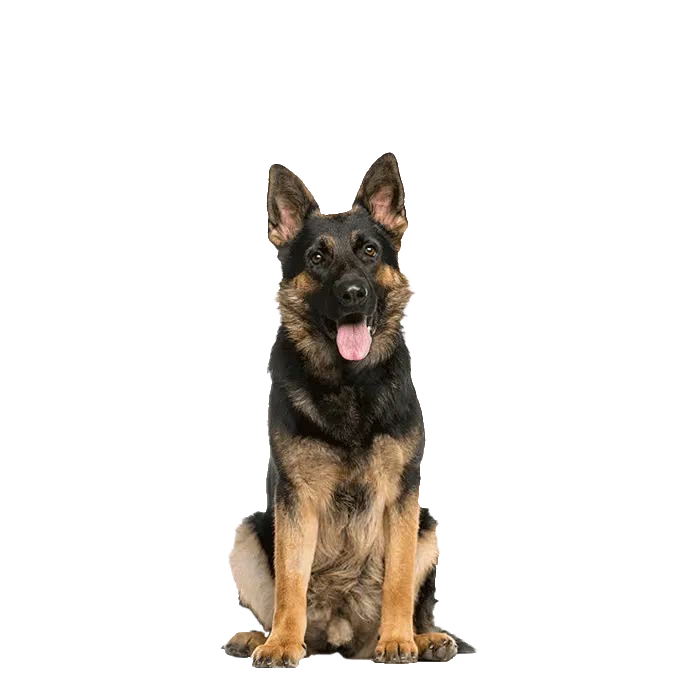
German Shepherd
The German Shepherd is a loyal, intelligent working dog renowned for its courage, versatility, and unwavering devotion.
- Size
- Large
- Lifespan
- 9–13 years
- Origin
- Germany
- Temperament
- Loyal
- Standard colours
- Black, White and Grey and 5 more
Characteristics
Coat and grooming
How the German Shepherd coat is built, and what that means when you groom it.
- Coat layers
- Double coat
- Coat texture
- Plush
- Coat length
- Medium
- Shedding
- Heavy shedding
Grooming guidance
Critical: A German Shepherd should not be shaved.
The undercoat keeps heat out as well as in, and the outer coat shields the skin from sun and insect bites. Clipping the whole coat off removes both. It often grows back patchy, soft or a different colour, and in some animals the guard hairs never return properly. Brush the undercoat out instead of cutting it off.
German Shepherd colours and patterns
What each club's breed standard says about every German Shepherd colour and pattern. Point at a ruling to see the club's own wording.
Breed standards describe the German Shepherd in Black, White, Grey, Silver, Tan, Red, Gold and Cream. Standard patterns: Solid, Bicolour, Sable and Tan point.
| Colour or pattern | FCI | AKC | UKC | KC | KUSA |
|---|---|---|---|---|---|
| Black | Standard (“single-coloured black”) | Standard (“Black”) | Standard (“Black”) | Standard (“all black”) | Standard (“single-coloured black”) |
| White | Disqualifying (“white hair colour (also with dark eyes and nails)”) | Disqualifying (“White”) | Standard (“pure white”) | Fault (“whites (i.e. almost pure white dogs with black noses) and near whites highly undesirable”) | Disqualifying (“white hair colour (also with dark eyes and nails)”) |
| Grey | Standard (“grey with darker shading”) | Standard (“Gray”) | Standard (“Sable (gray ... with black tips)”) | Standard (“all grey”) | Standard (“grey, with darker shading”) |
| Silver | Standard (“black with ... light grey markings”) | Standard (“Black & Silver”) | Standard (“Black and Silver”) | Standard (“gold to light grey markings”) | Standard (“black with ... light grey markings”) |
| Tan | Standard (“black with reddish-brown, brown and yellow to light grey markings”) | Standard (“Black & Tan”) | Standard (“Black and Tan”) | Standard (“black or black saddle with tan”) | Standard (“black with reddish-brown, brown, and yellow, to light grey markings”) |
| Red | Standard (“black with reddish-brown ... markings”) | Standard (“Black & Red”) | Standard (“Black and Red”) | No ruling | Standard (“black with reddish-brown ... markings”) |
| Gold | Standard (“black with ... yellow to light grey markings”) | Standard (“most colors are permissible”) | Not recognised | Standard (“Black & Gold”) | Standard (“black with ... yellow, to light grey markings”) |
| Cream | Standard (“black with ... yellow to light grey markings”) | Standard (“Black & Cream”) | Standard (“Black and Cream”) | Standard (“gold to light grey markings”) | Standard (“black with ... yellow, to light grey markings”) |
| Isabella | Not recognised | Fault (“pale, washed-out colors ... are serious faults”) | Disqualifying (“pale, washed-out colors”) | Alternate (“Isabella”) | Not recognised |
| Albino | Disqualifying (“albinism”) | No ruling | Disqualifying (“albinism”) | Fault (“albinos ... highly undesirable”) | Disqualifying (“albinism”) |
| Blue | Not recognised | Fault (“Blue”) | Disqualifying (“blue”) | Fault (“blues ... highly undesirable”) | Not recognised |
| Liver | Not recognised | Fault (“Liver”) | Disqualifying (“liver”) | Fault (“livers ... highly undesirable”) | Not recognised |
| Patterns | |||||
| Solid | Standard (“single-coloured black”) | Standard (“Black”) | Standard (“Black ... or pure white”) | Standard (“all black, all grey”) | Standard (“single-coloured black”) |
| Bicolour | No ruling | Standard (“Bi-Color”) | Standard (“Bi-color (Black with tan markings)”) | Standard (“Bi-colour: predominantly black, may have tan or gold markings”) | No ruling |
| Sable | Standard (“grey with darker shading”) | Standard (“Sable”) | Standard (“Sable (gray, tan, red, or silver with black tips)”) | Standard (“with lighter or brown markings referred to as Sables”) | Standard (“grey, with darker shading”) |
| Tan point | Standard (“black with reddish-brown, brown and yellow to light grey markings; black saddle”) | Standard (“Black & Tan”) | Standard (“Black and Tan”) | Standard (“black or black saddle with tan, or gold to light grey markings”) | Standard (“black with reddish-brown, brown, and yellow, to light grey markings”) |
| Brindle | No ruling | No ruling | Disqualifying (“brindle”) | No ruling | No ruling |
| Piebald | No ruling | No ruling | Disqualifying (“Panda (characterized by white markings on the muzzle, chest, legs, neck and tip of the tail) ... piebald”) | No ruling | No ruling |
| Reverse brindle | No ruling | No ruling | Disqualifying (“brindle”) | No ruling | No ruling |


| Colour or pattern | FCI | AKC | UKC | KC | KUSA |
|---|---|---|---|---|---|
| Dark brown | Standard (“as dark as possible”) | Standard (“as dark as possible”) | Standard (“as dark as possible”) | Standard (“dark brown preferred”) | Standard (“as dark as possible”) |
| Light brown | Fault (“light, piercing eyes are undesirable”) | No ruling | Fault (“light eyes”) | Standard (“lighter shade tolerated”) | Fault (“light, piercing eyes are undesirable”) |
| Colour or pattern | FCI | AKC | UKC | KC | KUSA |
|---|---|---|---|---|---|
| Black | Standard (“the nose must be black”) | Standard (“nose black”) | Standard (“the nose must be black”) | Standard (“nose black”) | Standard (“nose must be black”) |
What the rulings mean
- Standard
- Described by the club's breed standard.
- Alternate
- Registrable with the club but not described by its breed standard, such as an AKC alternate colour.
- Fault
- Named by the club's breed standard as a fault: the animal can be shown but is penalised.
- Disqualifying
- The club's breed standard disqualifies an animal of this colour or pattern.
- Not recognised
- The club does not accept this colour or pattern for the breed.
Colour changes
How a German Shepherd's colours can change over its life.
Blackchanges toRust
Coat · With body condition · can change back
Blackchanges toGrey
Coat · Progressive
Blackchanges toBrown
Coat · In the sun · can change back
Whitechanges toRoan
Coat · With age · from 2 weeks
Tan pointchanges toSaddle
Coat · With age · from 6 to 156 weeks
Tan pointchanges toSaddle
Coat · With age · from 6 to 156 weeks
Blackchanges toSnow nose
Nose · With the season · can change back
Blackchanges toPink
Nose · With the season · can change back


Sources
Each ruling comes from the club's published breed standard or colour list.
German Shepherd breed standard
What each club's standard asks of the German Shepherd: size, build and forms. A club speaks only for itself, and a figure no club published is left out.
Measurements


Outside the range
- Height at the withers: Male over 66 cm Disqualifying, Male under 59 cm Disqualifying, Female over 61 cm Disqualifying, Female under 54 cm Disqualifying
Conformation
Head shape
Wedge
“The head is wedge-shaped”
Bite
Scissors bite
“The German Shepherd Dog has a scissor bite”
Bite
OvershotFault
“Occlusal overlay, overbite and retrusive occlusion ... are faulty”
Bite
UndershotDisqualifying
“Overshot by 2 mm and more, undershot”
Dentition
Full dentition
“strong, healthy and complete (42 teeth”
Eye shape
Almond
“medium size, almond-shaped, slightly slanted”
Ear carriage
Erect (prick)
“erect ears of medium size, which are carried upright”
Ear carriage
Drop (pendant)Fault
“Tipped ears and drooping ears are faulty.”
Ear carriage
TippedFault
“Tipped ears and drooping ears are faulty.”
Dewlap
None (clean throat)
“without loose neck skin (dewlap)”
Chest
BarrelFault
“a barrel-shaped chest is just as faulty as flat ribs”
Feet
Cat foot
“The paws are rounded, well-closed and arched”


Markings


Cropping, docking and other procedures
- Tail docking: Not recognised “Operative corrections are forbidden.”
Parts of the body


Health
Conditions recorded as more common in the German Shepherd than in its species as a whole. A higher risk is not a diagnosis: many never develop any of them, and your vet can say which screening tests are worth doing.
High risk
- Musculoskeletal system
Canine elbow dysplasia
Strong evidenceHereditaryInheritance: Polygenic - Musculoskeletal system
Canine hip dysplasia
Strong evidenceHereditaryInheritance: PolygenicOMIA entry - Gastrointestinal system
Exocrine pancreatic insufficiency
Strong evidenceHereditaryInheritance: Autosomal recessive
Moderate risk
- Nervous system
Canine degenerative myelopathy
Strong evidenceHereditaryInheritance: Autosomal recessive
This content is for educational purposes and is not a substitute for professional veterinary advice. If you are worried about your pet, contact your veterinarian.
All health conditionsMeet some of our German Shepherd
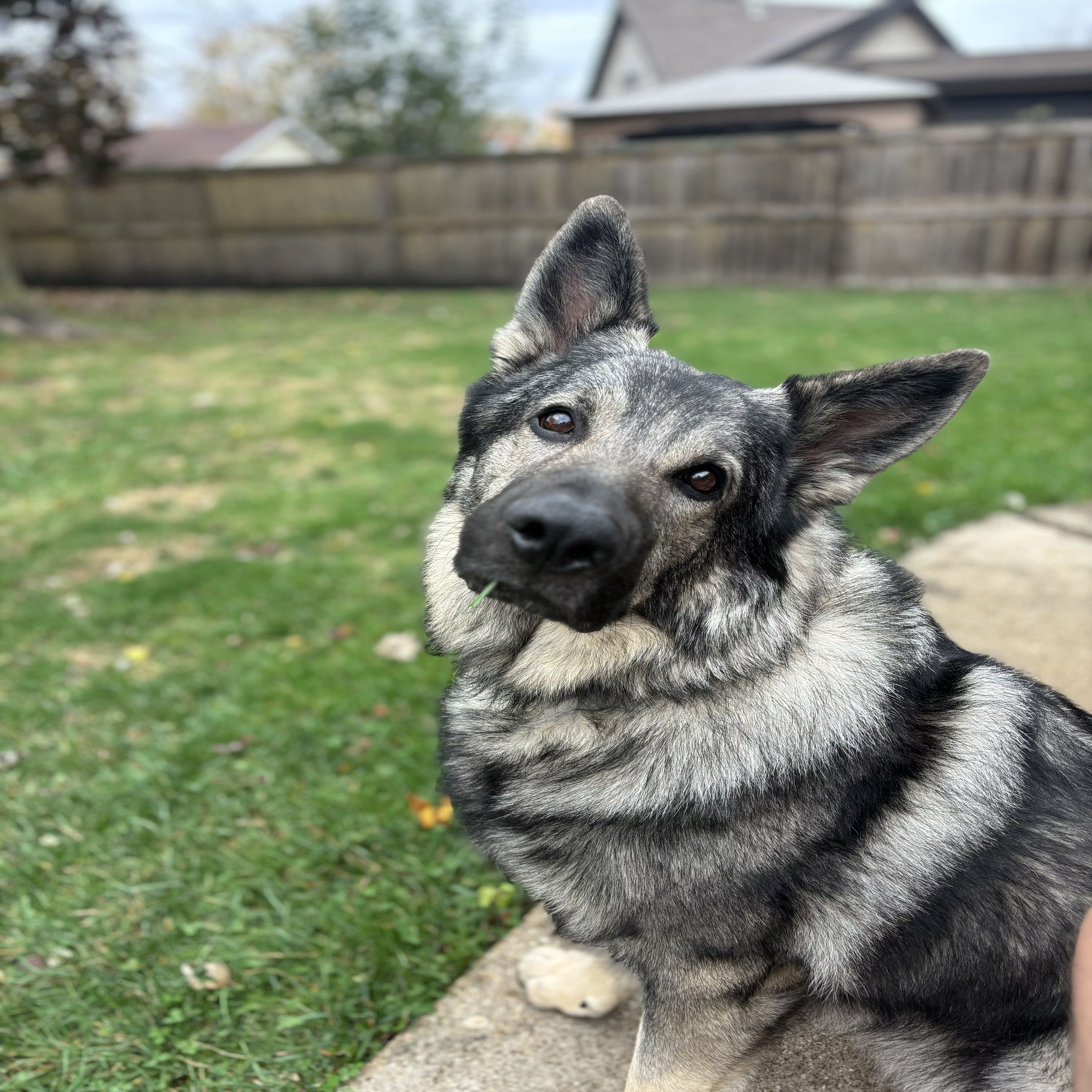
A few of the German Shepherd profiles members have added to United Pet Club.


About the German Shepherd
The German Shepherd is a large working breed from Germany, standing 55 to 65 cm tall and living 9 to 13 years. Widely used by Singapore's police and civil defence services, it is registered with the Singapore Kennel Club (SKC) and suited to private property or condominiums with management approval.
The German Shepherd is a large herding and working breed that originated in Germany in the late 1890s. In Singapore, the breed is one of the most recognisable working dogs and serves extensively with the Singapore Police Force and Singapore Civil Defence Force in patrol, detection, and search-and-rescue roles.
As a large breed, the German Shepherd is not permitted in HDB flats under current regulations. It is suited to private landed housing, or to condominiums and private apartments where management explicitly approves large dogs.
The breed has a deep chest, a confident and ground-covering gait, and is built for endurance rather than speed. The standard colour is black and tan. German Shepherds form strong attachments to their households and require daily physical activity, consistent training, and regular human company to remain settled.
| Item | Detail |
|---|---|
| Origin | Germany (1899) |
| Size | Large (55 to 65 cm at the shoulder) |
| Lifespan | 9 to 13 years |
| Group / role | Herding group; working, police, military, service, and guard roles |
| Good with | Families and children when raised and socialised well; can live with other pets if introduced gradually |
Who the breed suits
The German Shepherd suits active owners who live in private landed property or a condominium that permits large dogs. It works well for working-dog handlers, families prepared to commit to training, and people who want a watchful companion. It is not suited to HDB living, to owners who are away from home for most of the day, or to anyone who cannot provide regular exercise, grooming, and training.
History and origin
The German Shepherd was standardised in Germany in 1899 by Max von Stephanitz, who unified regional herding dogs into a single working breed. It spread internationally after both World Wars and today serves in police, military, and service roles worldwide, including in Singapore.
In 19th-century Germany, herding dogs varied widely from one region to the next. During the 1890s, a group of breeders set out to produce a single consistent type selected above all for working ability rather than appearance.
Max von Stephanitz, a former cavalry officer, acquired a dog named Hektor Linksrhein in 1899, renamed him Horand von Grafrath, and registered him as the founding German Shepherd Dog. That same year he established the Verein für Deutsche Schäferhunde (SV), the breed club that continues to govern the standard in Germany.
As traditional herding gave way to industrialisation, von Stephanitz directed the breed toward police and military roles. German Shepherds were used by German police in the early 1900s and served during the First World War as messenger, patrol, and rescue dogs. Soldiers returning from both world wars brought the breed to Britain, the United States, and beyond.
Public recognition grew further through popular culture, including the Hollywood dog Rin Tin Tin. Over the 20th century, breeding diverged into working lines emphasising drive and temperament, and show lines emphasising conformation, a split that persists today. In Singapore, the breed is recorded with the Singapore Kennel Club (SKC) and has a long-established presence in uniformed service.
Appearance and breed standard
The German Shepherd stands 55 to 65 cm at the shoulder and weighs 22 to 40 kg, with large erect ears, a bushy tail, and a double coat most commonly coloured black and tan. Males are noticeably larger than females.
The German Shepherd has a longer-than-tall build, a deep chest, and a wedge-shaped head with large, upright ears. The tail is bushy and hangs in a slight curve at rest. The gait is smooth and far-reaching, a feature bred in for tireless herding and patrol work. Males are considerably heavier and taller than females.
| Trait | Detail |
|---|---|
| Height | Males 60 to 65 cm; females 55 to 60 cm at the shoulder |
| Weight | Males 30 to 40 kg; females 22 to 32 kg |
| Coat | Double coat; dense outer coat over a softer undercoat. Short to medium length; a long-coated variety also occurs |
| Colours | Black and tan, black and red, sable, solid black, and bicolour. White is recognised by some registries but not all |
| Eyes | Medium-sized, almond-shaped, dark brown preferred |
Coat and colours
The standard coat is medium length with a thick undercoat that sheds heavily twice a year. The most common pattern is black and tan with a dark saddle across the back. Sable dogs carry banded hairs that give a grizzled appearance overall. Solid black and bicolour individuals also occur.
In Singapore's heat and humidity, a neglected undercoat can mat against the skin and trap moisture, leading to skin irritation or infection. Regular brushing is therefore both a cosmetic and a health requirement. The long-coated variety carries additional feathering on the legs and tail and demands more frequent attention in this climate.
What the German Shepherd standard says, club by club
Height at the withers for the German Shepherd: AKC 61-66 cm; CKC 61-66 cm; FCI 60-65 cm; KC 60.5-65.5 cm; UKC 61-66 cm.
Clubs set their own figures for the German Shepherd. These come from each club's published standard: AKC, CKC, FCI, KC, UKC.
Size
- Height at the withers, male: AKC 61-66 cm; CKC 61-66 cm; FCI 60-65 cm; KC 60.5-65.5 cm; UKC 61-66 cm
- Height at the withers, female: AKC 55.9-61 cm; CKC 56-61 cm; FCI 55-60 cm; KC 55.5-60.5 cm; UKC 55.9-61 cm
- Weight, male: CKC 34-38.5 kg; FCI 30-40 kg
- Weight, female: CKC 27.2-31.8 kg; FCI 22-32 kg
- Height to length: AKC 0.8; FCI 0.8-0.9; KC 0.8-0.9; UKC 0.9
- Skull to muzzle: FCI 1
- Shoulder angle: FCI under 110°; KC 90°
Sizes that count against it
- Height at the withers, male: Disqualifying: FCI over 66 cm, FCI under 59 cm
- Height at the withers, female: Disqualifying: FCI over 61 cm, FCI under 54 cm
Build and forms
At least one club accepts each of these:
- Head shape: Wedge
- Stop: Slight
- Bite: Scissors bite
- Dentition: Full dentition
- Eye shape: Almond
- Ear carriage: Erect (prick)
- Ear set: High
- Neck length: Long
- Dewlap: None (clean throat)
- Topline: Level, Sloping to the rear
Forms the clubs penalise
A fault or a disqualification is a judgment under a show standard. It can affect placings and, at some clubs, registration.
- Disqualifying: Bite: Undershot (AKC, FCI, UKC); Bite: Wry mouth (UKC); Ear carriage: Drop (pendant) (AKC, CKC, UKC); Ear carriage: Tipped (UKC)
- Fault: Stop: None (CKC); Bite: Undershot (CKC); Bite: Overshot (AKC, CKC, FCI, UKC); Bite: Level bite (AKC, UKC); Dentition: Missing teeth (AKC, UKC); Ear carriage: Drop (pendant) (FCI); Ear carriage: Tipped (FCI); Topline: Roach (arched) (KC, UKC); Topline: Swayback (UKC); Chest: Barrel (FCI, UKC)
Cropping, docking and other procedures
- Ear cropping: Disqualifying (AKC, CKC, UKC)
- Tail docking: Disqualifying (AKC, CKC); Not recognised (FCI)
- Dewclaw removal: Standard (AKC); Alternate (UKC)
This is each club's stance in the show ring, not the law. The law on these procedures differs by country.
Markings
Each club's ruling on the breed's named marks:
- Star: Alternate (UKC); Fault (FCI)
- Chest patch: Fault (KC)
- Tan points: Alternate (KC)
See every point side by side: compare the clubs.
Rulings come from each club's published breed standard, and clubs revise their standards. Before a show or a registration, check the current text with the club.
What does each club give for Height at the withers in the German Shepherd?
Height at the withers, male: AKC 61-66 cm; CKC 61-66 cm; FCI 60-65 cm; KC 60.5-65.5 cm; UKC 61-66 cm; Height at the withers, female: AKC 55.9-61 cm; CKC 56-61 cm; FCI 55-60 cm; KC 55.5-60.5 cm; UKC 55.9-61 cm.
Which forms do clubs penalise in the German Shepherd?
Disqualifying: Bite: Undershot (AKC, FCI, UKC); Bite: Wry mouth (UKC); Ear carriage: Drop (pendant) (AKC, CKC, UKC); Ear carriage: Tipped (UKC). Fault: Stop: None (CKC); Bite: Undershot (CKC); Bite: Overshot (AKC, CKC, FCI, UKC); Bite: Level bite (AKC, UKC); Dentition: Missing teeth (AKC, UKC); Ear carriage: Drop (pendant) (FCI); Ear carriage: Tipped (FCI); Topline: Roach (arched) (KC, UKC); Topline: Swayback (UKC); Chest: Barrel (FCI, UKC).
Which German Shepherd colours the clubs accept
Every club we track accepts Black, Grey, Silver, Tan, Cream for the German Shepherd.
On the German Shepherd, every club we track agrees on Black, Grey, Silver, Tan, Cream. Clubs compared: AKC, FCI, KC, KUSA, UKC.
Patterns listed as standard for the German Shepherd: Solid, Bicolour, Sable, Tan point.
Where the clubs split
At least one club accepts each of these, and at least one other penalises or refuses it.
- White: Standard (UKC); Fault (KC); Disqualifying (AKC, FCI, KUSA)
- Gold: Standard (AKC, FCI, KC, KUSA); Not recognised (UKC)
- Isabella: Alternate (KC); Fault (AKC); Disqualifying (UKC); Not recognised (FCI, KUSA)
Colours penalised in the show ring
A fault or a disqualification is a judgment under a show standard. It can affect placings and, at some clubs, registration.
- Disqualifying: Brindle (UKC), Piebald (UKC), White (AKC, FCI, KUSA), Albino (FCI, KUSA, UKC), Blue (UKC), Reverse brindle (UKC), Liver (UKC), Isabella (UKC)
- Fault: White (KC), Albino (KC), Blue (AKC, KC), Liver (AKC, KC), Isabella (AKC)
Beyond the main colour
Standards rule on more than the main colour. These are listed as standard:
- Eyes: Dark brown, Light brown
- Nose: Black
Rulings come from each club's published breed standard, and clubs revise their standards. Before a show or a registration, check the current text with the club.
Which German Shepherd colours do all the clubs accept?
All of these clubs accept Black, Grey, Silver, Tan, Cream: AKC, FCI, KC, KUSA, UKC.
Do clubs disagree about German Shepherd colours?
Yes. Clubs rule differently on White, Gold, Isabella.
Which German Shepherd colours are faults or disqualifications?
Disqualifying: Brindle (UKC), Piebald (UKC), White (AKC, FCI, KUSA), Albino (FCI, KUSA, UKC), Blue (UKC), Reverse brindle (UKC), Liver (UKC), Isabella (UKC). Fault: White (KC), Albino (KC), Blue (AKC, KC), Liver (AKC, KC), Isabella (AKC).
Temperament and behaviour
German Shepherds are alert, loyal, and highly trainable. They bond closely with their households, are reserved around strangers, and need early, broad socialisation to remain well adjusted. Insufficient activity and company reliably produce behavioural problems.
The German Shepherd is a confident, attentive breed with a strong drive to work alongside its handler. It picks up commands quickly and retains them well, which underpins its use across police, military, and service roles.
With family members, including children, it is affectionate and watchful. It tends to monitor the household and will bark to signal strangers or unusual activity. Around unfamiliar people it is typically reserved rather than immediately friendly, and early, broad socialisation is necessary to prevent over-guarding or anxiety. In a city like Singapore, where lifts, crowded void decks, and frequent encounters with strangers are part of daily life, a poorly socialised German Shepherd can become difficult to manage in public.
With other dogs and pets, the breed can coexist well when introductions are managed gradually. Its herding background can surface as chasing or nipping at fast-moving animals or small children. Without adequate exercise, company, and a clear sense of structure, barking, destructive chewing, and anxiety are common outcomes.
| Trait | Rating |
|---|---|
| Affection | 4 |
| Energy | 5 |
| Trainability | 5 |
| Vocalness | 3 |
| Shedding | 5 |
Care and grooming
Singapore's heat means German Shepherds must exercise in the early morning or after dark to avoid heat stroke. The double coat needs brushing two to three times a week, more often during seasonal sheds. This breed is not suited to being left alone without activity for long periods.
Exercise in Singapore's climate
- Walk the dog before 8 am or after 8 pm to avoid peak heat and humidity
- On particularly hot afternoons, keep outdoor activity brief and watch for heavy panting, excessive drooling, glazed eyes, or stumbling, which are early signs of heat stroke
- Test the pavement surface with your hand before walking; hot concrete and tar can burn paw pads
- Choose parks with shade over open concrete areas
- Combine walking with training, fetch, or scent games to meet the breed's mental as well as physical needs
- Provide constant access to cool fresh water, and consider a cooling mat indoors under aircon
Grooming
- Brush two to three times a week, and daily during the twice-yearly heavy shed
- In humid conditions, check the skin beneath the undercoat for moisture-related irritation or hot spots
- Bathe every four to six weeks or when the dog is dirty; frequent bathing strips coat oils
- Trim nails every three to four weeks
- Clean the upright ears regularly, as humidity raises the risk of ear infections
- Brush teeth several times a week
Environment
The German Shepherd is a large breed and is not permitted in HDB flats. It is suited to private landed housing, or to condominiums and private apartments where management explicitly permits dogs of this size. A securely fenced outdoor area or consistent access to a park is important. The breed does not tolerate long periods of confinement without activity, and owners who are away from home for most of the day will find the dog becomes destructive or vocal. In Singapore, all dog owners must comply with NParks and the Animal and Veterinary Service (AVS) licensing requirements, maintain mandatory microchipping, and keep the dog on a leash in all public areas.
Grooming a German Shepherd
The German Shepherd coat: Double coat, Plush, Medium, Heavy shedding. Main grooming rule: Do not shave.
Most of what a German Shepherd needs from grooming follows from its coat.
- Coat layers: Double coat
- Coat texture: Plush
- Coat length: Medium
- Shedding: Heavy shedding
What this coat asks of you
- A double coat has a soft undercoat beneath longer guard hairs. Brush right down to the undercoat, because that is the layer that packs down and traps loose hair.
- A plush coat is dense and soft, so a gentle brush that reaches the base of the hair works better than a stiff one.
- Medium-length hair starts to tangle wherever it rubs, so pay attention to those spots.
- Heavy shedding means loose hair most of the year. Frequent brushing helps, and so does a plan for the furniture.
What to tell a groomer
Mention these when you book. The coat notes on this page explain each one.
- Do not shave
A groomer who knows the breed can adapt all of this to the individual animal. Sore skin, mats pressed against the skin or a sudden change in the coat are worth showing to a vet.
What kind of coat does a German Shepherd have?
On our records: Coat layers: Double coat; Coat texture: Plush; Coat length: Medium; Shedding: Heavy shedding.
How much does a German Shepherd shed?
Heavy shedding means loose hair most of the year. Frequent brushing helps, and so does a plan for the furniture.
What should a groomer know about a German Shepherd?
These grooming rules apply: Do not shave.
Nutrition and feeding
German Shepherds need a complete diet built around quality animal protein, split into two daily meals to reduce bloat risk. Adults typically eat about 2.5 to 3.5 cups of dry food a day, adjusted for age, weight, and activity level.
Choose a complete, balanced food suited to the dog's life stage and activity level. As a large, active breed, the German Shepherd does well on food with quality animal protein and moderate fat. Puppies should eat a large-breed puppy formula, which controls calcium and growth rate to protect developing joints. Split the daily allowance into two meals rather than one: deep-chested breeds are prone to bloat (gastric dilatation-volvulus), and a single large meal increases the risk. Avoid vigorous activity for at least an hour before and after eating. Fresh water must be available at all times. Monitor body condition regularly, as excess weight places additional strain on the hips and elbows, which are already a concern in this breed.
| Life stage | Amount per day | Meals per day |
|---|---|---|
| Puppy (2 to 6 months) | Per large-breed puppy formula label, by weight | 3 to 4 |
| Puppy (6 to 12 months) | Per label, by weight | 2 to 3 |
| Adult | About 2.5 to 3.5 cups of dry food | 2 |
| Senior or less active | About 2 to 3 cups, reduced for activity | 2 |
Treats and supplements
Limit treats to roughly 10 per cent of the dog's daily caloric intake and account for them when calculating the total. Many owners use a portion of the dog's regular kibble as training rewards rather than adding separate treats. Joint supplements such as glucosamine and omega-3 fatty acids are sometimes used for breeds at higher risk of hip and elbow problems, but discuss any supplementation with a vet before starting.
Health and common conditions
German Shepherds live about 9 to 13 years and are prone to hip and elbow dysplasia, degenerative myelopathy, and bloat. Buying from health-tested parents and maintaining a lean body weight are the most effective ways to reduce the risk of serious inherited conditions.
The German Shepherd is generally sturdy but carries a known set of hereditary and structural health risks associated with its size and build. Lifespan is typically 9 to 13 years. Purchasing from a breeder who provides verified hip and elbow scores and genetic test results lowers the risk of the most serious inherited problems. Singapore's climate introduces additional considerations: the dog must have permanent access to shade and cool water, and owners should remain alert to heat stroke on warm days. The humidity can also promote skin and ear infections, particularly in dogs whose coats are not groomed regularly.
| Condition | Signs | Note |
|---|---|---|
| Hip dysplasia | Stiffness, limping, difficulty rising, reluctance to jump | Hereditary; screened with hip scoring before breeding |
| Elbow dysplasia | Front-leg lameness, particularly after exercise | Hereditary joint malformation; managed with weight control and treatment |
| Degenerative myelopathy | Progressive hind-limb weakness and loss of coordination | Incurable spinal cord disease; a DNA test for risk is available |
| Bloat (GDV) | Swollen abdomen, retching without vomiting, restlessness, collapse | Life-threatening emergency; requires immediate veterinary care |
| Exocrine pancreatic insufficiency | Weight loss despite normal appetite, loose pale stools | Treated with lifelong enzyme supplementation |
Preventive care
- Keep vaccinations and parasite prevention up to date according to your vet's schedule
- Schedule annual check-ups; seniors benefit from more frequent visits
- Keep the dog lean throughout its life to reduce stress on hips and elbows
- Feed two meals a day and avoid strenuous activity immediately before or after eating
- Ask the breeder for hip, elbow, and genetic screening documentation before purchasing a puppy
Training the German Shepherd
The German Shepherd is one of the most trainable breeds, with high intelligence and a strong drive to work with its handler. Socialisation beginning in puppyhood, combined with consistent reward-based training, produces a well-adjusted dog in an urban environment.
Few breeds respond to training as readily as the German Shepherd. It learns quickly, retains commands reliably, and seeks direction from its handler, qualities that account for its service with the Singapore Police Force and similar organisations worldwide. That same drive means an under-stimulated German Shepherd will find its own outlets, and they are rarely welcome ones.
In Singapore, socialisation takes on particular importance. Puppies need exposure to lifts, crowded void decks, public transport sounds, and a wide variety of people and other dogs before fixed responses develop. A German Shepherd that finds city environments stressful is difficult to manage in public and can become defensive when startled.
Basics
- Begin socialisation in the first few months: expose the puppy to varied people, dogs, surfaces, and sounds
- Establish name recognition and a reliable recall before moving on to other commands
- Build the core commands: sit, down, stay, come, and walking on a loose lead
- Keep sessions short, around 5 to 15 minutes, and end each one while the dog is succeeding
- Add structured activities such as obedience classes, scent work, or agility as the dog matures
- Keep rules consistent across all household members
Breeding and raising puppies
Female German Shepherds typically have their first heat between 6 and 12 months, but responsible breeders wait until around two years when health testing is complete. Gestation is about 63 days and litters average 6 to 8 puppies.
Female German Shepherds generally come into their first heat between 6 and 12 months of age. Responsible breeders wait until the female is approximately two years old and has completed hip, elbow, and genetic health screening before breeding. Mating is timed to coincide with the fertile window of the heat cycle. Gestation lasts around 63 days, and litters typically contain 6 to 8 puppies, though both smaller and larger litters occur.
Newborns are blind and deaf and depend entirely on the dam for warmth and nutrition through the first weeks. Eyes open at around two weeks and weaning begins between three and four weeks of age. The window from approximately 3 to 14 weeks is the most sensitive socialisation period: good breeders handle puppies regularly and expose them to varied sights, sounds, and surfaces during this time. Puppies are generally placed in new homes at 8 weeks or older. In Singapore, breeders and buyers must comply with AVS licensing and mandatory microchipping requirements, and buyers should confirm the puppy is registered and microchipped before collection.
| Metric | Value |
|---|---|
| Female sexual maturity | First heat around 6 to 12 months |
| Recommended breeding age | Around 2 years, after health testing |
| Gestation | About 63 days |
| Average litter size | 6 to 8 puppies |
| Eyes open | Around 14 days |
| Weaning | About 3 to 4 weeks |
| Go to new homes | 8 weeks or later |
Licensing done? Now register your German Shepherd and its chip
AVS handles the licence; United Pet Club keeps a free, searchable record behind your German Shepherd's microchip for life.
Registering a German Shepherd in Singapore
The Animal & Veterinary Service requires every dog here to be licensed and microchipped by three months of age, so for a German Shepherd the chip is settled law. What stays on you is the record behind it. A free United Pet Club profile holds your contact details against the dog for as long as he is yours, and it keeps working even outside Singapore. Registering your dog takes minutes and never costs a cent.
The AVS listing and a searchable contact record are two different things, and the second one is yours to set up. Register the microchip on the free lifetime plan: any chip brand a local vet implants qualifies, updates after a move between flats stay free, and the record can be pulled up 24 hours a day from anywhere. Create your free account and settle it tonight.
How do I register my German Shepherd in Singapore?
Set up a free United Pet Club account, key in your German Shepherd's details and a photo, and save. The lifetime plan keeps the profile live at no cost for as long as he is with you, alongside whatever AVS requires.
How do I register my German Shepherd's microchip?
Key the 15-digit chip number into your free account together with your address, mobile, and email. The lifetime plan covers the registration and every update free, whichever brand the clinic used.
Is a microchip compulsory for a German Shepherd in Singapore?
Yes. AVS requires dogs to be licensed and microchipped by three months of age. The licence is the legal part; a registered, searchable record with your current mobile is the part that gets a lost German Shepherd home, and that part is free.
How much does it cost to register a German Shepherd?
Nothing. United Pet Club's lifetime plan covers the profile, the chip record, and unlimited updates, with no renewal, ever.
Frequently asked questions
Common questions from Singapore owners about German Shepherd housing restrictions, size, heat tolerance, coat care, lifespan, licensing, and trainability.
Can I keep a German Shepherd in an HDB flat?
No. The German Shepherd is a large breed and is not on the HDB's approved list for flat dwellers. It is suited to private landed housing, or to condominiums and private apartments where management explicitly permits dogs of this size.
How big does a German Shepherd get?
It is a large breed. Males stand about 60 to 65 cm at the shoulder and weigh 30 to 40 kg. Females stand about 55 to 60 cm and weigh 22 to 32 kg.
Can a German Shepherd cope with Singapore's heat?
With consistent management, yes. Walks should be scheduled before 8 am or after 8 pm to avoid peak heat. Indoors, the dog needs access to cool water and aircon. Never leave a German Shepherd outdoors in direct sun. Early signs of heat stroke include heavy panting, excessive drooling, glazed eyes, and stumbling, and these require immediate action.
Do German Shepherds shed a lot?
Yes. The double coat sheds year-round and very heavily during two seasonal blows. In Singapore's humidity, neglected undercoat can mat against the skin, so brushing two to three times a week is the minimum, with daily brushing during heavy shedding periods.
How long do German Shepherds live?
Most live about 9 to 13 years. Keeping the dog lean, providing regular exercise, and addressing joint problems early all contribute to a longer, more comfortable life.
What licensing does a German Shepherd require in Singapore?
All dogs in Singapore must be licensed through the National Parks Board (NParks) and the Animal and Veterinary Service (AVS). Microchipping is mandatory and the dog must be kept on a leash in all public spaces. Check current AVS guidelines for any breed-specific conditions that apply to large dogs.
Are German Shepherds difficult to train?
They are among the easiest breeds to train. High intelligence and a strong drive to work with their handler make them fast learners. They need daily mental stimulation and a clear structure: without consistent training and sufficient exercise, barking, destructive behaviour, and anxiety are common outcomes.
From the community
Ask about the German ShepherdNo questions about the German Shepherd yet. Be the first to ask.
Browse Dog breeds