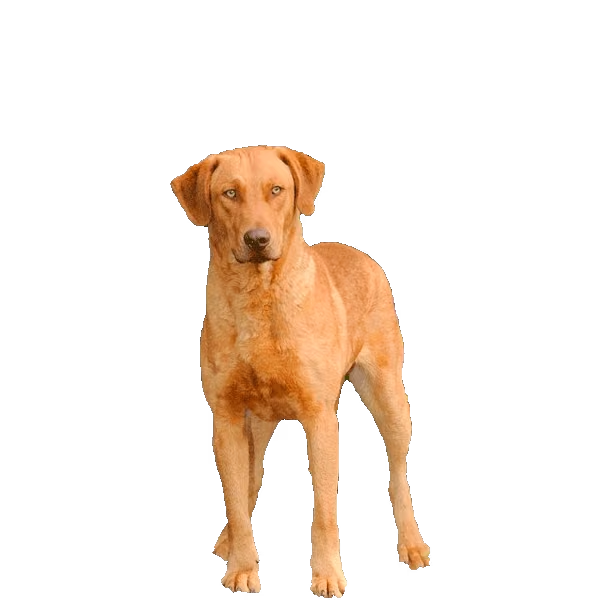
The Chesapeake Bay Retriever is a powerful, devoted American water dog, bred to brave icy waters with courage and unwavering loyalty.
How the Chesapeake Bay Retriever coat is built, and what that means when you groom it.
Critical: A Chesapeake Bay Retriever should not be shaved.
The undercoat keeps heat out as well as in, and the outer coat shields the skin from sun and insect bites. Clipping the whole coat off removes both. It often grows back patchy, soft or a different colour, and in some animals the guard hairs never return properly. Brush the undercoat out instead of cutting it off.
Information: A Chesapeake Bay Retriever drops its undercoat in heavy bursts.
The undercoat comes out in heavy bursts over a few weeks. An undercoat rake, or a bath followed by a proper blow-dry, clears it far faster than daily brushing. Clipping the coat down is not a shortcut for this.
A few of the Chesapeake Bay Retriever profiles members have added to United Pet Club.
The Chesapeake Bay Retriever is a large American water retriever bred to recover waterfowl from the cold currents of Chesapeake Bay. It is devoted, intelligent and built for hard work.
The Chesapeake Bay Retriever is a large gundog developed in the United States to retrieve ducks and geese from the rough, cold waters of Chesapeake Bay. It is one of the few retriever breeds that originated in North America. The breed is known for a dense, oily double coat that lets it work in icy conditions that would stop many other dogs.
The "Chessie" is a powerful, athletic dog with strong hindquarters and a deep chest. It forms a close bond with its family and tends to attach to one or two people in particular. Compared with other retrievers, it is more reserved with strangers and more inclined to guard its home.
The breed combines a strong work drive with a stubborn, independent streak. It needs an owner who can provide steady leadership, daily activity and regular tasks to stay balanced.
| Attribute | Detail |
|---|---|
| Origin | United States |
| Size | Large |
| Lifespan | 10 to 13 years |
| Group / role | Sporting group, water retriever |
| Good with | Family members, older children and pets it is raised with |
The Chesapeake Bay Retriever fits active households that can give it real exercise every day and a job to focus on. It works well for people who hunt, swim or train in dog sports. It is less suited to first-time owners, flat or condo living, or homes that are away for long hours, because its energy and independent nature can lead to problem behaviour without an outlet.
The breed traces to two Newfoundland-type dogs rescued from a shipwreck off Maryland in 1807, crossed with local retrievers to create a water dog suited to Chesapeake Bay.
The breed's origin story begins in 1807, when an English ship wrecked off the coast of Maryland. Two dogs aboard, a male and a female of a Newfoundland type, were saved along with the crew. The dogs were given to local families along the bay.
These dogs were bred with local retrieving and hound-type dogs used by waterfowl hunters in the region. Over the following decades, hunters along Chesapeake Bay selected dogs that could retrieve large numbers of ducks from cold, choppy water and break through ice. The result was a hardy water dog with a dense, water-resistant coat.
By the late 1800s the type had become consistent enough to be recognised as a distinct breed. The American Kennel Club registered the Chesapeake Bay Retriever in 1878, making it one of the earliest breeds in the registry. Market hunters of the era valued individual dogs that could retrieve well over a hundred birds in a single day.
The breed remained closely tied to its working role through the 20th century. It is the official state dog of Maryland, which reflects its long connection to the bay region. Today it is kept both as a hunting companion and a family dog, though it is far less common than the Labrador or Golden Retriever.
The Chesapeake Bay Retriever is a strong, medium-to-large dog with a wavy, oily double coat in shades of brown, sedge and deadgrass and yellow to amber eyes.
The Chesapeake Bay Retriever is a balanced, powerfully built dog with strong, well-muscled hindquarters that stand slightly higher than the front, which aids its swimming. The chest is deep and the body is slightly longer than it is tall. The head is broad with a medium-length muzzle, and the ears are small and set high.
The most recognisable feature is the coat. It is short and dense with a thick, woolly undercoat and a harsh, oily outer layer that sheds water and resists cold. The coat may show a slight wave over the shoulders, neck, back and loins, but it should not be curly.
| Trait | Detail |
|---|---|
| Height | Males 23 to 26 inches; females 21 to 24 inches at the shoulder |
| Weight | Males 65 to 80 pounds; females 55 to 70 pounds |
| Coat | Short, dense double coat with an oily, water-resistant outer layer and woolly undercoat |
| Colours | Brown, sedge (reddish) and deadgrass (tan to straw) |
| Eyes | Yellow to amber, medium-large and wide-set |
The breed comes in three colour ranges: brown in any shade, sedge in red to chestnut tones and deadgrass in pale tan to dull straw. Colours that match the dog's working environment were favoured so the dog could blend into marsh and field. Small white spots on the chest, belly, toes or back of the feet are allowed. The oily texture of the coat gives it a faint odour when wet and helps water bead off quickly.
The Chesapeake Bay Retriever is devoted and protective with its own family, more reserved than other retrievers with strangers, and intelligent but independent-minded.
The Chesapeake Bay Retriever is loyal and affectionate with its family and often bonds most closely with one or two people. It is calmer and more serious in temperament than the Labrador or Golden Retriever. With people it knows, it is steady and devoted.
With strangers the breed is reserved and watchful. It has a natural guarding instinct and will alert its household to visitors or unusual activity, which makes it an effective watchdog. Early and ongoing socialisation is needed so this caution does not turn into suspicion or aggression.
With children, the breed is generally patient with members of its own family, and it suits homes with older children who understand how to behave around a large dog. It can live well with other pets, especially when raised with them, though some individuals are dominant with unfamiliar dogs of the same sex.
The breed is intelligent and learns quickly, but it is also independent and can be stubborn. It tends to think for itself rather than follow commands automatically, which is part of what made it effective working alone in the water.
| Trait | Rating |
|---|---|
| Affection | 4 |
| Energy | 5 |
| Trainability | 3 |
| Vocalness | 2 |
| Shedding | 3 |
The Chesapeake Bay Retriever needs weekly brushing, heavy daily exercise including swimming where possible, and a home with space and an active routine.
The breed does best in a home with a securely fenced yard and an active family. It tolerates cold and wet weather well thanks to its coat, but in Singapore's heat and humidity it needs shade, water and rest during the warmest hours. It is not suited to flat or condo life or to being left alone for long stretches, since under-exercised dogs may dig, chew or bark.
Feed a complete, large-breed diet matched to the dog's age and activity level, split into two meals a day, and watch portions to prevent weight gain.
The Chesapeake Bay Retriever does well on a complete, balanced diet formulated for large, active dogs. Working and sporting dogs need more calories than pets with a quieter routine, so adjust the amount to the individual dog's activity and body condition. A diet with adequate protein supports the breed's muscle and stamina. Measure meals rather than feeding free-choice, because the breed can gain weight if overfed and under-exercised. Always provide fresh water, especially after exercise.
| Life stage | Amount per day | Meals per day |
|---|---|---|
| Puppy (2 to 6 months) | Per puppy-food label by weight | 3 to 4 |
| Puppy (6 to 12 months) | Per puppy-food label by weight | 2 to 3 |
| Adult | Roughly 2.5 to 3.5 cups of dry food | 2 |
| Senior / less active | Reduced portion to maintain weight | 2 |
Keep treats to no more than about ten percent of daily calories to avoid weight gain. A diet from a reputable manufacturer usually supplies all needed nutrients, so supplements are not necessary for most healthy dogs. Talk to a vet before adding joint or other supplements, particularly for growing puppies or older dogs.
The Chesapeake Bay Retriever is generally a hardy breed with a lifespan of 10 to 13 years, though it can be affected by hip dysplasia, eye disorders and certain inherited conditions.
The Chesapeake Bay Retriever is a robust, working breed with a typical lifespan of 10 to 13 years. Responsible breeders screen their dogs for inherited conditions, which reduces the risk in puppies. Keeping the dog at a healthy weight and providing regular exercise supports long-term joint and overall health.
| Condition | Signs | Note |
|---|---|---|
| Hip dysplasia | Stiffness, limping, trouble rising | Inherited joint malformation; breeders should screen hips |
| Elbow dysplasia | Front-leg lameness, reduced activity | Affects the elbow joint; screening is available |
| Progressive retinal atrophy | Night blindness, declining vision | Inherited eye disease; a DNA test exists |
| Cataracts | Cloudy eye, vision loss | May be inherited; can sometimes be treated surgically |
| Exercise-induced collapse | Weakness or collapse after intense activity | Inherited; a DNA test is available |
| Bloat (gastric torsion) | Swollen abdomen, retching, restlessness | A medical emergency in deep-chested dogs |
The Chesapeake Bay Retriever is intelligent but independent and stubborn, so it responds best to consistent, reward-based training started early.
The Chesapeake Bay Retriever learns quickly but has a mind of its own. It may test boundaries and will not respond well to harsh handling or repetitive drilling. Calm, consistent training with clear rules and rewards works best. Because the breed is reserved with strangers and protective of its home, early and broad socialisation is important so it grows up confident rather than wary.
Females reach maturity within the first one to two years, gestation lasts about 63 days, and litters usually contain seven to ten puppies.
Chesapeake Bay Retrievers reach sexual maturity in the first one to two years, though responsible breeders wait until a dog is physically mature and has passed health screening before breeding. Females typically come into season about twice a year. Health testing of both parents for hip, elbow, eye and inherited conditions is standard practice before a planned mating.
Gestation lasts roughly 63 days. Litters commonly contain seven to ten puppies, though size varies. Puppies are born blind and dependent and stay with the mother and littermates through the early weeks. Breeders begin gentle handling and socialisation before puppies go to new homes, usually at around eight weeks of age. Early exposure to people and household sounds helps the puppies grow into stable adults.
| Metric | Value |
|---|---|
| Sexual maturity | About 1 to 2 years |
| Heat cycle (female) | Roughly twice a year |
| Gestation | About 63 days |
| Average litter size | 7 to 10 puppies |
| Weaning age | About 6 to 8 weeks |
| Recommended age to new home | Around 8 weeks |
AVS handles the licence; United Pet Club keeps a free, searchable record behind your Chesapeake Bay Retriever's microchip for life.
Key in your Chesapeake Bay Retriever's name, his date of birth, and a clear photo, attach your mobile, and save: a lifetime record, no charge now or later. Dog registration sits happily alongside the AVS paperwork and takes the chip number whenever you have it.
Your Chesapeake Bay Retriever's chip went in before his third month, as the rules require; whether the number leads anywhere is a separate question. Give it a live answer with United Pet Club: registration free for life, every brand accepted, every update free. Microchip registration plus a free account, and the whole thing is squared away.
Set up a free United Pet Club account, key in your Chesapeake Bay Retriever's details and a photo, and save. The lifetime plan keeps the profile live at no cost for as long as he is with you, alongside whatever AVS requires.
Key the 15-digit chip number into your free account together with your address, mobile, and email. The lifetime plan covers the registration and every update free, whichever brand the clinic used.
Yes. AVS requires dogs to be licensed and microchipped by three months of age. The licence is the legal part; a registered, searchable record with your current mobile is the part that gets a lost Chesapeake Bay Retriever home, and that part is free.
Nothing. United Pet Club's lifetime plan covers the profile, the chip record, and unlimited updates, with no renewal, ever.
Common questions about the Chesapeake Bay Retriever's size, temperament, care needs, lifespan, suitability and availability.
It is a large breed. Males stand 23 to 26 inches at the shoulder and weigh 65 to 80 pounds. Females stand 21 to 24 inches and weigh 55 to 70 pounds.
It can be a devoted family dog for active households. It bonds closely with its family and suits homes with older children. It is more reserved with strangers and more protective than other retrievers, so early socialisation matters.
They are intelligent but independent and can be stubborn. They learn quickly with consistent, reward-based training, but they are generally not recommended for first-time owners who have not handled a strong-willed dog before.
The typical lifespan is 10 to 13 years. Good nutrition, regular exercise, a healthy weight and routine veterinary care help support a full life.
They need a lot. Plan for one to two hours of vigorous activity each day, ideally including swimming or retrieving. Without enough exercise they can become bored and destructive.
They shed a moderate amount year-round with two heavier shedding periods in spring and autumn. Weekly brushing, increased during those seasons, keeps loose hair under control. The coat should not be shaved.
They are far less common than Labradors or Golden Retrievers. Finding a puppy from a health-testing breeder may take time and a waiting list, and rescues that handle the breed exist but are limited.



