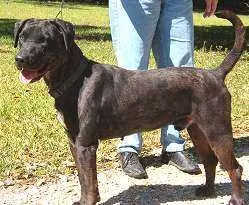
The Catahoula Leopard Dog is a striking, independent working breed known for its versatility, protectiveness, and tireless energy.
How the Catahoula Leopard Dog coat is built, and what that means when you groom it.
A few of the Catahoula Leopard Dog profiles members have added to United Pet Club.
A large, muscular working dog from Louisiana, prized for grit and independence, but its size and guarding instinct make it a poor fit for most Singapore homes.
The Catahoula Leopard Dog is a medium to large working breed from the United States, closely associated with the state of Louisiana, where it is recognised as the official state dog. It was developed to work livestock and hunt over swampy, forested terrain, and that history produced a dog that is athletic, hardy and used to making its own decisions.
This is a breed shaped by a job, not by a show ring. A Catahoula bonds tightly with its own household and is naturally watchful of home and family, though it tends to size up strangers before warming to them. Because it was bred to work at a distance from its handler and think for itself, it needs an owner who sets clear rules from the outset rather than one who expects instant obedience.
Coats usually carry a mottled or merle pattern, with patches of colour scattered across a lighter base, and many dogs have one or two pale, glass-blue eyes. The look draws attention, but the breed was built for stamina and working ability first, and those traits still define it more than its markings do.
| Attribute | Detail |
|---|---|
| Origin | United States (Louisiana) |
| Size | Large |
| Lifespan | 10 to 14 years |
| Group/role | Working and herding dog |
| Good with | Its own family; needs early socialisation with strangers and other pets |
The Catahoula fits an active household that can give it daily physical and mental work, not a quiet corner to sleep in. It does well with experienced owners, people who run, hike or handle livestock, and homes with secure outdoor space. Given its size, it can stand up to 66 cm at the shoulder, it does not sit comfortably within the usual list of flat-approved dog breeds, and a securely fenced landed home or a large condominium unit with management approval suits it far better than a high-rise flat. It is a poor match for owners who work long hours away from home or for anyone wanting a low-key first dog. Its independence and guarding instinct call for firm, steady handling and consistent socialisation from puppyhood, particularly in Singapore's dense, shared living environment.
How the Catahoula Leopard Dog took shape in Louisiana's backwoods, from Native American and early settler dogs to Louisiana's official state dog in 1979.
The breed is named after Catahoula Parish in northern Louisiana. Detailed records of its origins do not exist, but the widely accepted account traces it to dogs kept by Native American communities in the region, later crossed with dogs brought over by Spanish and French settlers from the 16th century onward. What emerged was a rugged working dog suited to forests, swamps and low-lying wetlands, conditions that have more in common with Singapore's climate than with the temperate homelands of many European breeds.
Catahoulas were put to work droving semi-wild cattle and hogs that ranged freely through the woods. They worked in a close, forceful style, often as a pack, to bring difficult stock under control. That same grit made them useful for hunting wild boar and other game across rough ground.
For generations the breed stayed a working dog of the American South, valued by ranchers and hunters rather than bred for the show ring, so its appearance varied a fair amount since selection favoured ability over a fixed look.
Louisiana named the Catahoula Leopard Dog its official state dog in 1979. It is recognised today by working-dog registries and several kennel clubs internationally, though outside the United States it remains a genuinely uncommon breed, Singapore included.
A muscular, medium to large dog built for stamina rather than show, with a short weather-resistant coat, a merle or mottled pattern, and often one or two pale blue eyes.
The Catahoula is a powerful, well-muscled dog with a deep chest, strong legs and a frame built to cover rough ground for hours. Its body is slightly longer than it is tall, and the overall impression is of a lean athlete rather than a bulky guard dog. The head is broad, the ears hang down and taper to a point, and the gait is smooth and efficient, built for distance rather than short bursts.
| Trait | Detail |
|---|---|
| Height | Approximately 51 to 66 cm at the shoulder |
| Weight | Approximately 23 to 43 kg |
| Coat | Short to medium, dense, close-lying, single coat |
| Colours | Merle and mottled patterns, solid colours, and patches; blue, red, black, brown and brindle tones |
| Eyes | Often pale blue (glass eyes); may be amber, brown or green, and two different colours in the same dog (heterochromia) are common |
The coat is short and tight, an advantage in Singapore's hot, humid climate, though it does little to guard against genuinely cold conditions, a non-issue for most owners here. The best-known pattern is the leopard or merle pattern, a mottled mix of darker patches over a lighter base, which is where the breed's name comes from. Solid-coloured dogs and dogs with white trim or points also turn up. Many Catahoulas have striking pale blue eyes, and it is not unusual for one dog to have two different eye colours, or eyes that are split between two colours.
Catahoulas are loyal, sharp and highly energetic dogs that bond tightly with family, stay wary of strangers, and need early socialisation and confident handling to settle well.
The Catahoula is loyal and forms a deep attachment to its own people. Around family it is affectionate and watchful, and it often takes on an informal guarding role at home, alerting to anything out of the ordinary. With strangers it tends to hold back and sum up the situation before deciding how to react, part of what makes it a capable watchdog rather than a dog that greets everyone the same way.
Independence runs through the breed. These dogs were bred to work well away from a handler and to make their own calls, so they can be strong-willed and are not naturally inclined to obey a command simply because it was given. They are sharp and pick things up quickly, but they need a handler who stays consistent and fair rather than heavy-handed.
Around other pets, results vary. A well-socialised Catahoula can share a home with other dogs, though tension between dogs of the same sex and a strong prey drive are both common. Cats and small pets may set off a chase response. Early and ongoing socialisation matters more than anything else in shaping how a Catahoula turns out around people and other animals, which counts for a lot in Singapore's close-knit condominium and landed estates, where dogs regularly cross paths with neighbours and their pets.
| Trait | Rating |
|---|---|
| Affection (with family) | 4 |
| Energy | 5 |
| Trainability | 3 |
| Vocalness | 3 |
| Shedding | 2 |
Catahoulas need little grooming but demand serious daily exercise, secure outdoor space and steady mental work to stay settled in Singapore's climate and housing.
The short, single coat is low-maintenance.
This is where the breed asks the most of an owner. A bored or under-exercised Catahoula tends to become destructive or hard to live with.
The Catahoula does best in a house with a securely fenced garden rather than a high-rise flat. Fencing needs to be tall and solid, since these dogs are athletic and determined escape artists. The short coat copes well with Singapore's year-round heat, but dogs still need shade, fresh water and a cool spot indoors during the hottest part of the day; there is no cold season here to plan for. This is not a breed suited to being left alone for long stretches, or to a household that is out at work all day with no one to break up its time.
Active Catahoulas need a complete, protein-rich diet matched to their working energy level, measured out to build muscle without adding excess weight.
Catahoulas are athletic dogs that do well on a complete, balanced diet built around quality animal protein to support muscle and stamina. Working dogs and dogs with a heavy exercise routine need more calories than a sedentary companion dog, so portions should track each dog's activity level, age and body condition rather than a fixed amount. You should be able to feel the ribs without pressing hard and see a clear waist when looking down at the dog from above.
| Life stage | Amount per day | Meals |
|---|---|---|
| Puppy (2 to 6 months) | As stated on the puppy food label, by weight | 3 to 4 |
| Puppy (6 to 12 months) | As stated on the label, by growth stage | 2 to 3 |
| Adult | Approximately 300 to 480 grams of quality dry kibble | 2 |
| Senior or less active | Reduced calories to hold a steady weight | 2 |
Keep treats to around 10 percent of daily calories so they do not throw off the overall diet. Most Catahoulas on a complete commercial food do not need extra supplements, though joint support or fish oil can help older dogs or those in heavy work. Check with your vet before adding any supplement, and keep fresh water available at all times, especially after exercise in Singapore's heat and humidity.
Catahoulas are a generally hardy breed living 10 to 14 years, though hip dysplasia and merle-linked deafness are the main concerns to screen for.
The Catahoula is a comparatively healthy, robust working breed, with a typical lifespan of 10 to 14 years. As with most large, active dogs, joint health and weight management matter over the long run. The main breed-specific concern is deafness linked to the merle pattern, particularly in puppies bred from two merle parents, a pairing that can also cause eye problems.
| Condition | Signs | Note |
|---|---|---|
| Hip dysplasia | Stiffness, limping, trouble rising | Common in large breeds; screen breeding stock |
| Deafness | No response to sound, hard to rouse | Linked to merle colouring; can affect one or both ears |
| Eye problems | Cloudiness, vision loss, eye abnormalities | More likely in double-merle dogs |
| Bloat (gastric torsion) | Swollen abdomen, retching, distress | An emergency in deep-chested dogs |
Catahoulas learn fast but stay independent and strong-willed, so early, consistent, reward-based training from a confident owner works best.
The Catahoula is sharp and capable, but it is also independent and was bred to act on its own judgement. That mix means it picks things up quickly yet will test boundaries and tune out commands it sees no point in following. Training goes best when it starts early, stays consistent and gives the dog a genuine sense of purpose. Harsh corrections tend to backfire and can knock the trust out of a dog that is both sensitive and headstrong. Socialisation with people, places and other animals matters as much as obedience work, given the breed's wariness of strangers and strong prey drive.
Catahoulas reach breeding maturity around 18 to 24 months, typically whelp six to ten puppies, and need careful pairing to avoid the health risks of double-merle litters.
Responsible Catahoula breeding puts health and temperament ahead of looks. Females should not be bred on their first season; holding off until around 18 to 24 months lets the dog finish maturing and complete hip and hearing screening. The rule that matters most for this breed is never to pair two merle dogs together, since double-merle puppies carry a high risk of deafness and serious eye defects.
Gestation runs to about 63 days from conception, in line with other breeds. Litters commonly run six to ten puppies. The dam usually whelps without assistance, but a quiet, clean whelping area and a vet on standby are sensible precautions for a large breed.
Puppies need early handling, gentle exposure to new sights and sounds, and BAER hearing testing where deafness is a concern. Because the breed is independent and protective by nature, socialisation that starts with the breeder and carries on in the new home shapes the adult dog considerably, and matters even more where a dog will regularly meet strangers in lifts, corridors and shared grounds.
| Metric | Value |
|---|---|
| Breeding maturity | About 18 to 24 months |
| Gestation | Approximately 63 days |
| Average litter size | 6 to 10 puppies |
| Weaning | Around 6 to 8 weeks |
| Key precaution | Do not breed merle to merle (double-merle health risks) |
AVS handles the licence; United Pet Club keeps a free, searchable record behind your Catahoula Leopard Dog's microchip for life.
An AVS licence satisfies the rules; it does not tell a finder in another country how to reach you. Your Catahoula Leopard Dog's free United Pet Club profile does exactly that, pairing your mobile with his photo and chip number for life. Register your dog once and the record follows him anywhere.
The AVS listing and a searchable contact record are two different things, and the second one is yours to set up. Register the microchip on the free lifetime plan: any chip brand a local vet implants qualifies, updates after a move between flats stay free, and the record can be pulled up 24 hours a day from anywhere. Create your free account and settle it tonight.
Set up a free United Pet Club account, key in your Catahoula Leopard Dog's details and a photo, and save. The lifetime plan keeps the profile live at no cost for as long as he is with you, alongside whatever AVS requires.
Key the 15-digit chip number into your free account together with your address, mobile, and email. The lifetime plan covers the registration and every update free, whichever brand the clinic used.
Yes. AVS requires dogs to be licensed and microchipped by three months of age. The licence is the legal part; a registered, searchable record with your current mobile is the part that gets a lost Catahoula Leopard Dog home, and that part is free.
Nothing. United Pet Club's lifetime plan covers the profile, the chip record, and unlimited updates, with no renewal, ever.
Common questions about the Catahoula Leopard Dog cover its size, temperament, care demands, lifespan, suitability as a family dog, and where to find one in Singapore.
It is a large breed, standing roughly 51 to 66 cm at the shoulder and weighing about 23 to 43 kg, with males usually bigger than females.
Catahoulas are loyal and protective with family, reserved with strangers, and highly intelligent but independent. They are energetic working dogs that need a job to do and firm, fair handling.
Grooming is easy thanks to the short coat, but exercise and training are demanding. They need 1 to 2 hours of activity daily plus mental work, which suits active, experienced owners far better than first-time dog owners.
Most live about 10 to 14 years. Keeping them at a healthy weight and screening for hip and hearing problems supports a long, sound life.
They can be devoted family dogs in an active household with older, respectful children, given early socialisation. Their guarding instinct, size and high energy make them a poor fit for a small flat or a home that sits empty most of the day.
With early socialisation they can, but a strong prey drive and tension between dogs of the same sex are both common. Introductions should go slowly, and small pets may trigger a chase response.
The breed is very uncommon here, with no established local breeders, so most owners import one from the United States through a licensed importer, subject to AVS import permit conditions and quarantine requirements based on the exporting country's rabies risk category. Check with the Animal & Veterinary Service (AVS) and the Singapore Kennel Club before committing, and weigh up whether its size suits typical Singapore housing.