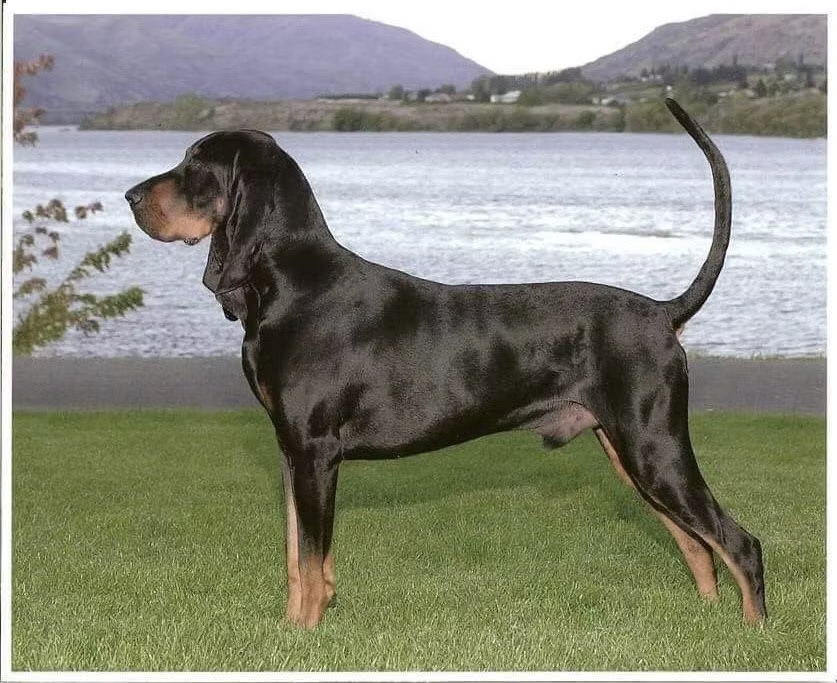
The Black and Tan Coonhound is an even-tempered, hardworking trail hound known for its keen nose and rich bell-like voice.
How the Black and Tan Coonhound coat is built, and what that means when you groom it.
A few of the Black and Tan Coonhound profiles members have added to United Pet Club.
A large American scenthound built to trail raccoon by scent, known for its deep bay and easygoing nature, though its size and voice make it a poor fit for most Singapore flats.
The Black and Tan Coonhound is a big scenthound from the United States, built to trail raccoon and other game through rough country using nothing but its nose. It works a trail for hours with its head down, then lets out a deep, carrying bay once the quarry is treed. The coat gives the breed its name: solid black across the body, with tan markings over the eyes, on the muzzle, chest, legs and under the tail.
Standing up to 27 inches at the shoulder, it is a solidly built dog made for endurance rather than sprinting. The long ears, loose skin and strong frame all help it do its job, drawing scent toward the nose and shielding the dog as it pushes through undergrowth. Away from work, most Black and Tans are calm and sociable, happy to rest between outings.
This is not a breed suited to most Singapore homes. HDB flats have a list of approved dog breeds and sizes, and a Black and Tan Coonhound is unlikely to qualify, so landed property or an approved condominium with a securely fenced garden is usually the realistic option. The breed's strong nose and tracking instinct also mean leashed walks and secure fencing matter, since a fresh scent picked up along a park connector can easily override a recall.
| Attribute | Detail |
|---|---|
| Origin | United States |
| Size | Large |
| Lifespan | 10 to 12 years |
| Group / role | Hound, scent-tracking hunter |
| Good with | Families and other dogs; supervise around smaller pets |
This breed suits owners with a landed home or a spacious, breed-approved condominium unit, plenty of outdoor time, and neighbours who will not mind occasional loud baying. It fits people who enjoy early morning or evening walks to dodge the worst of the heat and humidity, and who have the patience to manage a dog whose nose often has the final say over commands. It is a poor match for HDB flats or any home that needs a quiet, low-energy companion.
Developed in the United States from English and American hound stock to trail raccoon by scent, the breed gained American Kennel Club recognition in 1945 and remains rare in Singapore.
The Black and Tan Coonhound traces back to hounds brought to North America by early settlers, chiefly the Talbot hound of medieval England, later joined by Bloodhound and Foxhound lines. Settlers needed a dog that could work dense, heavily wooded frontier terrain and trail game after dark, so breeding favoured those needs over the open-country chase preferred back in England.
Much of the breed's development happened in the southern and Appalachian United States, where hunting raccoon at night was both a food source and a pastime. Breeders selected for a cold nose that could pick up an old trail, the stamina to work it for hours, and a distinctive voice that told the hunter when the quarry had been treed.
The Black and Tan is one of several coonhound types that grew out of this shared stock, set apart from its relatives by colouring and by careful selection for trailing ability. It was the first coonhound to gain formal recognition.
The American Kennel Club recognised the breed in 1945. It remains a working hunter across much of the United States today, and is also kept as a companion and shown in conformation and tracking events. The breed is uncommon in Singapore, where registrations with the Singapore Kennel Club lean toward smaller, flat-friendly breeds, so most local owners will meet it through imports or online research rather than at a nearby show.
A large, powerful scenthound with a coal-black coat marked by tan points, long low-set ears, and a deep muzzle built for following scent.
The Black and Tan Coonhound is built for endurance and reach rather than speed. The body is slightly longer than it is tall, with a deep chest, a strong back and well-muscled legs that let it cover ground at a steady working pace. The head is clean, without heavy wrinkling, though the skin is loose enough to help gather scent. The ears are long, set low, and hang in folds that reach past the tip of the nose when drawn forward. Dark brown to hazel eyes give the face a soft, alert look.
| Trait | Standard |
|---|---|
| Height | Males 25 to 27 in; females 23 to 25 in at the shoulder |
| Weight | Roughly 65 to 110 lb depending on size and sex |
| Coat | Short, dense and smooth |
| Colours | Coal black with tan markings (eyes, muzzle, chest, legs, under tail) |
| Eyes | Hazel to dark brown, almost round |
The defining coat is solid coal black with sharply defined tan markings. Tan points show above each eye, along the sides of the muzzle, across the chest and legs, and beneath the tail. The short, dense coat lies close to the body and gives some protection out in the field without demanding much upkeep, a practical trait in Singapore's year-round heat and humidity. The pattern should be clean, with a clear division between the black ground colour and the tan points, and no large patches of any other colour.
Friendly and even-tempered at home, the Black and Tan Coonhound is intensely focused on a scent trail and naturally vocal, a trait worth weighing before choosing a terraced house or condo.
The Black and Tan Coonhound is generally friendly and even-tempered, an easygoing companion that settles down indoors once it has had enough exercise. With its own family it tends to be affectionate and patient, and it usually gets on well with children who handle it gently. The breed is rarely aggressive toward people and often greets strangers with mild curiosity rather than suspicion, which makes it a poor guard dog despite its size and its voice.
Around other dogs the breed is typically sociable, a legacy of its history working in packs. Smaller pets are a different story. A strong prey and trailing instinct means cats and other small animals can trigger the urge to chase, so introductions need to be careful and supervised.
The most distinctive trait is the voice. The breed bays and bawls on a trail and will sound off at scents, sometimes loudly and for a good while, which is worth thinking through before keeping one in a semi-detached house or any home with close neighbours. On a trail it becomes intensely focused, and that focus can override a recall, so a fresh scent often matters more to the dog than a command. Owners who understand and plan for these instincts find the breed an agreeable, good-natured housemate.
| Trait | Rating |
|---|---|
| Affection | 4 |
| Energy | 4 |
| Trainability | 3 |
| Vocalness | 5 |
| Shedding | 3 |
The Black and Tan Coonhound needs daily exercise timed around Singapore's heat, routine ear care and a secure garden, with only modest coat grooming.
Day-to-day care in Singapore's climate centres on exercise timed around the heat, ear maintenance, and a secure space, since the coat itself asks little.
The breed does best in a home with a securely fenced garden and room to move, which usually means landed property rather than a flat. It settles well indoors once exercised, but the voice and the space it needs rule out HDB flats and most condominium units. Fencing should be solid and tall, since a determined hound on a scent will test any weak point, and Singapore's year-round warmth means shaded areas and fresh water outdoors are essential.
Feed a complete large-breed diet matched to the dog's age and activity, split into two meals to suit its working frame and lower the risk of bloat.
The Black and Tan Coonhound is a large, active dog that needs a complete and balanced diet suited to its size and workload. A working dog out in the field burns far more energy than a companion that goes for a daily walk, so portions should track activity rather than follow a fixed number. Choose a food formulated for large breeds, which helps manage growth in puppies and joint load in adults. Fresh water should always be on hand, especially after exercise in the heat.
| Life stage | Amount per day | Meals |
|---|---|---|
| Puppy (2 to 6 months) | Per large-breed puppy food label, by weight | 3 to 4 |
| Adolescent (6 to 12 months) | Per label, tapering toward adult portions | 2 to 3 |
| Adult (1 to 7 years) | Roughly 3 to 5 cups of dry food | 2 |
| Senior (7+ years) | Reduced to match lower activity | 2 |
Keep treats to about 10 percent of daily calories to avoid weight gain, which puts extra strain on a large dog's joints. Most coonhounds on a complete commercial diet need no supplements, though a vet may suggest joint support for older or hard-working dogs. Because the breed has a deep chest, split food into two meals and avoid strenuous exercise right before or after eating to lower the risk of bloat.
The Black and Tan Coonhound is generally healthy with a lifespan of 10 to 12 years, though ear infections and large-breed joint and bloat concerns are worth watching.
The Black and Tan Coonhound is a generally healthy, hardy breed with a typical lifespan of 10 to 12 years. Most health issues fall into two areas: the ears, because of their long folded shape, and the joints and digestion, which are common concerns in large dogs. Routine visits to the vet and attention to weight keep most of these problems manageable.
| Condition | Signs | Note |
|---|---|---|
| Ear infections | Head shaking, odour, scratching, discharge | Common due to long folded ears; weekly checks help |
| Hip dysplasia | Stiffness, limping, trouble rising | Large-breed joint issue; screening of breeding stock helps |
| Gastric dilatation-volvulus (bloat) | Distended belly, retching, restlessness | Medical emergency; feed two meals, avoid exercise around meals |
| Obesity | Weight gain, low stamina | Adds strain to joints; control portions and treats |
Intelligent but independent and scent-driven, the breed trains best with early, consistent, reward-based methods plus reliable leash and fence management.
The Black and Tan Coonhound is intelligent and capable, but it was bred to work a trail on its own initiative, so it can be independent and easily distracted by scent. Training works best when it starts early, stays consistent, and uses rewards the dog actually values. Patience matters: a nose to the ground will often win out over a command, which is why secure leashes and fencing belong in any training plan from day one rather than as an afterthought. Short, varied sessions hold its attention better than long drills, and recall should be practised in low-distraction settings before it is trusted off leash outdoors.
Black and Tan Coonhounds reach breeding maturity around 18 to 24 months, carry litters of about six to eight puppies after a roughly 63-day pregnancy, and need early socialisation.
Responsible breeding of the Black and Tan Coonhound waits until both dogs are physically and behaviourally mature, generally around 18 to 24 months, even though they can become fertile earlier. Breeding stock should be health-screened, particularly for hip dysplasia and other inherited large-breed conditions, and should show the sound, even temperament the breed is known for.
The female's pregnancy lasts about 63 days. Litters commonly run to six or eight puppies, though they can be larger. The whelping area should be warm, clean and quiet, with enough room for a large mother to move about and nurse in comfort.
Puppies grow quickly and need a large-breed puppy diet to support steady, controlled growth. The early weeks matter for socialisation: gentle handling, gradual exposure to household sounds, and meeting a range of people and dogs help build the friendly, even temperament the breed should have. Most puppies are ready to move to new homes at about eight weeks, by which point the trailing instinct and the breed's voice are already starting to show. Prospective owners in Singapore should also start checking HDB or condominium rules at this stage, well before bringing a puppy home.
| Metric | Value |
|---|---|
| Breeding maturity | About 18 to 24 months |
| Gestation | Roughly 63 days |
| Average litter size | 6 to 8 puppies |
| Weaning | About 6 to 8 weeks |
| Ready for new homes | Around 8 weeks |
AVS handles the licence; United Pet Club keeps a free, searchable record behind your Black and Tan Coonhound's microchip for life.
An AVS licence satisfies the rules; it does not tell a finder in another country how to reach you. Your Black and Tan Coonhound's free United Pet Club profile does exactly that, pairing your mobile with his photo and chip number for life. Register your dog once and the record follows him anywhere.
Your Black and Tan Coonhound's chip went in before his third month, as the rules require; whether the number leads anywhere is a separate question. Give it a live answer with United Pet Club: registration free for life, every brand accepted, every update free. Microchip registration plus a free account, and the whole thing is squared away.
Set up a free United Pet Club account, key in your Black and Tan Coonhound's details and a photo, and save. The lifetime plan keeps the profile live at no cost for as long as he is with you, alongside whatever AVS requires.
Key the 15-digit chip number into your free account together with your address, mobile, and email. The lifetime plan covers the registration and every update free, whichever brand the clinic used.
Yes. AVS requires dogs to be licensed and microchipped by three months of age. The licence is the legal part; a registered, searchable record with your current mobile is the part that gets a lost Black and Tan Coonhound home, and that part is free.
Nothing. United Pet Club's lifetime plan covers the profile, the chip record, and unlimited updates, with no renewal, ever.
Common questions about the Black and Tan Coonhound's size, temperament, care needs, lifespan and fit for Singapore homes.
It is a large breed. Males stand 25 to 27 inches at the shoulder and females 23 to 25 inches, with weight running roughly from 65 to 110 pounds depending on size and sex.
Yes. They are usually friendly and even-tempered, patient with children, and sociable with other dogs. Their strong trailing instinct means smaller pets should be introduced carefully and supervised.
The coat itself is low maintenance, but the breed needs daily exercise, weekly ear cleaning and secure fencing. The real challenges are the loud voice and an independent, scent-driven nature, not heavy grooming.
Most live 10 to 12 years. Regular vet visits, weight control and routine ear checks support a healthy life.
Yes. The breed is naturally vocal, with a deep, carrying bay it uses on a trail and whenever it picks up a scent. This makes it a poor choice for HDB flats or any home with neighbours who need quiet.
It is not a good fit. HDB has size and breed restrictions that this dog is unlikely to meet, and its voice and exercise needs make small flats difficult regardless. Landed property or a breed-approved condominium with a garden works far better.
They are intelligent but independent and easily distracted by scent. Early, consistent, reward-based training works well, though recall can be unreliable once the dog picks up an interesting trail.