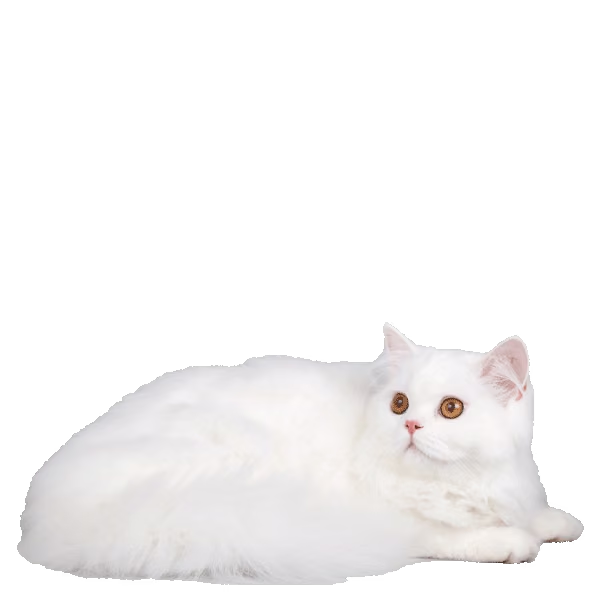
The Napoleon (Minuet) is a sweet, affectionate short-legged cat that blends the gentle charm of the Persian with playful good nature.
How the Napoleon coat is built, and what that means when you groom it.
Critical: A Napoleon should not be shaved.
The undercoat keeps heat out as well as in, and the outer coat shields the skin from sun and insect bites. Clipping the whole coat off removes both. It often grows back patchy, soft or a different colour, and in some animals the guard hairs never return properly. Brush the undercoat out instead of cutting it off.
Caution: A Napoleon coat mats easily.
Fine or long hair tangles at the base of the coat, out of sight, where the mats tighten and pull on the skin. Brushing has to reach right down to the roots in sections, not just skim the surface.
The Napoleon, also known as the Minuet, is a small short-legged cat from the United States that pairs a gentle Persian-type nature with a lively, sociable disposition.
The Napoleon is a small companion cat that was developed in the United States. Many breeders and registries now refer to it by its later name, the Minuet. The breed brings together the short legs of the Munchkin with the round head, large eyes, and soft expression of the Persian and Exotic group.
Most Napoleons are gentle and attached to their people. They like to stay near their owners, keep an eye on whatever is happening at home, and settle quickly into a quiet flat or house. The short legs do not hold them back much. They move well, reach low and medium perches, and enjoy short spells of play.
Two leg lengths occur within the breed. Standard Napoleons have short legs, while non-standard cats have legs of ordinary length. Both types share the same head shape, body proportions, and easygoing character.
| Attribute | Detail |
|---|---|
| Origin | United States |
| Size | Small |
| Lifespan | 12 to 15 years |
| Group/role | Companion cat |
| Good with | Families, children, other cats, calm dogs |
The Napoleon suits owners who want a calm, affectionate cat that enjoys company yet does not need constant high activity. It does well in HDB flats and landed homes alike, as its exercise needs are moderate. Prospective owners should be ready for regular coat care and for keeping climbing and jumping sensible for a short-legged cat.
The Napoleon was created in the United States during the 1990s by crossing the short-legged Munchkin with Persian-type breeds, and was later renamed the Minuet.
The Napoleon took shape in the United States in the middle of the 1990s. The breeding programme aimed to join the short legs of the Munchkin with the rounded head and sweet face of the Persian and Exotic Shorthair.
The first aim was a small, gentle cat with a doll-like look but a sturdier body, and without some of the extreme features seen in very flat-faced breeds. Breeders kept the muzzle moderate rather than fully flat, which supports easier breathing and feeding.
The founding crosses drew on Munchkin cats for leg length and Persian-group cats for head type and coat. Because litters carry two leg lengths, the breed standard allows both standard short-legged and non-standard longer-legged cats.
The breed was later renamed the Minuet, and both names are still in use. Recognition has widened over the years across several cat associations, though its status differs from one registry to another. The Napoleon remains a fairly new and uncommon breed.
The Napoleon is a small, rounded cat with a sweet open face, large eyes, and either short or standard legs, seen in both short and long coats.
The Napoleon has a small to medium body with a broad chest and a rounded, well-balanced frame. The head is round with full cheeks, a short to moderate nose, and large, round, widely spaced eyes that create an open and gentle look. The ears are medium and placed to keep the rounded line of the head.
The leg length is the most telling feature. Standard Napoleons have short legs caused by the same gene found in the Munchkin, while non-standard cats have legs of normal length. The tail matches the body in proportion and is carried with a slight curve.
| Trait | Standard |
|---|---|
| Height | About 15 to 20 cm at the shoulder |
| Weight | 2.3 to 4 kg |
| Coat | Short or long, soft and dense |
| Colours | All colours and patterns accepted |
| Eyes | Large and round, colour in keeping with coat |
The Napoleon comes in two coat lengths. The shorthair coat is plush and simple to manage, while the longhair coat is softer and fuller and calls for more frequent grooming. Both lengths have a dense, even texture. The breed is accepted in a broad range of colours and patterns, among them solids, tabby, bicolour, tortoiseshell, and pointed varieties.
Napoleons are affectionate, gentle, and sociable cats that form close bonds with their families and usually get on with children and other pets.
The Napoleon has a calm and friendly temperament. It is affectionate without being pushy and tends to look for company, often resting beside its owner or trailing from room to room to stay close.
With family members the breed is gentle and patient, which makes it a sound match for homes with children who handle pets with care. Napoleons are generally confident rather than timid around visitors, though a few need a little time to warm to strangers.
The breed plays in moderate spells and likes interactive toys and gentle games. Many Napoleons share a home happily with other cats and calm dogs when introductions are made slowly. They are not big talkers, but they will use a soft voice to ask for attention or food.
| Trait | Rating |
|---|---|
| Affection | 5 |
| Energy | 3 |
| Trainability | 3 |
| Vocalness | 2 |
| Shedding | 3 |
Napoleons need regular coat care, moderate play, and an indoor home arranged for short-legged movement, with extra grooming for the longhair variety.
The Napoleon is best kept as an indoor cat, which also suits the local climate and busy roads. A quiet, settled home matches its calm nature. Provide scratching posts, resting spots, and easy access to litter trays and food without large jumps. Short-legged cats can manage stairs and low furniture but do better with steps or ramps to reach higher resting places.
Napoleons do well on a complete, balanced cat food matched to life stage and weight, given in measured meals to guard against obesity.
The Napoleon needs a complete and balanced diet made for cats, with animal protein as the leading ingredient. As the breed is small and can put on weight easily, portions are best measured rather than left out all day. Fresh water should always be on hand, and wet food can help support hydration in a warm climate.
| Life stage | Amount per day | Meals |
|---|---|---|
| Kitten (2 to 12 months) | Per label, fed to appetite | 3 to 4 |
| Adult (1 to 7 years) | About 45 to 70 g dry or equivalent wet | 2 |
| Senior (7 years and older) | Adjusted to weight and activity | 2 |
Keep treats to around 10 percent of daily calories so the main diet stays balanced. A healthy cat on a complete food usually needs no extra supplements. Check with a veterinarian before adding any supplement, and weigh the cat regularly to catch early changes in weight.
Napoleons usually live 12 to 15 years and are broadly healthy, though they can inherit conditions tied to their Persian and Munchkin ancestry.
The Napoleon is generally a healthy breed with a usual lifespan of 12 to 15 years. As it descends from Persian-type and Munchkin cats, it can carry health risks linked to both lines. Responsible breeders screen the parent cats and avoid pairings that would worsen short-leg or flat-face traits.
| Condition | Signs | Note |
|---|---|---|
| Polycystic kidney disease | Increased thirst, weight loss, poor appetite | Inherited from Persian lines; DNA testing available |
| Hypertrophic cardiomyopathy | Lethargy, breathing changes, collapse | Heart muscle disease; found through ultrasound screening |
| Lordosis and spinal issues | Posture changes, reluctance to move | Linked to the short-leg gene in some cats |
| Dental disease | Bad breath, drooling, reduced eating | Common in small cats; regular care helps |
Napoleons are moderately trainable and respond well to short, reward-based sessions for litter habits, handling, and simple tricks.
The Napoleon is intelligent and keen to take part, which makes basic training achievable. The breed responds best to positive methods and short sessions. Its calm nature means it can learn to accept grooming, nail trims, and carrier handling with patience and consistency.
Napoleon breeding calls for careful pairing because the short-leg gene cannot be doubled safely, so standard cats are mated to longer-legged partners.
Napoleons reach sexual maturity at around 6 to 10 months, though responsible breeders wait until the cats are fully grown and health-tested before mating. The short-leg gene is dominant and cannot be carried safely in a double dose, so two standard short-legged cats are not bred together. Instead, a standard cat is paired with a non-standard longer-legged cat or an outcross partner.
Gestation lasts about 63 to 67 days. Litters are usually small, often two to four kittens, and hold both short-legged and longer-legged kittens. Queens generally raise their young well, but breeders watch the delivery and early growth closely because of the breed's small size.
Kittens are weaned at around 8 weeks and usually move to new homes at 12 to 14 weeks, once they are litter trained, vaccinated, and socialised. Outcrossing to approved breeds helps keep the gene pool healthy in this young breed.
| Metric | Value |
|---|---|
| Sexual maturity | 6 to 10 months |
| Gestation | 63 to 67 days |
| Average litter size | 2 to 4 kittens |
| Weaning age | About 8 weeks |
| Recommended rehoming age | 12 to 14 weeks |
With cat licensing phased in from 2024, a free United Pet Club record keeps your Napoleon's chip pointing at your current mobile.
A flat-dwelling Napoleon still bolts through an open door now and then, and that is exactly the moment a record matters. Hers is free: name, photo, chip number, your mobile, held by United Pet Club for her whole life. Register your cat before the door swings open.
Once the clinic has done the implant, the number needs a registry to live in. Register the microchip on the free lifetime plan: chips of any brand qualify, updating after a move between estates costs nothing, and the record stays searchable round the clock, in Singapore and out of it. Create your free account and finish both halves now.
Create a free United Pet Club account, add her name, colouring, and a photo, and save the profile. The lifetime plan holds it at no cost for her whole life, flat cat or wanderer.
Enter the 15-digit number from the clinic's paperwork into your free account with your current contact details. The lifetime plan never charges for the record or for updates, whatever the chip brand.
Yes, AVS is phasing in licensing and microchipping for pet cats from 2024. The licence answers the rules; the United Pet Club record answers the scanner, and it stays free for your Napoleon's whole life.
Not a cent. Profile, microchip registration, and all future updates are covered by the free lifetime plan, with nothing to renew.
Common questions about the Napoleon cat cover its size, temperament, care needs, lifespan, suitability, and availability in Singapore.
The Napoleon is a small breed, usually weighing about 2.3 to 4 kg and standing roughly 15 to 20 cm at the shoulder. Standard cats have short legs, which adds to the compact look.
Napoleons are affectionate, gentle, and sociable. They bond closely with their people, enjoy moderate play, and generally get on with children, other cats, and calm dogs.
Care is moderate. Shorthair cats need brushing once or twice a week, while longhair cats need it several times a week. They also need measured feeding, routine dental care, and a home arranged for short-legged movement.
A Napoleon typically lives 12 to 15 years with good nutrition, regular veterinary care, and weight management.
Yes. Its calm, friendly nature suits families, including those with gentle children, and it settles well into HDB flats and landed homes as an indoor cat.
The breed was developed as the Napoleon and later renamed the Minuet. Both names refer to the same short-legged, Persian-influenced cat, and they are used interchangeably.
The Napoleon is a fairly new and uncommon breed, so kittens can be limited and waitlists are common. Buy from breeders licensed by the AVS who health-test the parent cats for kidney and heart disease.
