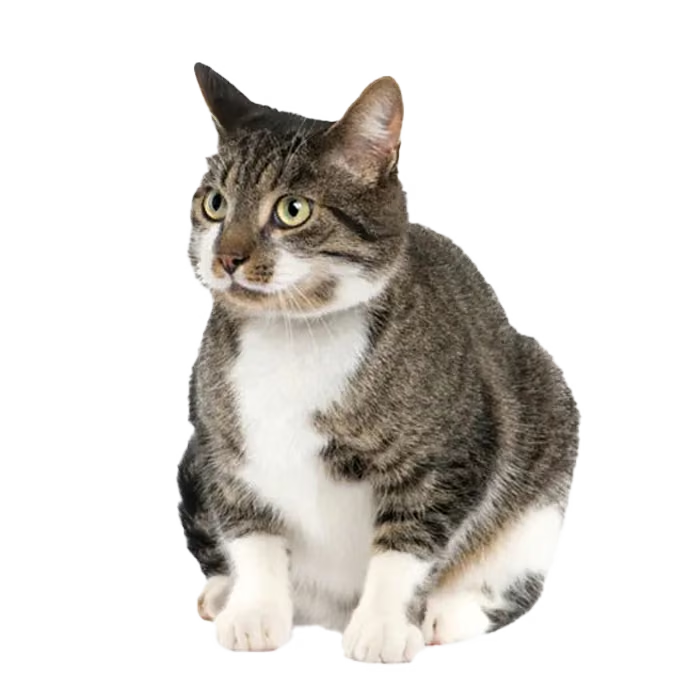
The Aegean is a friendly, water-loving native Greek cat known for its sociability and natural hardiness.
How the Aegean coat is built, and what that means when you groom it.
Critical: A Aegean should not be shaved.
The undercoat keeps heat out as well as in, and the outer coat shields the skin from sun and insect bites. Clipping the whole coat off removes both. It often grows back patchy, soft or a different colour, and in some animals the guard hairs never return properly. Brush the undercoat out instead of cutting it off.
Caution: A Aegean coat mats easily.
Fine or long hair tangles at the base of the coat, out of sight, where the mats tighten and pull on the skin. Brushing has to reach right down to the roots in sections, not just skim the surface.
The Aegean is a medium-sized natural cat from Greece, known for its friendly, sociable temperament and its unusual ease around water.
The Aegean is a natural breed that developed without any planned breeding on the Cyclades islands of Greece. It is one of only a handful of cat breeds native to the country, and many still live as semi-feral cats around fishing harbours and coastal villages. Formal recognition came later, through Greek breeders who worked to preserve the existing type instead of creating something new.
Cats of this breed are medium in size, muscular, and well balanced. What sets them apart is their outgoing personality. Aegeans like to seek out human company, stay active well into adulthood, and adapt readily to busy households. Their long link with fishing communities is often tied to their reported comfort with water and their interest in fish.
The breed is still uncommon outside Greece. Most Aegeans available today come from breeders within the country, and the population sits close to its free-living origins, which helps explain its general hardiness.
| Attribute | Detail |
|---|---|
| Origin | Greece (Cyclades islands) |
| Size | Medium |
| Lifespan | 9 to 12 years |
| Group / role | Natural breed, companion cat |
| Good with | Families, children, other pets |
The Aegean is a good fit for households that can give it attention and activity. It does well with families, including flats and homes with children and other animals, thanks to its sociable nature. Anyone after a quiet, independent cat may find the Aegean a bit too interactive, since it likes to take part in the daily routine and stays playful for many years.
The Aegean developed naturally on the Cyclades islands of Greece and was later organised into a recognised breed by Greek breeders in the late twentieth century.
The Aegean takes its name from the Aegean Sea and the Greek islands within it. Unlike breeds built through deliberate selection, the Aegean formed over a long period as a landrace, meaning a local population shaped by its environment rather than by planned matings. Cats of this type have lived around the Cyclades for centuries, often side by side with fishing communities.
For most of its history the breed carried no formal status. The cats got by as working and semi-feral animals, keeping rodents down near homes, markets, and harbours. Their close daily contact with people in these settings is one reason often given for their sociable behaviour.
Organised efforts to document and standardise the Aegean began in Greece in the late twentieth century. Breeders set out to record the type and promote it as a national breed while keeping its natural traits intact. Because the foundation came from free-living cats, breeders aimed to preserve traits already present rather than add new ones.
The Aegean is recognised within Greece and is often described as the country's first and main native breed. It stays rare elsewhere, and international populations are limited. Its development continues to draw on the existing island cat population.
The Aegean is a medium, muscular cat with a semi-long coat, almost always bicolour or tricolour with white, and almond-shaped eyes in shades of green.
The Aegean has a balanced, athletic build that reflects its working origins. The body is medium in length and muscular, with strong legs and rounded paws. The head is moderate with a slightly rounded shape, and the ears are medium and set fairly upright. On the whole the cat looks sturdy and capable rather than delicate.
| Feature | Standard |
|---|---|
| Height | About 23 to 25 cm at the shoulder |
| Weight | 3 to 5 kg |
| Coat | Semi-long, no thick undercoat |
| Colours | Bicolour or tricolour, always with white |
| Eyes | Almond shaped, shades of green |
The coat is semi-long and lies close to the body, with little or no dense undercoat. This gives a moderate, low-bulk look and lighter shedding than heavy double-coated breeds. The coat tends to grow thicker in winter.
Colour is a defining point. Aegeans are bicolour or tricolour and always carry white as one of the colours, usually covering a third to two thirds of the body. White shows up with patches of black, red, blue, cream, or tabby patterning. Solid single-colour coats fall outside the breed type. Eye colour is typically green.
The Aegean is friendly, playful, and intelligent, generally good with children and other pets and happy to be part of an active household.
The Aegean is a sociable cat that goes looking for interaction. It tends to attach to its household and follows family members between rooms, often staying involved in whatever is going on. That makes it a poor match for homes where a cat would be left alone for long stretches each day.
With family the breed is affectionate and communicative. It is usually patient with children when handled with normal care, and it commonly accepts other cats and dogs, helped by its background of living among other animals in island communities. With strangers most Aegeans are confident rather than shy, though individual cats vary.
Intelligence and activity are steady traits. Aegeans stay playful well past kittenhood, enjoy hunting games, and respond to puzzle feeders and interactive toys. Their reported interest in water means some individuals will paw at taps or watch fish closely. Bored or under-stimulated cats can get noisy or mischievous, so steady daily play matters.
| Trait | Rating |
|---|---|
| Affection | 4 |
| Energy | 4 |
| Trainability | 4 |
| Vocalness | 3 |
| Shedding | 2 |
The Aegean is a low-maintenance, hardy cat that needs weekly grooming, regular interactive play, and an enriched indoor or supervised outdoor environment.
The Aegean is a robust breed that grew from free-living stock, so its everyday care is straightforward. The main needs are coat upkeep, activity, and attention.
Aegeans suit indoor living when given enough enrichment, and many breeders keep them indoors or with supervised outdoor access for safety. This suits flats and HDB homes where the cat stays inside. They do well where people are around for part of the day, and the breed handles warm, humid conditions comfortably given shade and fresh water.
The Aegean does well on a balanced, protein-led cat diet portioned to its medium size and activity level, with fresh water always available.
The Aegean has no special dietary requirements beyond those of a healthy medium cat. A complete and balanced food formulated for the cat's life stage covers its needs. As an obligate carnivore, the cat should get most of its energy from animal protein, with controlled fat and limited carbohydrate. Active adults may need a bit more food than sedentary cats of the same weight.
| Life stage | Amount per day | Meals |
|---|---|---|
| Kitten (2 to 12 months) | Per package, fed to appetite | 3 to 4 |
| Adult (1 to 7 years) | About 50 to 70 g dry, or equivalent wet | 2 |
| Senior (8 years and older) | Adjusted to weight and activity | 2 |
Keep treats to no more than about ten percent of daily calories to prevent weight gain. A cat eating a complete diet usually needs no supplements; add them only on veterinary advice. Provide clean fresh water at all times, and note that some Aegeans prefer running water from a fountain or tap.
The Aegean is a naturally hardy breed with a typical lifespan of 9 to 12 years and no breed-specific genetic disorders, though general feline health care still applies.
As a natural breed shaped by survival rather than selective breeding, the Aegean is generally healthy and has avoided the inherited conditions that affect some heavily bred cats. The typical lifespan is 9 to 12 years, and many cats reach the upper end with good care. The conditions seen in Aegeans are mostly the common feline problems rather than breed-linked diseases.
| Condition | Signs | Note |
|---|---|---|
| Dental disease | Bad breath, drooling, reduced eating | Common in cats; prevent with dental care |
| Obesity | Weight gain, low activity | Manage with portion control and play |
| Parasites | Scratching, coat changes, digestive upset | More likely with outdoor access |
| Upper respiratory infection | Sneezing, eye or nasal discharge | Reduce risk with vaccination |
The Aegean is intelligent and food-motivated, which makes it responsive to reward-based training for litter habits, recall, and simple tricks.
The Aegean learns quickly and enjoys mental work, so it takes to training better than many cats. Its interest in food and play gives clear rewards to work with. Keep sessions short, a few minutes at a time, and end while the cat is still engaged. Consistency matters more than session length.
Aegean females reach maturity around five to ten months, carry litters for about nine weeks, and typically raise four to six kittens that are weaned by eight weeks.
The Aegean reproduces along the same lines as other domestic cats. Females usually reach sexual maturity between five and ten months, though responsible breeders wait until the female is fully grown before a first mating. Cats are induced ovulators, so mating triggers ovulation, and a female in season may call frequently to attract a male.
Gestation lasts roughly nine weeks. Litters are commonly four to six kittens. Because the breed sits close to its natural origins, queens are generally capable mothers and births usually go smoothly, though a veterinarian should be available in case of problems.
Kittens are born blind and deaf and rely fully on the mother at first. The eyes open at around one to two weeks. Weaning begins near four weeks and finishes by about eight weeks. Early handling and exposure to household sights and sounds help produce the sociable, confident adult the breed is known for. Reputable breeders keep kittens with the mother until at least twelve weeks and arrange health checks and vaccinations before rehoming.
| Metric | Value |
|---|---|
| Female maturity | 5 to 10 months |
| Gestation | About 63 days |
| Average litter | 4 to 6 kittens |
| Eyes open | 1 to 2 weeks |
| Weaning | About 8 weeks |
| Earliest rehoming | 12 weeks |
With cat licensing phased in from 2024, a free United Pet Club record keeps your Aegean's chip pointing at your current mobile.
Start the paperwork where it costs nothing: your Aegean's name, her colouring, a photo, your contact details, saved. The profile lasts her lifetime, takes any chip number the clinic issues, and never sends a bill. Cat registration is the five-minute version of responsible ownership.
Once the clinic has done the implant, the number needs a registry to live in. Register the microchip on the free lifetime plan: chips of any brand qualify, updating after a move between estates costs nothing, and the record stays searchable round the clock, in Singapore and out of it. Create your free account and finish both halves now.
Create a free United Pet Club account, add her name, colouring, and a photo, and save the profile. The lifetime plan holds it at no cost for her whole life, flat cat or wanderer.
Enter the 15-digit number from the clinic's paperwork into your free account with your current contact details. The lifetime plan never charges for the record or for updates, whatever the chip brand.
Yes, AVS is phasing in licensing and microchipping for pet cats from 2024. The licence answers the rules; the United Pet Club record answers the scanner, and it stays free for your Aegean's whole life.
Not a cent. Profile, microchip registration, and all future updates are covered by the free lifetime plan, with nothing to renew.
Common questions about the Aegean cat cover its size, temperament, care needs, lifespan, suitability, and availability.
The Aegean is a medium cat. Adults usually weigh between 3 and 5 kg and stand about 23 to 25 cm at the shoulder, with a muscular, balanced build.
Aegeans are friendly, playful, intelligent, and sociable. They seek human company, stay active into adulthood, and generally get along with children and other pets.
Yes. The coat needs only weekly brushing, and the breed is hardy with no special requirements. The main commitment is daily play and attention, since the cat dislikes being left alone for long periods.
The typical lifespan is 9 to 12 years. As a natural breed with no known breed-specific genetic disorders, many cats reach the upper end of that range with good care.
It suits active families well. Its sociable, patient nature makes it comfortable with children and other animals, provided it gets regular interaction and play.
Many do. The breed's background around fishing communities is linked to an unusual comfort with water, and some individuals will play with dripping taps or watch fish closely.
The breed is rare outside Greece. Most Aegeans come from breeders within the country, where the population remains close to its native island origins.
