

Boxer
The Boxer is a playful, devoted breed known for its boundless energy, expressive face, and loyal guardianship of family.
- Size
- Large
- Lifespan
- 10–12 years
- Origin
- Germany
- Temperament
- Playful
- Standard colors
- Black, White and Red and 2 more
Characteristics
Coat and grooming
How the Boxer coat is built, and what that means when you groom it.
- Coat layers
- Single coat
- Coat texture
- Smooth
- Coat length
- Short
- Shedding
- Moderate shedding
Boxer colors and patterns
What each club's breed standard says about every Boxer color and pattern. Point at a ruling to see the club's own wording.
Breed standards describe the Boxer in Black, White, Red, Gold and Fawn. Standard patterns: Solid, Brindle and Reverse brindle.
| Color or pattern | FCI | AKC | UKC | KC | KUSA |
|---|---|---|---|---|---|
| Black | Standard (“dark or black stripes”) | Standard (“black stripes”) | Standard (“black stripes”) | Standard (“Black stripes”) | Standard (“dark or black stripes”) |
| White | Standard (“White markings should not be discarded”) | Standard (“White Markings”) | Standard (“White markings are permissible if attractively distributed”) | Standard (“White markings acceptable not exceeding one-third of ground colour”) | Standard (“White markings should not be discarded”) |
| Red | Standard (“dark deer red”) | Standard (“Fawn shades vary from light tan to mahogany”) | Standard (“a deep dark red”) | Standard (“dark deer red”) | Standard (“dark deer red”) |
| Gold | Standard (“Fawn comes in various shades from light fawn to dark deer red”) | Standard (“Fawn shades vary from light tan to mahogany”) | Standard (“golden yellow”) | Standard (“Golden Brindle & White”) | Standard (“Various shades from light fawn to dark deer red”) |
| Fawn | Standard (“Fawn”) | Standard (“Fawn”) | Standard (“fawn”) | Standard (“Fawn”) | Standard (“Fawn”) |
| Albino | Fault | Disqualifying | Disqualifying (“Albinism”) | Not recognised | Fault |
| Patterns | |||||
| Solid | Standard (“Fawn”) | Standard (“the so-called "plain" fawn or brindle, is perfectly acceptable”) | Standard (“White markings are permissible if attractively distributed, but not required”) | Standard (“Fawn”) | Standard (“Fawn”) |
| Brindle | Standard (“brindle”) | Standard (“Brindle”) | Standard (“brindle”) | Standard (“brindle”) | Standard (“Brindle”) |
| Reverse brindle | Standard (“brindle”) | Standard (“Brindle”) | Standard (“brindle”) | Standard (“brindle”) | Standard (“Brindle”) |
| Piebald | Fault (“white markings exceeding one third of the ground colour”) | Disqualifying (“Boxers with a total of white markings exceeding one-third of the entire coat”) | Disqualifying (“White markings that exceed one-third of the entire coat”) | Not recognised | Fault (“white markings exceeding one-third of the ground colour”) |
| Sable | Fault (“Sooty ground colour”) | No ruling | No ruling | Not recognised | Fault (“Sooty ground colour”) |


| Color or pattern | FCI | AKC | UKC | KC | KUSA |
|---|---|---|---|---|---|
| Dark brown | Standard (“The dark eyes”) | Standard (“Dark brown in color”) | Standard (“dark brown in color”) | Standard (“Dark brown”) | Standard (“The dark eyes”) |
| Color or pattern | FCI | AKC | UKC | KC | KUSA |
|---|---|---|---|---|---|
| Black | Standard (“Nose is broad and black”) | Standard (“The nose should be broad and black”) | Standard (“The nose is broad and black”) | Standard (“Nose broad, black”) | Standard (“Nose is broad and black”) |
| Pink | Fault (“pale nose leather”) | No ruling | No ruling | No ruling | Fault (“pale nose leather”) |
What the rulings mean
- Standard
- Described by the club's breed standard.
- Fault
- Named by the club's breed standard as a fault: the animal can be shown but is penalised.
- Disqualifying
- The club's breed standard disqualifies an animal of this colour or pattern.
- Not recognised
- The club does not accept this colour or pattern for the breed.
Color changes
How a Boxer's colors can change over its life.
Blackchanges toRust
Coat · With body condition · can change back
Blackchanges toGrey
Coat · Progressive
Blackchanges toBrown
Coat · In the sun · can change back
Whitechanges toRoan
Coat · With age · from 2 weeks
Blackchanges toSnow nose
Nose · With the season · can change back
Blackchanges toPink
Nose · With the season · can change back


Sources
Each ruling comes from the club's published breed standard or color list.
Meet some of our Boxer
A few of the Boxer profiles members have added to United Pet Club.


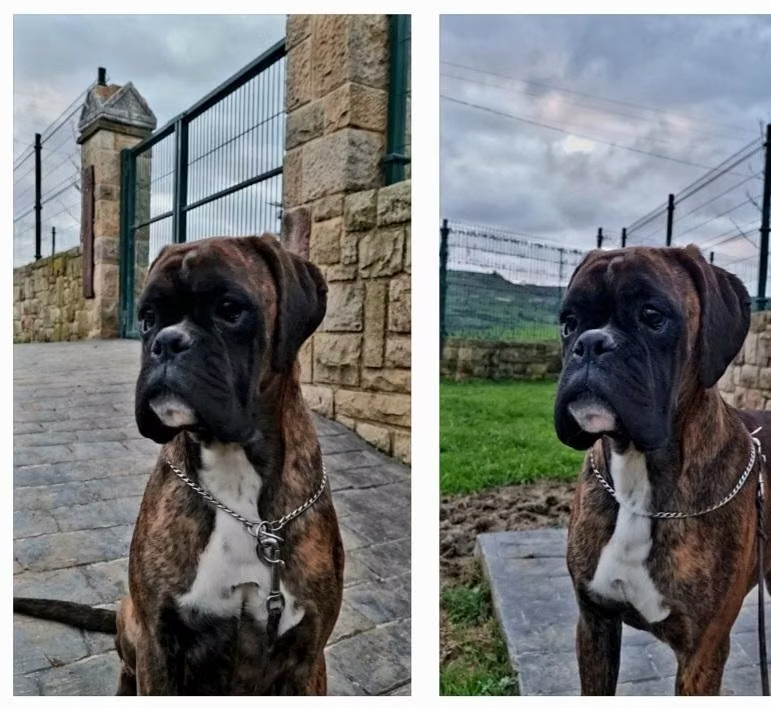


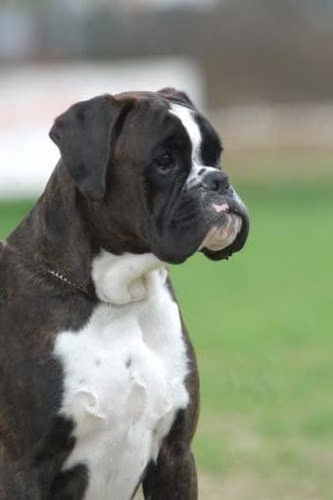
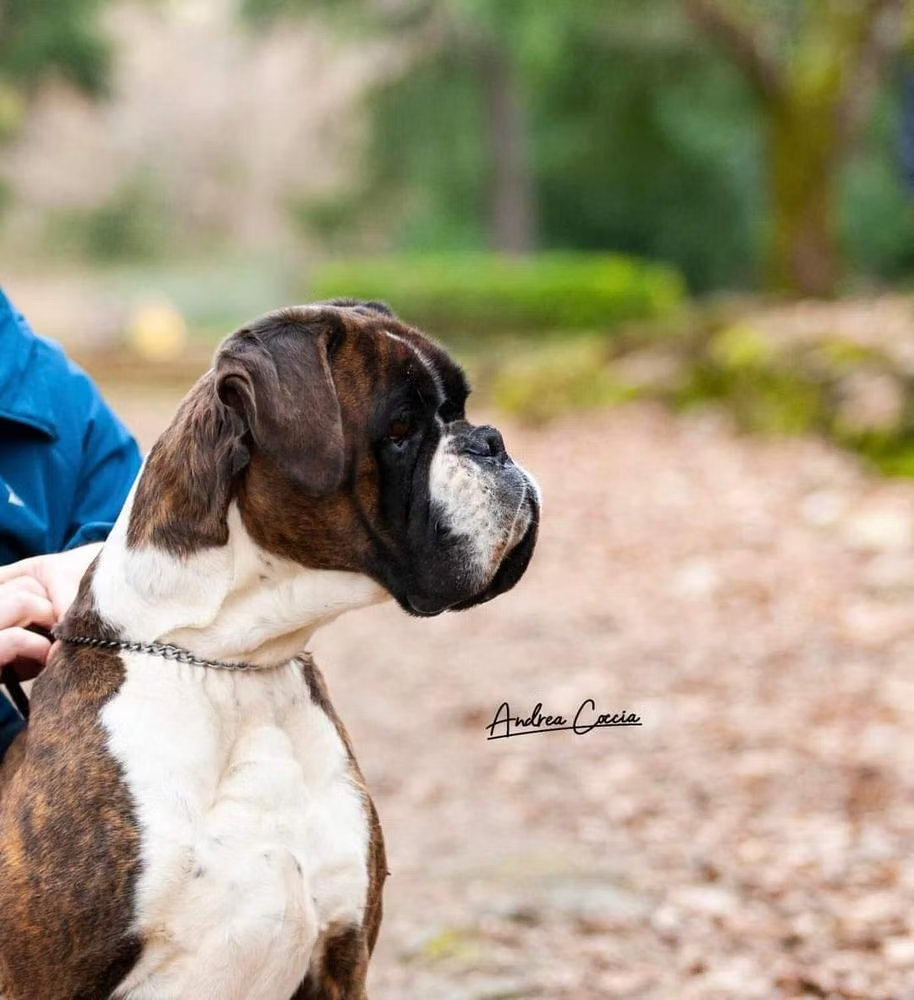
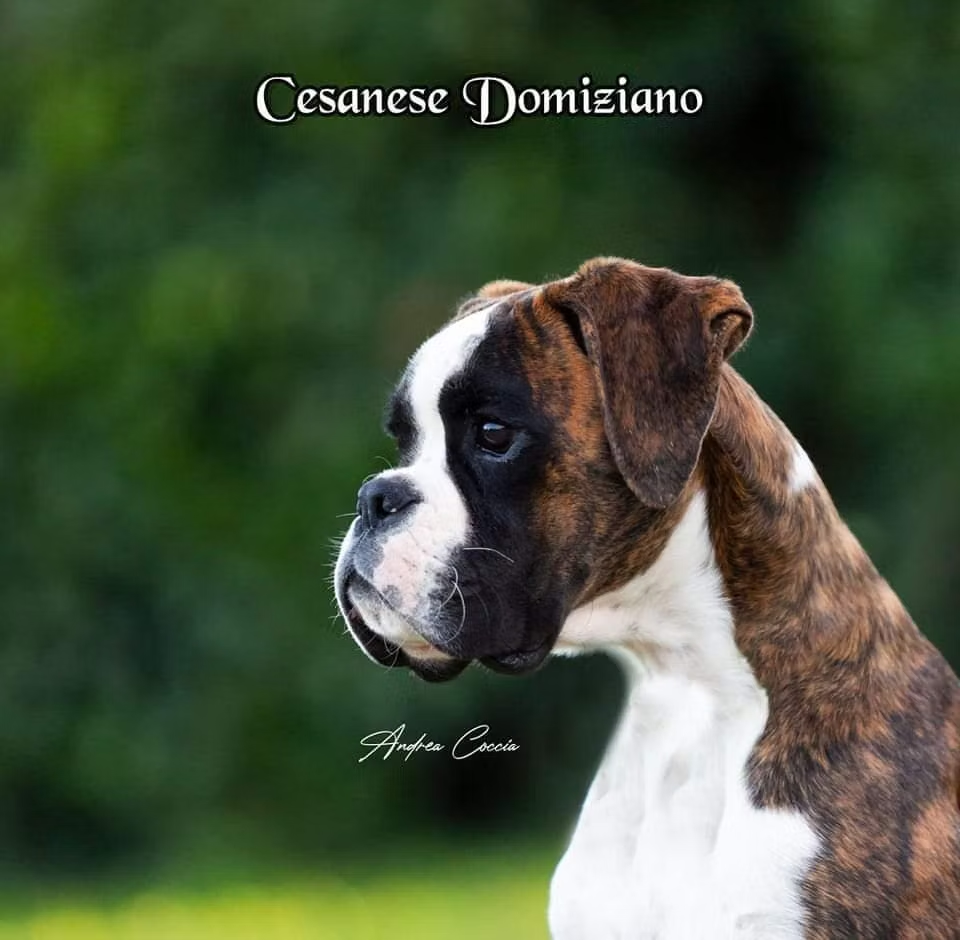

About the Boxer
The Boxer is a large German working dog weighing 25 to 32 kg, known for high energy, close family bonds, and a flat-faced build that requires careful heat management in Singapore's tropical climate.
The first thing a prospective owner in Singapore needs to know about the Boxer is that it is a large breed and is not on the Housing Development Board's list of approved breeds for HDB flats. Keeping one requires private property, a condo with management's written approval, or landed housing. This is not a minor administrative point: the breed is active and needs space, and the consequences of keeping an unapproved large dog in a flat are serious.
The Boxer is a medium-to-large working breed developed in Germany in the late 19th century. Adults weigh 25 to 32 kg and stand 53 to 63 cm at the shoulder. The breed is defined by its square head, broad short muzzle, deep chest, and smooth fawn or brindle coat. It is recognised in Singapore under the Singapore Kennel Club (SKC).
Boxers are high-energy and remain playful well into maturity. They attach closely to their household, prefer company over long stretches alone, and are patient with children they know. The same flat muzzle that gives the Boxer its characteristic expression also restricts airflow, and in Singapore's year-round heat this becomes a genuine management concern rather than a footnote.
| Attribute | Detail |
|---|---|
| Origin | Germany |
| Size | Large (25 to 32 kg) |
| Lifespan | 10 to 12 years |
| Group / role | Working dog; guardian and companion |
| Good with | Children and familiar people; needs introductions to other dogs |
Who the Boxer suits
Owners who live in private property or a condo, have an active schedule, and can exercise the dog during the cooler parts of the day will find the Boxer manageable. It is a reasonable choice for families with children who want an engaged, watchful dog. People who work long hours, live in an HDB flat, or cannot commit to daily vigorous activity should consider a different breed.
History and origin
The Boxer was shaped in Germany in the late 1800s from the Bullenbeisser, a large hunting dog, crossed with an English Bulldog, and the Deutscher Boxer Club in Munich standardised the breed in 1895.
The Boxer's ancestor was the Bullenbeisser, a heavy German working dog bred to grip and hold large quarry, including boar and bear, until hunters arrived. As large hunting estates contracted through the 19th century, the Bullenbeisser's role diminished, and Munich breeders began crossing the type with English Bulldogs imported from Britain. The goal was a smaller, more versatile dog that retained tenacity and strength.
The dogs produced by these crosses in the 1880s and 1890s carried the compact body, short muzzle, and square skull that are now standard for the breed. In 1895, a group of Munich fanciers established the Deutscher Boxer Club, recorded the first pedigrees, and published the initial breed standard. The origin of the name Boxer is often attributed to the dogs' habit of using their front paws during play, though this explanation has not been confirmed historically.
The breed left Germany in the early 20th century and spread widely after both World Wars, partly because soldiers returning home brought dogs with them. Boxers worked as messenger and patrol dogs during wartime, and the combination of trainability and a steady temperament translated well into civilian roles as police dogs, guide dogs, and family companions.
Appearance and breed standard
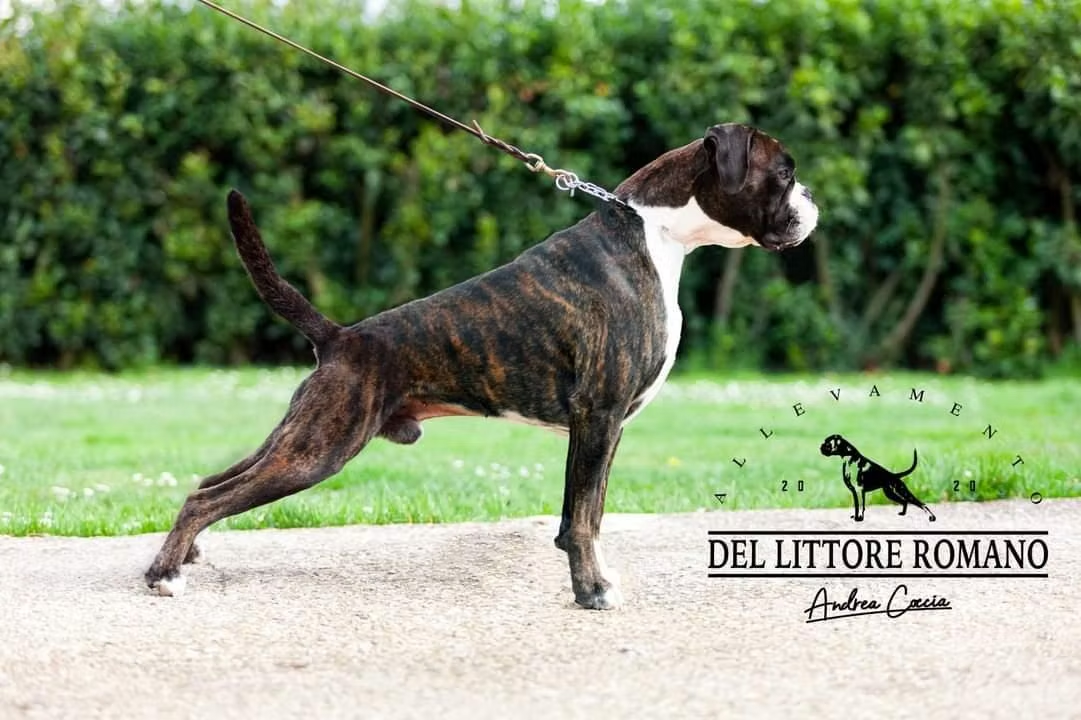
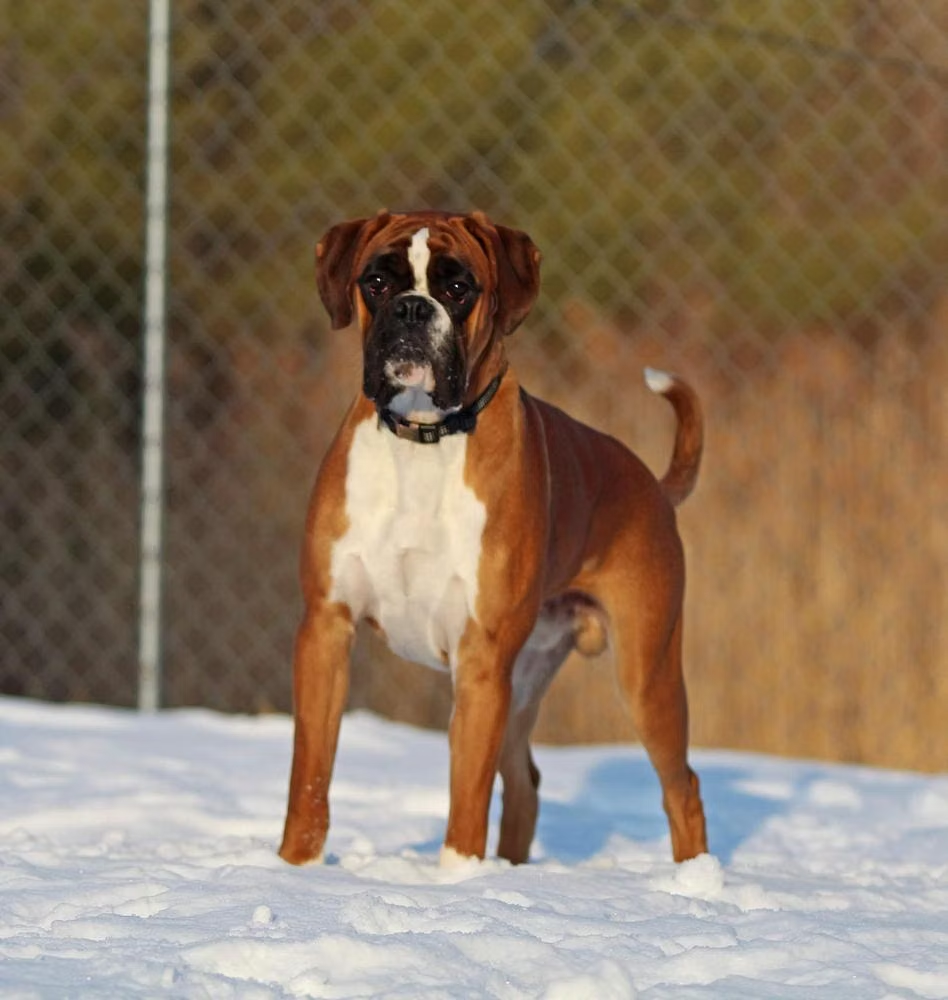
The Boxer is a square, muscular dog with a broad blunt muzzle, deep chest, and a short fawn or brindle coat that often carries white markings on the face, chest, and feet.
The Boxer's head is what most people notice first. A broad, blunt muzzle, an undershot jaw, and a furrowed brow produce an alert, almost quizzical expression. The body behind that head is compact and athletic: a deep chest, a short level back, strong straight legs, and visible musculature without bulk. The breed was built for both strength and speed, and the proportions reflect that.
| Feature | Standard |
|---|---|
| Height | Males 57 to 63 cm; females 53 to 59 cm at the shoulder |
| Weight | Males 27 to 32 kg; females 25 to 29 kg |
| Coat | Short, smooth, tight to the body |
| Colours | Fawn and brindle, with or without white markings |
| Eyes | Dark brown, set forward, with an alert expression |
Coat and colours
The short, flat coat requires little maintenance and sheds at a low rate. In practical terms for Singapore, the thin coat offers minimal insulation against heat but provides no meaningful cooling advantage either; the brachycephalic airway is a far greater thermal factor than coat length.
Fawn and brindle are the two accepted colours. Fawn ranges from pale cream to deep reddish brown; brindle has dark stripes across a fawn base. White markings on the chest, feet, and muzzle are common. Dogs with more than a third white, or fully white dogs, fall outside the show standard and have a statistically higher rate of inherited deafness. The dark facial mask is a characteristic feature of the breed.
Temperament and behaviour
The Boxer is watchful toward strangers and devoted to its household, stays playful through much of its adult life, and generally coexists with other pets when raised alongside them.
Toward strangers, the Boxer is alert and appraising. It tends to observe before it accepts, which produces a natural watchdog tendency without the constant barking of some smaller breeds. Early socialisation is necessary to keep that watchfulness measured; a Boxer that has met a wide range of people, sounds, and situations during puppyhood is more likely to assess calmly than to react defensively.
With its own household the breed is affectionate and engaged. Boxers often seek physical contact and follow household members from room to room. The breed is patient with children it has grown up with, though its size and energy mean an excited Boxer can easily knock over a small child without intent, so supervision during play is sensible.
Some Boxers, particularly intact males, are assertive with other dogs, so introductions with unfamiliar dogs should be managed carefully. The breed usually lives without conflict alongside cats and other pets it has been raised with. Left without enough exercise and mental engagement, a Boxer becomes destructive: chewing, digging, and vocalising are common results of boredom.
| Trait | Rating |
|---|---|
| Affection | 5 |
| Energy | 5 |
| Trainability | 3 |
| Vocalness | 2 |
| Shedding | 2 |
Care and grooming
The Boxer's short coat is easy to maintain, but the breed needs at least 60 to 90 minutes of daily exercise timed around Singapore's heat, with the bulk of outdoor activity before 8 a.m. or after sunset.
Exercise in Singapore's climate
Singapore's heat demands a different exercise plan than would apply in a temperate country. Temperatures sit at 30°C or above through most of the day, and humidity is consistently high. The Boxer's brachycephalic airway slows heat dissipation substantially: the dog cannot pant as efficiently as longer-muzzled breeds, so it reaches dangerous body temperature faster.
- Schedule the main walk before 8 a.m. Heat builds quickly after sunrise and the pavement temperature rises faster than the air.
- A second outing after dark is safer than one in the afternoon. The void deck, park connector, or nearby field that would be uncomfortably hot at noon is manageable in the evening.
- Keep individual sessions to 30 to 40 minutes outdoors rather than one long continuous outing.
- Bring water every time. Do not depend on finding a tap or a hawker centre stop.
- Watch for early heat stress signals: slowing down, heavy drooling, wide shallow panting, glazed eyes. If any appear, move the dog into shade or aircon immediately and apply cool (not iced) water to the paws and groin.
- Indoor sessions under aircon, including training drills, puzzle feeders, and scent games, count toward the total daily activity and are worth building into the routine.
Grooming
The coat needs minimal attention.
- Brush once a week with a rubber mitt or curry brush to remove loose hair.
- Bathe approximately every four to eight weeks, or when genuinely dirty.
- Wipe the facial skin folds regularly. Singapore's humidity makes moisture-trap infections more likely, so the wrinkles need checking at least twice a week.
- Trim nails every three to four weeks.
- Brush teeth several times a week and inspect the ears weekly for wax or odour.
Environment
The Boxer must live indoors with reliable air conditioning. It cannot be kept in an outdoor kennel or left in the garden during the day. A private house with an enclosed garden allows the dog to move freely during early morning and evening hours; a condo with a nearby park or estate can also work, provided the owner builds consistent early and evening exercise into the daily schedule.
Nutrition and feeding
An adult Boxer needs a complete, protein-rich diet of roughly 2 to 3 cups of quality dry food per day, divided into two meals to reduce the risk of bloat.
A large, active dog such as the Boxer does well on a complete commercial diet formulated for large breeds, with quality animal protein as the main ingredient and a moderate fat level. Portion size should reflect the individual dog's weight, age, and how active it actually is, not a fixed quantity from the bag. A Boxer that is exercising less because of heat restrictions may need slightly less food than the packaging suggests.
Bloat (gastric torsion) is a life-threatening condition to which deep-chested breeds are susceptible. Feed the daily amount across two separate meals rather than one, and avoid vigorous activity for at least an hour before and after eating. Dogs with food sensitivities, which some Boxers have, should have any dietary changes introduced gradually over seven to ten days.
| Life stage | Amount per day | Meals |
|---|---|---|
| Puppy (2 to 6 months) | 2 to 3 cups | 3 to 4 |
| Adolescent (6 to 12 months) | 2.5 to 3.5 cups | 2 to 3 |
| Adult (1 to 7 years) | 2 to 3 cups | 2 |
| Senior (7 years and older) | 2 to 2.5 cups | 2 |
Treats and supplements
Limit treats to around 10 per cent of daily calorie intake to keep weight under control; excess weight puts additional strain on joints and the heart. Lean cooked meat, plain carrots, and small commercial training treats are suitable. Most Boxers eating a complete diet do not require supplements. Older dogs or those with heavy exercise loads may benefit from joint support, but this should be discussed with a vet. Fresh water must be available at all times; in Singapore's heat the bowl needs refreshing more often than once a day.
Health and lifespan
The Boxer lives around 10 to 12 years and carries elevated risk for several cancers, two inherited heart conditions, hip dysplasia, and bloat; owners in Singapore must also manage the year-round heat stroke risk that the flat muzzle creates.
Boxers are generally active dogs through most of their lifespan of 10 to 12 years, but the breed has a notably higher incidence of certain serious conditions than many other working breeds. Cancer, including mast cell tumours and lymphoma, occurs at an above-average rate. Two cardiac conditions, Boxer cardiomyopathy (also called ARVC) and aortic stenosis, are heritable and can be screened for before breeding. Hip dysplasia and bloat complete the list of conditions that breeders and owners monitor closely.
In Singapore, heat stroke is an additional hazard that deserves equal weight. A Boxer exercised or left outside during the midday heat can deteriorate within minutes, and without prompt cooling and veterinary care the outcome can be fatal. This risk applies every day of the year, not seasonally.
| Condition | Signs | Note |
|---|---|---|
| Cancer (mast cell tumours, lymphoma) | Lumps, swelling, weight loss, lethargy | Boxers have an above-average cancer rate; check skin lumps promptly |
| Boxer cardiomyopathy (ARVC) | Fainting, weakness, irregular heartbeat | Inherited heart-rhythm disorder; can be screened by Holter monitor |
| Aortic stenosis | Tiring easily, fainting, heart murmur | Congenital narrowing near the heart; detected on examination and ultrasound |
| Hip dysplasia | Stiffness, limping, trouble rising | Inherited joint condition; breeding stock should be hip-scored |
| Bloat (gastric torsion) | Swollen abdomen, retching, distress | Life-threatening emergency; feed split meals and restrict exercise near mealtimes |
Preventive care
- Keep vaccinations, heartworm prevention, and tick and flea control current; consult a vet familiar with conditions prevalent in Singapore.
- Register the dog with the National Parks Board (NParks) or Animal and Veterinary Service (AVS) and ensure microchipping is completed as required by law.
- Book annual health checks, moving to twice-yearly visits once the dog passes seven.
- Ask for heart-screening and hip-evaluation certificates when purchasing from a breeder.
- Keep the dog at a healthy weight; even moderate excess weight compounds joint and cardiovascular strain.
- Inspect the skin monthly for new or changing lumps and report any findings to a vet without delay.
Training
The Boxer is intelligent and responds well to short, reward-based sessions, but it tests limits during its first two years and needs consistent rules established by everyone in the household from the start.
Boxers are clever and enjoy working alongside their owner, but the breed matures slowly and a young dog will probe for inconsistencies in the rules. The first two years are when habits, good and bad, are formed. Clear boundaries applied consistently by all household members from the beginning prevent the dog from learning that pushing back produces results.
Harsh corrections or forceful handling do not work well with this breed. The Boxer is sensitive to tone and tends to become anxious or resistant rather than compliant when handled roughly. Short sessions of 10 to 15 minutes, kept varied and ended before the dog loses focus, produce faster progress than long drilling routines. Singapore's heat also constrains outdoor training sessions, so indoor work under aircon should be part of the plan from the start.
Basics
- Begin socialisation as early as possible, before 16 weeks if the puppy's vaccination schedule permits, exposing it to different people, dogs, sounds, and surfaces.
- Establish name recognition and a reliable recall before working on anything else.
- Build the core skills: sit, down, stay, and walking on a loose lead. Leash use in public areas is required under Singapore law.
- Redirect jumping and mouthing onto toys and structured games rather than attempting to suppress the drive.
- Practise impulse control at doorways, around food, and when visitors arrive.
- Progress to more demanding work or a dog sport once the fundamentals are consistent.
Breeding
Boxers reach physical and mental readiness for breeding at around 18 to 24 months, produce litters of roughly 6 to 8 puppies after a 63-day gestation, and both parents should pass heart and hip screening before mating.
Sexual maturity in the Boxer arrives before the dog is physically or mentally ready to breed responsibly. Females may come into season from around six months, but waiting until both parents are fully grown and have completed the standard health tests is the accepted practice, typically from 18 to 24 months. The two tests considered non-negotiable before a breeding are cardiac evaluation covering both Boxer cardiomyopathy and aortic stenosis, and hip assessment, because both conditions pass to offspring at a measurable rate.
Gestation is approximately 63 days. Litters typically run six to eight puppies, though larger litters occur with some frequency. The Boxer's broad skull can complicate delivery, and caesarean section is not unusual for the breed. The dam should be monitored closely from mid-pregnancy through whelping.
Weaning happens at six to eight weeks. The time between birth and weaning is when handling by people and continued presence of the dam and littermates shapes the puppy's social confidence. Breeders registered with the Singapore Kennel Club (SKC) or equivalent bodies keep puppies with their litter until at least eight weeks before placement.
| Metric | Value |
|---|---|
| Breeding maturity | About 18 to 24 months |
| Gestation | About 63 days |
| Average litter size | 6 to 8 puppies |
| Weaning age | 6 to 8 weeks |
| Recommended pre-breeding tests | Heart screening and hip evaluation |
Licensing done? Now register your Boxer and its chip
AVS handles the licence; United Pet Club keeps a free, searchable record behind your Boxer's microchip for life.
Registering a Boxer in Singapore
The Animal & Veterinary Service requires every dog here to be licensed and microchipped by three months of age, so for a Boxer the chip is settled law. What stays on you is the record behind it. A free United Pet Club profile holds your contact details against the dog for as long as he is yours, and it keeps working even outside Singapore. Registering your dog takes minutes and never costs a cent.
Your Boxer's chip went in before his third month, as the rules require; whether the number leads anywhere is a separate question. Give it a live answer with United Pet Club: registration free for life, every brand accepted, every update free. Microchip registration plus a free account, and the whole thing is squared away.
How do I register my Boxer in Singapore?
Set up a free United Pet Club account, key in your Boxer's details and a photo, and save. The lifetime plan keeps the profile live at no cost for as long as he is with you, alongside whatever AVS requires.
How do I register my Boxer's microchip?
Key the 15-digit chip number into your free account together with your address, mobile, and email. The lifetime plan covers the registration and every update free, whichever brand the clinic used.
Is a microchip compulsory for a Boxer in Singapore?
Yes. AVS requires dogs to be licensed and microchipped by three months of age. The licence is the legal part; a registered, searchable record with your current mobile is the part that gets a lost Boxer home, and that part is free.
How much does it cost to register a Boxer?
Nothing. United Pet Club's lifetime plan covers the profile, the chip record, and unlimited updates, with no renewal, ever.
Frequently asked questions
Common questions from Singapore owners about housing rules, heat management, the Boxer's size and temperament, legal requirements, and where to source a puppy.
Can I keep a Boxer in an HDB flat?
No. The Boxer is a large breed and is not on the list of breeds approved by HDB for flat residents. Ownership requires private property, a condo where management permits the breed, or landed housing.
How do you exercise a Boxer safely in Singapore's heat?
Walk the dog before 8 a.m. or after dark. Keep individual outdoor sessions short, carry water, and watch for signs of overheating such as heavy panting, drooling, or stumbling. Indoor exercise under aircon, including training games and puzzle feeders, makes up part of the daily total.
What are the legal requirements for owning a dog in Singapore?
Dogs must be licensed through NParks or AVS, microchipped, and kept on a leash in public places. Large breeds must be kept in eligible housing types; HDB flats are not eligible for the Boxer.
How big does a Boxer get?
Males typically stand 57 to 63 cm at the shoulder and weigh 27 to 32 kg; females stand 53 to 59 cm and weigh 25 to 29 kg. The Boxer is classified as a large breed.
What is the Boxer's temperament like?
The Boxer is alert with strangers and affectionate with its own household. It is patient with children it knows, energetic and playful well into adulthood, and forms strong attachments to the people it lives with.
How long do Boxers live?
The typical lifespan is 10 to 12 years. The breed carries above-average risk for certain cancers and two inherited heart conditions, so regular veterinary checks and health screening of breeding animals matter.
Where can I find a Boxer in Singapore?
Puppies are available from breeders registered with the Singapore Kennel Club (SKC). The breed also appears occasionally through rescue organisations. Always ask to see cardiac and hip health-test results for both parents before committing to a purchase.
From the community
Ask about the BoxerNo questions about the Boxer yet. Be the first to ask.
Browse Dog breeds