
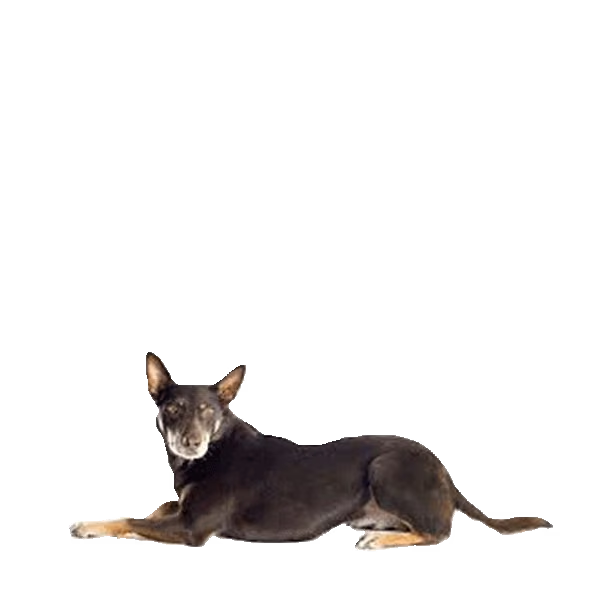
Working Kelpie
The Working Kelpie is a tireless, intelligent Australian herding dog renowned for its drive and stamina with livestock.
- Size
- Medium
- Lifespan
- 12–15 years
- Origin
- Australia
- Temperament
- Intelligent
- Standard colors
- Black, Blue and Tan and 2 more
Characteristics
Coat and grooming
How the Working Kelpie coat is built, and what that means when you groom it.
- Coat layers
- Double coat
- Coat texture
- Smooth
- Coat length
- Short
- Shedding
- Seasonal shedding
Grooming guidance
Critical: A Working Kelpie should not be shaved.
The undercoat keeps heat out as well as in, and the outer coat shields the skin from sun and insect bites. Clipping the whole coat off removes both. It often grows back patchy, soft or a different colour, and in some animals the guard hairs never return properly. Brush the undercoat out instead of cutting it off.
Information: A Working Kelpie drops its undercoat in heavy bursts.
The undercoat comes out in heavy bursts over a few weeks. An undercoat rake, or a bath followed by a proper blow-dry, clears it far faster than daily brushing. Clipping the coat down is not a shortcut for this.
Working Kelpie colors and patterns
What each club's breed standard says about every Working Kelpie color and pattern. Point at a ruling to see the club's own wording.
Breed standards describe the Working Kelpie in Black, Blue, Tan, Red and Fawn. Standard patterns: Solid and Tan point.


What the rulings mean
- Standard
- Described by the club's breed standard.
Color changes
How a Working Kelpie's colors can change over its life.
Blackchanges toRust
Coat · With body condition · can change back
Blackchanges toGrey
Coat · Progressive
Blackchanges toBrown
Coat · In the sun · can change back
Tan pointchanges toSaddle
Coat · With age · from 6 to 156 weeks

Sources
Each ruling comes from the club's published breed standard or color list.
About the Working Kelpie
The Working Kelpie is a medium-built Australian herding dog prized for stamina and intelligence, capable of moving large flocks over open country for hours together.
The Working Kelpie is a medium-sized herding dog developed in Australia to manage sheep and other livestock across vast, often unforgiving terrain. It is bred for endurance rather than looks, and within working circles a dog is judged purely on how well it handles stock, not on how it appears in a show ring. Many Kelpies cover long distances in dust and heat, working for hours with barely any direct instruction once they understand the task at hand.
The breed is closely related to the Australian Kelpie kept as a companion and show dog, but the working line is bred almost entirely for ability. Station owners and dog handlers select for biddability, a strong herding instinct, and the stamina needed for a full day of mustering. A well-trained Kelpie can handle hundreds of sheep working alongside just one person.
This is a dog that needs a proper job to do. Without daily physical work and mental challenge, a Working Kelpie turns restless and becomes difficult to manage at home. Given a farm to work on, or a sport such as herding trials, agility, or canicross, that same drive turns into a genuine asset.
| Attribute | Detail |
|---|---|
| Origin | Australia |
| Size | Medium |
| Lifespan | 12 to 15 years |
| Group / role | Herding and droving dog |
| Good with | Experienced, active owners, livestock, and households that can offer daily work |
Who it suits
The Working Kelpie suits people who can give it real work and several hours of activity every day. It fits well with farmers, cattle and sheep owners, and handlers active in dog sports. It is a poor match for households in flats or gated societies without a proper exercise plan, or for owners who remain away from home for long stretches, since boredom in this breed quickly turns into digging, barking, and attempts to escape.
History and origin
The Working Kelpie was developed in late 19th-century Australia from British collie-type herding dogs, selected by sheep stations for the stamina needed in hot, dry country.
The story of the Working Kelpie begins in Australia in the second half of the 19th century. As wool farming spread across vast inland properties, station owners needed dogs capable of mustering sheep over enormous distances in dust and heat. Collie-type herding dogs brought over from Britain formed the foundation stock for what would become the breed.
The name comes from a bitch called Kelpie, bred in the early 1870s from imported collie-type parents. Her offspring proved outstanding on stock, and in time the name came to describe the type itself. Working ability mattered above everything else, so early Kelpies varied a fair bit in coat and colour while sharing a strong herding instinct and real endurance.
Through the late 1800s and well into the 1900s, breeders kept selecting for traits that counted on a working property: a strong eye on stock, willingness to take direction, the toughness to put in long hours, and an instinct for reading livestock. Some Kelpies even developed the habit of running across the backs of sheep packed into yards, a trait still valued on working properties today.
Over the decades two distinct streams took shape. One was bred toward a fixed look for the show ring and companion homes. The other, the Working Kelpie, continued to be bred chiefly for stock work, with performance on livestock remaining the true measure of quality. Working Kelpies are still used widely on Australian farms and stations, and the breed has found its way to other countries with large grazing operations, including a small but growing following among working-dog enthusiasts in India.
Appearance
The Working Kelpie is a lean, medium-built dog with a weatherproof double coat, pricked ears, and an agile frame suited to long days spent herding livestock.
The Working Kelpie has a lean, well-balanced, athletic body built for speed and stamina rather than bulk. The head is slightly rounded with a clear stop, the muzzle tapers towards the nose, and the ears are usually pricked and alert. The overall look is of a fit, agile dog capable of running, turning, and stopping in an instant. Since the working line is bred purely for function, appearance varies far more here than it does in show breeds.
| Trait | Typical range |
|---|---|
| Height | 43 to 51 cm (17 to 20 in) at the shoulder |
| Weight | 11 to 20 kg (24 to 45 lb) |
| Coat | Short to medium double coat, weather resistant |
| Colours | Black, red, chocolate, fawn, blue, cream, often with tan points |
| Eyes | Almond shaped, brown, alert expression |
Coat and colours
The coat is a double coat, with a short, dense undercoat and a flatter, harder outer coat that sheds off dirt and rain with ease. Coat length ranges from short to medium, with a touch more feathering possible on the legs and tail. Colours include black, red, chocolate, fawn, blue (grey), and cream, and many dogs carry tan points on the face, legs, and chest. As the breed is chosen for work, colour is treated as purely cosmetic and carries no weight when judging a dog's true worth.
Temperament
The Working Kelpie is intelligent, focused, and driven to work non-stop, forming a close bond with its handler while needing a clear job and firm, fair structure.
The Working Kelpie is intelligent, full of energy, and strongly driven to work. It bonds closely with its handler and tends to watch closely for direction, which makes it quick to pick up training, but just as quick to invent its own mischief when left with nothing to do. Most Kelpies stay alert to their surroundings, so they double up well as watchdogs, though at heart they remain working dogs and not guard dogs.
Within the family, a properly socialised Kelpie is affectionate and loyal. With strangers it tends to hold back at first and may take a while to come around. The herding instinct runs deep, so some Kelpies try to gather or nip at running children, other pets, or anything that moves quickly, including two-wheelers in the yard. Early training and firm boundaries go a long way in redirecting this. Around other dogs and livestock the breed is usually sound when raised alongside them, though its drive means it needs supervision around smaller animals until it can be trusted.
This is a dog that thinks for itself. Without sufficient exercise and mental engagement, a Kelpie can turn anxious, destructive, or given to constant barking, which does not go down well in a shared compound or society. Given a job and consistent handling, it settles calmly indoors and stays steady out in the field.
| Trait | Rating |
|---|---|
| Affection | 4 |
| Energy | 5 |
| Trainability | 5 |
| Vocalness | 3 |
| Shedding | 3 |
Care and grooming
The Working Kelpie needs little grooming but demands a large amount of daily exercise and mental work to stay balanced, especially through India's hot and humid months.
The Working Kelpie is easy to keep clean but far more demanding to exercise. Its short to medium double coat asks for little upkeep, while its energy and intelligence call for a substantial daily outlet.
Grooming
- Brush once a week to clear loose hair and dirt, and more often during the seasonal coat shed.
- Bathe only when required, as frequent washing strips away the weatherproof coat.
- Check ears for dirt and dampness after work in tall grass, water, or during the monsoon.
- Trim nails every few weeks if they do not wear down on their own.
- Brush teeth several times a week to keep dental problems at bay.
Exercise
- Set aside at least one to two hours of active exercise every day.
- Combine physical work, such as running, herding, or fetch, with thinking tasks like training, scent games, or puzzle feeders.
- Take up dog sports such as herding trials, agility, flyball, or canicross when livestock work is not on offer.
- Avoid leaving the dog alone for long hours without any way to burn off its energy.
- Exercise early morning or after sunset during peak summer, since the breed's dark coat absorbs heat quickly in the afternoon sun.
Environment
The Working Kelpie suits a farm, a rural property, or an active household with a secure yard. It can adjust to city life only if the owner commits to genuine daily exercise and training, which is a big ask given how few Indian homes offer that kind of space and time. Fencing needs to be tall and secure, because a bored Kelpie will happily climb, dig, or leap over a compound wall to get out.
Nutrition and feeding
The Working Kelpie needs a complete, protein-rich diet matched to its workload, with active dogs requiring noticeably more energy than companion dogs of the same weight.
The Working Kelpie does best on a complete, balanced diet suited to an active dog. Dogs working hard on a farm need considerably more calories than pets that get only light exercise, so the amount fed should track the dog's actual workload, body condition, and age. Choose a quality food with adequate protein and fat to fuel sustained activity, and adjust the portions to keep the dog lean rather than heavy, particularly during the humid months when appetite can dip.
| Life stage | Amount per day | Meals |
|---|---|---|
| Puppy (2 to 6 months) | Per product guide for age and weight | 3 to 4 |
| Adolescent (6 to 12 months) | Slightly above adult maintenance | 2 to 3 |
| Adult, active working | Roughly 250 to 400 g dry food, adjusted to workload | 2 |
| Adult, light activity | Roughly 180 to 280 g dry food | 2 |
| Senior (8+ years) | Reduce to match lower activity | 2 |
Treats and supplements
Keep treats to a small share of the daily calorie count and use them chiefly as training rewards. Provide constant access to clean drinking water, especially during work in the heat or through a humid spell. Most healthy dogs on a complete diet do not need supplements; check with a veterinarian before adding any, including joint support for older dogs or those working hard.
Health and lifespan
The Working Kelpie is generally hardy with a lifespan of 12 to 15 years, though inherited eye conditions, hip dysplasia, and a few neurological disorders occur in the breed.
The Working Kelpie is, on the whole, a hardy and robust breed, the result of decades of selection for fitness and function. Typical lifespan runs to 12 to 15 years. As with any breed, a handful of inherited conditions do turn up, and responsible breeders screen their breeding stock to cut the risk of passing these on. Since working lines place such emphasis on soundness, many lines stay healthy, but buyers should still ask breeders about health testing before bringing a puppy home.
| Condition | Signs | Note |
|---|---|---|
| Progressive retinal atrophy | Night blindness, declining vision | Inherited eye disease; DNA testing available in some lines |
| Hip dysplasia | Stiffness, limping, difficulty rising | Reduced by hip scoring of breeding stock |
| Cerebellar abiotrophy | Loss of coordination, tremors in young dogs | Inherited neurological disorder; screen pedigrees |
| Collie eye anomaly | Often no signs; found on eye exam | Inherited; detected by veterinary eye screening |
Preventive care
- Keep vaccinations and parasite control (fleas, ticks, worms) up to date, particularly through the monsoon.
- Book annual veterinary check-ups, with more frequent visits once the dog reaches its senior years.
- Maintain a lean body condition to protect the joints.
- Arrange eye and hip screening before any breeding.
- Look after the teeth with regular brushing and dental checks.
Training
The Working Kelpie is among the most trainable of herding breeds, learning fast and working well at a distance, but it needs early, consistent training to channel its drive.
The Working Kelpie is highly trainable and picks things up fast. It reads its handler closely and is willing to take direction from a distance, which is exactly why it can manage stock on the strength of subtle commands. That same intelligence means it gets bored with repetition and will test its boundaries the moment training turns inconsistent. Start early, keep sessions varied and purposeful, and set clear, fair rules from day one. Socialise puppies widely so the natural reserve towards strangers does not harden into wariness.
Basics
- Socialise the puppy to people, places, sounds, and other animals from an early age.
- Teach core obedience: responding to its name, sit, down, recall, and a dependable stay.
- Build a strong recall and a reliable stop command, both essential for safe stock work.
- Channel the herding instinct into approved outlets and firmly discourage chasing or nipping at people.
- Add complexity gradually through distance work, directional commands, and dog sports.
Breeding
Working Kelpies are usually bred for proven stock ability, with the dam whelping litters of around four to seven pups after a gestation of roughly 63 days.
Working Kelpies are bred chiefly for working ability, so reputable breeders choose parents that have already proved themselves on temperament, stamina, and skill with livestock. Bitches reach physical maturity by around 18 to 24 months, and responsible breeders generally wait until then before a first litter, so the dam is fully grown and has cleared her health tests. Mating follows the female's heat cycle, which usually comes around twice a year.
Gestation runs to around 63 days. Litter size commonly falls between four and seven puppies, though it can run smaller or larger. The dam raises the pups through the early weeks, and breeders begin gentle socialisation and handling from just a few weeks of age. Puppies stay with the litter until at least eight weeks old, during which exposure to handling, everyday sounds, and farm activity helps shape steady working dogs. Health screening of breeding stock, including eye and hip checks, cuts the risk of passing on inherited conditions to the next generation.
| Metric | Value |
|---|---|
| Female maturity for breeding | About 18 to 24 months |
| Heat cycle frequency | Roughly twice a year |
| Gestation | Around 63 days |
| Typical litter size | 4 to 7 puppies |
| Weaning age | About 6 to 8 weeks |
| Earliest rehoming | 8 weeks or later |
Registering a Working Kelpie in India: profile and microchip
Municipal licences cover the paperwork; a free United Pet Club record is what actually connects your Working Kelpie to your phone.
How to register a Working Kelpie in India
A Working Kelpie that slips past the gate of the housing society is identified by its record, not by its pedigree. Provide that record without spending a rupee: the free United Pet Club profile carries your telephone number, the dog's photograph, and its details for life. Register your dog and the matter is settled.
Should your Working Kelpie already carry a microchip, the number must still be recorded separately, since the vet performs only the implant. Registering the microchip under the free lifetime plan accepts chips from any manufacturer an Indian vet works with, keeps every update free should your household shift cities, and leaves the record searchable at any hour. Create your free account and complete both tasks in one sitting.
How do I register my Working Kelpie in India?
Create a free United Pet Club account, enter your Working Kelpie's details along with a photograph, and save the profile. The lifetime plan maintains the record at no cost, and any municipal licence you hold sits alongside it rather than replacing it.
How do I register my Working Kelpie's microchip?
Enter the fifteen digit chip number into your free account together with your current address, phone number, and email. The lifetime plan covers the registration and every subsequent update without charge, whatever the chip's manufacturer.
Is registration compulsory for a Working Kelpie in India?
Several municipal corporations, Delhi and Mumbai among them, require dogs to be licensed under local by-laws. The United Pet Club profile is separate and voluntary, and it is the record a finder anywhere can actually search, free of cost.
What does it cost to register a Working Kelpie?
Nothing whatsoever. The free lifetime plan includes the profile, the microchip record, and unlimited updates, with no renewal fee at any point.
Frequently asked questions
Common questions about the Working Kelpie cover its size, temperament, exercise needs, lifespan, suitability as a pet, and where to find one in India.
How big does a Working Kelpie grow?
It is a medium-sized dog, usually standing 43 to 51 cm (17 to 20 in) at the shoulder and weighing about 11 to 20 kg (24 to 45 lb), with a lean, athletic build.
What is the temperament of a Working Kelpie like?
It is intelligent, focused, and driven to work non-stop. It bonds closely with its handler, tends to be reserved with strangers, and needs a proper job to stay calm and content.
Is a Working Kelpie difficult to maintain?
Grooming is simple enough, but the breed is demanding when it comes to exercise and mental stimulation. It needs one to two hours of active work a day and does not suit a low-activity household.
How long does a Working Kelpie live?
Most live 12 to 15 years. They are generally hardy, though some lines carry inherited eye, hip, or neurological conditions, so parents with proper health testing matter.
Does a Working Kelpie make a good family pet?
It can suit an active family that offers daily exercise and training. The strong herding instinct means it may try to gather or nip at running children, so early training and supervision matter.
Is a Working Kelpie suitable for a flat?
It is a poor fit for a flat unless the owner commits to several hours of daily activity. It does best on a farm or in an active home with a secure yard.
Where can I get a Working Kelpie in India?
The breed remains rare in India and is not commonly registered by the Kennel Club of India as a distinct working line. Most dogs here come through working-dog or herding-dog enthusiasts and importers; anyone looking for one should seek breeders who can prove working ability and provide health-tested parents, whether in India or abroad.
From the community
Ask about the Working KelpieNo questions about the Working Kelpie yet. Be the first to ask.
Browse Dog breeds