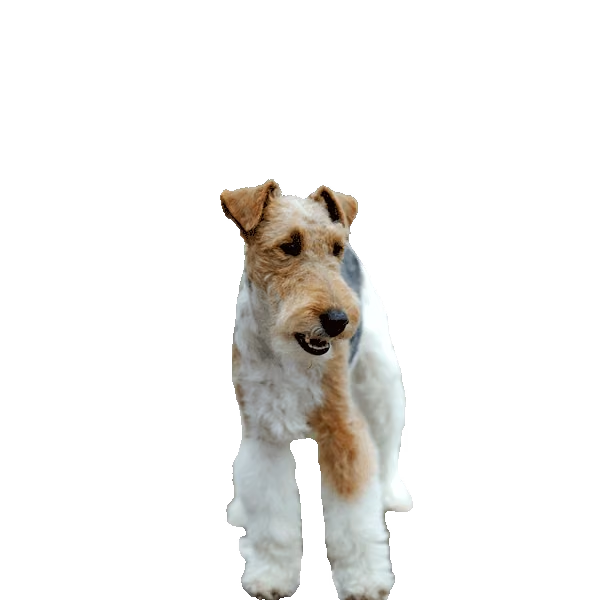
The Wire Fox Terrier is a spirited, confident English breed with a dense wiry coat, celebrated for its boundless energy and show-ring flair.
How the Wire Fox Terrier coat is built, and what that means when you groom it.
Caution: A Wire Fox Terrier coat should be hand-stripped rather than clipped.
A wire coat is meant to be pulled out at the root once the hair is ready to release. Clippers cut it off part way instead, leaving the soft undercoat behind. The result is a coat that grows back limp and faded, and the weatherproof texture only returns after the hair is stripped out again.
A few of the Wire Fox Terrier profiles members have added to United Pet Club.
The Wire Fox Terrier is a small, wiry-coated terrier from England, bred to bolt foxes and today kept mainly as an alert, energetic companion and show dog in India.
The Wire Fox Terrier is a small working terrier that was developed in England to bolt foxes out of their dens during the hunt. It stands at about 39 cm at the shoulder and weighs roughly 7 to 8 kg, with a hard, dense, wiry coat that is mostly white marked with black and tan.
The breed is alert, quick, and self-assured. It was bred for stamina and courage below ground, and that same drive shows up in daily life as high energy and constant curiosity. A Wire Fox Terrier kept as a pet needs proper exercise and mental work, not a quick walk around the block.
Owners commonly describe the breed as spirited, intelligent, energetic, alert, and confident. It has a long record in conformation rings, including at Kennel Club of India (KCI) shows, and remains one of the more consistently successful terriers on the show bench, which has kept its coat and outline largely unchanged over the generations.
| Attribute | Detail |
|---|---|
| Origin | England |
| Size | Small (about 7 to 8 kg) |
| Lifespan | 12 to 15 years |
| Group/role | Terrier; fox bolting and den work |
| Good with | Active adults and older children; supervise around small pets |
This breed suits owners who want an engaged, lively dog and can commit to daily exercise and consistent training, even through the hot months. Its terrier prey drive means it may chase cats, squirrels, and rodents, so households with small pets need proper management. First-time owners can manage well with one if they are ready for a confident dog that needs clear structure from the start.
The Wire Fox Terrier took shape in nineteenth-century England as a fox-bolting terrier, later sharing a breed standard with the Smooth Fox Terrier before its own recognition.
The Wire Fox Terrier comes from England, where terriers were used in fox hunting to enter dens and drive the fox back out towards the waiting hounds. The wire-coated type is generally traced to rough-coated black-and-tan working terriers from the coal-mining districts of northern England and Wales.
Through the 1800s, the Smooth and Wire Fox Terriers were treated as two coat varieties of a single breed and were frequently crossed. Breeders later worked to fix the wire coat and the mostly white body, since the white colour made it easier for hunters to tell the dog apart from the fox in the field.
The two coat types were eventually separated into distinct breeds, recognised first by England's Kennel Club and later by kennel clubs around the world, including the Kennel Club of India. The Wire Fox Terrier built a strong reputation in the show ring and has taken top honours at major conformation events.
As organised fox hunting declined, the breed's role shifted from working terrier to companion and show dog. Its working instincts, including a strong urge to dig and to chase, are still very much present in the modern dog, and show up readily in Indian gardens and courtyards too.
The Wire Fox Terrier is a compact, square-built terrier with a hard, wiry double coat that is mostly white with black and tan markings.
The Wire Fox Terrier has a short-backed, square outline, standing as tall as it is long from shoulder to the base of the tail. The head is long and wedge-shaped, with a flat skull, small V-shaped folded ears, and dark, deep-set eyes. The overall impression is of an alert, well-balanced dog, always on its toes.
| Trait | Standard |
|---|---|
| Height | About 39 cm at the withers (males); slightly less for females |
| Weight | Roughly 7 to 8 kg |
| Coat | Dense, hard, wiry outer coat over a softer undercoat |
| Colours | Mostly white with black and tan markings; white predominates |
| Eyes | Dark, small, moderately deep-set |
The coat is the breed's defining feature: a dense, wiry, broken outer layer with a finer undercoat below it. The texture should feel hard and crinkly, never soft. White is the base colour and should predominate, with black, tan, or black-and-tan markings usually seen on the head and at the base of the tail. All-white and black-and-white dogs do occur. To keep the correct texture and colour, show dogs are hand-stripped rather than clipped, since clipping softens the coat and dulls its markings, and in humid weather a clipped coat also holds moisture against the skin for longer.
The Wire Fox Terrier is confident, energetic, and clever, affectionate at home but bold with strangers and quick to chase anything smaller than itself.
The Wire Fox Terrier is a high-spirited, confident dog that rarely sits still. With its family it is affectionate, playful, and attentive, and it likes to be part of whatever is going on in the house. It tends to be alert and quick to bark, which makes it a capable watchdog, though it is not a guard dog in the true sense.
With strangers, the breed is usually friendly but watchful, and it warms up in its own time. Its strong prey drive means cats, squirrels, and other small pets can set off a chase, so introductions need care, and small caged animals are best kept in a separate room. With other dogs it can be assertive, and some individuals are scrappy with dogs of the same sex.
This is an intelligent breed with an independent streak, a habit left over from working alone underground. It picks things up fast but can be stubborn and easily bored, so it does best with owners who stay engaged and offer structure, exercise, and games that give the dog a proper job to do.
| Trait | Rating |
|---|---|
| Affection | 4 |
| Energy | 5 |
| Trainability | 3 |
| Vocalness | 4 |
| Shedding | 2 |
The Wire Fox Terrier needs regular brushing with periodic hand-stripping, vigorous daily exercise, and a secure garden that contains its urge to chase and dig.
The wiry coat needs routine upkeep, and the breed's energy needs a daily outlet. Care is moderate in effort but has to be consistent, especially through the monsoon and the peak summer months.
The Wire Fox Terrier adjusts to a flat or an independent house as long as it gets daily exercise. A securely fenced garden is ideal, and boundaries should be checked at ground level because the breed digs, particularly in the soft mud that follows monsoon rain. Without enough activity it can turn noisy and destructive, and in the heat it can also overheat quickly if left without shade.
A Wire Fox Terrier does well on a complete diet made for small, active dogs, fed in measured portions to keep its weight in check.
Feed a complete and balanced food suited to the dog's life stage and small build. Because the breed is active, it burns energy readily, but portions should still be measured, since small dogs put on weight quickly. Match the quantity to age, activity level, and body condition rather than the maximum stated on the packet.
| Life stage | Amount per day | Meals |
|---|---|---|
| Puppy (2 to 6 months) | About 120 to 180 g (split) | 3 to 4 |
| Puppy (6 to 12 months) | About 120 to 150 g | 2 to 3 |
| Adult | About 90 to 180 g | 2 |
| Senior | Adjusted down for lower activity | 2 |
Keep treats to around 10 percent of daily calories, and use small pieces during training so the total stays low. Most dogs on a complete diet need no extra supplements; check with a vet before adding any. Keep fresh water available at all times, and top it up more often in hot weather.
The Wire Fox Terrier is generally a healthy breed with a lifespan of 12 to 15 years, though eye, joint, and a few inherited conditions are worth watching for.
The Wire Fox Terrier is a sturdy breed and usually lives 12 to 15 years. Responsible breeders screen for known inherited conditions, and routine veterinary care supports a long life. As a small, active dog, it stays fit well into its senior years when kept at a healthy weight.
| Condition | Signs | Note |
|---|---|---|
| Primary lens luxation | Eye redness, pain, cloudiness, change in vision | Inherited eye disorder; DNA testing available |
| Cataracts | Cloudy lens, reduced vision | May appear with age; treatable in some cases |
| Patellar luxation | Skipping gait, occasional hind-leg lameness | Common in small breeds; ranges from mild to surgical |
| Deafness | Poor response to sound, easily startled | Linked to coat colour; can be tested in pups |
| Hip and elbow issues | Stiffness, reluctance to jump | Keep the dog lean to reduce strain on joints |
The Wire Fox Terrier is clever and quick to learn but independent-minded, so it responds best to short, varied, reward-based sessions.
The Wire Fox Terrier learns quickly but has a mind of its own, a habit carried over from working alone underground. It can lose interest in drills, so keep sessions short, varied, and upbeat. Reliable recall is hard to guarantee, since prey drive takes over the moment a squirrel or a stray cat runs, so off-leash freedom should be limited to safe, enclosed areas. Early, ongoing socialisation with people, dogs, and everyday situations, including the noise of Indian streets and festivals, helps the dog stay confident rather than reactive.
Wire Fox Terriers reach maturity around one to two years, carry litters of about three to six puppies, and need health-screened parents and early socialisation.
Wire Fox Terriers reach physical and behavioural maturity between about one and two years of age. Responsible breeding pairs dogs only after health screening, including eye testing for lens luxation, hearing checks, and patella evaluation, and after confirming a sound temperament. Gestation runs roughly 63 days, and litters typically number three to six puppies.
The dam usually raises the litter with little intervention, though the breeder keeps an eye on weight gain and health from birth. Puppies are weaned by about seven to eight weeks. Early handling and exposure to sights, sounds, and gentle social experiences matter for this alert breed, since well-socialised pups grow into steadier adults. Breeding is best left to experienced, ethical breeders registered with the Kennel Club of India who put the health of the dogs first.
| Metric | Value |
|---|---|
| Sexual maturity | About 1 to 2 years |
| Gestation | About 63 days |
| Litter size | About 3 to 6 puppies |
| Weaning | About 7 to 8 weeks |
| Pre-breeding screening | Eyes, hearing, patellas, temperament |
Municipal licences cover the paperwork; a free United Pet Club record is what actually connects your Wire Fox Terrier to your phone.
Begin with the essentials: your Wire Fox Terrier's name, its date of birth, a clear photograph, and your mobile number, saved to a registry that levies no charge at any stage. Dog registration functions with or without a microchip, so nothing need wait for the next clinic visit.
A microchip without a registration is merely a number under the skin. File your Wire Fox Terrier's fifteen digit number with United Pet Club and it becomes a working address: free for life, open to every chip brand, and searchable from any clinic or shelter in the country or abroad. Microchip registration first, the free account alongside.
Create a free United Pet Club account, enter your Wire Fox Terrier's details along with a photograph, and save the profile. The lifetime plan maintains the record at no cost, and any municipal licence you hold sits alongside it rather than replacing it.
Enter the fifteen digit chip number into your free account together with your current address, phone number, and email. The lifetime plan covers the registration and every subsequent update without charge, whatever the chip's manufacturer.
Several municipal corporations, Delhi and Mumbai among them, require dogs to be licensed under local by-laws. The United Pet Club profile is separate and voluntary, and it is the record a finder anywhere can actually search, free of cost.
Nothing whatsoever. The free lifetime plan includes the profile, the microchip record, and unlimited updates, with no renewal fee at any point.
Common questions about the Wire Fox Terrier cover its size, temperament, grooming needs, lifespan, suitability for Indian homes, and availability.
It is a small breed, standing about 39 cm at the shoulder and weighing roughly 7 to 8 kg.
Spirited, confident, intelligent, and energetic. It is affectionate with family, alert around strangers, and has a strong urge to chase small animals.
Care is moderate. The coat needs weekly brushing and periodic hand-stripping, and the dog needs vigorous daily exercise and mental work to stay content, especially in India's heat.
Typically 12 to 15 years with good care, a healthy weight, and routine veterinary attention.
Yes, for active households and older children. Homes with cats or small caged pets need to manage the breed's prey drive carefully.
It sheds relatively little. The wiry coat is maintained mainly through brushing and hand-stripping rather than heavy seasonal shedding.
They are not common here. Expect to contact reputable breeders registered with the Kennel Club of India or breed-specific rescues, and possibly join a waiting list.



