

Scottish Terrier
The Scottish Terrier is a dignified, independent Scottish breed with a distinctive silhouette, known for its confident and loyal character.
- Size
- Small
- Lifespan
- 11–13 years
- Origin
- Scotland
- Temperament
- Dignified
- Standard colors
- Black, Silver, Red and Wheaten
Characteristics
Coat and grooming
How the Scottish Terrier coat is built, and what that means when you groom it.
- Coat layers
- Double coat
- Coat texture
- Wire
- Coat length
- Medium
- Shedding
- Low shedding
Grooming guidance
Caution: A Scottish Terrier coat should be hand-stripped rather than clipped.
A wire coat is meant to be pulled out at the root once the hair is ready to release. Clippers cut it off part way instead, leaving the soft undercoat behind. The result is a coat that grows back limp and faded, and the weatherproof texture only returns after the hair is stripped out again.
Scottish Terrier colors and patterns
What each club's breed standard says about every Scottish Terrier color and pattern. Point at a ruling to see the club's own wording.
Breed standards describe the Scottish Terrier in Black, Silver, Red and Wheaten. Standard patterns: Brindle and Reverse brindle.
| Color or pattern | FCI | AKC | UKC | KC | KUSA |
|---|---|---|---|---|---|
| Black | Standard (“Black”) | Standard (“Black”) | Standard (“Black”) | Standard (“Black”) | Standard (“Black”) |
| Silver | Standard (“brindle of any shade”) | Standard (“Silver Brindle”) | Standard (“brindle of any color”) | Standard (“brindle of any shade”) | Standard (“brindle of any shade”) |
| Red | Standard (“brindle of any shade”) | Standard (“Red Brindle”) | Standard (“brindle of any color”) | Standard (“brindle of any shade”) | Standard (“brindle of any shade”) |
| Wheaten | Standard (“wheaten”) | Standard (“Wheaten”) | Standard (“wheaten”) | Standard (“wheaten”) | Standard (“wheaten”) |
| Albino | Not recognised | Not recognised | Disqualifying (“Albinism”) | Not recognised | Not recognised |
| Patterns | |||||
| Brindle | Standard (“brindle of any shade”) | Standard (“Brindle”) | Standard (“brindle of any color”) | Standard (“brindle of any shade”) | Standard (“brindle of any shade”) |
| Reverse brindle | Standard (“brindle of any shade”) | Standard (“Brindle”) | Standard (“brindle of any color”) | Standard (“brindle of any shade”) | Standard (“brindle of any shade”) |


| Color or pattern | FCI | AKC | UKC | KC | KUSA |
|---|---|---|---|---|---|
| Black | No ruling | Standard (“dark brown or nearly black, the darker the better”) | Standard (“dark brown or nearly black, the darker the better”) | No ruling | No ruling |
| Dark brown | Standard (“dark brown”) | Standard (“dark brown or nearly black”) | Standard (“dark brown or nearly black”) | Standard (“dark brown”) | Standard (“dark brown”) |
| Light brown | No ruling | Fault (“light eyes”) | Fault (“light eyes”) | No ruling | No ruling |
| Color or pattern | FCI | AKC | UKC | KC | KUSA |
|---|---|---|---|---|---|
| Black | Standard (“Black”) | Standard (“black, regardless of coat color”) | Standard (“black, regardless of coat color”) | Standard (“Nose large, black”) | Standard (“Nose large, black”) |
| Pink | No ruling | Fault (“lack of pigment in the nose”) | No ruling | No ruling | No ruling |
| Patterns | |||||
| Butterfly nose | No ruling | No ruling | Fault (“Incomplete nose pigmentation”) | No ruling | No ruling |

What the rulings mean
- Standard
- Described by the club's breed standard.
- Fault
- Named by the club's breed standard as a fault: the animal can be shown but is penalised.
- Disqualifying
- The club's breed standard disqualifies an animal of this colour or pattern.
- Not recognised
- The club does not accept this colour or pattern for the breed.
Color changes
How a Scottish Terrier's colors can change over its life.
Blackchanges toRust
Coat · With body condition · can change back
Blackchanges toGrey
Coat · Progressive
Blackchanges toBrown
Coat · In the sun · can change back
Blackchanges toSnow nose
Nose · With the season · can change back
Blackchanges toPink
Nose · With the season · can change back

Sources
Each ruling comes from the club's published breed standard or color list.
Scottish Terrier breed standard
What each club's standard asks of the Scottish Terrier: size, build and forms. A club speaks only for itself, and a figure no club published is left out.
Measurements


Conformation
Stop
Slight
“Slight but distinct stop between skull and foreface”
Bite
Scissors bite
“perfect and regular scissor bite”
Eye shape
Almond
“Almond-shaped, dark brown”
Ear carriage
Erect (prick)
“pointed, erect and set on top of skull”
Neck length
Medium
“Muscular and of moderate length”
Topline
Level
“Topline: Straight and level”
Hocks
Well let down
“Hocks short, strong”
Tail carriage
Raised (gay)
“Set on with upright carriage or slight bend”


Parts of the body


Meet some of our Scottish Terrier
A few of the Scottish Terrier profiles members have added to United Pet Club.



About the Scottish Terrier
The Scottish Terrier is a small, sturdy Highland terrier with a bold, unmistakable outline, devoted to its own family but reserved with outsiders, and still a rare sight in Indian homes.
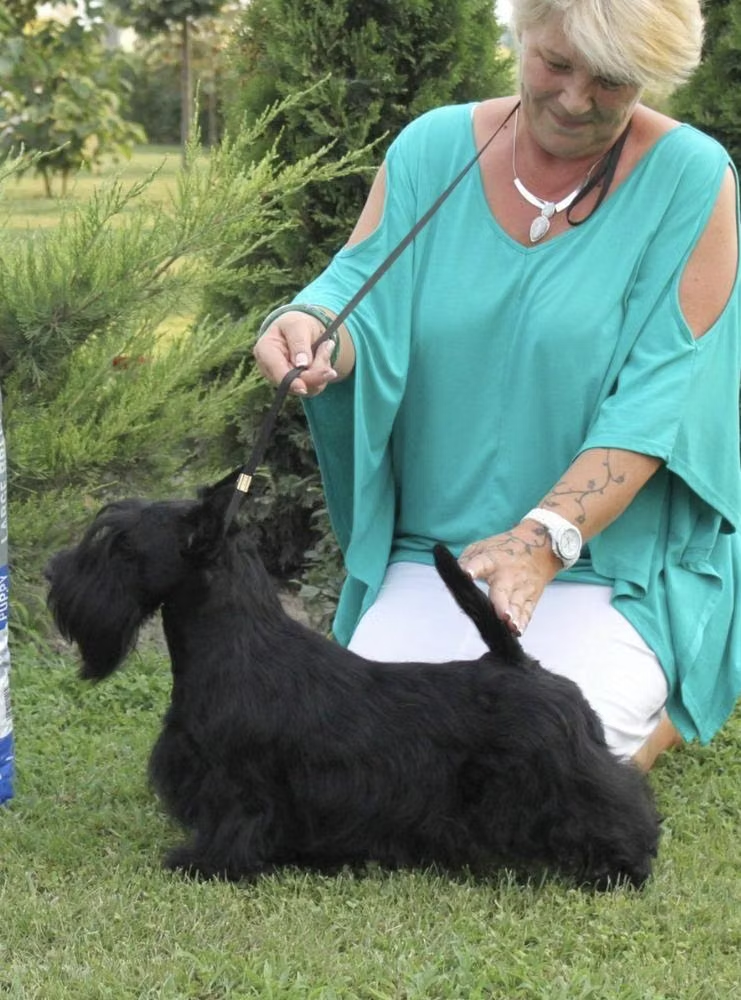
The Scottish Terrier, once also called the Aberdeen Terrier, is a small, thickset terrier bred in the Scottish Highlands to go after vermin and to bolt foxes and badgers from their dens. Short legs, a long head and a harsh, wiry coat give it a silhouette that is hard to mistake for any other breed. Most people picture the black dog seen in old advertisements and cartoons, though wheaten and brindle coats are just as correct.
The temperament matches the build. A Scottish Terrier is confident, alert and fiercely independent, with firm ideas about how its day ought to go. It attaches closely to its own family, usually to one or two people in particular, and stays reserved rather than friendly with strangers, which is standard breed character rather than a fault to correct.
This is a small dog carrying a large terrier personality. It is game, occasionally pig-headed, and rarely the sort to sit in anyone's lap for long. Owners in India who have kept one often describe it as less like a pet and more like sharing the house with a flatmate who has fixed habits and strong opinions.
| Attribute | Detail |
|---|---|
| Origin | Scotland |
| Size | Small |
| Lifespan | 11 to 13 years |
| Group / role | Terrier, originally bred to go to ground after vermin |
| Good with | Committed owners and older children; supervise closely around small pets |
Who this breed suits
The Scottish Terrier suits an owner looking for a small dog with genuine backbone, not a lapdog that craves constant fussing. It settles in a flat as readily as in an independent house, since its exercise needs are moderate rather than demanding. It does best with people who enjoy a dog that has opinions of its own and who stay consistent with training rather than giving up after a week. Households keeping small pets such as rabbits, guinea pigs or hens in the compound should think it through carefully, since the breed keeps a strong prey drive.
History and origin
The Scottish Terrier developed as a working earth dog in the Scottish Highlands and was formalised as a distinct breed in the late 1800s, reaching India through colonial-era terrier keepers and staying niche here today.
The Scottish Terrier descends from the rough-coated terrier stock of the Scottish Highlands, where farmers and gamekeepers kept short-legged, hardy dogs to control rats and to bolt foxes and badgers from their dens. For much of its early history, one name covered several rough Highland terrier types that had not yet been sorted into the separate breeds recognised today.
Through the 1800s, Scottish breeders began distinguishing these local terriers from one another. The lines that became the Scottish Terrier, the West Highland White, the Cairn and the Skye Terrier all trace back to this same regional stock, and disagreements over type and naming were common as fanciers worked towards a settled standard.
A written breed standard for the Scottish Terrier came together in the 1880s, and the breed was exhibited and recorded as a distinct type in Britain that decade. It reached North America soon after and was registered by the American Kennel Club in 1885.
British officers and civil servants carried terrier breeds such as this one to India during the colonial period, and the Scottish Terrier saw some popularity in cantonment and hill-station households of that era. It never became a common breed on the subcontinent, and it stays a niche presence here today, kept mainly by dedicated fanciers who import or source carefully from breeders abroad, with Kennel Club of India registrations for the breed staying limited.
Appearance and breed standard
The Scottish Terrier is a short-legged, compact terrier with a long head, erect ears and a harsh wiry double coat, most often seen in black, that needs extra attention in Indian heat and humidity.
The Scottish Terrier carries a thickset, low-slung body on short, sturdy legs. Its head looks long against the rest of the dog, with a flat skull, a strong muzzle, and a noticeable beard and eyebrows formed by the longer furnishings. The ears are small, pointed and stand erect, and the tail is short and carried upright. Seen in silhouette, the outline is angular and unmistakable, the shape most people recognise even without knowing the breed's name.
| Feature | Standard |
|---|---|
| Height | About 25 cm (10 inches) at the shoulder |
| Weight | 8.5 to 10 kg (19 to 22 lb) |
| Coat | Double coat: harsh wiry outer coat over a soft dense undercoat |
| Colour | Black, wheaten, and brindle (various shades) |
| Eyes | Small, almond-shaped, dark brown, set well apart |
Coat and colour
The coat is what defines the breed. The outer layer is hard and weather-resistant, and the undercoat beneath is soft and insulating, a pairing built for Scotland's cold, damp climate rather than an Indian summer. Black remains the colour most people associate with the breed, though wheaten ranges from pale straw to light fawn, and brindle shows a mix of dark striping over a lighter base. Show dogs are kept hand-stripped to preserve the coat's harsh texture, though many pet owners in India clip instead for convenience, which softens the texture over time and, combined with high humidity, calls for closer attention to the skin underneath.
Temperament and behaviour
The Scottish Terrier is loyal, independent and confident, affectionate with its own family but wary of strangers and assertive with other animals, including the free-roaming dogs common on Indian streets.
The Scottish Terrier stays loyal and devoted to its household while carrying itself with a dignified, self-contained manner. It tends to bond most firmly with one or two people and shows affection steadily rather than in an over-the-top way. Around family it can be playful and good-humoured, but it does not demand constant fussing the way some companion breeds do.
With strangers, the breed stays wary and watchful. This reserve makes it a useful watchdog around the gate, since it will bark at visitors and unfamiliar sounds, though it is not suspicious of everyone without reason. Early and continued socialisation helps a Scottish Terrier stay polite with new people rather than sharp or snappy.
Around other animals, the record is mixed. Many Scottish Terriers get along with dogs they were raised alongside, but the breed can turn assertive with unfamiliar dogs, including the free-roaming dogs common on Indian streets, and it carries a strong prey drive towards small animals. It is independent and stubborn enough to test boundaries regularly, so owners need patience and consistency rather than a heavy hand.
| Trait | Rating |
|---|---|
| Affection | 3 |
| Energy | 3 |
| Trainability | 2 |
| Vocalness | 3 |
| Shedding | 2 |
Care and daily needs
The Scottish Terrier needs regular coat upkeep suited to Indian heat and humidity, moderate daily exercise timed away from the midday sun, and a secure garden that accounts for its digging and prey instincts.
Grooming
- Brush the wiry coat two or three times a week to prevent mats, giving extra attention to the beard, legs and underbody furnishings
- Hand-strip the coat a few times a year to preserve its texture, or clip it if lower upkeep suits you better (clipping softens the coat over time)
- Wipe the beard after meals, since it collects food and water and turns musty quickly in humid weather
- Trim nails every few weeks and check the ears for wax and debris, more often through the monsoon
- Bathe only when needed, since frequent bathing softens the wiry coat, and dry the undercoat thoroughly so it does not stay damp
Exercise
- Give 30 to 60 minutes of activity a day, split across one or two walks, timed for the cooler hours of early morning or evening
- Add short play sessions plus scent or digging games to satisfy terrier instincts
- Keep the dog on lead or inside a fenced area, since it will chase small animals and ignore recall once its attention locks on
- Avoid exercise in the midday heat, since the dense double coat traps warmth and raises the risk of heatstroke through Indian summers
Environment
The Scottish Terrier settles well in a flat as readily as in an independent house, provided its exercise and grooming needs are met. It digs with real enthusiasm, so unsupervised time in a garden can wreck flower beds and open up escape routes under boundary walls or fencing. The breed tolerates being left alone better than many companion breeds, but it still needs company and something to occupy its mind for most of the day.
Nutrition and feeding
The Scottish Terrier needs a complete diet portioned to its small size and activity level, with care taken to avoid weight gain and to keep rich, onion-heavy home food away from its bowl.
Feed a complete, balanced dog food matched to the Scottish Terrier's small size and life stage. Because the breed is compact and prone to putting on weight, portions should be measured out rather than left down all day, and treats need to be counted towards the daily total. Pick a formula built on quality protein to support muscle on its sturdy frame, and split the day's food across more than one meal to help digestion and cut down on begging.
| Life stage | Amount per day | Meals |
|---|---|---|
| Puppy (2 to 6 months) | Per puppy food label, divided | 3 to 4 |
| Junior (6 to 12 months) | About 100 to 130 g dry food | 2 to 3 |
| Adult | About 130 to 190 g dry food | 2 |
| Senior | Reduced to maintain weight | 2 |
Treats and supplements
Use treats for training in small pieces and keep them under about 10 percent of the day's calories. Most Scottish Terriers on a complete diet need no extra supplements; add joint, skin or other supplements only on a vet's advice. Keep fresh water available at all times, and wipe the beard after drinking to keep the face clean and dry, especially through the humid months.
Health and lifespan
The Scottish Terrier typically lives 11 to 13 years and stays generally hardy, though it carries breed-linked conditions, including a raised bladder cancer risk, that warrant regular monitoring.
The Scottish Terrier is a generally sturdy small breed with a typical lifespan of 11 to 13 years. Like most purebred dogs, it carries a number of conditions that turn up more often within the breed, several of them inherited. Buying from breeders who health-test their stock, and staying current with routine veterinary care, are the best ways to bring the risk down.
| Condition | Signs | Note |
|---|---|---|
| Scottie cramp | Brief stiffening or arching of the back during excitement or exercise | A breed-specific movement disorder; usually mild and painless |
| Von Willebrand disease | Excessive bleeding from minor cuts or surgery | An inherited clotting disorder; DNA testing is available |
| Bladder cancer (transitional cell carcinoma) | Blood in urine, straining, frequent urination | The breed carries an elevated risk; report urinary changes early |
| Patellar luxation | Intermittent hind-leg skipping or lameness | Common in small breeds; ranges from mild to needing surgery |
| Craniomandibular osteopathy | Jaw swelling and pain in young puppies | A developmental bone condition usually outgrown by adulthood |
Preventive care
- Keep core vaccinations and parasite control current, with extra attention to ticks and mosquito-borne disease through the monsoon
- Book annual checkups, moving to twice a year once the dog is a senior
- Brush the teeth regularly and arrange professional dental cleaning as advised
- Watch the dog's weight, since extra kilos strain the joints and back
- Report any blood in the urine or a change in urination promptly, given the breed's bladder cancer risk
Training the Scottish Terrier
The Scottish Terrier is intelligent but independent and stubborn, so it trains best with short, consistent, reward-based sessions started early and practised around Indian street noise and crowds.
The Scottish Terrier is intelligent and picks things up quickly once it sees a reason to cooperate, but its independence and stubborn streak mean it will not work simply to please its handler. Training calls for patience and consistency. Harsh corrections tend to make the breed dig its heels in further, while clear rules and rewarding outcomes get far better results. Keep sessions short and varied, since a bored Scottie loses interest fast. Recall is a particular sticking point once prey instinct takes hold, so off-lead freedom should stay limited to secure, enclosed areas.
Basics
- Start socialisation early, introducing the puppy to people, dogs and everyday situations, including the noise and crowds typical of Indian streets
- Teach name response and attention before layering on commands
- Build the core cues one at a time: sit, down, stay and come
- Practise recall on a long line in a fenced space before trusting the dog off lead
- Reinforce calm behaviour around visitors to manage the breed's natural wariness
- Keep sessions to about five to ten minutes and end on a success
Breeding and raising young
Scottish Terriers reach maturity around one to two years, carry an average litter of three to five puppies, and do best bred from health-tested parents, though the breed stays scarce in India.
Responsible breeding of Scottish Terriers starts with health-tested parents, since several conditions within the breed are inherited. Females are generally bred only once they are physically mature and have cleared the relevant screening, commonly from around two years of age. Gestation in dogs runs to about 63 days. Litters stay small, and newborn puppies depend entirely on the dam for warmth and feeding through the first weeks.
Weaning usually starts around three to four weeks as puppies move onto solid food, and they stay with the dam and littermates until at least eight weeks so they pick up early social skills. This window matters for a breed that can turn reserved as an adult, so good breeders handle the puppies often and expose them to ordinary household sights and sounds. Given conditions such as von Willebrand disease and the breed's bladder cancer risk, breeding decisions should weigh DNA results and family health history, and prospective owners should ask breeders for that documentation rather than take it on trust. Since the breed is uncommon in India, most buyers end up waiting for a litter from an established breeder or looking at import, and Kennel Club of India registration for the breed stays limited.
| Metric | Value |
|---|---|
| Sexual maturity | About 6 to 12 months (breeding usually deferred to maturity) |
| Recommended breeding age (female) | Around 2 years, after health screening |
| Gestation | About 63 days |
| Average litter size | 3 to 5 puppies |
| Weaning age | About 6 to 8 weeks |
| Earliest rehoming age | 8 weeks or later |
Registering a Scottish Terrier in India: profile and microchip
Municipal licences cover the paperwork; a free United Pet Club record is what actually connects your Scottish Terrier to your phone.
How to register a Scottish Terrier in India
Municipal corporations in Delhi, Mumbai, Bengaluru, and numerous other cities require dogs to be registered or licensed under their by-laws, and a United Pet Club profile complements whichever rules apply where you live. The profile holds your contact information against your Scottish Terrier for its entire life, at no charge whatsoever. Registering your dog requires only a few minutes.
A microchip without a registration is merely a number under the skin. File your Scottish Terrier's fifteen digit number with United Pet Club and it becomes a working address: free for life, open to every chip brand, and searchable from any clinic or shelter in the country or abroad. Microchip registration first, the free account alongside.
How do I register my Scottish Terrier in India?
Create a free United Pet Club account, enter your Scottish Terrier's details along with a photograph, and save the profile. The lifetime plan maintains the record at no cost, and any municipal licence you hold sits alongside it rather than replacing it.
How do I register my Scottish Terrier's microchip?
Enter the fifteen digit chip number into your free account together with your current address, phone number, and email. The lifetime plan covers the registration and every subsequent update without charge, whatever the chip's manufacturer.
Is registration compulsory for a Scottish Terrier in India?
Several municipal corporations, Delhi and Mumbai among them, require dogs to be licensed under local by-laws. The United Pet Club profile is separate and voluntary, and it is the record a finder anywhere can actually search, free of cost.
What does it cost to register a Scottish Terrier?
Nothing whatsoever. The free lifetime plan includes the profile, the microchip record, and unlimited updates, with no renewal fee at any point.
Frequently asked questions
Common questions Indian readers ask about the Scottish Terrier's size, temperament, care needs, lifespan, suitability and availability.
How big does a Scottish Terrier get?
It is a small breed. Adults stand about 25 cm (10 inches) at the shoulder and weigh roughly 8.5 to 10 kg (19 to 22 lb).
What is the Scottish Terrier's temperament like?
Loyal, independent, dignified, alert and confident. It is affectionate with its own family but reserved with strangers, and it can turn assertive towards other dogs and small animals.
Is a Scottish Terrier hard to maintain in India?
Upkeep is moderate but specific. The wiry coat needs brushing several times a week plus hand-stripping or clipping a few times a year, and the dog needs 30 to 60 minutes of daily exercise, best scheduled outside the midday heat. Its stubborn streak makes consistent training essential.
How long do Scottish Terriers live?
Typical lifespan is 11 to 13 years with good care, a suitable diet and regular veterinary checkups.
Is the Scottish Terrier good for families and flats?
Yes, for committed owners and homes with older children, and it adapts well to flat living. Households keeping very small pets should stay cautious given its strong prey drive.
Are Scottish Terriers good for first-time owners?
They can be, but the breed's independence and stubbornness suit an owner who stays patient and consistent. Someone wanting an eager-to-please dog may find it a harder fit.
Where can I get a Scottish Terrier in India?
The breed is uncommon here. Reputable breeders who health-test their dogs are the safest route, though many Indian buyers end up importing or waiting a while for a litter, since Kennel Club of India registrations for the breed stay limited. Ask for health documentation and meet the parents wherever possible.
From the community
Ask about the Scottish TerrierNo questions about the Scottish Terrier yet. Be the first to ask.
Browse Dog breeds