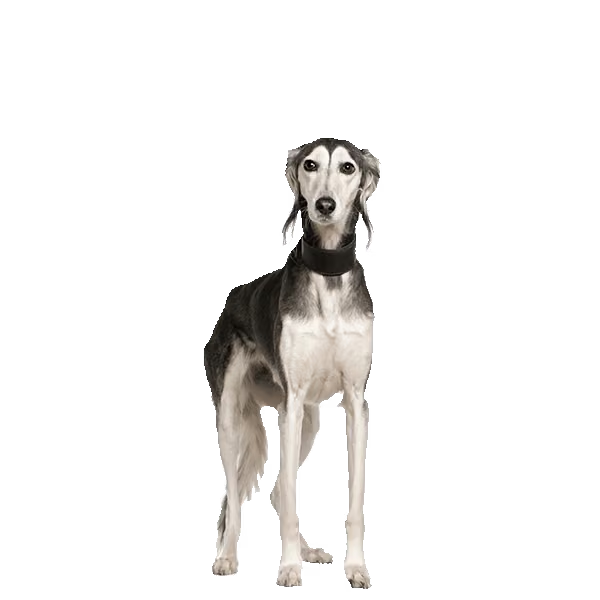
The Saluki is an ancient, graceful sighthound known for its remarkable speed and quietly dignified, aloof elegance.
How the Saluki coat is built, and what that means when you groom it.
Information: A Saluki needs clipping every few weeks.
This coat keeps growing rather than shedding out, so it has to be trimmed every few weeks. Left to grow it mats down against the skin and traps moisture, dirt and heat.
A few of the Saluki profiles members have added to United Pet Club.
The Saluki is an ancient medium sized sighthound from the Arabian Peninsula, gentle and reserved at home but built for sustained, high speed pursuit across open ground.
The Saluki ranks among the oldest sighthound breeds still recognised today, developed across the Arabian Peninsula and carried into the wider Middle East over many centuries. It is a medium sized dog built to run down game across open desert and rocky ground purely by sight, relying on stamina and top speed rather than nose work. The frame is light and narrow, with long legs and a deep chest that lets the dog gallop flat out for long stretches.
Indoors the Saluki is calm and undemanding, almost cat like in the way it curls up and rests for hours at a stretch. Outdoors, the same dog turns into a determined hunter the moment something moves fast. With its own household it is affectionate in a quiet, understated manner, while strangers get a polite but distant welcome.
Salukis are dignified rather than boisterous, and they do not enjoy rough play or loud scolding. Owners who understand sighthound instincts, particularly the pull to chase anything that runs, tend to get on best with this breed.
| Attribute | Detail |
|---|---|
| Origin | Arabian Peninsula |
| Size | Medium |
| Lifespan | 12 to 14 years |
| Group / role | Sighthound, originally bred for hunting by sight |
| Good with | Family members and older children; needs a careful, supervised introduction to small pets because of the chase instinct |
A Saluki suits owners who want a quiet, low fuss house dog but can also provide hard, off lead running inside a properly fenced compound. It is not the breed for a cramped flat with no safe open space nearby, since the urge to sprint needs somewhere secure to play out. A high boundary wall matters more than a large garden, as a Saluki can clear a low fence in one bound. Households that already keep birds, rabbits, or free ranging pets should plan introductions slowly and under supervision.
The Saluki ranks among the oldest sighthound types, developed by desert and nomadic peoples of the Arabian Peninsula and the Middle East as a coursing hound over thousands of years.
Historians trace the Saluki back to the Arabian Peninsula and the broader Middle East, where nomadic and desert communities bred lean, long legged hounds to run down gazelle, hare, and other fast game. Carvings and paintings of slim, long legged hounds turn up in ancient art from the region, and the type is widely considered one of the oldest hunting hounds still around in recognisable form today.
The breed grew out of a hunting tradition where swift hounds worked across open country, at times alongside falcons and horses. Local bloodlines were prized for speed and staying power, and these dogs were often kept as valued household companions rather than plain working animals. Depending on the terrain, different regions favoured either a smooth coated or a feathered type.
Salukis travelled to Europe through traders, travellers, and diplomatic contact with the Middle East. British interest picked up through the late nineteenth and early twentieth centuries, when dedicated breeders set about establishing the type in Western kennels.
From that starting point, major kennel bodies recognised the Saluki, and the breed spread to other countries as both a show dog and a companion, while a smaller group of enthusiasts kept up lure coursing and similar speed sports. Through all of this, the breed's core purpose stayed constant: a sighthound built to spot and run down fast game over distance.
The Saluki is a slender, graceful sighthound of medium size with long legs, a deep narrow chest, and a smooth or lightly feathered coat across a wide range of colours.
The Saluki carries a light, streamlined outline built purely for speed. The body is narrow and deep through the chest, the loin is tucked up, and the legs are long and fine boned. The head is long and refined, the skull smooth, and the eyes are large, oval, and set with a calm, far seeing expression. The tail hangs low with a natural curve and often carries feathering underneath.
Two coat types exist: the smooth Saluki, with a short, close coat right through, and the feathered Saluki, which grows longer hair on the ears, the back of the legs, and the tail.
| Trait | Standard |
|---|---|
| Height | Roughly 58 to 71 cm (23 to 28 in) at the shoulder; females are usually smaller |
| Weight | About 18 to 27 kg (40 to 60 lb) |
| Coat | Smooth or feathered; soft, silky texture |
| Colours | A wide range, including solid cream and red, grizzle, black and tan, and tricolour patterns |
| Eyes | Large, oval, dark to hazel, with a calm expression |
The Saluki's coat lies fine and close to the body, so upkeep is lighter than with heavier coated breeds. Feathered dogs carry extra hair mainly on the ears, legs, and tail. Colour varies widely and most shades are accepted, including solid cream and red, grizzle, black and tan, and tricolour patterns. Because the coat is thin, the breed has little natural insulation and feels the cold quickly, though this rarely troubles owners across most of India.
Salukis are gentle, calm, and devoted with their own people but independent and reserved with strangers, carrying a strong instinct to chase anything that moves fast.
At home, the Saluki is usually quiet and gentle, content to lounge for hours between short bursts of activity. With its own family it can be deeply attached, though it shows this in a reserved rather than showy manner. The breed is sensitive by nature and shuts down fast under rough handling or a raised voice.
With unfamiliar people the Saluki tends to hold back and observe first. It is not an aggressive breed, but it takes its time warming up to strangers. Around children it is generally patient, and it gets on best with older children who know how to handle a dog calmly.
The chase instinct is the one trait every owner must plan around. A stray cat, a squirrel, or a loose community dog crossing its path can set off an instant, full speed pursuit, and a Saluki mid chase is nearly impossible to call back. This makes a securely walled compound and a leash in open areas essential, and any introduction to smaller household pets needs to be slow and closely watched.
| Trait | Rating |
|---|---|
| Affection | 3 |
| Energy | 4 |
| Trainability | 2 |
| Vocalness | 2 |
| Shedding | 2 |
Salukis need only modest grooming but substantial secure running space, plus warmth in winter and cool shade in summer to protect their lean, thin coated bodies.
The Saluki settles well into a calm household and stays fairly quiet indoors. Because the coat is thin and body fat is low, the breed feels the cold quickly and does better with a light coat in winter, warm bedding, and padded resting spots that protect bony pressure points. In Indian summers the same lean build means the dog needs shade, water, and cool flooring to avoid overheating, while the monsoon calls for extra ear checks to keep moisture from settling. A high, secure boundary wall remains a must, since a Saluki clears low barriers easily and covers ground at real speed.
Salukis do well on a complete, balanced diet matched to their lean build and activity level, with portions adjusted to keep the natural sighthound waistline.
The Saluki is naturally lean, and a slim, tucked up waist is normal and healthy for this breed rather than a sign of being underfed. Feed a complete, balanced food suited to the dog's age and activity level, and adjust the quantity so the ribs are easy to feel but not sharply visible. Working or coursing dogs may need extra food on heavy exercise days, while a quiet house dog needs less. Clean drinking water should be available at all times, particularly through the hot months.
| Life stage | Amount per day | Meals |
|---|---|---|
| Puppy (2 to 6 months) | As per the puppy food label, by weight | 3 to 4 |
| Adolescent (6 to 12 months) | As per the label, by weight | 2 to 3 |
| Adult | About 2 to 3 cups (roughly 200 to 300 grams) of good quality dry food, split across meals | 2 |
| Senior or less active | A reduced portion to keep the weight lean | 2 |
Keep treats to a small part of the day's calories so the lean body condition holds steady. Most Salukis on a complete diet do not need routine supplements, and anything extra, such as joint support for an active or older dog, should be discussed with a veterinary doctor first. Because the breed runs lean and burns through food quickly, any change in diet should happen gradually to avoid an upset stomach.
Salukis are generally healthy with a typical lifespan of 12 to 14 years, though owners should watch for heart conditions, certain cancers, and sensitivity to anaesthesia.
The Saluki is generally a hardy, long lived breed, with a typical lifespan of 12 to 14 years. Being a lean sighthound, it carries very little body fat, which affects how it copes with cold weather and how it reacts to certain medicines. Like every breed it has a handful of health concerns worth watching, and care from a veterinary doctor who understands sighthounds is worthwhile.
| Condition | Signs | Note |
|---|---|---|
| Heart disease (including cardiomyopathy) | Tiring quickly, coughing, fainting, changes in breathing | Periodic cardiac checks are worthwhile in older dogs |
| Cancer | Lumps, weight loss, low energy | A fairly common cause of illness in ageing sighthounds |
| Anaesthesia sensitivity | Slow or unusual recovery from sedation | Low body fat changes how the dog handles certain drugs; tell the vet the dog is a sighthound before any procedure |
| Hypothyroidism | Weight gain, coat changes, low energy | Diagnosed with a blood test and managed with medicine |
Salukis are intelligent but independent and sensitive, so they respond best to patient, reward based training and early socialisation rather than repetition or pressure.
The Saluki is intelligent but independent, and it does not train in the eager to please style of many working breeds. It picks up commands well enough, yet it often decides for itself whether to obey, especially outdoors where the chase instinct competes with any recall command. The breed is sensitive and goes quiet under harsh handling, so calm, consistent, reward based methods work far better than pressure or repetition. Early socialisation helps a naturally reserved dog grow confident around people, places, and other animals.
Saluki breeding follows the normal canine pattern with modest sized litters, and responsible breeders screen for health while prioritising sound temperament and structure.
Salukis mature slowly in body, and breeding is best left until both parents are fully grown and health screened, usually around two years of age. Mating, pregnancy, and whelping follow the usual canine pattern, with a gestation period of roughly nine weeks. Litter size varies, averaging a handful of puppies.
Newborn puppies depend on the mother entirely for warmth and milk through the first weeks. Since the breed is lean and does not carry much natural insulation, a warm, draught free whelping area matters. Puppies should stay with the mother and littermates through the early socialisation period so they pick up normal dog behaviour, then continue gentle exposure to new experiences once they move to new homes. Responsible breeders screen their breeding stock for heart trouble and other known concerns, and place puppies only with owners ready for a sighthound's exercise and containment needs.
| Metric | Value |
|---|---|
| Breeding maturity | Around 2 years |
| Gestation | About 63 days (roughly 9 weeks) |
| Average litter size | A handful of puppies (varies by individual) |
| Weaning | Around 6 to 8 weeks |
| Recommended health screening | Cardiac evaluation and general health checks for both parents |
Municipal licences cover the paperwork; a free United Pet Club record is what actually connects your Saluki to your phone.
Municipal corporations in Delhi, Mumbai, Bengaluru, and numerous other cities require dogs to be registered or licensed under their by-laws, and a United Pet Club profile complements whichever rules apply where you live. The profile holds your contact information against your Saluki for its entire life, at no charge whatsoever. Registering your dog requires only a few minutes.
Should your Saluki already carry a microchip, the number must still be recorded separately, since the vet performs only the implant. Registering the microchip under the free lifetime plan accepts chips from any manufacturer an Indian vet works with, keeps every update free should your household shift cities, and leaves the record searchable at any hour. Create your free account and complete both tasks in one sitting.
Create a free United Pet Club account, enter your Saluki's details along with a photograph, and save the profile. The lifetime plan maintains the record at no cost, and any municipal licence you hold sits alongside it rather than replacing it.
Enter the fifteen digit chip number into your free account together with your current address, phone number, and email. The lifetime plan covers the registration and every subsequent update without charge, whatever the chip's manufacturer.
Several municipal corporations, Delhi and Mumbai among them, require dogs to be licensed under local by-laws. The United Pet Club profile is separate and voluntary, and it is the record a finder anywhere can actually search, free of cost.
Nothing whatsoever. The free lifetime plan includes the profile, the microchip record, and unlimited updates, with no renewal fee at any point.
Common questions about Saluki size, temperament, care needs, lifespan, suitability for Indian homes, and where to find a puppy.
The Saluki is a medium sized dog, standing roughly 58 to 71 cm (23 to 28 in) at the shoulder and weighing about 18 to 27 kg (40 to 60 lb). Females are usually smaller than males.
Salukis are gentle and quiet at home, independent minded, and reserved around strangers. They are devoted to their own family but show it in a calm, understated way, and they carry a strong instinct to chase fast moving animals.
The thin coat and low body fat mean the breed feels the cold in winter and needs shade and water through the hot months. It suits a house with a secure, high walled compound rather than a small flat with no safe outdoor space, since it needs room to run and reliable containment.
Salukis typically live 12 to 14 years. They are generally a healthy breed, though heart conditions and certain cancers are worth watching for as the dog ages.
It can be, in the right home. Salukis are gentle and patient, and they often get along well with older children. They suit calm households that can offer secure space to run and understand the breed's chase drive around smaller pets.
The Saluki is not a common breed in India, so finding a puppy from a responsible breeder registered with the Kennel Club of India can take time and may involve a waiting list. Sighthound rescue groups abroad are another option, though imports involve extra paperwork and cost.

![Saluki Shami [Hon Florence Amherst's], a Male Saluki registered with United Pet Club](https://media.unitedpetclub.com/m/8dJUgTj1uz/saluki-shami-hon-florence-amherst-s-saluki_orig.avif "Saluki Shami [Hon Florence Amherst's] — Saluki")

