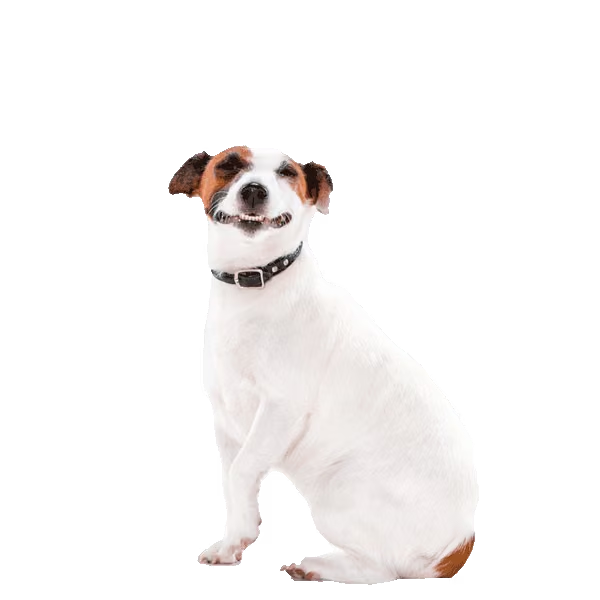
The Russell Terrier is a compact, spirited working terrier full of energy and intelligence, bred for going to ground after quarry.
How the Russell Terrier coat is built, and what that means when you groom it.
Critical: A Russell Terrier should not be shaved.
The undercoat keeps heat out as well as in, and the outer coat shields the skin from sun and insect bites. Clipping the whole coat off removes both. It often grows back patchy, soft or a different colour, and in some animals the guard hairs never return properly. Brush the undercoat out instead of cutting it off.
A few of the Russell Terrier profiles members have added to United Pet Club.
The Russell Terrier is a small, high-energy working terrier from England, bred to go to ground after fox and other quarry. It stands about 25 to 30 cm at the shoulder and lives 12 to 14 years.
The Russell Terrier packs a serious amount of working drive into a small frame. English hunters developed the breed to follow fox underground and either bolt the quarry or hold it at bay, and that job explains almost everything about the dog: its size, its legs, its flexible chest, and its bold, no-nonsense character.
Adults typically weigh 4 to 7 kg and stand about 25 to 30 cm at the shoulder, a shade smaller and squarer than the related Jack Russell and Parson Russell lines. The coat is mostly white, a trait early breeders selected on purpose so the dog stood out from the fox underground.
The breed is known for its energy and its sharp, busy mind. A Russell Terrier wants a task to do; in Indian flats and independent houses alike, that usually means a proper walk, a game of fetch, or some training work each day. Give it enough exercise and the dog is a cheerful, affectionate companion. Leave it bored and it will dig up the garden, bark at every passer-by, and invent mischief of its own.
| Attribute | Detail |
|---|---|
| Origin | England |
| Size | Small (about 25 to 30 cm, 4 to 7 kg) |
| Lifespan | 12 to 14 years |
| Group / role | Terrier, originally bred to go to ground after fox and vermin |
| Good with | Active owners and older children; needs supervision around very small pets |
This breed suits an active household that can offer daily exercise and mental work. It does well with owners who enjoy training games, dog sports, and long walks, and it settles happily into a city flat as long as it gets out enough. It is a poor fit for a sedentary home or someone who wants a quiet lap dog. The strong prey drive means homes with rabbits, guinea pigs, or birds need extra care, and busy families who can channel that energy tend to get the best out of the dog.
The Russell Terrier traces to the working fox terriers bred by the Reverend John Russell in nineteenth-century England, later refined into a small, white, go-to-ground type recognised as its own breed in modern times.
The breed's roots go back to the Reverend John Russell, a parson and passionate hunting man from Devon, England, in the first half of the nineteenth century. Russell wanted a terrier that could keep pace with the hounds and then go to ground to bolt fox. He bred for working ability rather than looks, choosing dogs with a mostly white coat, a narrow flexible chest, and the nerve to face quarry underground.
The dogs Russell developed became known broadly as Jack Russell terriers, though the type was never uniform. Working terriers varied in leg length, coat, and size depending on the terrain and the game being hunted. Over the following decades these terriers travelled with hunting circles across Britain and beyond, valued first as working dogs and only later as pets.
In the twentieth century, breeders and kennel clubs began sorting the varied stock into distinct types. The taller, squarer dog became the Parson Russell Terrier, while a shorter, more compact terrier was recognised separately as the Russell Terrier, selected toward a height of roughly 25 to 30 cm.
Major kennel bodies, including the Kennel Club of India, which follows the FCI framework, recognise the Russell Terrier as its own breed, a status formalised internationally in the early 2000s. The breed today still carries much of the drive and hardiness of the original hunting dogs.
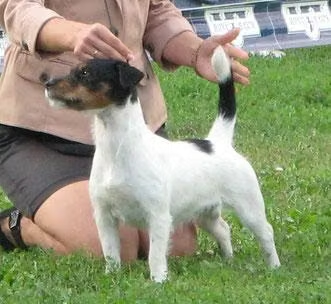
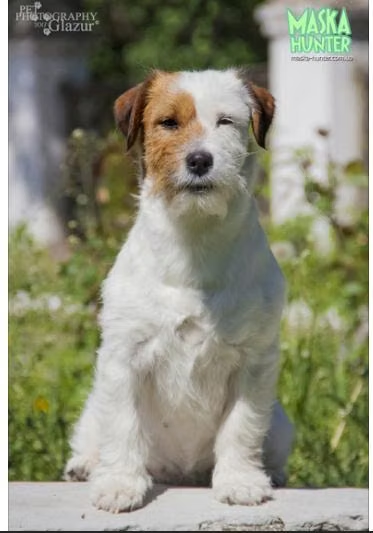
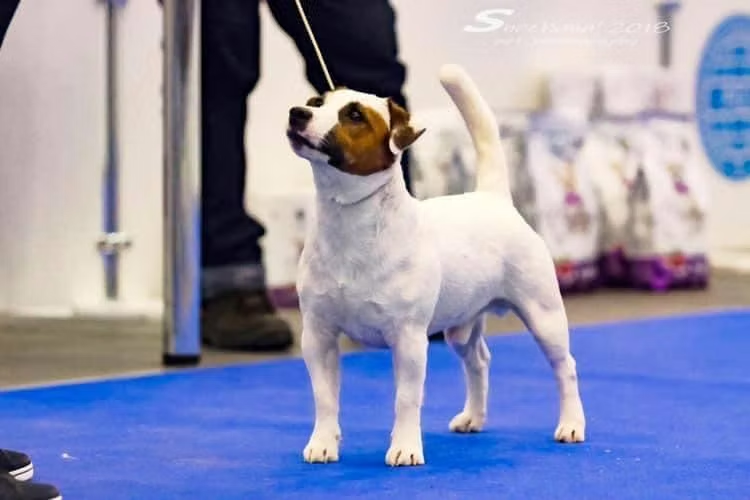
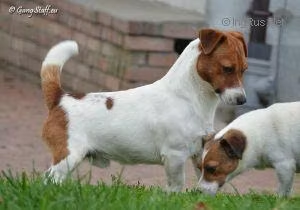
The Russell Terrier is a small, sturdy, rectangular terrier standing about 25 to 30 cm tall, with a predominantly white coat marked with tan or black and a confident, alert expression.
The Russell Terrier has a small but solid build that is slightly longer than it is tall, giving it a rectangular outline. The chest is narrow enough to be spanned by two hands, a feature carried over from working dogs that needed to fit into burrows. The legs are straight and the dog moves with an easy, ground-covering gait. The expression is keen and the ears fold forward in a button or V shape.
| Trait | Standard |
|---|---|
| Height | About 25 to 30 cm at the shoulder |
| Weight | About 4 to 7 kg |
| Coat | Smooth, broken, or rough; dense and weatherproof |
| Colours | Predominantly white with tan, black, or tricolour markings |
| Eyes | Dark, almond-shaped, set with an alert expression |
The breed comes in three coat types: smooth, broken, and rough. All three are dense and built to shed rain and resist damage in the field, a real advantage through the monsoon months. The coat is mostly white by design, which let hunters tell the dog apart from fox in dim underground light. Markings are usually tan, black, or a mix of both as tricolour, and they show up most often on the head and at the base of the tail. The smooth coat is short and flat, the broken coat carries some longer hair on the face and body, and the rough coat is the longest and most wiry. None of the three should be woolly or curly.
The Russell Terrier is spirited, intelligent, and bold, an affectionate companion that bonds closely with its family but carries a strong prey drive and needs firm, consistent guidance.
The Russell Terrier is confident and full of drive. It is friendly and devoted with its family and usually greets people with enthusiasm rather than shyness. The breed stays alert and will bark to announce visitors, which makes it a capable watchdog for its size.
With children the dog is playful and tolerant when raised together, though its energy and quick reactions suit older kids better than toddlers. Around strangers it tends to warm up fast once introduced. The main caution concerns other animals: a high prey drive means the breed often chases cats, squirrels, and rodents, and some individuals are scrappy with unfamiliar dogs. Early socialisation helps a great deal, particularly in a busy neighbourhood with street dogs and stray cats about.
This is an independent thinker bred to work alone underground, so it can be stubborn. It is not aggressive by nature, but it is bold and persistent. Owners who set clear rules and keep the dog occupied end up with a happy, manageable companion. Owners who leave it idle end up with digging, barking, and escape attempts.
| Trait | Rating |
|---|---|
| Affection | 4 |
| Energy | 5 |
| Trainability | 4 |
| Vocalness | 4 |
| Shedding | 3 |
The Russell Terrier needs vigorous daily exercise, regular coat care that varies by coat type, and a secure home that channels its energy and digging instinct.
The breed adapts to a flat or an independent house as long as it gets enough exercise, but a securely fenced yard is a real bonus. Fencing should be solid at the base, since the dog digs and can squeeze through small gaps. A bored Russell Terrier invents its own entertainment, so a home that offers structure, company, and activity, along with shade and cool water through the hot months, keeps the dog content.
The Russell Terrier does well on a complete diet matched to its small size and high activity, fed in measured meals to keep its athletic frame lean.
Feed a complete, balanced dog food formulated for the dog's life stage and activity level. Because the breed is small but very active, the food should be calorie-dense enough to fuel exercise without leading to overfeeding. Measure portions rather than leaving food out all day, since the breed can put on weight quickly once activity drops. Adjust amounts by body condition: you should be able to feel the ribs easily and see a waist when looking down at the dog.
| Life stage | Amount per day | Meals |
|---|---|---|
| Puppy (2 to 6 months) | About 45 to 90 g, by puppy food guidelines | 3 to 4 |
| Junior (6 to 12 months) | About 45 to 90 g | 2 to 3 |
| Adult | About 45 to 70 g | 2 |
| Senior | Adult amount adjusted down for lower activity | 2 |
Keep treats to no more than about 10 percent of daily calories so they do not throw the diet off balance or add extra weight. Small, low-calorie treats work well as training rewards, which matters for a breed that trains this often. Most Russell Terriers on a complete diet need no supplements. Speak to a veterinarian before adding joint, skin, or other supplements, since extras are rarely necessary for a healthy dog.
The Russell Terrier is generally hardy with a lifespan of 12 to 14 years, though the breed is prone to a few inherited eye, joint, and ear conditions that screening and routine care help manage.
The Russell Terrier is a robust, long-lived breed, with most dogs living 12 to 14 years and many going on longer with good care. The small gene pool and working background mean a handful of inherited conditions turn up more often than in the wider dog population. Buying from breeders who screen their stock lowers the risk of several of these.
| Condition | Signs | Note |
|---|---|---|
| Patellar luxation | Skipping gait, occasional hind-leg lameness | Common in small breeds; ranges from mild to surgical |
| Primary lens luxation | Cloudy or painful eye, change in vision | Inherited; a DNA test is available for breeding stock |
| Legg-Calve-Perthes disease | Hind-limb lameness, muscle loss in young dogs | Affects the hip; often treated surgically |
| Deafness | No response to sound, often present from birth | Linked to white coats; can be checked with BAER testing |
| Dental disease | Bad breath, tartar, red gums | Manageable with regular brushing and cleaning |
The Russell Terrier is intelligent and quick to learn but independent and easily bored, so training works best when it is short, consistent, reward-based, and started early.
This breed learns fast and enjoys a mental challenge, which makes it capable in obedience and dog sports. The catch is its independence: bred to work alone underground, it can decide its own agenda and switch off during repetitive drills. Sessions that stay short, varied, and rewarding hold its attention. Harsh methods backfire and make the dog stubborn or evasive. Early socialisation with people, dogs, and everyday situations matters given the breed's strong prey drive and watchdog tendencies. Reliable recall takes real work, since a dog in chase mode will often ignore every command.
Russell Terriers reach maturity at around one to two years and usually produce small litters. Responsible breeding depends on health screening of both parents.
Russell Terriers reach sexual maturity within the first year, but responsible breeders wait until a dog is physically and mentally mature, usually around 18 to 24 months, and has cleared health screening. Females typically cycle twice a year. Gestation runs about 63 days from conception, in line with dogs generally.
Litters are small, commonly 3 to 6 puppies, which reflects the breed's size. Whelping is usually straightforward, but the breeder should be ready to assist and to call a veterinarian if labour stalls. Newborn puppies are blind and deaf at birth and depend entirely on the mother through the first weeks.
Raising the litter well means keeping the puppies with the mother and littermates through the early weeks, then starting socialisation once they are mobile and alert. Because deafness and some eye conditions are inherited in the breed, breeders should test the parents and, where relevant, the puppies before placement. Puppies usually go to new homes at about 8 to 10 weeks.
| Metric | Value |
|---|---|
| Sexual maturity | About 6 to 12 months |
| Recommended breeding age | About 18 to 24 months |
| Gestation | About 63 days |
| Average litter size | 3 to 6 puppies |
| Weaning age | About 4 to 6 weeks |
| Age to new home | About 8 to 10 weeks |
Municipal licences cover the paperwork; a free United Pet Club record is what actually connects your Russell Terrier to your phone.
Begin with the essentials: your Russell Terrier's name, its date of birth, a clear photograph, and your mobile number, saved to a registry that levies no charge at any stage. Dog registration functions with or without a microchip, so nothing need wait for the next clinic visit.
Should your Russell Terrier already carry a microchip, the number must still be recorded separately, since the vet performs only the implant. Registering the microchip under the free lifetime plan accepts chips from any manufacturer an Indian vet works with, keeps every update free should your household shift cities, and leaves the record searchable at any hour. Create your free account and complete both tasks in one sitting.
Create a free United Pet Club account, enter your Russell Terrier's details along with a photograph, and save the profile. The lifetime plan maintains the record at no cost, and any municipal licence you hold sits alongside it rather than replacing it.
Enter the fifteen digit chip number into your free account together with your current address, phone number, and email. The lifetime plan covers the registration and every subsequent update without charge, whatever the chip's manufacturer.
Several municipal corporations, Delhi and Mumbai among them, require dogs to be licensed under local by-laws. The United Pet Club profile is separate and voluntary, and it is the record a finder anywhere can actually search, free of cost.
Nothing whatsoever. The free lifetime plan includes the profile, the microchip record, and unlimited updates, with no renewal fee at any point.
Common questions about the Russell Terrier cover its size, temperament, exercise needs, lifespan, suitability for families, and how it differs from related Jack Russell types.
It is a small breed, standing about 25 to 30 cm at the shoulder and weighing roughly 4 to 7 kg. The body is slightly longer than it is tall.
Spirited, intelligent, and bold. It is affectionate with its family and alert enough to work as a watchdog, but it has a strong prey drive and an independent streak that need managing.
The basic care is straightforward, but the breed demands time. It needs 45 to 60 minutes of exercise daily plus mental work, and through the Indian summer that exercise is best done early morning or evening. Without enough activity it digs, barks, and tries to escape.
Most live 12 to 14 years, and many go on longer with good diet, exercise, and veterinary care.
It suits active families and does well with older children. Its prey drive calls for caution around cats, rabbits, and rodents, and early socialisation helps it get along with other dogs, including the neighbourhood strays it will meet on walks.
They share the same working origin with the Reverend John Russell. The Russell Terrier is the smaller, more compact type at about 25 to 30 cm, while the Parson Russell is taller and squarer. The name Jack Russell is used loosely for the original, varied working stock.
Look for breeders registered with the Kennel Club of India who health test for eye, hearing, and patella conditions, and check breed-specific rescue groups, since terriers sometimes need rehoming when owners underestimate how much energy they have.