

Rough Collie
The Rough Collie is a graceful, gentle family dog known for its intelligence, loyalty, and flowing coat made famous by Lassie.
- Size
- Large
- Lifespan
- 12–14 years
- Origin
- Scotland
- Temperament
- Gentle
- Standard colors
- Black, White, Blue and Tan
Characteristics
Coat and grooming
How the Rough Collie coat is built, and what that means when you groom it.
- Coat layers
- Double coat
- Coat texture
- Rough
- Coat length
- Long
- Shedding
- Seasonal shedding
Grooming guidance
Critical: A Rough Collie should not be shaved.
The undercoat keeps heat out as well as in, and the outer coat shields the skin from sun and insect bites. Clipping the whole coat off removes both. It often grows back patchy, soft or a different colour, and in some animals the guard hairs never return properly. Brush the undercoat out instead of cutting it off.
Caution: A Rough Collie coat mats easily.
Fine or long hair tangles at the base of the coat, out of sight, where the mats tighten and pull on the skin. Brushing has to reach right down to the roots in sections, not just skim the surface.
Information: A Rough Collie drops its undercoat in heavy bursts.
The undercoat comes out in heavy bursts over a few weeks. An undercoat rake, or a bath followed by a proper blow-dry, clears it far faster than daily brushing. Clipping the coat down is not a shortcut for this.
Rough Collie colors and patterns
What each club's breed standard says about every Rough Collie color and pattern. Point at a ruling to see the club's own wording.
Breed standards describe the Rough Collie in Black, White, Blue and Tan. Standard patterns: Solid, Tricolour, Merle, Piebald, Sable and Tan point.
| Color or pattern | FCI | AKC | UKC | KC | KUSA |
|---|---|---|---|---|---|
| Black | Standard (“Tricolour: predominantly black”) | Standard (“Black White & Tan”) | Standard (“Tri-color: predominately black”) | Standard (“Tricolour: predominantly black”) | Standard (“Tricolour: predominantly black”) |
| White | Standard (“All should carry typical white Collie markings”) | Standard (“White”) | Standard (“White: predominately white”) | Standard (“All should carry typical white Collie markings”) | Standard (“All should carry typical white Collie markings”) |
| Blue | Standard (“Blue Merle: predominantly clear, silvery blue”) | Standard (“Blue Merle”) | Standard (“blue merle”) | Standard (“Blue Merle: predominantly clear, silvery blue”) | Standard (“Blue Merle: predominantly clear, silvery blue”) |
| Tan | Standard (“rich tan markings about legs and head”) | Standard (“Black White & Tan”) | Standard (“rich tan markings on the head and legs”) | Standard (“rich tan markings about legs and head”) | Standard (“rich tan markings about legs and head”) |
| Slate | Fault (“Large black markings, slate colour, or rusty tinge either of top or undercoat are highly undesirable”) | Not recognised | Not recognised | Fault (“Large black markings, slate colour, or rusty tinge either of top or undercoat are highly undesirable”) | Fault (“Large black markings, slate colour, or rusty tinge either of top or undercoat are highly undesirable”) |
| Rust | Fault (“A rusty tinge in top coat highly undesirable”) | Not recognised | Not recognised | Fault (“A rusty tinge in top coat highly undesirable”) | Fault (“A rusty tinge in topcoat highly undesirable”) |
| Cream | Fault (“Light straw or cream coloured highly undesirable”) | Not recognised | Not recognised | Fault (“Light straw or cream coloured highly undesirable”) | Fault (“Light straw or cream coloured highly undesirable”) |
| Albino | Not recognised | Not recognised | Disqualifying (“Albinism”) | Not recognised | Not recognised |
| Patterns | |||||
| Solid | Fault (“All white or predominantly white is highly undesirable”) | Standard (“predominantly white, preferably with sable, tri-color or blue merle markings”) | Standard (“predominately white, preferably with sable, tri-color or blue merle markings”) | Fault (“All white or predominantly white is highly undesirable”) | Fault (“All white or predominantly white is highly undesirable”) |
| Tricolour | Standard (“Tricolour”) | Standard (“Black White & Tan”) | Standard (“tri-color”) | Standard (“Tricolour”) | Standard (“Tricolour”) |
| Merle | Standard (“Blue Merle”) | Standard (“Blue Merle”) | Standard (“blue merle”) | Standard (“Blue Merle”) | Standard (“Blue Merle”) |
| Piebald | Fault (“All white or predominantly white is highly undesirable”) | Standard (“White”) | Standard (“predominately white, preferably with sable, tri-color or blue merle markings”) | Fault (“All white or predominantly white is highly undesirable”) | Fault (“All white or predominantly white is highly undesirable”) |
| Sable | Standard (“Sable: any shade of light gold to rich mahogany or shaded sable”) | Standard (“Sable”) | Standard (“sable”) | Standard (“Sable: any shade of light gold to rich mahogany or shaded sable”) | Standard (“Sable: any shade of light gold to rich mahogany or shaded sable”) |
| Tan point | Standard (“rich tan markings about legs and head”) | Standard (“Black & Tan Markings”) | Standard (“rich tan markings on the head and legs”) | Standard (“rich tan markings about legs and head”) | Standard (“rich tan markings about legs and head”) |
| Double merle | No ruling | No ruling | No ruling | No ruling | No ruling |


| Color or pattern | FCI | AKC | UKC | KC | KUSA |
|---|---|---|---|---|---|
| Blue | Standard (“blue merles when eyes are frequently (one or both, or part of one or both) blue”) | Standard (“either or both eyes may be merle or china in color without specific penalty”) | Standard (“the Blue Merle, which may have blue, or blue flecked, eyes (one or both)”) | Standard (“blue merles when eyes are frequently (one or both, or part of one or both) blue”) | Standard (“blue merles when eyes are frequently (one or both, or part of one or both) blue”) |
| Dark brown | Standard (“dark brown colour”) | Standard (“The color is dark”) | Standard (“dark brown in color”) | Standard (“dark brown colour”) | Standard (“dark brown colour”) |
| Patterns | |||||
| Marbled | Standard (“blueflecked”) | Standard (“either or both eyes may be merle”) | Standard (“blue flecked”) | Standard (“blue-flecked”) | Standard (“blue-flecked”) |
| Odd-eyed | Standard (“one or both”) | Standard (“either or both eyes may be merle or china”) | Standard (“(one or both)”) | Standard (“one or both”) | Standard (“one or both”) |
| Sectoral | Standard (“part of one or both”) | No ruling | No ruling | Standard (“part of one or both”) | Standard (“part of one or both”) |


| Color or pattern | FCI | AKC | UKC | KC | KUSA |
|---|---|---|---|---|---|
| Black | Standard (“black nose”) | Standard (“the black nose”) | Standard (“Must be black”) | Standard (“Nose always black”) | Standard (“Nose always black”) |
What the rulings mean
- Standard
- Described by the club's breed standard.
- Fault
- Named by the club's breed standard as a fault: the animal can be shown but is penalised.
- Disqualifying
- The club's breed standard disqualifies an animal of this colour or pattern.
- Not recognised
- The club does not accept this colour or pattern for the breed.
Color changes
How a Rough Collie's colors can change over its life.
Blackchanges toRust
Coat · With body condition · can change back
Blackchanges toGrey
Coat · Progressive
Blackchanges toBrown
Coat · In the sun · can change back
Whitechanges toRoan
Coat · With age · from 2 weeks
Tan pointchanges toSaddle
Coat · With age · from 6 to 156 weeks
Bluechanges toDark brown
Eyes · With age · from 2 weeks
Bluechanges toBrown
Eyes · With age · from 2 weeks
Bluechanges toLight brown
Eyes · With age · from 2 weeks
Bluechanges toAmber
Eyes · With age · from 2 weeks
Bluechanges toHazel
Eyes · With age · from 2 weeks
Bluechanges toYellow
Eyes · With age · from 2 weeks
Blackchanges toSnow nose
Nose · With the season · can change back
Blackchanges toPink
Nose · With the season · can change back


Sources
Each ruling comes from the club's published breed standard or color list.
Health
Conditions recorded as more common in the Rough Collie than in its species as a whole. A higher risk is not a diagnosis: many never develop any of them, and your vet can say which screening tests are worth doing.
High risk
- Eyes & vision
Collie eye anomaly
Strong evidenceHereditaryInheritance: Autosomal recessive - Nervous system
MDR1 (ABCB1) drug sensitivity
Strong evidenceHereditaryInheritance: Autosomal recessiveGene: ABCB1OMIA entry
This content is for educational purposes and is not a substitute for professional veterinary advice. If you are worried about your pet, contact your veterinarian.
All health conditionsMeet some of our Rough Collie
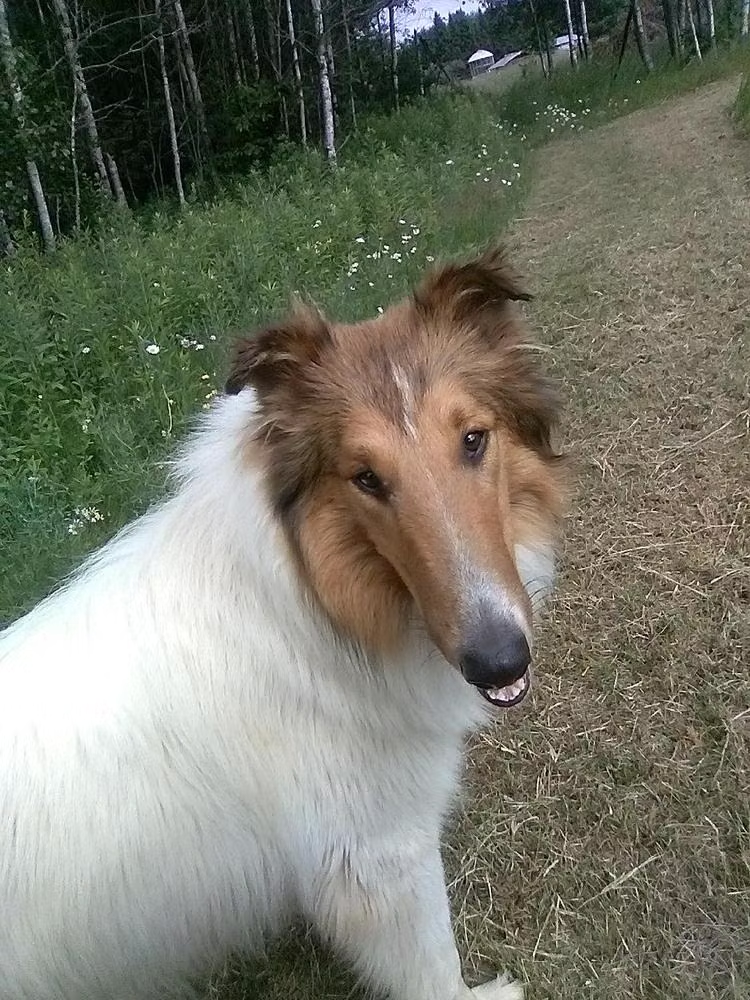
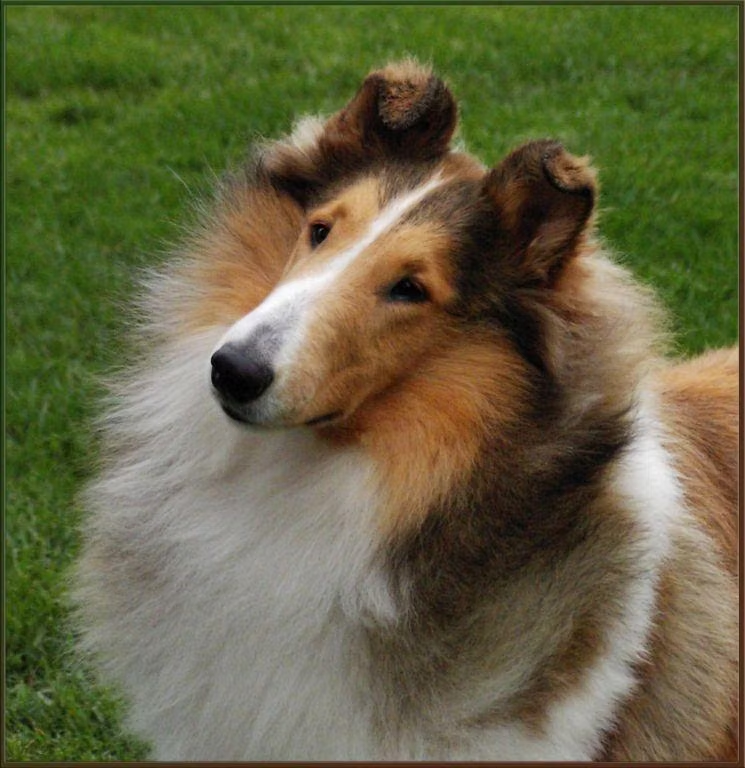
A few of the Rough Collie profiles members have added to United Pet Club.




About the Rough Collie in India
The Rough Collie is a large Scottish herding breed with a long flowing coat, gentle temperament, and a strong attachment to children and family.
The Rough Collie is a large herding dog from Scotland, known for its long double coat, narrow wedge-shaped head, and soft almond eyes. Many Indian households first came to know the breed through the Lassie films, which fixed its image as a devoted family dog long before it was commonly seen in Indian homes.
Adult dogs stand roughly 56 to 66 cm (22 to 26 inches) at the shoulder and weigh about 23 to 34 kg (50 to 75 lb). Despite the size, the temperament is soft. Rough Collies tend to stay calm indoors, keep close to family members, and pick up on tone of voice and household mood quickly.
The breed carries the working intelligence of its herding background. Collies learn fast, watch their people closely, and often respond to the smallest cue. That same sensitivity means a harsh hand tends to backfire, so patient handling suits the breed better.
| Attribute | Detail |
|---|---|
| Origin | Scotland |
| Size | Large (23 to 34 kg) |
| Lifespan | 12 to 14 years |
| Group / role | Herding |
| Good with | Children and families |
Who the breed suits
The Rough Collie fits households that can offer daily company, moderate exercise, and regular grooming. Families with children usually get along well with the breed, and it tends to stay close to its people rather than wander off. Owners who are frequently out of station, or who leave a dog alone for long stretches through the day, may find the breed's attachment hard to meet, particularly in a flat with no one home for most of the day.
History and origin of the Rough Collie
The Rough Collie developed as a herding dog in the Scottish Highlands and became known worldwide after Queen Victoria took an interest in the breed in the 1860s.
The Rough Collie traces back to herding dogs used in the Scottish Highlands and northern England. These working dogs managed sheep across rough, open country, and breeders valued stamina, willingness to work, and a coat that stood up to wet, cold weather.
The breed gained royal attention in the 1860s, when Queen Victoria saw Collies during a visit to Balmoral in Scotland and kept several at Windsor. Royal interest raised the breed's profile and helped move it from farm work toward the show ring and companion homes.
The first dog shows of the late 19th century shaped the modern type. Breeders refined the long, narrow head and the heavy double coat, and the Collie was among the breeds recorded in early kennel club registers in Britain and the United States. In India, the breed is recognised under the Kennel Club of India (KCI), and Rough Collies occasionally appear in the breed ring at KCI-affiliated shows, though numbers remain small compared with more common breeds.
Through the 20th century the Lassie books, films, and television series carried the breed to a global audience, India included. The fictional dog set the Rough Collie's reputation as a loyal, intelligent rescuer and drove a long period of high demand that has only partly faded.
Appearance and KCI breed standard
The Rough Collie is a large, elegant dog with a long double coat, a refined wedge-shaped head, and almond-shaped eyes that give it a soft expression.
The Rough Collie has a lean, balanced frame built for movement rather than bulk. The head is long and refined, narrowing to the nose in a smooth wedge, and the ears are semi-erect with the tips folding forward. The almond eyes give the breed its gentle, watchful expression.
| Trait | Standard |
|---|---|
| Height | 56 to 66 cm (22 to 26 inches) at the shoulder |
| Weight | 23 to 34 kg (50 to 75 lb) |
| Coat | Long, straight outer coat over a dense undercoat |
| Colours | Sable and white, tricolour, blue merle, white |
| Eyes | Almond-shaped, dark (merles may have blue or flecked eyes) |
Coat and colours
The double coat is the breed's most recognised feature. A coarse, straight outer coat sits over a soft, dense undercoat, with a heavy mane and frill around the neck and chest. Recognised colours are sable and white, tricolour (black, white, and tan), blue merle, and mostly white with coloured markings. The coat sheds through the year and comes away in handfuls during the seasonal coat blow, which tends to be heaviest around the change from winter to the hot months.
Temperament and personality
Rough Collies are gentle, loyal, and sensitive dogs that bond closely with their families, do well with children, and stay reserved rather than aggressive with strangers.
The Rough Collie is gentle and devoted. The breed forms strong attachments to its household and would rather stay near its people than off on its own. With children the temperament is patient and tolerant, which is a large part of why the breed has such a long-standing name as a family dog.
With strangers, Collies are usually reserved rather than hostile. Many bark to announce a visitor at the gate, then settle down once the household has accepted the newcomer. The breed generally gets on well with other dogs and household pets, helped by a herding background that favours managing a situation rather than confronting it.
The breed is sensitive. Rough Collies pick up on tone and mood quickly, and they do not respond well to shouting or a rough correction. Some lines are vocal, and the herding instinct can show up as gentle following or gathering of children and other animals around the house or in the garden.
| Trait | Rating |
|---|---|
| Affection | 5 |
| Energy | 3 |
| Trainability | 5 |
| Vocalness | 4 |
| Shedding | 5 |
Care and grooming in Indian conditions
The Rough Collie needs frequent brushing for its heavy double coat, daily moderate exercise, and steady company, and the breed can struggle with India's summer heat.
Grooming
- Brush the coat two to three times a week, and daily during the seasonal coat blow.
- Work through the dense areas behind the ears, under the legs, and around the frill, where mats form fastest.
- Bathe every six to eight weeks or as needed, and dry the coat through fully afterwards, since damp undercoat left through the monsoon invites fungal skin trouble.
- Trim nails monthly and check ears weekly for wax and debris.
- Avoid shaving the double coat. It does not grow back the same way, and the dog loses some of its natural insulation and protection from the sun.
Exercise
- Provide 45 to 60 minutes of activity daily, split across walks and play.
- Add mental work such as scent games, basic training, or herding-style activities.
- Use secure, fenced spaces, since the herding drive can prompt chasing of cyclists, joggers, or smaller animals.
- Walk early morning or after sunset during the Indian summer, and cut exercise short in the peak afternoon heat, since the heavy coat raises the risk of overheating.
Environment
The Rough Collie adapts to a house or a flat when given daily exercise and steady company, though a bit of open space suits the size better. The breed tolerates cold well thanks to the double coat but needs shade, a fan or cooler, and water on hand through the hot months, particularly in the plains. Hill towns such as Ooty, Kodaikanal, or Shimla suit the coat far better than a hot, humid coastal city. The breed does best with regular human contact and can struggle with long hours alone in an empty flat.
Nutrition and feeding
Rough Collies do well on a balanced diet sized for a large breed, fed in two daily meals, with portions adjusted to keep the dog lean.
The Rough Collie needs a complete, balanced diet formulated for large breeds. Choose a food with a named protein source and feed the amount suited to the dog's weight, age, and activity level. Because the heavy coat hides weight gain easily, check body condition by running a hand along the ribs rather than going by appearance alone.
| Life stage | Amount per day | Meals |
|---|---|---|
| Puppy (2 to 6 months) | Roughly 240 to 360 grams, growth formula | 3 to 4 |
| Adult | Roughly 300 to 420 grams | 2 |
| Senior | Roughly 240 to 360 grams, adjusted for activity | 2 |
Treats and supplements
Keep treats to about 10 percent of daily calories. Many owners support coat and joint health with omega-3 fatty acids, though any supplement should be added only on a vet's advice. Keep fresh water available at all times, and top up the bowl more often after exercise through the hot, humid months.
Health and common conditions
The Rough Collie typically lives 12 to 14 years and stays generally healthy, though the breed is prone to inherited eye disorders and a drug sensitivity linked to the MDR1 gene.
The Rough Collie is generally a sound breed with a lifespan of 12 to 14 years. Responsible breeding and screening cut down the most common inherited problems. The breed carries a well-documented drug sensitivity tied to the MDR1 gene, which changes how some dogs process certain medicines, and every vet treating the breed should be told about it before prescribing.
| Condition | Signs | Note |
|---|---|---|
| Collie eye anomaly | Often none; picked up on an eye exam | Inherited; screen breeding dogs |
| Progressive retinal atrophy | Night blindness, loss of vision | Inherited; DNA testing available |
| MDR1 drug sensitivity | Severe reaction to certain drugs | DNA test; inform your vet |
| Hip dysplasia | Stiffness, reduced activity | Screen breeding stock |
Preventive care
- Schedule annual vet checkups and keep vaccinations current.
- Test or confirm MDR1 status and share the result with your vet before any new medicine is prescribed.
- Arrange periodic eye examinations.
- Keep the dog at a lean body weight to protect the joints.
- Stay current on tick and flea prevention, since ticks are active through most of the year in Indian conditions and can carry ehrlichiosis and babesiosis.
Training
Rough Collies are highly trainable and quick to learn, and they respond best to patient, reward-based methods that suit the breed's sensitive nature.
The Rough Collie is intelligent and keen to work with its handler, which makes training straightforward for most owners. The breed picks up commands quickly and enjoys having a job to do. Because Collies are sensitive, a harsh correction tends to make the dog withdraw rather than improve, so calm and consistent handling gets better results.
Basics
- Start socialisation early, exposing the puppy to people, sounds, traffic, and other animals.
- Teach foundation cues such as sit, stay, come, and walking politely on a lead.
- Add structured mental work, including scent games and trick training.
- Channel the herding instinct into approved games to cut down on chasing.
- Address barking early with clear, consistent responses.
Breeding
Rough Collies reach breeding maturity at one to two years, carry a litter for about 63 days, and typically have six to eight puppies that need careful early socialisation.
Rough Collies reach physical maturity between one and two years of age, and a responsible breeder waits until a dog is fully grown and health-screened before breeding it. Gestation runs about 63 days, and litters commonly range from six to eight puppies.
Before breeding, the dam and sire should both be tested for inherited conditions, including MDR1 status and eye disorders, so the affected genes are not passed on. Early handling and socialisation of the puppies lay the groundwork for the breed's gentle adult temperament. Puppies usually go to new homes at around eight weeks, once weaned and started on vaccinations. Many breeders in India also register the litter with the Kennel Club of India, which lets buyers confirm parentage and health testing.
| Metric | Value |
|---|---|
| Breeding maturity | 12 to 24 months |
| Gestation | About 63 days |
| Average litter size | 6 to 8 puppies |
| Weaning age | Around 6 to 8 weeks |
| Recommended health tests | MDR1, eye exam, hip screening |
Registering a Rough Collie in India: profile and microchip
Municipal licences cover the paperwork; a free United Pet Club record is what actually connects your Rough Collie to your phone.
How to register a Rough Collie in India
A Rough Collie that slips past the gate of the housing society is identified by its record, not by its pedigree. Provide that record without spending a rupee: the free United Pet Club profile carries your telephone number, the dog's photograph, and its details for life. Register your dog and the matter is settled.
A microchip without a registration is merely a number under the skin. File your Rough Collie's fifteen digit number with United Pet Club and it becomes a working address: free for life, open to every chip brand, and searchable from any clinic or shelter in the country or abroad. Microchip registration first, the free account alongside.
How do I register my Rough Collie in India?
Create a free United Pet Club account, enter your Rough Collie's details along with a photograph, and save the profile. The lifetime plan maintains the record at no cost, and any municipal licence you hold sits alongside it rather than replacing it.
How do I register my Rough Collie's microchip?
Enter the fifteen digit chip number into your free account together with your current address, phone number, and email. The lifetime plan covers the registration and every subsequent update without charge, whatever the chip's manufacturer.
Is registration compulsory for a Rough Collie in India?
Several municipal corporations, Delhi and Mumbai among them, require dogs to be licensed under local by-laws. The United Pet Club profile is separate and voluntary, and it is the record a finder anywhere can actually search, free of cost.
What does it cost to register a Rough Collie?
Nothing whatsoever. The free lifetime plan includes the profile, the microchip record, and unlimited updates, with no renewal fee at any point.
Frequently asked questions
Common questions about the Rough Collie cover its size, temperament, grooming needs, lifespan, suitability for Indian homes, and availability.
How big does a Rough Collie get?
Rough Collies are a large breed. Adults stand about 56 to 66 cm (22 to 26 inches) at the shoulder and weigh roughly 23 to 34 kg (50 to 75 lb), with males usually larger than females.
Is a Rough Collie a good family dog?
Yes. The breed is gentle, loyal, and patient with children, and it tends to bond closely with the whole household, which is a big reason for its long-standing reputation as a family companion.
Is a Rough Collie hard to maintain?
Maintenance is moderate. The main demands are frequent brushing of the heavy double coat, daily exercise, and steady company, since the breed dislikes being left alone for long stretches, and the coat needs extra attention through the monsoon.
What is the lifespan of a Rough Collie?
The typical lifespan is 12 to 14 years. Regular vet care, a lean weight, and health screening of breeding dogs support a long, healthy life.
Do Rough Collies shed a lot?
Yes. The double coat sheds through the year and comes away heavily during the seasonal coat blow. Brushing two to three times a week, and daily during the shedding season, keeps loose hair under control.
Are Rough Collies easy to train?
Very. The breed is intelligent and keen to cooperate, learning quickly with patient, reward-based methods. Its sensitivity means gentle handling gets the best results.
Are Rough Collies easy to find in India?
The breed is established but not common. A few Kennel Club of India-registered breeders produce litters, and rescue groups occasionally place adult dogs. Health-tested puppies from screened parents may mean a wait.
From the community
Ask about the Rough CollieNo questions about the Rough Collie yet. Be the first to ask.
Browse Dog breeds