
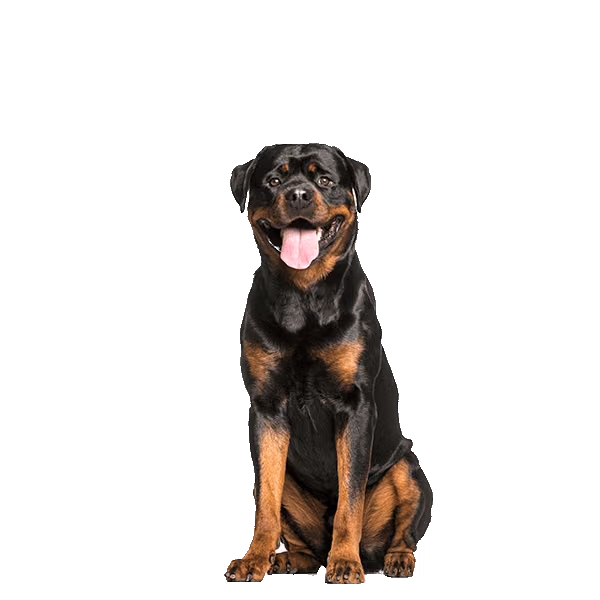
Rottweiler
The Rottweiler is a confident, loyal guardian known for its intelligence, protective devotion, and calm self-assurance.
- Size
- Large
- Lifespan
- 9–10 years
- Origin
- Germany
- Temperament
- Confident
- Standard colors
- Black and Tan
Characteristics
Coat and grooming
How the Rottweiler coat is built, and what that means when you groom it.
- Coat layers
- Double coat
- Coat texture
- Smooth
- Coat length
- Short
- Shedding
- Seasonal shedding
Grooming guidance
Critical: A Rottweiler should not be shaved.
The undercoat keeps heat out as well as in, and the outer coat shields the skin from sun and insect bites. Clipping the whole coat off removes both. It often grows back patchy, soft or a different colour, and in some animals the guard hairs never return properly. Brush the undercoat out instead of cutting it off.
Information: A Rottweiler drops its undercoat in heavy bursts.
The undercoat comes out in heavy bursts over a few weeks. An undercoat rake, or a bath followed by a proper blow-dry, clears it far faster than daily brushing. Clipping the coat down is not a shortcut for this.
Rottweiler colors and patterns
What each club's breed standard says about every Rottweiler color and pattern. Point at a ruling to see the club's own wording.
Breed standards describe the Rottweiler in Black and Tan. Standard patterns: Tan point.
| Color or pattern | FCI | AKC | UKC | KC | KUSA |
|---|---|---|---|---|---|
| Black | Standard (“Black”) | Standard (“Black & Tan”) | Standard (“black”) | Standard (“Black”) | Standard (“Black”) |
| Tan | Standard (“markings of a rich tan”) | Standard (“Black & Tan”) | Standard (“rich tan markings”) | Standard (“Colour of markings from rich tan to mahogany”) | Standard (“markings of a rich tan”) |
| White | Disqualifying (“White markings”) | Fault (“white marking any place on dog”) | Disqualifying (“White markings anywhere on the dog”) | Fault (“White marking is highly undesirable”) | Disqualifying (“White markings”) |
| Albino | Disqualifying | Disqualifying | Disqualifying (“Albinism”) | Not recognised | Disqualifying |
| Blue | Disqualifying | Disqualifying | No ruling | Not recognised | Disqualifying |
| Red | Disqualifying | Disqualifying | No ruling | Not recognised | Disqualifying |
| Patterns | |||||
| Tan point | Standard (“Black with clearly defined markings of a rich tan”) | Standard (“Black & Tan”) | Standard (“black with clearly-defined rich tan markings”) | Standard (“Black & Tan”) | Standard (“Black with clearly defined markings of a rich tan”) |
| Sable | Disqualifying | Fault (“sooty markings”) | Disqualifying | Not recognised | Disqualifying |
| Solid | Disqualifying | Disqualifying (“absence of all markings”) | Disqualifying | Not recognised | Disqualifying |


| Color or pattern | FCI | AKC | UKC | KC | KUSA |
|---|---|---|---|---|---|
| Dark brown | Standard (“dark brown in colour”) | Standard (“The desired color is a uniform dark brown”) | Standard (“dark brown in color”) | Standard (“dark brown in colour”) | Standard (“dark brown in colour”) |
| Light brown | No ruling | No ruling | No ruling | Fault (“light eye undesirable”) | No ruling |
| Yellow | Disqualifying (“yellow eyes”) | Fault (“Yellow (bird of prey) eyes”) | Fault (“Yellow eyes”) | No ruling | Disqualifying (“yellow eyes”) |
| Patterns | |||||
| Odd-eyed | Disqualifying (“different coloured eyes”) | Fault (“eyes of different color or size”) | Fault (“Eyes of different color or size”) | No ruling | Disqualifying (“different-coloured eyes”) |

| Color or pattern | FCI | AKC | UKC | KC | KUSA |
|---|---|---|---|---|---|
| Black | Standard (“always black”) | Standard (“always black”) | Standard (“The nose is broad and black in color”) | Standard (“always black”) | Standard (“always black”) |
| Pink | Fault (“pale or spotted nose”) | No ruling | No ruling | No ruling | Fault (“pale or spotted nose”) |
| Patterns | |||||
| Butterfly nose | Fault (“spotted nose (butterfly nose)”) | No ruling | No ruling | No ruling | Fault (“spotted nose (butterfly nose)”) |

What the rulings mean
- Standard
- Described by the club's breed standard.
- Fault
- Named by the club's breed standard as a fault: the animal can be shown but is penalised.
- Disqualifying
- The club's breed standard disqualifies an animal of this colour or pattern.
- Not recognised
- The club does not accept this colour or pattern for the breed.
Color changes
How a Rottweiler's colors can change over its life.
Blackchanges toRust
Coat · With body condition · can change back
Blackchanges toGrey
Coat · Progressive
Blackchanges toBrown
Coat · In the sun · can change back
Whitechanges toRoan
Coat · With age · from 2 weeks
Tan pointchanges toSaddle
Coat · With age · from 6 to 156 weeks
Blackchanges toSnow nose
Nose · With the season · can change back
Blackchanges toPink
Nose · With the season · can change back


Sources
Each ruling comes from the club's published breed standard or color list.
Health
Conditions recorded as more common in the Rottweiler than in its species as a whole. A higher risk is not a diagnosis: many never develop any of them, and your vet can say which screening tests are worth doing.
High risk
- Musculoskeletal system
Canine elbow dysplasia
Strong evidenceHereditaryInheritance: Polygenic - Musculoskeletal system
Canine hip dysplasia
Strong evidenceHereditaryInheritance: Polygenic - Skeletal
Osteosarcoma
Strong evidence - Musculoskeletal system
Cranial cruciate ligament disease
Moderate evidence
This content is for educational purposes and is not a substitute for professional veterinary advice. If you are worried about your pet, contact your veterinarian.
All health conditionsMeet some of our Rottweiler
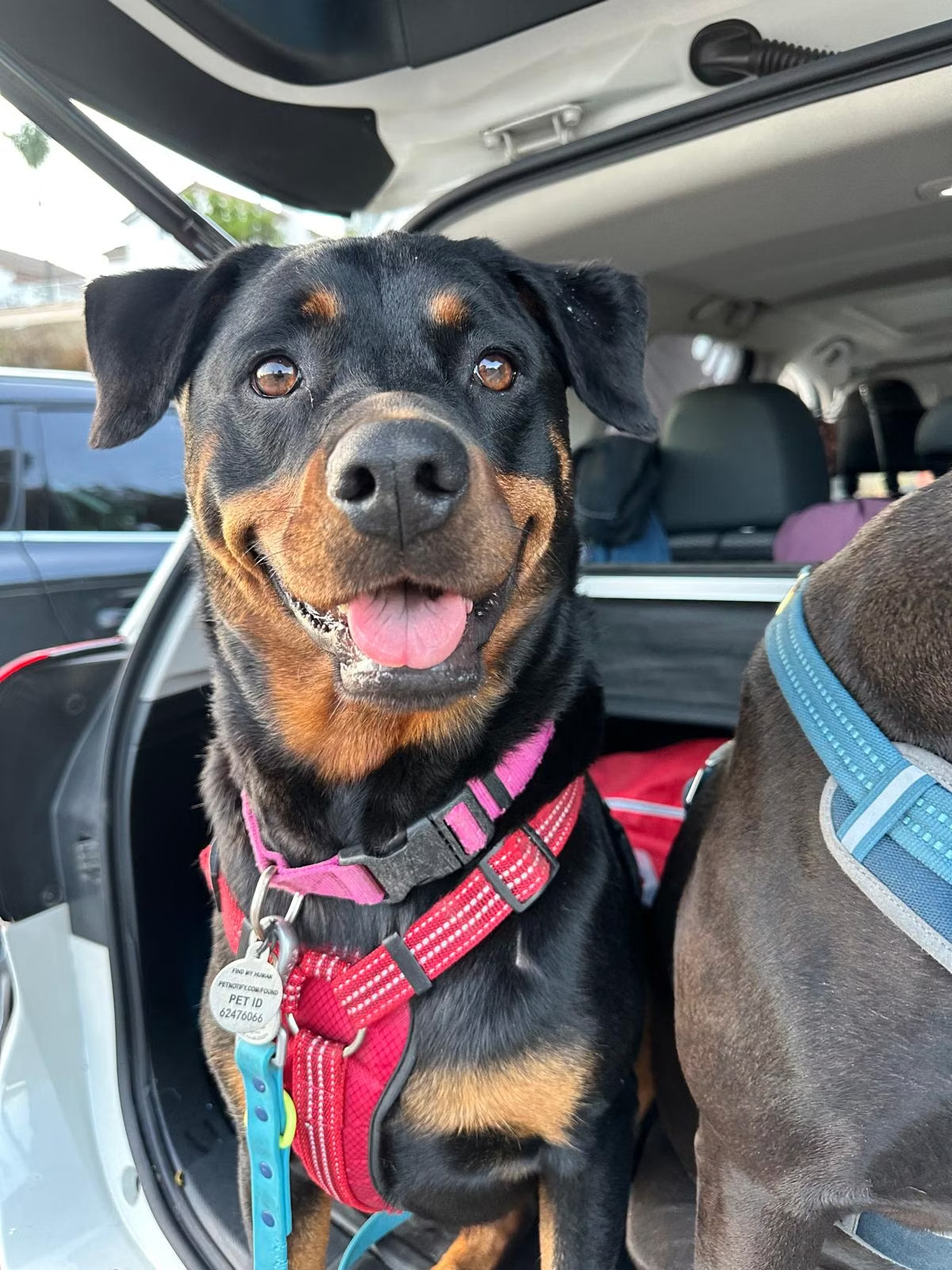
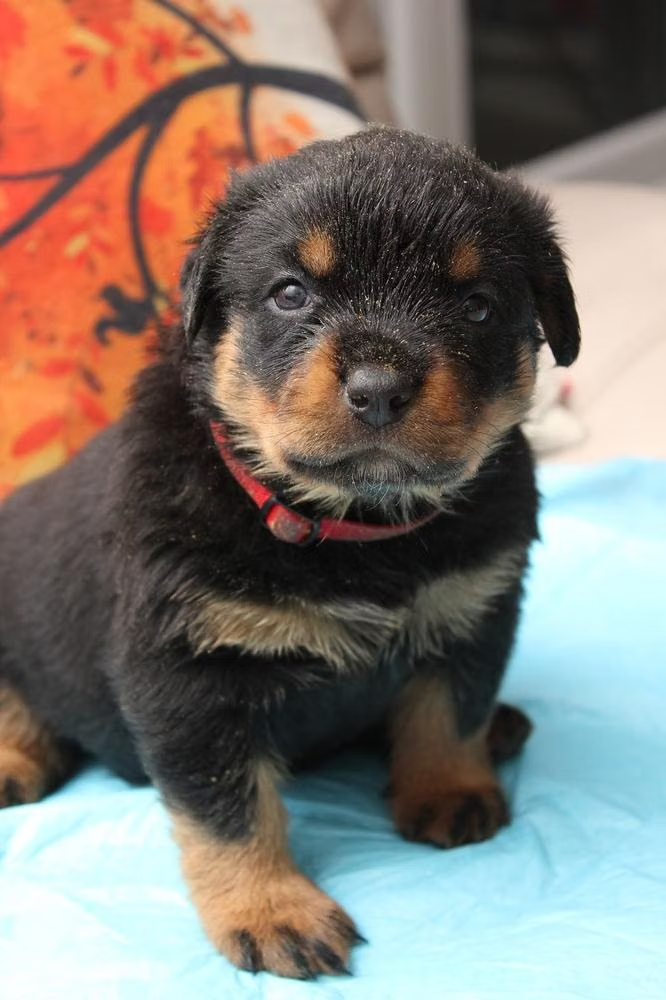
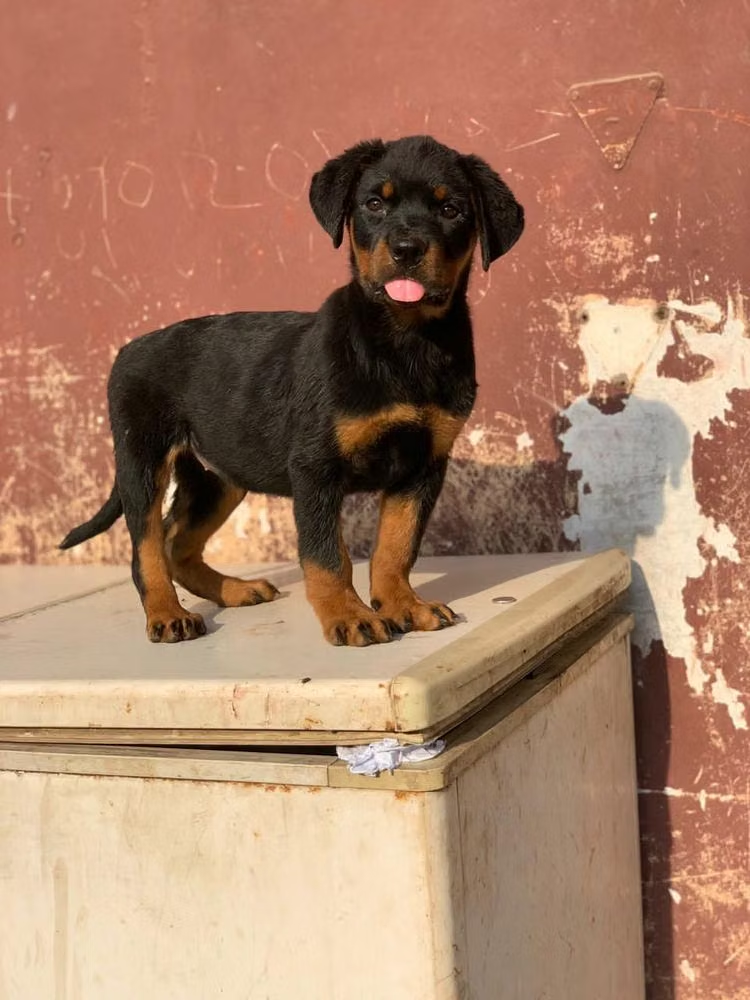
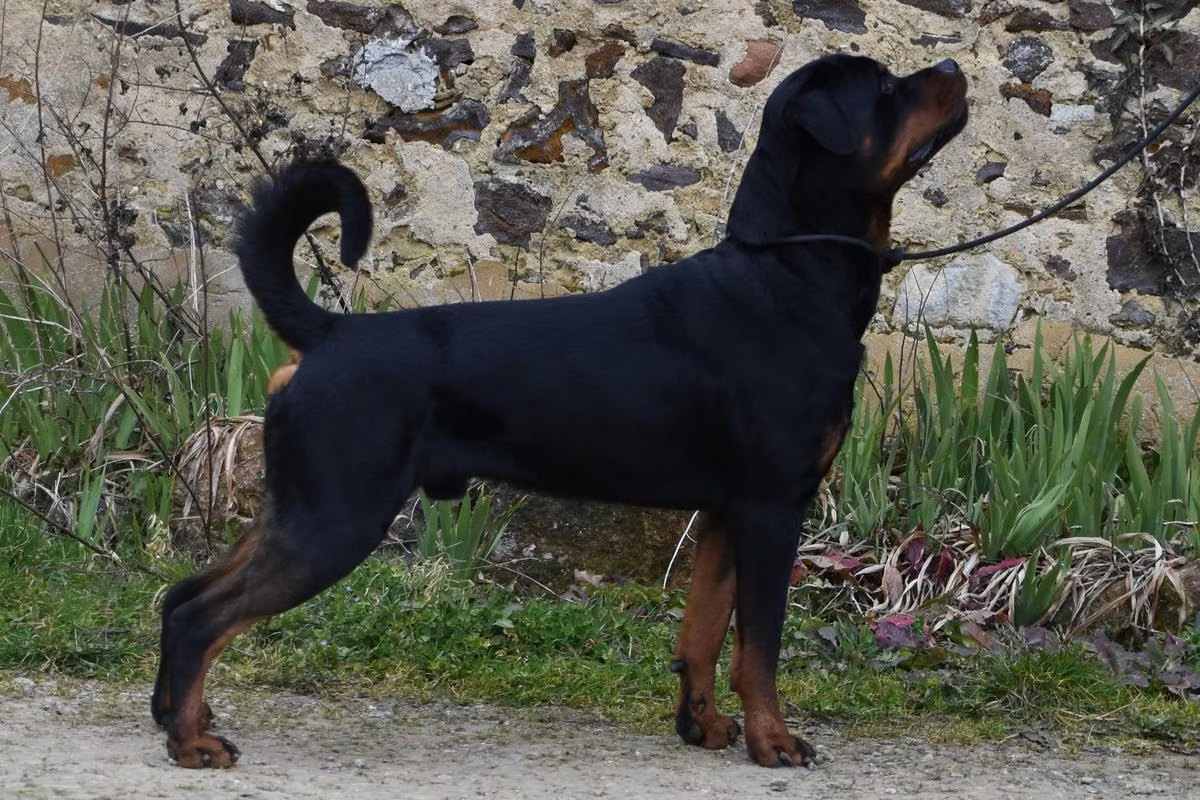
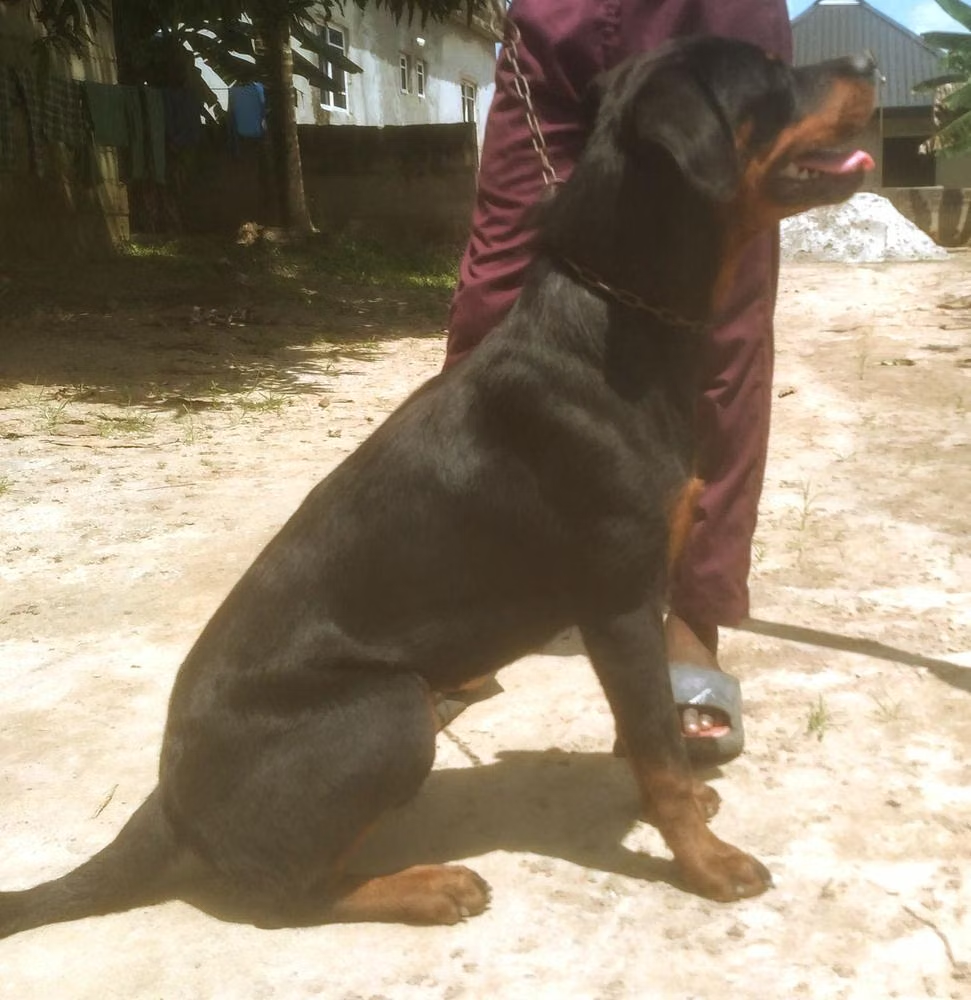
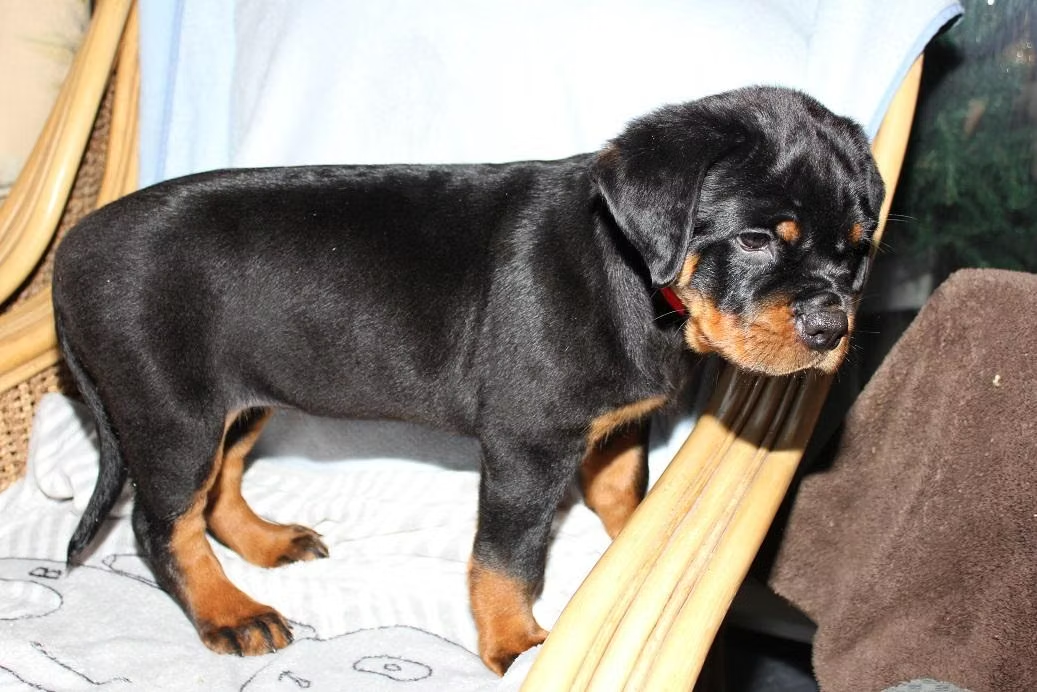
A few of the Rottweiler profiles members have added to United Pet Club.





About the Rottweiler
The Rottweiler is a large German working breed registered with the Kennel Club of India (KCI), calm and self-assured by nature, deeply loyal to its household, and best suited to an owner who can provide daily exercise, early socialisation, and consistent training.
The Rottweiler, registered with the Kennel Club of India (KCI), is a large German working breed kept across the country as a guardian and companion. Males stand 61 to 69 cm at the shoulder and weigh 43 to 61 kg; females are 56 to 63 cm and 36 to 45 kg. The coat is short and black with clearly defined rust to mahogany markings on the face, chest, legs, and under the tail. For the size, a well-bred dog moves with real balance.
The Rottweiler is calm and self-assured rather than excitable or nervous. At home it settles near the people it lives with, tends to be quiet and even-tempered, and becomes alert the moment something is out of place. With strangers it is watchful and slow to warm. Many owners describe the dog as undemonstrative indoors yet completely switched on the moment something needs its attention. That combination draws owners in India who want a credible guardian as well as a household companion.
The breed's background is in work: cattle driving, cart pulling, and later police, military, and search roles across Germany and beyond. That history shapes the dog today. A Rottweiler without sufficient exercise, mental work, and structure will find its own outlet, and rarely a welcome one.
| Attribute | Detail |
|---|---|
| Origin | Germany |
| Size | Large (36 to 61 kg) |
| Lifespan | 9 to 10 years |
| Group / role | Working dog, guardian and herder |
| Good with | Family and children when socialised and supervised |
Who this breed suits
The Rottweiler fits an owner with time, experience, and the physical ability to manage a large, powerful dog. It does well in an independent house with a compound, where it has space to move and a defined territory. Owners in metro flats can keep the breed successfully, but it requires more planning: society rules about large dogs, behaviour in lifts and corridors, and long walks in heat all need deliberate management. The breed is not a good match for a first-time owner looking for low-effort companionship, for a household where the dog would spend most of its day confined alone, or for anyone who cannot commit to daily training and exercise.
History and origin
The Rottweiler descends from Roman drover dogs that settled in southern Germany, became the cattle and cart dog of the trading town of Rottweil, nearly disappeared in the 19th century, and was revived through police and military work in the early 20th century.
The Rottweiler's ancestry runs back to the large mastiff-type dogs that Roman legions brought north through Europe to herd the cattle that fed the troops on campaign. When the legions eventually withdrew from the territories they had occupied, many of those dogs remained. In the area of southern Germany that later became the town of Rottweil, these dogs crossed with local herding stock over generations and became the working animals the town depended on.
Rottweil grew into a significant cattle-trading centre through the Middle Ages. The dogs there drove herds to market, guarded both the livestock and the money their owners carried, and pulled the heavy carts that butchers used to move meat. This working role gave the breed its lasting name: Rottweiler Metzgerhund, the butcher's dog of Rottweil.
The expansion of railways in the 19th century ended the practice of driving cattle long distances on foot, and demand for the drover dog collapsed sharply. The Rottweiler came close to extinction by the late 1800s. Recovery came in the early 20th century, when breeders and police authorities recognised the dog's suitability for security and law enforcement. Formal breed clubs formed in Germany during that period, and a unified standard was set.
The breed spread internationally through the 20th century and is now kept in police, customs, search and rescue, and service roles alongside its widespread use as a guardian companion. In India it is registered with the Kennel Club of India (KCI) and has been kept for several decades, most often in households that want both a deterrent and a loyal family dog.
Appearance and breed standard
The Rottweiler is a large, compact dog, slightly longer than it is tall, with a black coat, clearly defined rust to mahogany markings, a broad head with dark almond-shaped eyes, and a short dense double coat.
The Rottweiler's body is compact and slightly longer than it is tall. The chest is deep and broad, the back straight and strong, and the hindquarters are muscular enough to drive the dog forward with evident power. The head is wide, with a moderately arched skull, a well-developed muzzle, and dark, almond-shaped eyes that give the breed its composed and attentive expression. Ears are medium, triangular, and fold forward close to the sides of the head. Despite the heavy frame, a correctly built dog moves with balance and surprising efficiency.
| Trait | Standard |
|---|---|
| Height | Males 61 to 69 cm, females 56 to 63 cm |
| Weight | Males 43 to 61 kg, females 36 to 45 kg |
| Coat | Short, dense double coat with a flat outer coat |
| Colours | Black with rust to mahogany markings |
| Eyes | Dark brown, almond-shaped |
Coat and colours
The outer coat is short, straight, and dense, lying flat over a softer undercoat that sits heaviest around the neck and thighs. In India's warmer regions the undercoat tends to stay relatively thin year-round, which reduces the heavy seasonal shedding seen in colder climates. The coat requires no specialist products and is easy to keep clean. The only accepted colour is black with sharply defined markings ranging from rust to deep mahogany. These appear in a fixed pattern: spots above each eye, patches on the cheeks and muzzle, colouring across the chest and legs, and markings under the tail. Clear, well-separated markings are preferred under the breed standard. The tail was traditionally docked, though many breeders in India now leave it natural, in which case it is carried roughly level with the topline when the dog is moving.
Temperament and personality
The Rottweiler is confident, loyal, and deeply attached to its household, naturally reserved with strangers, and requires thorough early socialisation to develop into a balanced and stable adult.
At home the Rottweiler is calm and even-tempered. It forms strong bonds with the people it lives with and is often physically affectionate within the family, leaning against or following a favoured person through the house. The breed does not demand constant attention but it does want proximity. An owner who is rarely at home will find that the dog struggles.
With strangers the breed is naturally cautious and assessing rather than immediately friendly or immediately aggressive. A Rottweiler reads a situation before deciding how to respond. This guardianship instinct is embedded in the breed's character, and it is why early, ongoing socialisation matters so much. A puppy exposed from an early age to busy markets, traffic, people in different clothing, visitors to the home, and other animals grows into a more settled and discerning adult. One that is kept isolated tends toward suspicion and becomes difficult to manage in public.
With children in its own household a well-raised Rottweiler is usually patient and tolerant. Its size means that even friendly contact can knock a small child over, so all interactions with young children should be supervised. With other dogs the picture is variable. Same-sex aggression can occur, particularly between intact males, but a dog raised alongside other pets from puppyhood typically coexists without serious difficulty. The breed's intelligence and independent character together mean that clear, consistent leadership from the owner is not a suggestion.
| Trait | Rating |
|---|---|
| Affection | 4 |
| Energy | 3 |
| Trainability | 5 |
| Vocalness | 2 |
| Shedding | 3 |
Care and grooming
The Rottweiler needs daily exercise timed around India's heat, careful management during monsoon to prevent fungal skin infections, straightforward weekly grooming, and indoor living as part of the household.
Heat is the first practical concern for Rottweiler owners across most of India. The breed handles cold far better than warmth, and in cities like Delhi, Nagpur, or Ahmedabad where temperatures regularly exceed 40°C from May through September, outdoor activity must be planned carefully. Keep walks to early morning, before 7 a.m., and to the evening after 7 p.m. during peak summer. Always have water available, and watch for early signs of heat stress: excessive panting, heavy drooling, and reluctance to continue walking. The monsoon brings a different challenge: persistent humidity encourages fungal skin infections, particularly in the skin folds around the neck and under the ears. Dry the dog thoroughly after rain, check the coat and skin regularly during the rains, and treat any developing hot spots promptly.
Grooming
- Brush once or twice a week with a firm bristle brush or rubber curry tool to remove loose hair and check the skin beneath.
- During the monsoon, when dampness under the coat can cause fungal problems, increase brushing frequency and ensure the coat dries fully each time the dog gets wet.
- Bathe every two to three months under normal conditions. In the monsoon, more frequent bathing may be needed if the dog gets repeatedly wet, but complete drying after each bath is essential.
- Trim nails every three to four weeks if they do not wear down naturally.
- Check and clean the ears at least once a week. Humid conditions after rain and bathing increase the risk of ear infections. Brush the teeth several times a week.
Exercise
- Aim for one to two hours of activity daily, split across early morning and evening sessions to avoid the heat.
- In summer, pavements heat up quickly and can burn paw pads; check the surface before long walks on tarmac.
- Supplement walks with training sessions, scent games, or puzzle feeders indoors during the hottest part of the day. The breed bores quickly and needs mental engagement.
- Track, obedience work, and similar structured activities suit the breed's working background and give it a purpose beyond walking.
- Avoid repetitive, high-impact exercise on hard surfaces with young dogs while the joints are still developing.
Living situation
A Rottweiler in an independent house with a compound has natural territory to patrol and space to move without the complications of shared spaces. For owners in a metro society flat, the arrangement is workable but requires more thought: the dog must be reliable in lifts, calm in corridors with neighbours, and manageable on the street outside the gate. Check the society's rules about large breeds before acquiring the dog, as policies vary and can change. Regardless of housing type, the dog should live indoors as part of the household rather than being left outside or in a kennel alone. Long periods of isolation produce problem behaviours in this breed.
Nutrition and feeding
Rottweilers need a balanced large-breed diet with measured portions to protect the joints and prevent weight gain, with amounts adjusted for activity levels and reduced appetite during the hottest months.
A complete, balanced diet formulated for large breeds suits the Rottweiler throughout its life. The breed gains weight easily, and excess weight on a dog of this frame places real strain on the joints and heart. Weigh out each meal and adjust portions based on the dog's actual weight, age, and activity level rather than feeding by eye or following packet guides loosely. During the hottest summer months, appetite often drops naturally; reduce portions accordingly rather than trying to maintain the same quantity. Puppies should be fed a large-breed puppy formula, which controls calcium and energy density to support steady, appropriate growth and reduce the risk of developmental joint problems.
| Life stage | Amount per day | Meals |
|---|---|---|
| Puppy (2 to 6 months) | 300 to 600 g, split | 3 to 4 |
| Puppy (6 to 12 months) | 400 to 720 g, split | 2 to 3 |
| Adult | 400 to 950 g | 2 |
| Senior | 300 to 720 g, adjusted for activity | 2 |
Treats and supplements
Keep treats to no more than ten per cent of the daily calorie allowance to avoid gradual weight gain. Many owners add joint supplements containing glucosamine and chondroitin, and some use omega-3 fatty acids for coat and joint support. Discuss any supplement with a vet before starting. Fresh water must be available at all times, and this matters particularly during summer when the dog drinks significantly more than usual. Because the Rottweiler has a deep chest and is susceptible to bloat, split the daily ration into two meals and avoid vigorous exercise for at least an hour after feeding.
Health and common conditions
The Rottweiler lives about 9 to 10 years and is prone to joint dysplasia, certain cancers, heart conditions, and bloat; owners in India should also account for tick and flea burden and keep rabies vaccination current.
The Rottweiler is a generally sturdy breed, but its large size comes with a shorter average lifespan of 9 to 10 years and several conditions that appear with enough regularity to warrant active management. Responsible breeders screen for hip and elbow dysplasia and for cardiac defects before mating, and sourcing a puppy from health-screened lines is the most practical way to reduce inherited risk. Keeping the dog lean throughout its life protects the joints and reduces cardiovascular strain.
In India there are additional considerations. Tick and flea burden is significant across much of the country, particularly in the months following the monsoon, and a Rottweiler's thick neck and dense coat can make ticks harder to find. Year-round tick and flea prevention is not optional. Rabies vaccination compliance is equally important: it is legally required for dogs in most Indian states, and in a country with a substantial stray dog population, it is a genuine protective measure. Vet access is generally good in major metros, but can be limited in tier-2 and tier-3 cities. Owners outside major cities should identify the nearest clinic with emergency capacity before they need it.
| Condition | Signs | Note |
|---|---|---|
| Hip and elbow dysplasia | Limping, stiffness, difficulty rising | Screen breeding stock; keep the dog lean |
| Osteosarcoma (bone cancer) | Lameness, swelling on a limb | The breed carries elevated risk |
| Aortic stenosis | Fatigue, fainting, heart murmur | Detected through cardiac screening |
| Gastric dilatation-volvulus (bloat) | Swollen belly, unproductive retching, distress | A medical emergency; go to a vet immediately |
| Hypothyroidism | Weight gain, low energy, coat changes | Managed with daily medication |
Preventive care
- Schedule annual veterinary checkups; senior dogs benefit from a visit every six months.
- Keep all vaccinations current, including rabies, which is required by law in most Indian states.
- Use year-round tick and flea prevention. After walks in grassy or wooded areas, check the coat and skin folds for ticks.
- Maintain a lean body weight throughout the dog's life to reduce joint and cardiac strain.
- Provide routine dental care and monitor the joints and gait as the dog ages.
- Source puppies from breeders who supply written hip, elbow, and cardiac screening results.
Training
The Rottweiler is highly trainable and intelligent but has a strong, independent will, and needs early socialisation, consistent reward-based training, and a confident owner to develop reliable behaviour.
The Rottweiler learns quickly, retains what it is taught, and engages readily with an owner it respects. That intelligence is paired with a strong, independent character, so the breed needs an owner who is calm and consistent. Harsh handling tends to produce stubbornness or reactivity rather than compliance. Inconsistency produces the same. Both become harder to correct as the dog grows larger.
In India's urban environment, reliable training has direct practical value. A Rottweiler that walks calmly on a leash, sits quietly in a vet's waiting room, and behaves predictably around people in a lift or a crowded street is a very different experience from one trained loosely or too late. Early socialisation, starting well before the vaccination schedule is complete if you can find appropriate controlled environments, builds the foundation that urban ownership demands.
Training approach
- Begin socialisation in puppyhood: expose the dog to people, traffic, markets, vet visits, lifts, stairwells, and other animals while it is young and impressionable.
- Teach core obedience cues early: sit, down, stay, recall, and walking on a loose lead.
- Keep sessions short, frequent, and positive. The Rottweiler focuses well but disengages when sessions drag.
- Apply household rules consistently. Every person in the home should give the same signals and hold the same boundaries.
- Move to structured activities such as tracking, obedience work, or similar outlets once the basics are solid, to channel the working drive constructively.
- Continue reinforcing and practising obedience throughout the dog's life. Puppyhood training is the start, not the end.
Breeding
Responsible Rottweiler breeding waits until dogs reach two years for health screening, produces litters of 6 to 12 puppies after a gestation of about 63 days, and places puppies only with owners prepared for the breed's demands.
Responsible Rottweiler breeding centres on health and temperament before appearance. Though dogs reach physical maturity earlier, most breeders wait until around two years of age before breeding, by which point hip, elbow, and cardiac screening can be completed and the adult character is clear. Females come into heat roughly twice a year; gestation lasts about 63 days from a successful mating.
Litters are typically large, commonly ranging from 6 to 12 puppies. Whelping a large-breed litter can involve complications, and arranging for veterinary support during the birth is sensible practice. In the first weeks, the breeder's role is to keep the whelping area clean, warm, and undisturbed while monitoring each puppy's weight to confirm adequate feeding.
Handling and socialisation begin in the litter. By seven to eight weeks most puppies are weaned and ready for new homes, having been introduced gently to human contact, sounds, and varied experiences. Given the breed's strength and guarding instinct, matching puppies to genuinely prepared owners is an important part of responsible breeding. KCI registration provides a record of lineage and health screening history, and is the standard reference for traceability in India.
| Metric | Value |
|---|---|
| Breeding maturity | Around 2 years |
| Heat cycle | About twice per year |
| Gestation | About 63 days |
| Average litter size | 6 to 12 puppies |
| Weaning age | About 7 to 8 weeks |
Registering a Rottweiler in India: profile and microchip
Municipal licences cover the paperwork; a free United Pet Club record is what actually connects your Rottweiler to your phone.
How to register a Rottweiler in India
A Rottweiler that slips past the gate of the housing society is identified by its record, not by its pedigree. Provide that record without spending a rupee: the free United Pet Club profile carries your telephone number, the dog's photograph, and its details for life. Register your dog and the matter is settled.
A microchip without a registration is merely a number under the skin. File your Rottweiler's fifteen digit number with United Pet Club and it becomes a working address: free for life, open to every chip brand, and searchable from any clinic or shelter in the country or abroad. Microchip registration first, the free account alongside.
How do I register my Rottweiler in India?
Create a free United Pet Club account, enter your Rottweiler's details along with a photograph, and save the profile. The lifetime plan maintains the record at no cost, and any municipal licence you hold sits alongside it rather than replacing it.
How do I register my Rottweiler's microchip?
Enter the fifteen digit chip number into your free account together with your current address, phone number, and email. The lifetime plan covers the registration and every subsequent update without charge, whatever the chip's manufacturer.
Is registration compulsory for a Rottweiler in India?
Several municipal corporations, Delhi and Mumbai among them, require dogs to be licensed under local by-laws. The United Pet Club profile is separate and voluntary, and it is the record a finder anywhere can actually search, free of cost.
What does it cost to register a Rottweiler?
Nothing whatsoever. The free lifetime plan includes the profile, the microchip record, and unlimited updates, with no renewal fee at any point.
Frequently asked questions
Common questions from Indian owners about the Rottweiler's size in metric, suitability for flat and society living, how it copes with the Indian summer, lifespan, temperament, and care requirements.
How big does a full-grown Rottweiler get?
Males typically stand 61 to 69 cm at the shoulder and weigh 43 to 61 kg; females are 56 to 63 cm and 36 to 45 kg. Males are noticeably heavier and broader than females, and both sexes carry significant bone and muscle.
Can a Rottweiler be kept in a flat in a metro city?
Yes, but it requires consistent effort and planning. The dog needs daily outdoor exercise, reliable behaviour in lifts and shared corridors, and should not be left alone for long stretches. Check the society's rules about large breeds before acquiring the dog, as many societies impose restrictions.
How does a Rottweiler cope with Indian summers?
It needs active management. The breed tolerates cold better than heat, and temperatures above 35 to 40 degrees Celsius pose a genuine risk. Limit outdoor activity to early morning and late evening during peak summer, always provide fresh water, and watch for signs of heat stress such as excessive panting, heavy drooling, and reluctance to move.
How long do Rottweilers live?
The average lifespan is 9 to 10 years, which is typical for a large breed. Keeping the dog at a healthy weight, providing regular veterinary care, and sourcing from health-screened breeding lines all support a longer and healthier life.
Is the Rottweiler suitable for a first-time dog owner?
It is a challenging choice for a first-time owner. The breed's strength, guarding instinct, and strong will require confident and consistent handling. A first-time owner who invests in professional training support from the start and commits fully to the process can succeed, but the Rottweiler is not a low-effort pet.
Does the Rottweiler shed heavily?
It sheds a moderate amount year-round. In India the pronounced seasonal coat-blow seen in colder climates is less marked, but regular weekly brushing keeps loose hair manageable. During the monsoon, more frequent grooming and thorough drying after rain are worthwhile to prevent fungal skin problems.
Is the Rottweiler naturally aggressive?
The breed is protective and reserved with strangers, which is not the same as inherently aggressive. A well-bred, well-socialised Rottweiler is typically stable and discerning. Behaviour problems in the breed generally trace back to poor breeding, absent socialisation, or inconsistent handling rather than to the breed's nature.
From the community
Ask about the RottweilerNo questions about the Rottweiler yet. Be the first to ask.
Browse Dog breeds