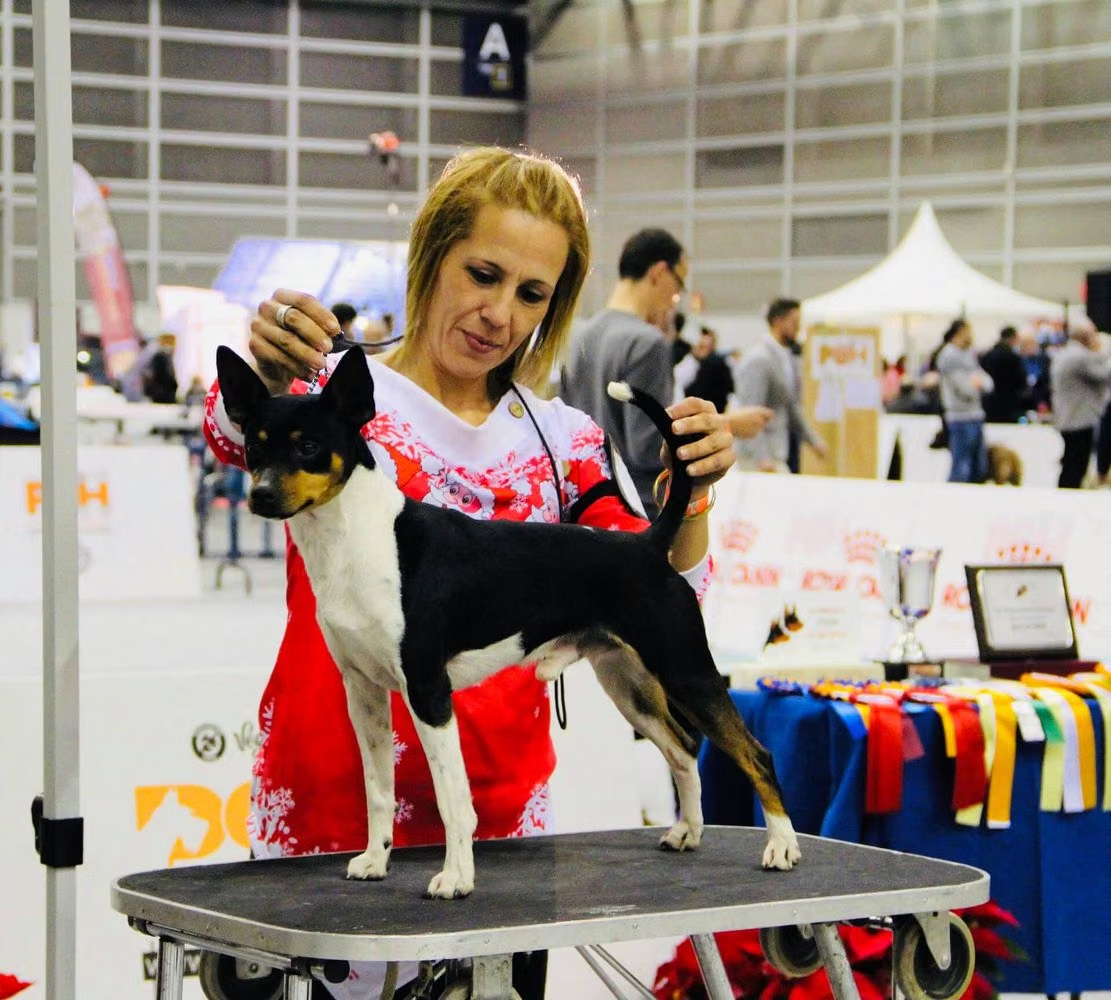
The Rater Valenciá is a lively Spanish ratting terrier known for its alertness, courage, and boundless energy.
How the Rater Valenciá coat is built, and what that means when you groom it.
A few of the Rater Valenciá profiles members have added to United Pet Club.
A small, sharp-eyed Spanish terrier bred to hunt rats in farms and godowns, the Rater Valenciá brings bold energy and quick reflexes into an Indian home too.
The Rater Valenciá is a small terrier that was developed in Spain's Valencia region to hunt rats and other vermin around farms, homes and stables. Compact and quick on its feet, it is built to chase prey into narrow spaces such as grain stores and godowns, work that will feel familiar to anyone who has dealt with a rodent problem in an Indian farmhouse or warehouse. Adults typically weigh well under 9 kg, so this is very much a small-breed dog.
The breed is sharp and alert, watching its surroundings closely and reacting fast to the smallest movement or sound. This made it a useful working dog in Spain, and for the same reasons it makes an attentive companion in a home here, quick to notice a stranger at the gate or a squirrel on the compound wall. Courage is a defining trait. A dog this size will square up to prey many times its own size without a second thought.
Energy levels run high. The Rater Valenciá was bred to work long hours, and that drive has not gone anywhere in pet dogs today. Owners who build in daily activity and some mental work tend to end up with a settled, affectionate dog indoors, an important point to remember in flats and housing societies where space is limited.
| Attribute | Detail |
|---|---|
| Origin | Spain (Valencia region) |
| Size | Small |
| Lifespan | 12 to 15 years |
| Group / role | Terrier, ratting and vermin control |
| Good with | Active families and experienced owners |
This breed suits an active household that can keep up with its exercise and engagement needs, whether that is a house with a garden or a well-run flat with regular outdoor time. It rewards owners who enjoy training and time outdoors, and its watchfulness suits anyone who wants a dog that will bark at an unfamiliar face at the gate. Because of its strong prey drive, homes with small pets such as mice, rabbits or birds need careful management, and early socialisation helps it stay calm around other animals. Note too that the Rater Valenciá is not a Kennel Club of India (KCI) recognised breed, so bringing one home usually means working directly with a breeder or importer rather than going through a standard KCI-registered litter.
The Rater Valenciá took shape in Spain's Valencia region as a working terrier kept to control rats and other vermin on farms and in towns.
The name Rater Valenciá tells you exactly what this dog is and where it comes from. "Rater" points to its job as a ratter, and "Valenciá" ties it to the Valencia region on Spain's Mediterranean coast. For most of its history this was a working dog, not a show dog.
Rat control was a constant headache in both rural and urban Spain, much as it remains in many parts of India today. Grain stores, stables, markets and farmhouses all drew rodents, and small terriers were the practical answer long before chemical pest control existed. The Rater Valenciá was selected for speed, a sharp nose and the nerve to finish off prey in tight corners. Function came first, looks came a distant second.
For generations the breed passed between farmers, traders and townspeople with no formal registration, which is typical of regional working dogs everywhere, not unlike how India's own native breeds were shaped by local reputation rather than paperwork. Local Rater Valenciá lines were judged by results in the field, not by a written pedigree.
In recent decades, interest in preserving Spain's regional dog types has grown, and enthusiasts have worked to document and stabilise the Rater Valenciá. It is best understood today as a regional working terrier with a long practical history and a newer, smaller role as a companion animal, one that remains rare outside Spain, including in India.
The Rater Valenciá is a small, compact terrier with an alert face, a lean athletic build and a short coat that copes well with Indian heat.
The Rater Valenciá is a small, well-proportioned terrier built for agility. The body is compact and a touch longer than it is tall, with clean lines and light bone. The head is wedge-shaped with an attentive expression, and the ears sit high on the skull. The overall look is of a quick, balanced dog that is always ready to move.
| Feature | Typical range or description |
|---|---|
| Height | Roughly 30 to 40 cm at the shoulder |
| Weight | About 4 to 8 kg |
| Coat | Short, smooth, close-lying |
| Colours | Commonly white with black or tan markings, often tricolour |
| Eyes | Dark, oval, alert |
The coat is short and smooth, suited to a working dog that pushes through scrub and narrow gaps. Grooming needs are low, and the short coat is also a practical advantage in India's heat and humidity, since it does not trap warmth the way a heavier coat would. White is the common base colour, usually combined with black and tan patches, and tricolour markings are typical. The short coat shows off the dog's lean shape clearly and dries quickly after a walk in the rain or after work.
The Rater Valenciá is clever, energetic and alert, warm with its own family while staying watchful of strangers and sharp after small prey.
The Rater Valenciá is bright and rarely still. It bonds closely with its household and tends to be affectionate and playful with people it knows well. With strangers it is watchful and will announce arrivals loudly, which comes from its background as an alert farm dog rather than any real aggression.
The breed is courageous well out of proportion to its size and will stand its ground if it senses its territory or family is under threat. Around other dogs it can be sociable given proper introductions, though some individuals are bold and need supervision, especially around street dogs on a walk. Its strong prey drive means small pets such as hamsters, rabbits or birds could be at risk, so contact needs careful management.
This is a high-energy terrier that thinks for itself. Without enough activity and mental work it can turn noisy or pick up habits such as digging up a garden bed or a potted plant on the balcony. Given a proper outlet for its drive, it settles well indoors and makes a responsive, engaged companion.
| Trait | Rating |
|---|---|
| Affection | 4 |
| Energy | 5 |
| Trainability | 4 |
| Vocalness | 4 |
| Shedding | 2 |
The Rater Valenciá needs daily exercise and mental work, though grooming stays simple thanks to its short, easy coat.
The short, smooth coat keeps grooming simple.
This is an active breed that needs a genuine outlet for its energy.
The Rater Valenciá adapts to a flat or an independent house as long as its exercise needs are met. A secure garden suits its love of activity, but fencing has to be genuinely sound, since the breed can dig under it and will chase anything that moves. It copes well with India's heat thanks to the short coat, though the same coat gives little protection during the monsoon or on cold winter nights up north, so a light coat can help on chilly walks and a dry, sheltered spot matters during heavy rain.
The Rater Valenciá does well on a complete diet built for a small, active dog, fed in measured meals to keep it lean.
The Rater Valenciá needs a complete and balanced diet formulated for small, active dogs. Because it is energetic, it burns calories efficiently, but its small frame means portions must be measured out to avoid weight gain. Choose a food with good-quality animal protein and adjust the amount to the dog's age, weight and activity level. Clean, fresh water should always be available, and this matters even more through the hot Indian summer, when a dog can dehydrate quickly.
| Life stage | Amount per day | Meals |
|---|---|---|
| Puppy (2 to 6 months) | Per product guide, divided small | 3 to 4 |
| Junior (6 to 12 months) | Roughly 100 to 150 g dry food | 2 to 3 |
| Adult | Roughly 80 to 130 g dry food | 2 |
| Senior | Adjusted down for lower activity | 2 |
Keep treats to about 10 percent of daily calories so they do not throw the diet off balance. Small, low-fat treats work well for training a food-motivated terrier. Most dogs on a complete diet need no extra supplements. Discuss joint or skin supplements with a vet before adding them, and tailor any changes to the individual dog rather than following a one-size-fits-all routine.
The Rater Valenciá is generally a hardy small terrier with a typical lifespan of 12 to 15 years, though a few conditions common to small breeds are worth watching.
The Rater Valenciá is generally a robust working breed with no exaggerated features, which supports good overall health. The typical lifespan runs to 12 to 15 years. As with many small terriers, a handful of conditions turn up more often than in the general dog population, and routine vet care helps catch problems early, along with sensible precautions for India's climate, such as regular tick and flea checks after the monsoon.
| Condition | Signs | Note |
|---|---|---|
| Patellar luxation | Skipping gait, intermittent hind-leg lameness | Common in small breeds; severity varies |
| Dental disease | Bad breath, tartar, reluctance to chew | Small jaws crowd teeth; regular care helps |
| Luxating or eye conditions | Cloudiness, redness, rubbing at eyes | Have any persistent eye change examined |
| Allergies and skin irritation | Itching, redness, hair loss | Identify triggers with veterinary guidance |
The Rater Valenciá is clever and trainable, and responds well to consistent, reward-based methods that give its busy mind a job.
The Rater Valenciá picks things up fast and likes having a task to do. Its intelligence and food motivation make it responsive in training, though its independent streak and prey drive can pull its attention away. Short, varied sessions hold its focus better than long, repetitive drills. Consistency matters, since a clever terrier will test any rule that is not firmly held. Recall deserves special attention, because the urge to chase, a squirrel or a stray cat, can override a call, so train it early and build up around distractions gradually.
The Rater Valenciá follows the breeding pattern typical of a small dog, with modest litters and pups that mature relatively quickly.
As a small breed, the Rater Valenciá reaches sexual maturity earlier than larger dogs, though responsible breeders wait until a dam is physically and behaviourally mature before her first litter. Mating follows the female's heat cycle, and gestation in dogs runs to about 63 days on average. Litter sizes stay modest, in line with the breed's size.
Newborn puppies are born blind and deaf and depend entirely on the dam through the first weeks. Eyes and ears open in the second to third week, and weaning starts around three to four weeks. The socialisation period that follows matters a great deal for this alert, active breed, so careful early handling and exposure go a long way toward shaping a calm adult temperament. Health screening of breeding stock for conditions common to small terriers, such as patellar problems, supports sound litters, and this matters even more for a rare breed where the gene pool outside Spain is small.
| Metric | Value |
|---|---|
| Sexual maturity | Around 6 to 12 months |
| Gestation | About 63 days |
| Typical litter size | Roughly 3 to 5 puppies |
| Eyes and ears open | About 2 to 3 weeks |
| Weaning | About 4 to 7 weeks |
Municipal licences cover the paperwork; a free United Pet Club record is what actually connects your Rater Valenciá to your phone.
A Rater Valenciá that slips past the gate of the housing society is identified by its record, not by its pedigree. Provide that record without spending a rupee: the free United Pet Club profile carries your telephone number, the dog's photograph, and its details for life. Register your dog and the matter is settled.
A microchip without a registration is merely a number under the skin. File your Rater Valenciá's fifteen digit number with United Pet Club and it becomes a working address: free for life, open to every chip brand, and searchable from any clinic or shelter in the country or abroad. Microchip registration first, the free account alongside.
Create a free United Pet Club account, enter your Rater Valenciá's details along with a photograph, and save the profile. The lifetime plan maintains the record at no cost, and any municipal licence you hold sits alongside it rather than replacing it.
Enter the fifteen digit chip number into your free account together with your current address, phone number, and email. The lifetime plan covers the registration and every subsequent update without charge, whatever the chip's manufacturer.
Several municipal corporations, Delhi and Mumbai among them, require dogs to be licensed under local by-laws. The United Pet Club profile is separate and voluntary, and it is the record a finder anywhere can actually search, free of cost.
Nothing whatsoever. The free lifetime plan includes the profile, the microchip record, and unlimited updates, with no renewal fee at any point.
Common questions about the Rater Valenciá cover its size, temperament, care needs, lifespan, suitability, and how easy it is to find in India.
It is a small dog, typically standing around 30 to 40 cm at the shoulder and weighing about 4 to 8 kg.
It is intelligent, energetic, alert and courageous. It is affectionate with family and watchful of strangers, with a strong prey drive typical of ratting terriers.
Grooming is easy thanks to the short coat, but the breed needs daily exercise and mental work. The real demand is meeting its high activity level, not the coat, and the short coat also suits India's hot, humid weather.
The typical lifespan is 12 to 15 years, in line with many healthy small breeds.
It suits active families and can get along with other dogs when socialised early. Its prey drive means small pets such as rodents and birds need careful management.
It is alert and will announce visitors or unusual activity, useful for a household that wants a dog to flag someone at the gate. Training and enough exercise help keep the barking in check.
It is a regional Spanish breed, far more common around Valencia than anywhere else, and it is not recognised by the Kennel Club of India. Finding one in India would mean importing through a breeder abroad, so it takes real patience and research.