
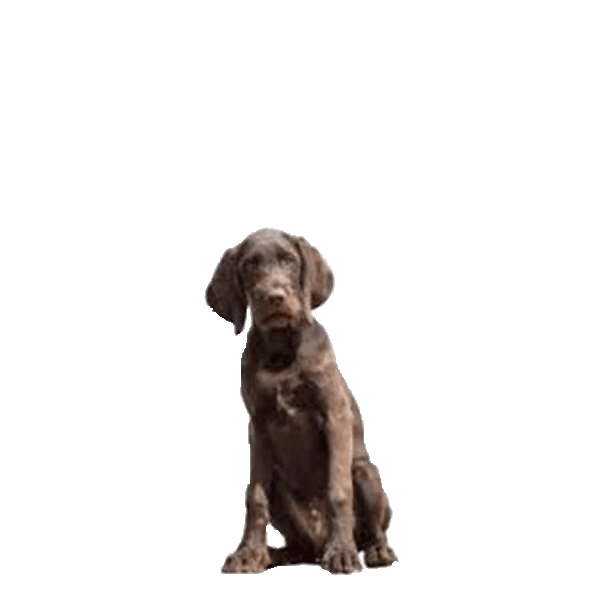
Pudelpointer
The Pudelpointer is a calm, versatile German gundog combining a keen working drive with a steady, trainable temperament.
- Size
- Large
- Lifespan
- 11–14 years
- Origin
- Germany
- Temperament
- Calm
- Standard colors
- Black and Brown
Characteristics
Coat and grooming
How the Pudelpointer coat is built, and what that means when you groom it.
- Coat layers
- Double coat
- Coat texture
- Wire
- Coat length
- Medium
- Shedding
- Low shedding
Grooming guidance
Caution: A Pudelpointer coat should be hand-stripped rather than clipped.
A wire coat is meant to be pulled out at the root once the hair is ready to release. Clippers cut it off part way instead, leaving the soft undercoat behind. The result is a coat that grows back limp and faded, and the weatherproof texture only returns after the hair is stripped out again.
Pudelpointer colors and patterns
What each club's breed standard says about every Pudelpointer color and pattern. Point at a ruling to see the club's own wording.
Breed standards describe the Pudelpointer in Black and Brown. Standard patterns: Solid.
| Color or pattern | FCI | AKC | UKC |
|---|---|---|---|
| Black | Standard (“Black”) | Standard (“Black”) | Standard (“black”) |
| Brown | Standard (“Brown”) | Standard (“Liver”) | Standard (“Solid brown”) |
| Patterns | |||
| Solid | Standard (“Whole coloured”) | Standard (“Whole coloured”) | Standard (“Solid”) |

| Color or pattern | FCI | AKC | UKC |
|---|---|---|---|
| Amber | Standard (“of a dark amber colour”) | Standard (“of a dark amber colour”) | Standard (“dark amber in color”) |
| Color or pattern | FCI | AKC | UKC |
|---|---|---|---|
| Black | Standard (“Strongly pigmented corresponding to the coat colour”) | Standard (“Strongly pigmented corresponding to the coat colour”) | Standard (“Strongly pigmented according to the color of the coat”) |
| Liver | Standard (“Strongly pigmented corresponding to the coat colour”) | Standard (“Strongly pigmented corresponding to the coat colour”) | Standard (“Strongly pigmented according to the color of the coat”) |
What the rulings mean
- Standard
- Described by the club's breed standard.
Color changes
How a Pudelpointer's colors can change over its life.
Blackchanges toRust
Coat · With body condition · can change back
Blackchanges toGrey
Coat · Progressive
Blackchanges toBrown
Coat · In the sun · can change back
Blackchanges toSnow nose
Nose · With the season · can change back
Blackchanges toPink
Nose · With the season · can change back

Sources
Each ruling comes from the club's published breed standard or color list.
About the Pudelpointer
The Pudelpointer is a large German gundog with a calm temperament and a coat built for water work, kept in India mainly as a versatile retrieving and trial companion.
The Pudelpointer is a German gundog bred by crossing the Poodle with the English Pointer, with the goal of getting one dog that could point, retrieve from land and water, work through thick cover, and still settle indoors afterward. The plan worked: the breed carries a weather-hardy coat over a medium-to-large frame, along with a temperament steady enough for a household.
In India the breed remains rare and is known mostly to gundog trial circles and a handful of importers, since the Wildlife Protection Act restricts hunting live game and the dog's original job cannot be practised here in the traditional sense. Owners instead use the Pudelpointer for retrieving trials, tracking, dummy launcher work, and water retrieves, activities that call on the same instincts the breed was built for.
Away from fieldwork, the Pudelpointer settles well at home once its exercise is done for the day. It bonds closely with its family and stays fairly quiet indoors, which makes it manageable for owners with a farmhouse, an independent house with a yard, or a bungalow rather than a compact flat. Breeding has always leaned toward working soundness over ring points, so temperament and drive matter more to most breeders than coat colour or show wins.
| Attribute | Detail |
|---|---|
| Origin | Germany |
| Size | Large |
| Lifespan | 11 to 14 years |
| Group / role | Versatile gundog (pointing and retrieving) |
| Good with | Active households, experienced owners, working or trial homes |
Who should get this breed
The Pudelpointer works for owners who can give it a real daily outlet, not just a walk around the block. It does best with access to open ground, a pond or river for water retrieves, or membership in a gundog trial or tracking club. Anyone who wants a calm indoor dog that still needs a proper job will get along with this breed. It is a poor match for a busy professional in a city flat with no time for training, or for anyone expecting a low-energy lapdog.
History and origin
The Pudelpointer was developed in Germany in the late 1800s by crossing the Poodle with the English Pointer to create one all-purpose gundog.
The Pudelpointer took shape in Germany during the final decades of the nineteenth century. Baron von Zedlitz, who published under the pen name Hegewald, led the breeding programme with the aim of producing a single dog that German hunters could rely on for every stage of a day's work.
The founding cross used the Poodle for its trainable mind, love of water, and dense coat, paired with the English Pointer for nose, pointing instinct, and drive in open country. Records suggest only a small number of Pointers were used against a much larger base of Poodles, after which breeders concentrated on locking in the working qualities both parent breeds offered rather than widening the gene pool further.
Function decided everything from the outset. Dogs earned their place in the breeding programme through field and water trials, not through looks, and that testing culture has carried through to today's breed clubs.
For most of the twentieth century the Pudelpointer stayed a German specialist's dog. It later travelled to North America, where breed clubs still require working tests before a dog is used for breeding. Numbers in India are small; most dogs here arrived through private import by shooting or trial enthusiasts rather than through any organised breeding programme, and the Kennel Club of India does not currently maintain a breed standard of its own for the Pudelpointer.
Appearance and breed standard
The Pudelpointer is a large, athletic gundog with a wiry, weather-resistant coat, usually in brown shades, built for stamina rather than show-ring polish.
The Pudelpointer is built for a full day's work rather than a ribbon at a dog show. The body reads slightly longer than it is tall, with a deep chest, strong legs, and a level topline that holds up over rough ground. A beard and heavy eyebrows frame the face, giving the breed a slightly unkempt, purposeful look rather than a groomed one.
| Trait | Standard |
|---|---|
| Height | Approx. 53 to 68 cm (21 to 27 in) at the shoulder |
| Weight | Approx. 20 to 30 kg (44 to 66 lb) |
| Coat | Harsh, dense, wiry and weather-resistant, medium length |
| Colours | Brown (liver), chestnut and dead-leaf shades; some black |
| Eyes | Amber to brown, set under heavy eyebrows |
Coat, colours, and coping with Indian heat
The coat does real work rather than just looking a certain way. It is harsh and wiry on top with a dense undercoat underneath, which protects the dog in cold water and thick brush back in Europe. In India's climate that same undercoat traps heat during the hot months, so owners need to manage exercise timing and grooming more carefully than a European owner would.
Brown is the most common colour, running from liver and chestnut through to paler dead-leaf shades, and black coats turn up occasionally. A few dogs carry small white patches on the chest or toes. The beard and eyebrows stay a defining feature regardless of coat colour.
Temperament and personality
The Pudelpointer is even-tempered and highly trainable, quiet and affectionate at home, with a strong working drive suited to Indian gundog and retrieving trial circles.
The Pudelpointer carries a level, steady temperament that stands out next to sharper gundog breeds. Indoors it is calm and generally quiet, and it settles once its physical and mental needs are met for the day. With its own family the breed stays affectionate and loyal, often shadowing its favourite person from room to room.
Around strangers the Pudelpointer tends to be reserved rather than suspicious or aggressive. Regular socialisation from puppyhood helps it stay confident around visitors, delivery staff, and the general noise of an Indian household or housing society. Raised alongside children it is usually patient, though any large, energetic dog needs supervision around small kids.
The breed generally gets along with other dogs. Its prey drive runs high, so caution is needed around cats, poultry, or a neighbour's free-ranging birds unless the dog grew up with them, a point worth flagging for owners in farmhouse or semi-rural settings. That same drive turns into focus and stamina during fieldwork, which is why trial handlers rate the Pudelpointer as one of the more cooperative gundogs to train.
| Trait | Rating |
|---|---|
| Affection | 4 |
| Energy | 5 |
| Trainability | 5 |
| Vocalness | 2 |
| Shedding | 2 |
Care and grooming
The Pudelpointer needs serious daily exercise and mental work; the wiry coat itself is low-maintenance, needing only regular brushing and occasional hand-stripping.
Looking after a Pudelpointer is mostly about meeting its exercise needs. The coat, by comparison, is one of the simpler parts of owning this breed.
Grooming
- Brush the coat once or twice a week to clear out loose hair and any debris picked up outdoors.
- Hand-strip or tidy the wiry coat every so often to keep its texture; heavy clipping softens the coat and should be avoided.
- Wipe down the beard after meals and any water work, since a damp beard left unchecked can mat and start to smell, especially in humid weather.
- Check and clean the ears often; drop ears trap moisture easily after a swim, and India's humidity makes ear infections more likely than in a drier climate.
- Trim nails as needed and brush teeth a few times a week.
Exercise
- Give the dog at least one to two hours of proper activity daily, split across the cooler parts of the day.
- Schedule the main sessions for early morning or after sunset in summer, since Indian afternoon heat carries a real risk of heatstroke for a dog carrying this much coat.
- Work in retrieving, swimming, scent games, or structured field training to keep the working brain occupied.
- Use a securely fenced compound or a trial ground for off-leash running wherever one is available.
- Pair physical exercise with short training tasks; a bored Pudelpointer gets destructive fast.
Environment
The Pudelpointer suits a house with a securely fenced garden and, ideally, access to a pond, river, or trial ground nearby. It can live indoors as a calm housemate but is a poor fit for a small city flat unless the owner is genuinely committed to daily outdoor sessions. The coat handles cold and wet conditions well, but it needs help coping with peak Indian summer heat: shade, water, and exercise timed around the cooler hours.
Nutrition and feeding
An active Pudelpointer needs a complete, high-quality diet matched to its working energy output, fed in measured portions to avoid both underfeeding and weight gain.
The Pudelpointer is a working breed with a high energy spend, so the diet needs enough protein and fat to support sustained activity. A complete, balanced food formulated for active large breeds works well. During the trial season or a stretch of heavy training, calorie needs go up and portions may need a top-up. In quieter months, keep an eye on body condition to avoid creeping weight gain. Clean water should be available at all times, particularly around exercise and any water work, and even more so through the hot months when a dog loses far more fluid than owners expect.
| Life stage | Amount per day | Meals |
|---|---|---|
| Puppy (2 to 6 months) | Per product guide for growth | 3 to 4 |
| Junior (6 to 12 months) | Per product guide, large-breed formula | 2 to 3 |
| Adult | Approx. 300 to 450 g of quality dry food | 2 |
| Working adult (active season) | Increased portion to match output | 2 to 3 |
| Senior | Reduced calories, maintain protein | 2 |
Treats and supplements
Keep treats to around ten percent of daily calories and use them mainly as training rewards. A dog on a complete commercial diet usually needs no extra supplements. Talk to a veterinarian before adding joint support, fish oil, or anything else, particularly for a hardworking or older dog. Large, deep-chested breeds run a higher bloat risk, so avoid a heavy meal right before or after strenuous exercise.
Health and common conditions
The Pudelpointer is a generally healthy, hardy breed with a lifespan of 11 to 14 years, though owners should watch for hip dysplasia, ear infections, and bloat.
The Pudelpointer is considered a sound, hardy breed, helped along by a breeding culture that has always prized working fitness over appearance. Typical lifespan runs 11 to 14 years. As with any large, active dog, a few conditions deserve attention, and buying from breeders who health-test their stock lowers the risk considerably.
| Condition | Signs | Note |
|---|---|---|
| Hip dysplasia | Stiffness, limping, reluctance to rise or jump | Screen breeding stock; manage weight and exercise |
| Ear infections | Head shaking, odour, scratching at the ears | More likely after swimming or in humid weather; keep ears dry and clean |
| Bloat (gastric torsion) | Swollen abdomen, retching without bringing anything up, visible distress | Emergency; deep-chested breeds carry higher risk |
| Skin and coat irritation | Itching, redness, hot spots | Often linked to allergies, ticks, or trapped moisture during the monsoon |
| Eye conditions | Cloudiness, redness, changes in vision | Periodic veterinary eye checks are worthwhile |
Preventive care
- Keep vaccinations and parasite control current, including tick and flea prevention, which matters more in India's climate than in cooler countries.
- Maintain a lean body condition to protect the joints.
- Clean and dry the ears after every swim or wet session, especially through the monsoon.
- Book annual veterinary checks, with eye and hip screening for any dog used for breeding.
- Feed measured meals and let the dog rest before and after exercise to cut bloat risk.
Training and intelligence
The Pudelpointer ranks among the most trainable gundogs, pairing intelligence with a strong wish to cooperate, and responds best to consistent, reward-based handling.
The Pudelpointer is intelligent and keen to work with its handler, which makes it one of the more straightforward gundogs to train for anyone willing to put in regular, structured sessions. The breed picks up new commands quickly and holds on to them, and it does best when training links to real work such as retrieving and field exercises. Harsh corrections backfire with this breed; it responds far better to fair, consistent guidance. Early exposure to gunfire or loud noise, water, and different terrain builds a confident working dog, and in the Indian context this can mean introducing the dog early to traffic noise, crowded streets, and monsoon downpours as much as to fieldwork.
Basics
- Start socialisation and gentle handling as a puppy, introducing new people, places, and sounds.
- Teach name recognition and a solid recall before layering on field commands.
- Build core obedience: sit, stay, down, and walking on a loose lead.
- Introduce retrieving with simple fetch games, then move on to marked retrieves.
- Add water work and scent or pointing tasks gradually, keeping sessions short and upbeat.
- Proof commands in distracting settings before relying on them out in the field.
Breeding and raising young
Pudelpointer breeding prioritises proven working ability and health testing, with average-sized litters that benefit from early exposure to water, birds, and varied terrain.
Breeding of the Pudelpointer has always centred on working performance rather than looks. Most clubs that support the breed require a dog to clear a hunting aptitude or field test, alongside health screening, before it can be used for breeding. That selective approach has kept the breed sound and close to its original purpose.
Dogs typically reach sexual maturity somewhere between 12 and 24 months, though responsible breeders wait until a dog is physically mature and has proven both its working ability and its health before breeding from it. Once mating succeeds, gestation runs about 63 days, in line with dogs in general.
Litter sizes sit around average for a large breed. Puppies are weaned over several weeks and start socialisation early. Because the breed is bred to work, breeders often expose young dogs to water, birds, and varied surroundings during the first few months to build confidence and sharpen natural instincts. In India, where the breed has no organised local breeding programme, most puppies come through private importers or overseas breeders, so a buyer should ask directly for health clearances and working proof on both parents rather than assuming any local registry has already checked this.
| Metric | Value |
|---|---|
| Sexual maturity | Approx. 12 to 24 months |
| Recommended breeding age | After physical maturity and health/working clearance |
| Gestation period | Approx. 63 days |
| Average litter size | Typically 6 to 9 puppies |
| Weaning age | Around 6 to 8 weeks |
| Breeding requirements | Health screening and field/aptitude testing (per club) |
Registering a Pudelpointer in India: profile and microchip
Municipal licences cover the paperwork; a free United Pet Club record is what actually connects your Pudelpointer to your phone.
How to register a Pudelpointer in India
Municipal corporations in Delhi, Mumbai, Bengaluru, and numerous other cities require dogs to be registered or licensed under their by-laws, and a United Pet Club profile complements whichever rules apply where you live. The profile holds your contact information against your Pudelpointer for its entire life, at no charge whatsoever. Registering your dog requires only a few minutes.
A microchip without a registration is merely a number under the skin. File your Pudelpointer's fifteen digit number with United Pet Club and it becomes a working address: free for life, open to every chip brand, and searchable from any clinic or shelter in the country or abroad. Microchip registration first, the free account alongside.
How do I register my Pudelpointer in India?
Create a free United Pet Club account, enter your Pudelpointer's details along with a photograph, and save the profile. The lifetime plan maintains the record at no cost, and any municipal licence you hold sits alongside it rather than replacing it.
How do I register my Pudelpointer's microchip?
Enter the fifteen digit chip number into your free account together with your current address, phone number, and email. The lifetime plan covers the registration and every subsequent update without charge, whatever the chip's manufacturer.
Is registration compulsory for a Pudelpointer in India?
Several municipal corporations, Delhi and Mumbai among them, require dogs to be licensed under local by-laws. The United Pet Club profile is separate and voluntary, and it is the record a finder anywhere can actually search, free of cost.
What does it cost to register a Pudelpointer?
Nothing whatsoever. The free lifetime plan includes the profile, the microchip record, and unlimited updates, with no renewal fee at any point.
Frequently asked questions
Common questions about the Pudelpointer's size, temperament, care needs, lifespan, suitability as a family dog, and availability in India.
How big does a Pudelpointer get?
The Pudelpointer is a large dog, standing roughly 53 to 68 cm (21 to 27 in) at the shoulder and weighing about 20 to 30 kg (44 to 66 lb), with males usually running larger than females.
What is the Pudelpointer's temperament like?
The breed is calm, even-tempered, and highly trainable. It stays quiet and affectionate at home, reserved with strangers, and focused and hardworking out in the field.
Is the Pudelpointer difficult to maintain?
Grooming is simple thanks to the low-shedding wiry coat, which needs only weekly brushing and occasional hand-stripping. The real commitment is exercise: the breed needs one to two hours of proper activity and mental work every single day, ideally scheduled around India's hot afternoons rather than through them.
How long does a Pudelpointer live?
Typical lifespan is 11 to 14 years. Good nutrition, regular veterinary care, and weight management help a dog reach the upper end of that range.
Is the Pudelpointer good with kids and a family setup?
Yes, for an active family. It is patient and affectionate with its people and usually good with children when raised together. Its strong prey drive means care is needed around cats or free-ranging birds, and the owner needs to be able to meet its exercise needs.
Where can I get a Pudelpointer in India?
Not easily. The breed is rare here and bred mainly within hunting and trial circles abroad, since there is no organised local breeding programme. Most Indian owners go through a private importer or wait for a litter from a health-tested, field-tested breeder overseas.
Does the Pudelpointer need a hunting home, given hunting is restricted in India?
Not strictly, but it needs an equivalent outlet. Since the Wildlife Protection Act rules out hunting live game in India, owners should provide retrieving trials, scent work, dummy launcher training, or water work to satisfy the breed's working drive.
From the community
Ask about the PudelpointerNo questions about the Pudelpointer yet. Be the first to ask.
Browse Dog breeds