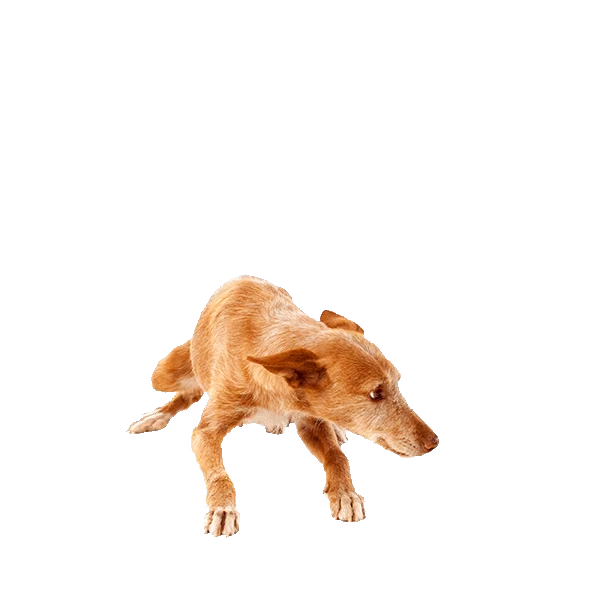
The Portuguese Podengo is a lively, alert hunting hound from Portugal, intelligent and agile with a playful, devoted nature.
How the Portuguese Podengo coat is built, and what that means when you groom it.
A few of the Portuguese Podengo profiles members have added to United Pet Club.
A medium-built Portuguese hunting hound, agile and alert, that trails rabbits by sight, scent and sound and adapts readily to India's climate and active households.
The Portuguese Podengo is a hunting hound that has worked the rabbit warrens and scrubland of Portugal for centuries. It comes in three sizes, small, medium and large, and two coat types, smooth and wire. This page covers the medium Podengo, an athletic, all-purpose hunter that works by sight, scent and hearing together rather than leaning on just one sense.
The breed is sharp-witted and physically quick, with the drive one expects of a working hound rather than a house pet bred purely for looks. At home it is described as loyal, playful and constantly alert, picking up on the smallest change in its surroundings well before its owner does. The erect ears and lean, wiry frame give it a permanently ready look, as though it is midway between resting and setting off.
The medium Podengo is recognised by the Federation Cynologique Internationale but is not yet registered with the Kennel Club of India, and it remains a rare sight in Indian homes outside a handful of importers and hunting-hound enthusiasts. It suits an active household prepared to put in daily exercise and some mental work, and its short smooth coat in particular copes with Indian heat far better than many European breeds. The strong chase instinct inherited from its rabbiting past means a secure boundary wall and solid recall training matter more than they would for a placid companion breed. With its own people it stays affectionate and involved, and it generally settles into family life once its energy has a proper outlet.
| Attribute | Detail |
|---|---|
| Origin | Portugal |
| Size | Medium |
| Lifespan | 12 to 15 years |
| Group/role | Hound; rabbit and small-game hunter |
| Good with | Active families; older children; other dogs, with proper socialisation |
The medium Podengo suits people who run, hike or take part in dog sports and want a companion that can keep pace, rather than a breed content to nap through the day. It does not do well in a sedentary flat or a home that cannot manage a strong prey drive around cats, hens or other small pets, both common around Indian homes and streets. Early socialisation and a settled daily routine help this hound fit into family life without becoming a serial escape artist.
An old Iberian hunting hound native to Portugal, the Podengo was shaped over centuries by farm life and rabbit hunting rather than by any breed ring.
The Podengo ranks among Portugal's oldest native dog types, part of the wider family of primitive hunting hounds found across the Mediterranean and the Iberian Peninsula, dogs prized for hardiness and independence rather than for a fixed look. For most of its history it was a working farm dog first and a show animal a distant second, if at all.
Portuguese breeders developed the three sizes for different jobs on the same land. The small Podengo (Podengo Pequeno) went to ground after rabbits in burrows and dense scrub, often hunting close to the earth in small packs. The medium Podengo (Podengo Medio), the size covered on this page, became the all-rounder, tracking, flushing and retrieving rabbits across open and broken country. The large Podengo (Podengo Grande) took on bigger game such as deer and wild boar.
Usefulness, not appearance, earned the breed its keep on small Portuguese farms, where a dog had to justify its food by hunting, guarding the house and living peaceably alongside the family, all at once. That practical brief produced a sound, adaptable dog rather than one bred to a fixed silhouette.
The Podengo now holds status as a national breed of Portugal and has picked up recognition from kennel bodies elsewhere in Europe and beyond, though it has made little headway into India, where it is neither KCI-registered nor commonly seen even among hound enthusiasts. Globally, plenty of Podengos still earn their keep as working hunters alongside their role as companions.
A lean, wedge-headed hunting hound with tall prick ears and a smooth or wire coat, built for stamina on rough ground rather than for the show ring.
The medium Podengo is moderately built, longer than it is tall, with clean lines and nothing overdone anywhere on the frame. The head is wedge-shaped, the skull flat and the muzzle pointed. The ears stand fully erect, large and constantly mobile, swivelling towards the faintest sound. The eyes are oval and set at a slant, which gives the face its alert, faintly mischievous expression. Taken together, the dog reads as fit, balanced and built to work rather than to pose.
| Trait | Detail |
|---|---|
| Height | About 40 to 54 cm (16 to 21 in) at the shoulder |
| Weight | About 16 to 20 kg (35 to 44 lb) |
| Coat | Two types: smooth (short, dense) or wire (rough, longer, often bearded) |
| Colours | Yellow and fawn from pale to dark, and black, usually marked with white |
| Eyes | Oval, obliquely set, honey to brown depending on coat colour |
The smooth coat is short, dense and lies flat against the body, which is a real advantage through an Indian summer and makes the dog easy to clean up after a muddy monsoon walk. The wire coat is harsher and somewhat longer, often growing into a beard on the muzzle for a rougher, more weathered outline, and it benefits from a closer eye during humid months to prevent matting. Neither coat needs trimming for the ring. The usual colours are yellow and fawn across a range of shades, plus black, frequently broken up by white on the chest, feet or face, patchy colouring that owes more to working usefulness than to any breeder's eye for uniformity.
Loyal, sharp and full of energy, the Podengo is devoted at home, watchful with strangers, and driven by a hunting instinct that needs managing around small animals.
The Podengo stays alert and playful well past puppyhood, a trait many owners find endearing and a few find exhausting. With its own family it is affectionate and closely bonded, often trailing its people from room to room rather than settling in one spot for long. It is a quick, observant dog, reading a situation and reacting to it faster than most owners expect.
Around strangers the Podengo tends to hold back rather than greet everyone at the gate, which makes it a useful watchdog for a home or farm. It generally warms up once it has decided a visitor is welcome, and consistent, early socialisation keeps that natural wariness from tipping into excessive suspicion.
With children the breed is usually good when it has grown up around them, though its energy level suits older kids who can join in a game of fetch rather than toddlers wanting a lap dog. It tends to get on well with other dogs, a trait inherited from generations of hunting in packs, but the strong prey drive calls for real caution around cats, rabbits and the free-roaming animals common on Indian streets, since a Podengo will happily give chase to anything it reads as quarry. Calm, supervised introductions are worth the effort in a multi-pet or multi-animal household.
| Trait | Rating |
|---|---|
| Affection | 4 |
| Energy | 5 |
| Trainability | 3 |
| Vocalness | 3 |
| Shedding | 2 |
Grooming is simple for both coat types, but exercise is the real demand, and Indian heat calls for careful timing of walks and runs.
Day-to-day upkeep of a Podengo is uncomplicated, but its energy level means exercise sits at the centre of good care. A Podengo left under-exercised and bored tends to dig, escape or otherwise invent its own entertainment, usually at the owner's expense.
The Podengo adapts to either an independent house or a flat provided its exercise needs are met, though a securely walled compound is a genuine advantage over a balcony and a lift ride. Boundaries need to be tall and resistant to digging, since this is an athletic dog that can clear a low wall or tunnel under a flimsy fence without much trouble. It prefers to stay near its family and does best folded into the household routine rather than left alone in a yard for long stretches.
An active medium Podengo needs a complete, good-quality diet portioned to its weight and workload, served in measured meals rather than left out all day.
The Podengo is a lean, active hound and does best on a complete and balanced diet suited to its life stage and energy output. Keep the dog trim; the ribs should be easy to feel under a light covering of flesh, not hidden under a layer of fat. Since the breed stays busy, a working or sporting Podengo may need more than the amounts below, while a quieter household dog may need less. Adjust the quantity to keep the dog in good condition rather than sticking rigidly to a printed number.
| Life stage | Amount per day | Meals |
|---|---|---|
| Puppy (2 to 6 months) | Per product guide, divided | 3 to 4 |
| Puppy (6 to 12 months) | Per product guide, divided | 2 to 3 |
| Adult | About 1.5 to 2.5 cups, by weight and activity | 2 |
| Senior | Adjusted for lower activity | 2 |
Keep treats in moderation and count them towards the day's total, since a Podengo can put on weight quickly once exercise drops off. Small pieces of plain cooked chicken or mutton, or a commercial training treat, work well. A dog on a complete diet generally needs no supplements; discuss anything extra, such as joint support for an older or particularly active dog, with a veterinarian first. Keep fresh water available at all times, topped up more often through the hotter months.
A generally hardy, long-lived breed with a typical lifespan of 12 to 15 years and comparatively few inherited health problems.
The Podengo counts as a robust, healthy breed, the result of a long working history and a broad gene pool rather than any breeding for extreme looks. The typical lifespan runs 12 to 15 years. As with any dog, sound breeding, good nutrition, regular exercise and routine veterinary care give the best odds of a long, healthy life. The conditions below are not unique to the Podengo but are worth keeping an eye on.
| Condition | Signs | Note |
|---|---|---|
| Hip dysplasia | Stiffness, reluctance to jump, altered gait | Less common than in larger breeds; screening breeding stock helps |
| Patellar luxation | Occasional skipping or a hop on a hind leg | Seen in some smaller hounds; severity varies |
| Eye conditions | Cloudiness, changes in vision | Routine eye checks catch problems early |
| Ear infections | Head shaking, odour, scratching | Erect ears stay well ventilated but still need regular checks, especially in humid weather |
| Dental disease | Bad breath, tartar, red gums | Common across breeds; managed with home care and professional cleaning |
Sharp and capable but independent-minded, the Podengo trains best with consistent, reward-based methods and a recall built up carefully from puppyhood.
The Podengo learns fast and thinks for itself, a combination inherited from its hunting background. It will work willingly for a handler it respects and for rewards worth having, but it can just as easily decide that a scent on the breeze matters more than a command. Training should stay consistent, positive and engaging, run in short, varied sessions that hold the dog's interest rather than long drills. Harsh handling tends to make this breed evasive rather than obedient.
Recall deserves particular attention. Given the strong chase instinct, a Podengo off the lead may bolt after a stray cat, a squirrel or one of the free-roaming dogs common on Indian streets, so recall needs to be built up gradually in a secure space and reinforced often. Early, ongoing socialisation with people, dogs and everyday situations, including the noise and crowding of an Indian street, lays the groundwork for a confident, manageable adult.
Breeding follows the usual pattern for a medium dog: health-screened parents, a roughly two-month pregnancy, and a moderate-sized litter.
Responsible Podengo breeding starts with healthy, sound-tempered parents that match the breed standard and have been screened for relevant conditions. Females generally reach sexual maturity within their first year, but breeding is best held off until the dog is physically and mentally mature, usually around two years old. Mating is timed to the female's heat cycle, which comes around roughly twice a year.
Pregnancy in dogs runs about 63 days. A pregnant female needs a quiet, clean whelping area, good nutrition and veterinary monitoring right through the term, with particular attention to keeping her cool and comfortable if the due date falls during the hotter months. Medium-sized hounds typically produce a moderate-sized litter. Newborn puppies are blind and deaf at birth and depend entirely on the mother for warmth and feeding.
Raising the litter means keeping the whelping area clean and warm, tracking weight gain, and starting weaning at around three to four weeks. Gentle early handling and exposure to household sights and sounds, including everyday Indian household noise and activity, help the puppies grow into confident dogs. Puppies are usually ready to go to new homes from around eight weeks, after their first vaccination and a veterinary check-up.
| Metric | Value |
|---|---|
| Sexual maturity | Around 6 to 12 months |
| Recommended breeding age | About 2 years |
| Heat cycle | Roughly twice a year |
| Gestation | About 63 days |
| Typical litter size | About 4 to 7 puppies |
| Weaning | Around 3 to 4 weeks |
| Ready for new homes | From about 8 weeks |
Municipal licences cover the paperwork; a free United Pet Club record is what actually connects your Portuguese Podengo to your phone.
A Portuguese Podengo that slips past the gate of the housing society is identified by its record, not by its pedigree. Provide that record without spending a rupee: the free United Pet Club profile carries your telephone number, the dog's photograph, and its details for life. Register your dog and the matter is settled.
A microchip without a registration is merely a number under the skin. File your Portuguese Podengo's fifteen digit number with United Pet Club and it becomes a working address: free for life, open to every chip brand, and searchable from any clinic or shelter in the country or abroad. Microchip registration first, the free account alongside.
Create a free United Pet Club account, enter your Portuguese Podengo's details along with a photograph, and save the profile. The lifetime plan maintains the record at no cost, and any municipal licence you hold sits alongside it rather than replacing it.
Enter the fifteen digit chip number into your free account together with your current address, phone number, and email. The lifetime plan covers the registration and every subsequent update without charge, whatever the chip's manufacturer.
Several municipal corporations, Delhi and Mumbai among them, require dogs to be licensed under local by-laws. The United Pet Club profile is separate and voluntary, and it is the record a finder anywhere can actually search, free of cost.
Nothing whatsoever. The free lifetime plan includes the profile, the microchip record, and unlimited updates, with no renewal fee at any point.
Common questions about the Portuguese Podengo cover its size, temperament, care needs, lifespan, suitability as a family dog, and availability in India.
The breed comes in three sizes. The medium variety, covered on this page, stands about 40 to 54 cm (16 to 21 in) at the shoulder and weighs roughly 16 to 20 kg (35 to 44 lb). The small and large varieties fall below and above this range.
It is loyal, sharp-witted, energetic and alert. The breed is affectionate and playful with its own family, reserved with strangers, and generally sociable with other dogs, though its hunting instinct gives it a strong urge to chase small animals.
Grooming is simple for both the smooth and wire coats, and the breed sheds only moderately. The smooth coat in particular copes well with Indian heat. The real demand is exercise: at least an hour of activity a day plus some mental work, which suits an active owner far better than a quiet, sedentary household.
The typical lifespan is 12 to 15 years. The breed is generally hardy, and good diet, regular exercise and routine veterinary care support a long life.
Yes, for an active family. It bonds closely with its people and suits older children who can match its energy. Households with cats, hens or other small pets, or with free-roaming animals nearby, need to manage its prey drive carefully.
They are intelligent but independent-minded. They respond well to consistent, reward-based training and short, engaging sessions. Recall needs particular attention because of the strong chase instinct.
It remains a rare breed in India, without KCI registration, and most Podengos still work as hunting dogs back in Portugal. A prospective Indian owner would likely need to go through an overseas breeder or a specialist import, so it is worth budgeting time for that process rather than expecting to find one locally.



