
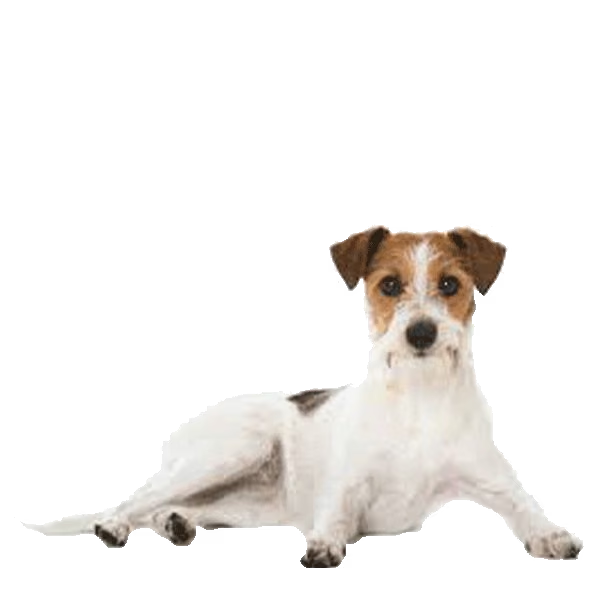
Kromfohrlander
The Kromfohrlander is a friendly, affectionate German companion breed that thrives as a devoted and good-natured family dog.
- Size
- Small
- Lifespan
- 13–15 years
- Origin
- Germany
- Temperament
- Friendly
- Standard colors
- White, Brown and Tan
Characteristics
Coat and grooming
How the Kromfohrlander coat is built, and what that means when you groom it.
- Coat layers
- Double coat
- Coat texture
- Wire
- Coat length
- Medium
- Shedding
- Low shedding
Grooming guidance
Caution: A Kromfohrlander coat should be hand-stripped rather than clipped.
A wire coat is meant to be pulled out at the root once the hair is ready to release. Clippers cut it off part way instead, leaving the soft undercoat behind. The result is a coat that grows back limp and faded, and the weatherproof texture only returns after the hair is stripped out again.
Kromfohrlander colors and patterns
What each club's breed standard says about every Kromfohrlander color and pattern. Point at a ruling to see the club's own wording.
Breed standards describe the Kromfohrlander in White, Brown and Tan. Standard patterns: Bicolour and Sable.
| Color or pattern | FCI | UKC | KUSA | AKC |
|---|---|---|---|---|
| White | Standard (“Basic colour white”) | Standard (“the basic color is white”) | Standard (“Basic colour white”) | Standard (“White & Brown”) |
| Brown | Standard (“light brown, tan to very dark brown markings”) | Standard (“tan or light to dark brown”) | Standard (“light brown, tan to very dark brown markings”) | Standard (“White & Brown”) |
| Tan | Standard (“light brown, tan to very dark brown markings”) | Standard (“tan or light to dark brown”) | Standard (“light brown, tan to very dark brown markings”) | Standard (“White & Tan”) |
| Black | Fault (“Black shaded patches without brown undercoat”) | Fault (“Black shaded patches without brown undercoat”) | Fault (“Black shaded patches without brown undercoat”) | No ruling |
| Patterns | ||||
| Bicolour | Standard (“Basic colour white with light brown, tan to very dark brown markings in shape of variously large patches or saddle”) | Standard (“the basic color is white, with patches or saddle of tan or light to dark brown”) | Standard (“Basic colour white with light brown, tan to very dark brown markings in shape of variously large patches or saddle”) | Standard (“White & Brown”) |
| Sable | Standard (“With a brown undercoat the tips of hairs may be black”) | Standard (“If the undercoat is brown, the tips of the hair may be black”) | Standard (“With a brown undercoat the tips of hairs may be black”) | No ruling |
| Solid | Fault (“Absence of markings on body”) | No ruling | Fault (“Absence of markings on body”) | No ruling |


| Color or pattern | FCI | UKC | KUSA |
|---|---|---|---|
| Brown | Standard (“medium brown permitted”) | No ruling | Standard (“medium brown permitted”) |
| Dark brown | Standard (“Dark brown, medium brown permitted”) | Standard (“Dark brown is preferred”) | Standard (“Dark brown, medium brown permitted”) |
| Light brown | Fault (“Light eyes”) | No ruling | Fault (“Light eyes”) |
| Blue | Disqualifying (“Blue eyes”) | Disqualifying (“Blue eyes”) | Disqualifying (“Blue eyes”) |
| Color or pattern | FCI | UKC | KUSA |
|---|---|---|---|
| Black | Standard (“preferably black, brown permitted”) | Standard (“preferably black, but brown is permitted”) | Standard (“preferably black, brown permitted”) |
| Liver | Standard (“preferably black, brown permitted”) | Standard (“preferably black, but brown is permitted”) | Standard (“preferably black, brown permitted”) |
What the rulings mean
- Standard
- Described by the club's breed standard.
- Fault
- Named by the club's breed standard as a fault: the animal can be shown but is penalised.
- Disqualifying
- The club's breed standard disqualifies an animal of this colour or pattern.
Color changes
How a Kromfohrlander's colors can change over its life.
Blackchanges toRust
Coat · With body condition · can change back
Blackchanges toGrey
Coat · Progressive
Blackchanges toBrown
Coat · In the sun · can change back
Whitechanges toRoan
Coat · With age · from 2 weeks
Blackchanges toSnow nose
Nose · With the season · can change back
Blackchanges toPink
Nose · With the season · can change back


Sources
Each ruling comes from the club's published breed standard or color list.
About the Kromfohrlander
The Kromfohrlander is a small, affectionate German companion breed that settles well into Indian homes, given steady company and shelter from the heat.
The Kromfohrlander is a small companion dog that started out in Germany, in the years right after World War II. It has never been bred as a hunting or working dog. It has stayed close to what it was created for: a devoted, indoor family dog. Its light build and small size make it a sensible choice for a flat or a compact house, which suits many Indian homes.
What sets the breed apart is temperament rather than looks. Owners across the world describe the Kromfohrlander as friendly, affectionate, playful, loyal, and easygoing. It bonds strongly with its family and likes to potter about the house with them, room to room. This is not a dog to chain up in a yard or leave with the chowkidar all day; long stretches alone do not suit it at all.
The breed is still rare outside continental Europe, and that includes India, where litters are almost never available locally. Anyone drawn to this breed usually wants a companion first, a dog with a moderate need for exercise, and a temperament built for life indoors with people.
| Attribute | Detail |
|---|---|
| Origin | Germany |
| Size | Small |
| Lifespan | 13 to 15 years |
| Group / role | Companion dog |
| Good with | Families, attentive owners, joint households where someone is usually home |
Who it suits
The Kromfohrlander suits households that want a small, people-oriented dog and can keep it company for most of the day, the way many joint families in India naturally do. It works well with children who have been taught to handle a dog gently, and with owners who want a companion that stays underfoot rather than off exploring on its own. It is not the right fit for people who work long hours away from home, or who want a low-maintenance pet that is happy on its own.
History and origin
The Kromfohrlander is a post-war German breed named after the Krumme Furche area near Siegen, and it has no working or show background in India.
The story of the Kromfohrlander goes back to Germany in the years right after World War II. Ilse Schleifenbaum, who lived near Siegen, is credited with founding the breed from a stray dog of mixed background that had stayed with American or French soldiers stationed there during the war.
That original dog was mated to a local female, and the litter that followed had a consistent look and temperament. Schleifenbaum kept selecting for these same traits over several generations until the type held steady.
The name comes straight from the local landscape. "Kromfohr" derives from the regional word for the crooked furrow, or bent terrain, found near Siegen, and "lander" simply means the dog from that area, not unlike how several Indian breeds carry the name of their home region, such as the Rajapalayam or the Chippiparai. The Federation Cynologique Internationale recognized the Kromfohrlander in the mid twentieth century, placing it among the companion breeds. The Kennel Club of India does not run a separate breed standard for it, and where it is registered here at all, it tends to be under FCI import papers rather than as a locally established breed.
Through its history the Kromfohrlander has stayed a household companion. It was never developed for hunting, herding, or guarding, and its numbers have remained modest, with most breeding still concentrated in Germany and its neighbouring countries.
Appearance and breed standard
The Kromfohrlander is small and lightly built, with two coat types, wire-haired and smooth-haired, usually white with brown or tan patches.
The Kromfohrlander is small and lightly built, with proportions that stay balanced rather than exaggerated. The body is a touch longer than it is tall, the chest is moderate, and the whole dog reads as agile rather than heavy or powerful. The head is wedge-shaped with a clear stop, the ears sit high and fold forward against the skull, and the tail carries in a gentle curve.
The breed comes in two coat types. The wire-haired variety has a rough outer coat, a beard, and bushier furnishings on the face, while the smooth-haired variety has a shorter, closer coat with a less obvious beard. Both share the same build and size, so the coat is really the only thing that tells them apart at a glance.
| Trait | Standard |
|---|---|
| Height | Approx. 38 to 46 cm (15 to 18 in) at the withers |
| Weight | Approx. 9 to 16 kg (20 to 35 lb) |
| Coat | Two varieties: wire-haired (rough, bearded) and smooth-haired (shorter, close) |
| Colours | White base with brown or tan patches; saddle or patched markings |
| Eyes | Dark, medium-sized, oval, set to give an alert and friendly expression |
Coat and colours
The usual pattern is a white base marked with patches that range from pale tan to deep brown. Markings often show up on the head and across the back as a saddle, though how much varies from dog to dog. The coat sheds off rain and cold reasonably well for a European breed, but it was never built for India's kind of heat and humidity, so owners here need to watch it more closely through summer and the monsoon. The wire-haired coat carries longer furnishings on the muzzle and legs, while the smooth-haired coat lies flatter and shows the body outline more clearly.
Temperament and personality
The Kromfohrlander is friendly, affectionate, and devoted, warm with its own family though often standoffish with strangers at first.
The Kromfohrlander is a friendly, affectionate dog that forms a strong bond with its household. At home it is good-natured and playful, and it would rather join in on whatever the family is doing than watch from the sofa. The breed reads its people closely and picks up on mood and routine faster than most.
With family it is gentle and devoted, and it generally gets on well with children who are taught to handle it with care. With strangers, including the delivery person or new domestic help, it tends to hang back at first and may bark to announce them before it warms up. This is watchfulness, not aggression, and it is not a guard dog by temperament.
Around other pets the Kromfohrlander is usually sociable, particularly if raised with them or introduced slowly. Because it attaches so closely to people, long hours alone can unsettle it, something worth planning around in households where everyone works full days. Early socialisation helps it stay confident around new people, places, and animals.
| Trait | Rating |
|---|---|
| Affection | 5 |
| Energy | 3 |
| Trainability | 4 |
| Vocalness | 3 |
| Shedding | 2 |
Care and grooming
The Kromfohrlander needs moderate grooming depending on coat type, daily exercise, and an indoor home with steady company through India's hot months.
Day to day upkeep for the Kromfohrlander is moderate. The breed does not shed heavily, but its coat and its need for company both call for regular attention, and Indian summers add one more thing to plan for.
Grooming
- Brush the coat once or twice a week to clear loose hair and stop tangles forming, more often for the wire-haired variety.
- Get the wire-haired coat hand-stripped or trimmed every so often to keep its texture, rather than clipping it short.
- Check and clean the drop ears regularly, since India's humidity makes ear infections more likely than in a drier climate.
- Trim nails every few weeks and brush teeth several times a week.
- Bathe only when needed, since frequent baths strip the coat of its natural oils, though a rinse after a walk in the rains helps keep the coat clean.
Exercise
- Give one or two walks a day, ideally in the cooler hours of early morning or evening, plus some free playtime.
- Add mental work such as scent games, short training drills, or puzzle toys, which suit the breed's quick mind.
- Skip long, high-intensity runs in the heat; the breed does better with varied, moderate activity alongside its people.
Environment
The Kromfohrlander is an indoor dog and should live inside with the family, not tied up outside or left with household staff for the day. It adapts to flats or independent houses as long as it gets its daily walks and is not left alone for long stretches. A secure balcony or small garden is a nice extra but does not stand in for human company, and access to a cool, shaded spot or a fan matters during the hotter months and the humid monsoon season.
Nutrition and feeding
The Kromfohrlander does well on a complete, balanced diet portioned for its small size, split into two meals a day, with weight watched closely.
The Kromfohrlander needs a complete and balanced diet suited to a small dog. Pick a food matched to its life stage, with good quality protein and controlled fat content. Since the breed is small and only moderately active, portions should be measured out rather than guessed, to stop steady weight gain creeping in. Fresh water should be available at all times, and dogs need more of it during hot, humid weather.
| Life stage | Amount per day | Meals |
|---|---|---|
| Puppy (2 to 6 months) | As per the food label, split across the day | 3 to 4 |
| Junior (6 to 12 months) | Approx. 100 to 160 g dry food | 2 to 3 |
| Adult | Approx. 90 to 150 g dry food | 2 |
| Senior | Slightly reduced, lower-calorie formula | 2 |
Treats and supplements
Keep treats to around 10 percent of the day's calories, and use small pieces for training so the diet stays balanced. A dog on a complete commercial food usually needs no extra supplements; give vitamins or joint products only when a vet advises it. Adjust the total amount if the dog starts gaining or losing weight, and remember that a less active dog indoors during peak summer heat may need slightly less food than usual.
Health and lifespan
The Kromfohrlander is generally a healthy breed with a lifespan of 13 to 15 years, though a handful of inherited conditions turn up in the breed.
The Kromfohrlander is, on the whole, a healthy breed, with a lifespan of 13 to 15 years. Because the breed comes from such a small founding population, responsible breeders keep a close eye on genetic diversity and screening. A few inherited conditions are known within the breed, and anyone buying a puppy, in India or anywhere else, should ask to see health test results for the parents.
| Condition | Signs | Note |
|---|---|---|
| Patellar luxation | Skipping gait, occasional hind-leg lameness | Affects the kneecap; ranges from mild to needing surgery |
| Hyperkeratosis (foot pad and nose) | Thickened, cracked pads or nose | A breed-linked skin condition managed with care and moisturisers |
| Epilepsy | Seizures of varying frequency | Manageable in many dogs with veterinary treatment |
| Eye conditions | Cloudiness, vision changes | Screening helps identify affected lines |
Preventive care
- Keep vaccinations and parasite control up to date, including protection against ticks and mosquito-borne conditions common in India.
- Book annual checkups, with more frequent visits for senior dogs.
- Keep the dog at a healthy weight to protect its joints.
- Look after teeth, ears, and foot pads on a regular schedule.
- Buy only from breeders who screen for the conditions above and are willing to share the results.
Training
The Kromfohrlander is intelligent and keen to please, which makes it respond well to calm, reward-based training.
The Kromfohrlander is intelligent and attentive, and it generally wants to please the people it lives with. These traits make it a fast learner when the handling stays consistent. The breed is sensitive, so harsh corrections tend to backfire and can leave a dog anxious or withdrawn. Short, upbeat sessions hold its attention and build its confidence. Early socialisation matters because the breed can be reserved with strangers, and it benefits from calm, steady exposure to new people, dogs, and places while it is still young.
Basics
- Start socialisation and gentle handling from puppyhood.
- Teach name recognition and a reliable recall before anything else.
- Add core cues such as sit, down, and stay in short sessions.
- Practise calm greetings to manage its reserve towards visitors and guests.
- Build up to walking politely on a lead and settling alone for short stretches.
Breeding
Kromfohrlander breeding is managed with care because the breed comes from a small founding population, so litters stay modest in number.
Breeding the Kromfohrlander takes care because the breed descends from a small number of founding dogs. Keeping genetic diversity intact is a major concern, and breed clubs track pedigrees and health results to avoid close matings. Dogs used for breeding should be health screened, sound in temperament, and physically mature first.
Females are usually bred once they are mature, not at their first season. After a successful mating, gestation in dogs runs to about 63 days. Litters in this breed tend to be on the smaller side. Puppies are born helpless and rely fully on the mother through the first weeks, with their eyes opening at around two weeks and weaning starting at roughly four to six weeks.
Raising the litter well means keeping puppies with the mother and littermates through the early socialisation window, then bringing in gentle handling and new experiences before they leave for their new homes. Responsible breeders place puppies no earlier than about eight weeks, and match each one to a suitable household, something worth asking about directly if importing a puppy into India, given how few local litters exist.
| Metric | Value |
|---|---|
| Sexual maturity | Around 12 to 18 months |
| Gestation | About 63 days |
| Average litter size | Small (often around 3 to 5 puppies) |
| Weaning age | About 4 to 6 weeks |
| Recommended placement age | From about 8 weeks |
Registering a Kromfohrlander in India: profile and microchip
Municipal licences cover the paperwork; a free United Pet Club record is what actually connects your Kromfohrlander to your phone.
How to register a Kromfohrlander in India
A Kromfohrlander that slips past the gate of the housing society is identified by its record, not by its pedigree. Provide that record without spending a rupee: the free United Pet Club profile carries your telephone number, the dog's photograph, and its details for life. Register your dog and the matter is settled.
Should your Kromfohrlander already carry a microchip, the number must still be recorded separately, since the vet performs only the implant. Registering the microchip under the free lifetime plan accepts chips from any manufacturer an Indian vet works with, keeps every update free should your household shift cities, and leaves the record searchable at any hour. Create your free account and complete both tasks in one sitting.
How do I register my Kromfohrlander in India?
Create a free United Pet Club account, enter your Kromfohrlander's details along with a photograph, and save the profile. The lifetime plan maintains the record at no cost, and any municipal licence you hold sits alongside it rather than replacing it.
How do I register my Kromfohrlander's microchip?
Enter the fifteen digit chip number into your free account together with your current address, phone number, and email. The lifetime plan covers the registration and every subsequent update without charge, whatever the chip's manufacturer.
Is registration compulsory for a Kromfohrlander in India?
Several municipal corporations, Delhi and Mumbai among them, require dogs to be licensed under local by-laws. The United Pet Club profile is separate and voluntary, and it is the record a finder anywhere can actually search, free of cost.
What does it cost to register a Kromfohrlander?
Nothing whatsoever. The free lifetime plan includes the profile, the microchip record, and unlimited updates, with no renewal fee at any point.
Frequently asked questions
Common questions about the Kromfohrlander cover its size, temperament, care needs, lifespan, suitability for Indian homes, and availability.
How big does a Kromfohrlander get?
It is a small breed, standing roughly 38 to 46 cm (15 to 18 in) at the shoulder and weighing about 9 to 16 kg (20 to 35 lb).
What is the Kromfohrlander's temperament like?
It is friendly, affectionate, playful, and devoted. It bonds closely with its family and is usually gentle with children, though it can be reserved with strangers at first.
Is the Kromfohrlander hard to look after?
Upkeep is moderate. It needs weekly brushing, more for the wire-haired type, daily walks, and steady company. Its main need is simply not being left alone for long stretches.
How long do Kromfohrlanders live?
The typical lifespan is 13 to 15 years.
Is the Kromfohrlander suited to Indian homes and flats?
Yes, with some care. It settles into flats or independent houses as long as it gets daily exercise, regular human company, and some shelter from peak summer heat and humidity. It suits owners who are home for much of the day.
Are Kromfohrlanders easy to find in India?
No. The breed is uncommon even in Europe, and it is rarer still in India, where litters are almost never bred locally. Buyers should expect a wait, likely an import, and should look for breeders who health test their dogs.
Do Kromfohrlanders shed a lot?
Shedding is on the low side. Regular brushing keeps loose hair under control, and the wire-haired variety does better with periodic hand-stripping.
From the community
Ask about the KromfohrlanderNo questions about the Kromfohrlander yet. Be the first to ask.
Browse Dog breeds