

Akbash
The Akbash is a stately Turkish livestock guardian known for its protective instincts, independence, and calm vigilance.
- Size
- Giant
- Lifespan
- 10–12 years
- Origin
- Turkey
- Temperament
- Protective
- Standard colors
- White
Characteristics
Coat and grooming
How the Akbash coat is built, and what that means when you groom it.
- Coat layers
- Double coat
- Coat texture
- Rough
- Coat length
- Medium
- Shedding
- Seasonal shedding
Grooming guidance
Critical: A Akbash should not be shaved.
The undercoat keeps heat out as well as in, and the outer coat shields the skin from sun and insect bites. Clipping the whole coat off removes both. It often grows back patchy, soft or a different colour, and in some animals the guard hairs never return properly. Brush the undercoat out instead of cutting it off.
Information: A Akbash drops its undercoat in heavy bursts.
The undercoat comes out in heavy bursts over a few weeks. An undercoat rake, or a bath followed by a proper blow-dry, clears it far faster than daily brushing. Clipping the coat down is not a shortcut for this.
Akbash colors and patterns
What each club's breed standard says about every Akbash color and pattern. Point at a ruling to see the club's own wording.
Breed standards describe the Akbash in White. Standard patterns: Solid.
| Color or pattern | UKC |
|---|---|
| White | Standard (“The Akbash Dog is always white”) |
| Albino | Disqualifying (“albinism”) |
| Patterns | |
| Solid | Standard (“always white”) |
| Spotted | Disqualifying (“defined spots on the outer coat”) |


| Color or pattern | UKC |
|---|---|
| Dark brown | Standard (“golden brown to dark brown, with darker color preferred”) |
| Amber | Standard (“golden brown”) |
| Yellow | Fault (“Very pale yellow eyes”) |
| Blue | Disqualifying (“Blue eyes”) |
| Color or pattern | UKC |
|---|---|
| Black | Standard (“solid black”) |
| Liver | Standard (“solid dark brown”) |
| Pink | Disqualifying (“Complete lack of pigmentation on nose”) |
| Patterns | |
| Snow nose | Standard (“a slight seasonal fading of nose pigment should not be penalized”) |
| Butterfly nose | Fault (“Butterfly nose”) |


What the rulings mean
- Standard
- Described by the club's breed standard.
- Fault
- Named by the club's breed standard as a fault: the animal can be shown but is penalised.
- Disqualifying
- The club's breed standard disqualifies an animal of this colour or pattern.
Color changes
How a Akbash's colors can change over its life.
Whitechanges toRoan
Coat · With age · from 2 weeks
Blackchanges toSnow nose
Nose · With the season · can change back
Blackchanges toPink
Nose · With the season · can change back

Meet some of our Akbash
A few of the Akbash profiles members have added to United Pet Club.
About the Akbash
The Akbash is a giant Turkish livestock guardian breed, calm and independent, bred to protect flocks in open country and rarely kept as a pet in India.
The Akbash is a large, all white guardian dog that comes from the western part of Turkey, where it has stood watch over sheep and goat flocks for hundreds of years. The name itself is Turkish for white head, describing the breed's pale, solid coat. Shepherds selected these dogs for a level head and the confidence to decide things on their own, often far from any human command.
An Akbash is built to last a long day on its feet rather than to sprint. It walks the boundary of its pasture, keeps an eye on its flock, and answers a threat with exactly as much force as the situation calls for, no more. Inside its own family circle the dog is usually quiet and settled, though it never really switches off its watchfulness. This mix of calm and constant alertness is what defines the breed.
The Akbash is a good match for owners who already understand independent working dogs and can offer open space, firm structure, and a real task to do. It is not a breed for a flat in the city. In the Indian context, it suits a farmhouse, a large estate, or a rural property with livestock far more than a residential society compound, since the dog's guarding instinct needs a genuine job.
| Attribute | Detail |
|---|---|
| Origin | Turkey |
| Size | Giant |
| Lifespan | 10 to 12 years |
| Group / role | Livestock guardian dog |
| Good with | Family and livestock it is raised with; wary of strangers |
Who this breed suits
The Akbash suits experienced owners with rural or farm property, an actual guarding requirement, and patience for a dog that thinks for itself. It is a poor fit for first time owners, city apartments, or households that want an obedient companion with an easy off switch.
History and origin
The Akbash took shape over centuries in western Turkey as a livestock guardian and became known outside the country only through study and export in the twentieth century.
The Akbash comes from the western stretches of Turkey, where shepherds bred large white dogs to guard sheep and goats across wide open grazing tracts. It belongs to a broader group of Anatolian guardian breeds that worked the Turkish highlands and neighbouring regions for a very long stretch of time. These working dogs were shaped by pastoral practice, not by formal stud books, so much of what is known about the early breed comes down through use rather than written pedigree, not unlike how several of India's own native guarding breeds developed alongside herding communities rather than through kennel club records.
Shepherds favoured the white coat for a practical reason. A pale dog stood out clearly from a wolf or jackal at dusk, which mattered when a herder had only seconds to react. Selection therefore centred on guarding sense, toughness, and a level temperament, not on looks for a show ring.
Interest from beyond Turkey picked up in the later part of the twentieth century, when researchers and breeders studied the country's guardian dogs and carried some to North America and Europe. The Akbash was among the types recorded and exported in this period, and overseas breeding programmes tried to keep the working guarding instinct intact rather than softening it for companion life.
The breed is still used as a working livestock guardian in parts of Turkey today, and it also has a small following among owners who value the traditional guarding temperament. It remains an uncommon breed in India, and the Kennel Club of India does not currently recognise it, so anyone bringing one home is usually working through direct import rather than a KCI pedigree.
Appearance and breed standard
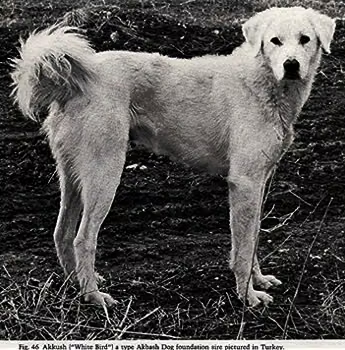
The Akbash is a tall, athletic white dog with a wedge shaped head and a weather resistant double coat that runs from short to medium in length.
The Akbash is a giant dog that reads as athletic rather than bulky. It has long legs, a deep chest, and a frame that is slightly longer than it is tall, giving it an easy, ground covering gait. The head is wedge shaped with a strong muzzle, and the ears drop close to the head. The tail is long and hangs low at rest, curling upward when the dog is alert.
| Trait | Description |
|---|---|
| Height | Roughly 71 to 86 cm (28 to 34 in) at the shoulder, males larger |
| Weight | About 41 to 64 kg (90 to 140 lb) |
| Coat | Double coat; short to medium length, weather resistant |
| Colours | White, sometimes with light biscuit or grey shading on the ears |
| Eyes | Almond shaped, ranging from light gold to dark brown |
Coat and colours
The Akbash has a double coat, a coarser outer layer over a softer undercoat beneath. Some dogs carry a shorter, smoother coat while others grow longer, with feathering on the legs and tail. White is the standard colour. A faint biscuit or grey shading sometimes shows on the ears or along the back, but the overall look stays pale and solid coloured. In India's climate the coat tends to shed steadily through the year rather than in two neat seasonal blow outs, so owners should expect ongoing hair fall alongside heavier spells around the change of seasons.
Temperament and personality
The Akbash is calm, independent and fiercely protective, gentle with its own family and flock yet reserved and watchful around strangers and unfamiliar animals.
The Akbash carries the steady, self reliant character of a working guardian. At home it tends to stay quiet and composed, settling near its family or flock and watching rather than demanding attention. That calmness sits over a strong protective streak, and when the dog senses genuine trouble it can move from resting to acting in moments.
With its own people the Akbash is loyal and gentle, and it usually forms a close bond with whatever it is raised to protect, whether that is livestock, children, or the household staff and watchmen it sees every day. Towards strangers it stays reserved and careful. It does not warm up quickly to new faces and may challenge anyone it does not trust on its own ground, so visitors and delivery staff need a proper introduction rather than a surprise arrival.
How it behaves with other animals depends heavily on upbringing. An Akbash raised alongside livestock generally treats them as charges under its care rather than playmates. It can be territorial with strange dogs, including any that wander near a farm boundary, and its independent streak means it often decides for itself rather than waiting on a command. This is a dog bred to think alone, so an owner should expect a working partner, not a follower.
| Trait | Rating |
|---|---|
| Affection | 3 |
| Energy | 3 |
| Trainability | 2 |
| Vocalness | 3 |
| Shedding | 4 |
Care and grooming
The Akbash needs regular brushing for its double coat, daily room to patrol, and a secure, shaded set up that accounts for India's heat and monsoon humidity.
Grooming
- Brush once or twice a week, and step this up to most days when the coat is shedding heavily
- Expect steady hair fall through the year, with heavier spells around the change of seasons rather than one tidy blow out
- Bathe only as needed, since the coat sheds dirt reasonably well on its own
- Trim nails on a regular schedule, and clean the drop ears often, since India's humidity raises the risk of ear infections
- Check the coat after time outdoors for ticks, burrs, and matting behind the ears and along the legs, especially during and after the monsoon
Exercise
- Give the dog daily activity such as patrolling a large secured yard, farm, or pasture
- Let it move at its own steady pace rather than depending only on short leash walks
- Provide a real task where possible, such as guarding livestock or watching over a property
- Skip forced, high intensity exercise in a young giant puppy to protect joints that are still developing
- Exercise in the cooler hours of early morning or evening during Indian summers, and avoid the midday sun altogether
Environment
The Akbash needs land to do well. A securely fenced farm or large rural property suits it far better than a flat or a small plot in a housing society. Fencing has to be tall and solid, since the breed patrols its boundary and can wander off if a gap opens up. The dense double coat was built for the cooler Anatolian highlands, not for a hot, humid Indian summer, so shade, airflow, and constant fresh water matter a great deal, and owners should watch closely for signs of heat stress.
Nutrition and feeding
The Akbash needs a balanced, large breed diet fed in measured meals to support steady growth in puppies and a healthy weight in adults.
The Akbash should eat a complete, balanced diet formulated for large or giant breeds. As a big dog with a fairly calm working rhythm, its calorie needs are real but not extreme, and an inactive adult is easy to overfeed. Match the quantity to the individual dog's age, weight, and activity level, and adjust by body condition rather than sticking to a fixed amount month after month.
Giant breed puppies take a long time to reach full size, and controlled growth matters for healthy joints. A diet formulated for large breed growth, served in measured portions, helps prevent the pup from growing too fast. Keep fresh water available at all times, which matters even more for a dog that works or rests outdoors through a hot Indian day.
| Life stage | Amount per day | Meals |
|---|---|---|
| Puppy (2 to 6 months) | Per large-breed growth formula, divided | 3 to 4 |
| Junior (6 to 18 months) | Adjust as growth slows | 2 to 3 |
| Adult | Roughly 4 to 6 cups of quality dry food, by weight and activity | 2 |
| Senior | Reduced calories to hold a healthy weight | 2 |
Treats and supplements
Keep treats to a small share of the day's calories so they do not throw the diet off balance or add extra weight. Most dogs eating a complete commercial food need no additional supplements. Discuss joint support or any other addition with a veterinarian first, since giant breeds can be sensitive to over supplementation during their growing months.
Health and common conditions
The Akbash is a generally hardy working breed with a lifespan of 10 to 12 years, though like most giant dogs it can face joint problems, bloat, and tick borne disease.
The Akbash is a sturdy breed, shaped by generations of demanding outdoor work, and many individuals stay sound well into their older years. Its typical lifespan runs 10 to 12 years, in line with other giant breeds. Good health rests on sensible feeding, controlled growth as a puppy, regular veterinary check ups, and screening carried out by responsible breeders.
As with most large and giant breeds, joint and orthopaedic problems are the chief concern, and bloat is a serious, sudden risk that owners need to recognise quickly. India's climate adds another factor: ticks are common through the warmer months, and tick borne illnesses such as ehrlichiosis and babesiosis are a real concern for any large outdoor dog kept here.
| Condition | Signs | Note |
|---|---|---|
| Hip dysplasia | Stiffness, limping, trouble rising | Common in large breeds; screening helps |
| Elbow dysplasia | Front-leg lameness, reluctance to exercise | Linked to growth and genetics |
| Gastric dilatation-volvulus (bloat) | Swollen belly, retching without vomit, restlessness | Emergency; seek immediate veterinary care |
| Hypothyroidism | Weight gain, low energy, coat changes | Manageable with diagnosis and treatment |
Preventive care
- Keep up with routine veterinary check ups, vaccinations, and parasite control, including regular tick and flea prevention suited to the Indian climate
- Feed for lean body condition and controlled growth in puppies
- Choose a pup from breeders who screen their breeding dogs for hip and elbow problems
- Split the day's food into measured meals and avoid heavy activity right after eating to lower the risk of bloat
- Keep nails trimmed and check the coat and ears on a regular basis
Training and socialisation
The Akbash is intelligent yet independent, so training goes best with early socialisation, consistency, and respect for the breed's habit of thinking for itself.
The Akbash is sharp and capable, but it was bred to make its own calls out in the field, so it does not train like a handler focused working breed. It can learn what is being asked of it, yet it also weighs up whether to actually comply, especially once its guarding instincts switch on. Training should aim for a reliable, well mannered adult rather than quick obedience, and it works best when it starts young and continues steadily over time.
Socialisation matters more than anything else. A guardian breed that meets plenty of people, places, and situations as a pup is far better at telling an ordinary event from a genuine threat once it is grown. Short, consistent sessions and calm, fair handling get more out of an Akbash than pressure or endless repetition.
Basics
- Start socialisation early, exposing the pup to a range of people, animals, and settings, including the noise and bustle of a street or market if the household is near one
- Teach a reliable recall and basic manners while the dog is still young and impressionable
- Keep sessions short and consistent, and reward calm, correct behaviour
- Set clear, fair boundaries that everyone in the household sticks to
- Build a secure set up so the dog is set up to succeed rather than corrected constantly for roaming or over guarding
Breeding and raising young
The Akbash matures slowly like other giant breeds, with a normal canine gestation of about 63 days and litters that need careful early socialisation to grow into sound guardians.
Breeding an Akbash is a serious undertaking best left to experienced people who health test their dogs and understand the breed's working role. Like other giant breeds, the Akbash matures slowly and may not reach full physical and mental maturity until two years of age or later. Breeders generally wait until their dogs are mature and screened for hip and elbow problems before pairing them.
Gestation in dogs runs about 63 days from conception. Litter sizes vary, and whelping in a giant breed can carry added risk, so veterinary support through the pregnancy and birth is a wise precaution. The early weeks count for a great deal in this breed. Pups meant for livestock guarding work are usually raised alongside the stock they will protect, while those headed for a companion or farmhouse home need wide ranging socialisation with people and everyday life. Careful, early handling decides whether the adult dog reads situations calmly or reacts with excess suspicion later on.
| Metric | Value |
|---|---|
| Sexual maturity | Around 1 to 2 years; full maturity comes later |
| Gestation | About 63 days |
| Litter size | Varies; several puppies is typical |
| Weaning | Around 6 to 8 weeks |
| Recommended health screening | Hip and elbow evaluation of breeding dogs |
Registering an Akbash in India: profile and microchip
Municipal licences cover the paperwork; a free United Pet Club record is what actually connects your Akbash to your phone.
How to register an Akbash in India
Municipal corporations in Delhi, Mumbai, Bengaluru, and numerous other cities require dogs to be registered or licensed under their by-laws, and a United Pet Club profile complements whichever rules apply where you live. The profile holds your contact information against your Akbash for its entire life, at no charge whatsoever. Registering your dog requires only a few minutes.
Should your Akbash already carry a microchip, the number must still be recorded separately, since the vet performs only the implant. Registering the microchip under the free lifetime plan accepts chips from any manufacturer an Indian vet works with, keeps every update free should your household shift cities, and leaves the record searchable at any hour. Create your free account and complete both tasks in one sitting.
How do I register my Akbash in India?
Create a free United Pet Club account, enter your Akbash's details along with a photograph, and save the profile. The lifetime plan maintains the record at no cost, and any municipal licence you hold sits alongside it rather than replacing it.
How do I register my Akbash's microchip?
Enter the fifteen digit chip number into your free account together with your current address, phone number, and email. The lifetime plan covers the registration and every subsequent update without charge, whatever the chip's manufacturer.
Is registration compulsory for an Akbash in India?
Several municipal corporations, Delhi and Mumbai among them, require dogs to be licensed under local by-laws. The United Pet Club profile is separate and voluntary, and it is the record a finder anywhere can actually search, free of cost.
What does it cost to register an Akbash?
Nothing whatsoever. The free lifetime plan includes the profile, the microchip record, and unlimited updates, with no renewal fee at any point.
Frequently asked questions
Common questions about the Akbash cover its size, temperament, care needs, lifespan, suitability as a pet, and availability in India.
How big does an Akbash grow?
The Akbash is a giant breed. Adults typically stand about 71 to 86 cm (28 to 34 in) at the shoulder and weigh roughly 41 to 64 kg (90 to 140 lb), with males larger than females.
What is the Akbash dog's temperament?
It is calm, independent, watchful, and strongly protective. The breed is loyal and gentle with its own family and flock but stays reserved and cautious around strangers.
Is the Akbash difficult to maintain in India?
It is a demanding breed for the wrong set up. The dog needs secure land, a genuine guarding job, weekly brushing with heavier hair fall through warm months, and an owner used to an independent working breed. It is not suited to flats, small plots, or first time owners, and India's heat and humidity call for extra care around shade and water.
What is the lifespan of an Akbash?
The typical lifespan is 10 to 12 years, which is normal for a giant breed.
Is Akbash a good family dog?
It can be devoted to a family that gives it space, a job, and early socialisation, usually on a farm or secured rural property. It suits households wanting an easy going, highly obedient companion in a small home far less well.
Is the Akbash a good guard dog?
Yes. It was bred specifically to guard livestock and stays naturally protective of its territory and its charges, meeting a threat with a measured but firm response.
Where can I get an Akbash puppy in India?
They are rare outside their working role and the Kennel Club of India does not currently recognise the breed. Finding one usually means going through overseas guardian breed breeders or specialist importers rather than expecting local availability.
From the community
Ask about the AkbashNo questions about the Akbash yet. Be the first to ask.
Browse Dog breeds