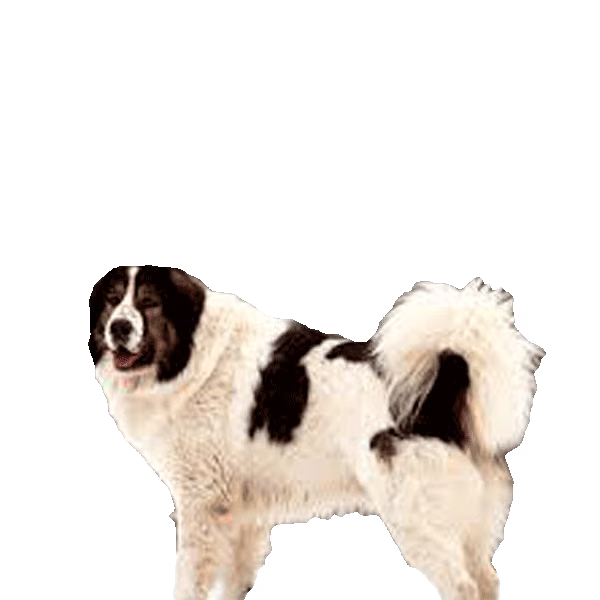
The Tornjak is a calm, devoted mountain livestock guardian from the Balkans known for its steady courage and loyalty.
How the Tornjak coat is built, and what that means when you groom it.
Critical: A Tornjak should not be shaved.
The undercoat keeps heat out as well as in, and the outer coat shields the skin from sun and insect bites. Clipping the whole coat off removes both. It often grows back patchy, soft or a different colour, and in some animals the guard hairs never return properly. Brush the undercoat out instead of cutting it off.
Caution: A Tornjak coat mats easily.
Fine or long hair tangles at the base of the coat, out of sight, where the mats tighten and pull on the skin. Brushing has to reach right down to the roots in sections, not just skim the surface.
Information: A Tornjak drops its undercoat in heavy bursts.
The undercoat comes out in heavy bursts over a few weeks. An undercoat rake, or a bath followed by a proper blow-dry, clears it far faster than daily brushing. Clipping the coat down is not a shortcut for this.
The Tornjak is a large livestock guardian dog from Bosnia and Herzegovina, known for calm temperament, deep loyalty, and steady courage in protecting flocks.
The Tornjak is a large mountain dog bred in the highlands of Bosnia and Herzegovina and neighboring parts of Croatia. For centuries it has worked beside shepherds, guarding sheep and cattle against wolves, bears, and theft. The name comes from the word for a sheep pen, which points directly to the job the breed was built to do.
This is a guardian rather than a herder. A Tornjak watches over its charges, moves with the flock, and acts on its own judgment when a threat appears. It is calm and unhurried in daily life, then decisive and brave when it decides protection is needed. Devotion to its people and animals runs through the whole temperament.
Adult dogs are heavy and powerfully built, with a thick double coat suited to harsh winters at altitude. Owners describe the breed as steady, watchful, and quietly confident. It bonds closely with family and the animals it lives with, while remaining reserved toward strangers.
| Attribute | Detail |
|---|---|
| Origin | Bosnia and Herzegovina |
| Size | Large |
| Lifespan | 12 to 14 years |
| Group / role | Livestock guardian dog |
| Good with | Its own family and the animals it is raised to protect |
The Tornjak fits people who have space, a job for the dog, and experience with independent large breeds. It does well on farms, smallholdings, and rural properties where it can guard animals or patrol a perimeter. It is less suited to apartments, small yards, or households that want a constantly biddable companion. First-time owners should expect a strong-willed, self-directed dog that needs firm, fair leadership and early socialization.
The Tornjak developed over centuries as a livestock guardian in the mountains of Bosnia and Herzegovina and Croatia, and was revived through organized breeding programs in the late twentieth century.
The Tornjak comes from the mountainous regions of Bosnia and Herzegovina and the bordering highlands of Croatia. Dogs of this type worked the Dinaric Alps and surrounding pastures for a very long time, guarding sheep and cattle on seasonal grazing routes. References to large guardian dogs in these regions appear in church and administrative records from the medieval period, which suggests the working type is old even if the modern breed name is newer.
For most of its existence the Tornjak was a working dog kept by shepherds rather than a formally registered breed. Selection was practical. Dogs that guarded well, endured the climate, and could be trusted around stock were kept and bred. There were no written standards, only the demands of the job.
During the twentieth century the population declined as traditional shepherding faded and predator numbers fell. Beginning in the 1970s and 1980s, cynologists in Bosnia and Herzegovina and Croatia searched the mountains for surviving dogs that matched the old type and started organized breeding to recover the breed. These programs recorded pedigrees, set a standard, and stabilized the population.
Today the Tornjak is recognized as a national breed in its homeland and is still used for livestock protection as well as kept as a guardian and companion. It remains uncommon outside the Balkans.
The Tornjak is a large, square-built mountain dog with a long, dense double coat, most often white with large patches of color.
The Tornjak is a large, strong, and roughly square dog, meaning its body length is close to its height at the withers. It is powerfully built without looking heavy or slow, with a deep chest, level topline, and a well-furred tail carried over the back when the dog is alert. Males are clearly larger and more massive than females. The overall impression is of a sturdy, balanced working dog suited to long days outdoors in cold mountains.
| Trait | Standard |
|---|---|
| Height | Males about 65 to 70 cm, females about 60 to 65 cm at the withers |
| Weight | Males about 35 to 50 kg, females about 28 to 42 kg |
| Coat | Long, thick double coat with a dense undercoat and a mane around the neck |
| Colors | Usually white as the base with large patches; black, tan, and red markings are common |
| Eyes | Medium, almond shaped, dark, with a calm expression |
The coat is the breed's most distinctive feature. It is long, profuse, and weatherproof, with a soft undercoat under a coarser outer layer. The hair is longest around the neck, on the back of the legs, and on the tail. Most Tornjaks are predominantly white with large patches of another color, though dogs with more extensive color are also seen. Common markings include black, gray, tan, and red. The thick coat protects the dog in deep snow and cold wind, and it sheds heavily once or twice a year.
The Tornjak is calm, devoted, and watchful, deeply loyal to its family and reserved with strangers, with an independent guarding instinct.
The Tornjak is calm and steady in everyday life and serious about its work. With its own family it is affectionate, loyal, and gentle, and it forms strong bonds with the people and animals it lives with. It is naturally watchful and notices changes in its surroundings, but it is not nervous or frantic. A well-raised Tornjak is confident and even-tempered.
With strangers the breed is reserved and cautious. It does not warm up quickly and tends to assess new people before accepting them. This wariness is part of its guardian nature and should be managed with steady, early socialization rather than treated as a fault. The dog is protective and will act on its own judgment to defend its charges, so owners need to be in clear control of introductions and access.
With other animals the Tornjak is usually trustworthy around livestock it has been raised with, since protecting them is its purpose. It can live with other dogs, though two assertive dogs of the same sex may clash. It guards by presence and warning, and it uses its deep bark to deter intruders before anything escalates. This is an independent thinker, not a dog that waits for instructions in a crisis.
| Trait | Rating |
|---|---|
| Affection (with family) | 4 |
| Energy | 3 |
| Trainability | 3 |
| Vocalness | 4 |
| Shedding | 5 |
The Tornjak needs regular coat care, moderate daily exercise, and space to patrol, and it thrives in cool climates with a clear job to do.
The Tornjak is built for cool and cold climates and tolerates heat poorly because of its dense coat. It needs secure, high fencing, since it patrols territory and will challenge intruders. It is happiest with space and a job and is not suited to apartments or small yards. Provide shade, fresh water, and shelter, and limit activity during hot weather.
The Tornjak needs a balanced large-breed diet portioned to its weight and activity, with controlled growth in puppies to protect developing joints.
The Tornjak does well on a complete, balanced diet formulated for large breeds. Because it is a big, slow-maturing dog, controlled growth in puppyhood matters; overfeeding a young Tornjak can stress developing bones and joints. Adults are fairly efficient feeders for their size and should be kept lean, since extra weight strains the joints over a long working life. Match the amount to the individual dog's weight, age, and activity level rather than feeding to a fixed number.
| Life stage | Amount per day | Meals |
|---|---|---|
| Puppy (2 to 6 months) | Per large-breed puppy food guidelines for target adult weight | 3 to 4 |
| Adolescent (6 to 18 months) | Roughly 3 to 5 cups of quality food, by size and activity | 2 |
| Adult | Roughly 3 to 5 cups, kept to maintain a lean body | 2 |
| Senior | Reduced calories to match lower activity | 2 |
Keep treats to roughly ten percent of daily calories so they do not unbalance the diet. Use small, healthy treats for training and reduce meal portions to account for them. A diet that is already complete and balanced does not usually need supplements; discuss any joint or coat supplements with a veterinarian, especially for a large breed prone to joint wear. Provide fresh water at all times, particularly after exercise.
The Tornjak is generally a hardy, healthy breed with a 12 to 14 year lifespan, though as a large dog it can be prone to joint and bloat-related issues.
The Tornjak is generally a robust, healthy breed, a result of centuries of selection for working soundness in a harsh environment. Typical lifespan is 12 to 14 years, which is long for a dog of its size. As with all large and deep-chested breeds, the main concerns are joint problems and the risk of bloat. Responsible breeders screen for hip and elbow health, so ask to see screening results when choosing a puppy.
| Condition | Signs | Note |
|---|---|---|
| Hip dysplasia | Stiffness, limping, trouble rising | Screen breeding dogs; keep the dog lean |
| Elbow dysplasia | Front-limb lameness, reluctance to exercise | More common in fast-growing large breeds |
| Gastric dilatation-volvulus (bloat) | Swollen abdomen, retching without bringing anything up, distress | A medical emergency; seek a vet at once |
| Obesity-related joint strain | Weight gain, reduced activity | Manage diet and exercise across the dog's life |
The Tornjak is intelligent and capable but independent, so it learns best with early socialization, consistency, and reward-based methods rather than force.
The Tornjak is intelligent and learns quickly, but it is an independent guardian bred to make its own decisions. It will not work for repetition or pressure the way some companion breeds do, and it may question commands that seem pointless to it. Training works best when the owner is calm, consistent, and fair, and when the dog understands the purpose behind what is asked. Early and ongoing socialization is the most important part of raising this breed, since it shapes how the adult dog handles strangers and new situations.
Start while the dog is young. Expose the puppy to a wide range of people, places, animals, and sounds so its natural wariness develops into sound judgment rather than fear or excessive suspicion. Set clear household rules and enforce them consistently. Secure fencing and controlled introductions are part of training too, because a guardian must learn what is and is not a threat.
The Tornjak is a slow-maturing large breed; bitches typically produce moderate to large litters, and puppies need early socialization and controlled growth.
The Tornjak matures slowly, as large breeds do, and dogs should be physically and mentally mature before breeding. Responsible breeding focuses on health, sound temperament, and working ability, with hip and elbow screening of the parents. Mating and whelping follow the normal canine pattern, with a gestation of roughly nine weeks. Litters are typically moderate to large, and the dam usually raises her pups attentively.
Early handling and socialization of puppies are essential for this guardian breed. From a young age, pups benefit from gentle exposure to people, household sounds, and, where relevant, the livestock they will later protect. Puppies raised with stock under supervision learn to bond with the animals rather than chase them. Feed for steady, controlled growth to protect developing joints, and avoid hard exercise while the skeleton is still maturing. Pups generally go to new homes after weaning and the first stage of socialization, around eight weeks or later depending on the breeder.
| Metric | Value |
|---|---|
| Sexual maturity | Reached during the first to second year, but breeding is best delayed until full maturity |
| Gestation | About 63 days (roughly 9 weeks) |
| Typical litter size | Moderate to large for a large breed |
| Weaning | Around 6 to 8 weeks |
| Recommended health screening | Hip and elbow evaluation of parents |
The city vet office handles the RA 9482 paperwork; a free United Pet Club record is what a finder anywhere can actually search for your Tornjak.
The Anti-Rabies Act, Republic Act 9482, tells every dog owner to register with the city or municipal veterinary office and keep the anti-rabies shots current, and that covers the local paperwork for your Tornjak. What the city record cannot do is tell a finder two provinces away how to reach you. A free United Pet Club profile fills that gap for life. Registering your dog costs nothing to start and nothing later.
The clinic's part ended with the implant; the tracing part is yours. File your Tornjak's 15-digit number with United Pet Club and every scan leads to your phone: free for life, all brands accepted, updates free every time your details change. Microchip registration plus a free account finishes the job.
Open a free United Pet Club account, add your Tornjak's details and a photo, then save the profile. It stays free for his whole life and sits alongside the city vet office registration RA 9482 requires.
Type the 15-digit chip number into your free account together with your mobile number and address. The lifetime plan charges nothing for the registration or for any update, whatever brand the clinic used.
Yes, RA 9482 requires dog registration with your city or municipal veterinary office, along with current anti-rabies vaccination. The United Pet Club profile is the searchable half: free, worldwide, and tied to your current mobile.
Nothing. The free lifetime plan covers the profile, the microchip record, and every update, with no renewal fees at all.
Common questions about the Tornjak's size, temperament, care needs, lifespan, suitability, and availability.
It is a large breed. Males stand about 65 to 70 cm at the withers and weigh roughly 35 to 50 kg, while females are smaller at about 60 to 65 cm and 28 to 42 kg.
Calm and devoted at home, watchful and protective on duty. It is loyal and gentle with its own family, reserved with strangers, and independent in how it guards.
It is moderate to demanding. The thick double coat needs regular brushing and heavy attention during seasonal sheds, and the dog needs space, secure fencing, and ideally a job. Its independent guardian nature suits experienced owners best.
Typically 12 to 14 years, which is long for a dog of this size.
It can be, in the right home. It bonds closely with family and is gentle with people it trusts, but it needs space, early socialization, and an owner comfortable with a large, protective, independent breed. It is not suited to apartment living.
They are uncommon outside Bosnia and Herzegovina, Croatia, and the wider Balkans. Finding a puppy elsewhere usually means contacting specialist breeders and waiting for a litter.
It needs moderate daily exercise rather than intense activity. Long walks and room to patrol a secured property suit it well, and a guarding role keeps it mentally satisfied.
