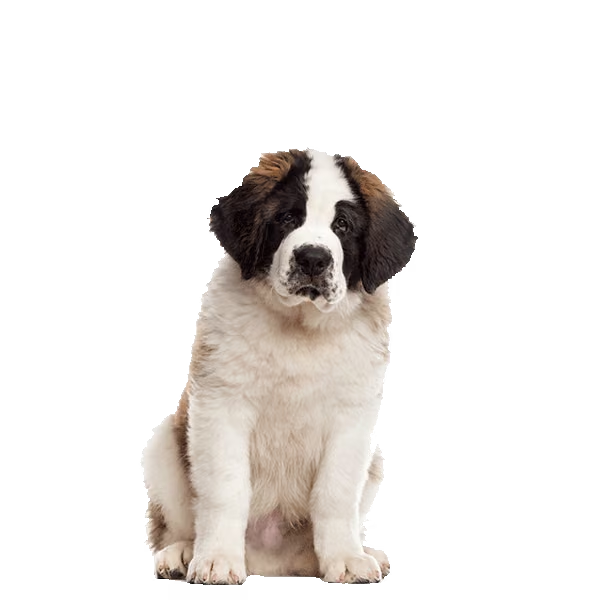
The Saint Bernard is a gentle, friendly giant famed for its alpine-rescue heritage and its calm, affectionate devotion to family.
How the Saint Bernard coat is built, and what that means when you groom it.
Critical: A Saint Bernard should not be shaved.
The undercoat keeps heat out as well as in, and the outer coat shields the skin from sun and insect bites. Clipping the whole coat off removes both. It often grows back patchy, soft or a different colour, and in some animals the guard hairs never return properly. Brush the undercoat out instead of cutting it off.
Information: A Saint Bernard drops its undercoat in heavy bursts.
The undercoat comes out in heavy bursts over a few weeks. An undercoat rake, or a bath followed by a proper blow-dry, clears it far faster than daily brushing. Clipping the coat down is not a shortcut for this.
A few of the Saint Bernard profiles members have added to United Pet Club.
The Saint Bernard is a giant Alpine working dog known for a calm, gentle temperament and a strong bond with family, suited to homes with plenty of space.
The Saint Bernard is a giant breed that developed in the western Alps, in the border country between Switzerland and northern Italy. A full-grown dog stands about 26 to 30 inches at the shoulder, and males commonly weigh 140 to 180 pounds. The breed carries a long history of service at the hospice on the Great St. Bernard Pass, and it kept the calm, patient character that suited it to that work.
Indoors, most Saint Bernards are even-tempered and unhurried, moving at their own slow pace rather than rushing about the house. They form close attachments to the household they live with and are generally patient around children. Given how large the dog grows, early training and consistent handling from the first weeks at home make a real difference later on.
This breed fits an owner who has the space, the time, and the patience for a fair amount of drool and heavy shedding each season. A Saint Bernard does not need intense exercise, but it does need room to move around, plus a family ready for the higher cost of feeding and caring for a giant dog.
| Attribute | Detail |
|---|---|
| Origin | Switzerland |
| Size | Giant breed (males typically 140 to 180 lb) |
| Lifespan | 8 to 10 years |
| Group / role | Working dog; historically used for alpine rescue and draft work |
| Good with | Children and family members; usually gets along with other pets when socialized early |
A Saint Bernard needs a settled household with enough room, indoors and out, for a very large dog. It works well for families with children, provided interactions are supervised given the dog's sheer weight. Anyone considering the breed should plan ahead for a relatively short lifespan, regular grooming sessions, and the higher food and veterinary bills that come with a giant dog.
The Saint Bernard was bred at a hospice on the Great St. Bernard Pass in the Swiss Alps, where the dogs served as companions, draft animals, and mountain rescuers.
The breed's name comes from the hospice on the Great St. Bernard Pass, a high crossing in the western Alps between Switzerland and Italy. The hospice was founded in the 11th century as a refuge for travelers, and dogs were kept there as working animals from early on. Written and pictorial records of large hospice dogs go back to the late 1600s and early 1700s.
The monks put the dogs to work at several tasks: guarding the property, pulling carts, turning kitchen spits, and providing warmth on cold nights. Over time the dogs were also trained to search for travelers lost in deep snow along the pass. They worked in groups and could locate people buried after a storm, after which handlers dug the travelers out and led them to shelter.
In the early 1800s the hospice line lost numbers to harsh winters and disease. To rebuild the stock, hospice dogs were crossed with other large breeds, including longhaired types. The longer coat tended to hold ice and snow, so the shorthaired variety stayed the preferred working dog on the pass itself, while longhaired dogs were kept in the valleys below.
The breed took the name Saint Bernard by the middle of the 19th century, and a Swiss breed club was set up in 1884. Barry, a rescue dog who worked at the hospice in the early 1800s, is the best known individual from the line and is regularly cited whenever the breed's rescue history comes up. Dog owners in the Philippines who want to register a Saint Bernard go through the Philippine Canine Club, Inc. (PCCI), the country's national kennel club.
The Saint Bernard is a powerful, large-headed dog with a deep chest, available in short and long coats marked in white with red or brown.
The Saint Bernard is tall and heavily built, with a broad, deep chest and strong bone throughout. The head is large and wide, with a short muzzle, a well-defined stop, and loose flews that account for the breed's tendency to drool. The eyes are dark and set fairly deep, giving a soft expression, and the ears are medium-sized and hang close to the head.
| Trait | Description |
|---|---|
| Height | Males about 28 to 30 in; females about 26 to 28 in at the shoulder |
| Weight | Males about 140 to 180 lb; females about 120 to 140 lb |
| Coat | Two varieties: shorthaired (smooth, dense) and longhaired (medium length, slightly wavy) |
| Colors | White with red or brown markings, or red and brown with white markings; brindle shading is common |
| Eyes | Dark, medium-sized, with a gentle expression |
Both coat types carry the same color pattern: a white base combined with red or brown, and many dogs have a dark mask over the eyes and ears. The shorthaired coat lies flat and feels dense to the touch. The longhaired coat runs longer over the body, legs, and tail, though it is not curly. Both varieties shed heavily, with noticeable seasonal coat changes.
The Saint Bernard is calm, affectionate, and devoted, usually gentle with children and tolerant of other pets when raised alongside them.
The Saint Bernard is known for a steady, easygoing nature. Indoors it is usually quiet and content just to rest near its family, and it forms strong attachments to the people it lives with, often trailing them from room to room.
With children, most Saint Bernards are patient and gentle, though the dog's size means young kids should always be supervised around it. Toward strangers the breed tends to stay calm and accepting rather than defensive, and it is not much of a guard dog by nature. Raised alongside other dogs and cats from an early age, a Saint Bernard generally lives with them without any trouble.
The breed is not highly active or excitable. It can be slow to mature and may hold on to puppyish behavior well past its first year, so early, consistent socialization goes a long way toward helping a giant dog grow into a manageable adult.
| Trait | Rating |
|---|---|
| Affection | 5 |
| Energy | 2 |
| Trainability | 3 |
| Vocalness | 2 |
| Shedding | 4 |
The Saint Bernard needs regular brushing, moderate daily exercise, and a cool living space, with extra attention to its heavy coat and drool.
The Saint Bernard does best in a home with room indoors and a secure outdoor area to move around in. The breed tolerates cold well but struggles badly in heat, so a cool, shaded, well-ventilated space matters a great deal. In the Philippines, the climate runs hot and humid all year, a sharp contrast to this breed's Alpine origin in the Swiss mountains, so heat tolerance is a real concern for such a large, heavy-coated dog. A room with good airflow or air conditioning is close to a necessity rather than a luxury in most parts of the country. Despite its size, the Saint Bernard is an indoor companion and should not be left outside alone for long stretches.
The Saint Bernard needs a complete diet sized for a giant breed, fed in measured meals to support steady growth and prevent excess weight.
A Saint Bernard needs a complete and balanced diet formulated for large or giant breeds. During growth, a large-breed puppy formula with controlled calcium and energy supports a slower, steadier growth rate, which helps protect the joints later on. Adult portions depend on weight, age, and activity level, so amounts should be adjusted to keep the dog at a healthy body condition rather than fed by a fixed rule. Splitting the day's food into two meals rather than one large one is the common practice for the breed.
| Life stage | Amount per day | Meals |
|---|---|---|
| Puppy (2 to 6 months) | Per large-breed puppy formula, divided | 3 to 4 |
| Puppy (6 to 12 months) | Per large-breed puppy formula | 2 to 3 |
| Adult | About 6 to 10 cups of dry food, by weight and activity | 2 |
| Senior | Reduced to maintain condition | 2 |
Keep treats to a small share of the day's calories, since extra weight adds real strain to the joints of a giant dog. Fresh water should be available at all times. Check with a veterinarian before adding any joint or other supplement, as a balanced complete food usually covers what a healthy dog needs.
The Saint Bernard typically lives 8 to 10 years and is prone to joint problems, bloat, and certain heart and eye conditions common in giant breeds.
The Saint Bernard has an average lifespan of 8 to 10 years, typical for a giant breed. Most of the breed's health concerns trace back to its size and rapid growth, including joint disorders and the risk of gastric dilatation and volvulus, more commonly called bloat. Responsible breeders screen their breeding dogs for hip, elbow, heart, and eye conditions before pairing them.
| Condition | Signs | Note |
|---|---|---|
| Hip and elbow dysplasia | Limping, stiffness, reluctance to get up | Screened in breeding stock; weight control helps |
| Gastric dilatation and volvulus (bloat) | Swollen abdomen, retching, restlessness | A medical emergency; seek care right away |
| Dilated cardiomyopathy | Tires easily, coughing, fainting | Heart screening recommended |
| Eye conditions (entropion, ectropion) | Eye irritation, discharge, drooping lids | May need surgical correction by a vet |
| Osteosarcoma (bone cancer) | Lameness, swelling on a limb | More common in giant breeds |
The Saint Bernard is willing and food motivated but slow to mature, so early, consistent, reward-based training matters given its size.
The Saint Bernard is generally cooperative and responds well to calm, consistent handling. It tends to mature more slowly than many breeds, so patience is needed through the first year or two. Because a full-grown dog is very large and strong, basic manners such as walking on a loose leash and staying off people should be taught while the dog is still young enough to control easily. Reward-based methods work best; the breed does not respond well to harsh handling.
Saint Bernards mature slowly, tend to have large litters, and need careful health screening of breeding stock because of giant-breed risks.
Saint Bernards reach physical maturity later than smaller breeds, and responsible breeders wait until a dog is fully grown and health tested before breeding it. Gestation runs about 63 days. The breed tends toward large litters, and giant-breed whelping can carry higher risk, so having veterinary support on hand around the birth is a sound precaution.
Newborn puppies grow fast and pack on weight quickly, which makes early nutrition and a clean, warm whelping area important from day one. Breeding dogs should be screened for hip and elbow dysplasia, heart disease, and eye conditions, and breeders should share the parents' results openly. Given the breed's size and relatively short lifespan, careful selection for health and temperament carries real weight.
| Metric | Value |
|---|---|
| Sexual maturity | Later than small breeds; breed only once fully grown |
| Gestation | About 63 days |
| Average litter size | Commonly 6 to 10 puppies, sometimes more |
| Weaning age | About 6 to 8 weeks |
| Recommended health screening | Hips, elbows, heart, eyes |
The city vet office handles the RA 9482 paperwork; a free United Pet Club record is what a finder anywhere can actually search for your Saint Bernard.
Type in your Saint Bernard's name, his birth date, and a clear photo, add your mobile number, and save. That is the entire process, and the profile stays free for his whole life. Dog registration works with or without a chip, so the vet visit can come later.
The clinic's part ended with the implant; the tracing part is yours. File your Saint Bernard's 15-digit number with United Pet Club and every scan leads to your phone: free for life, all brands accepted, updates free every time your details change. Microchip registration plus a free account finishes the job.
Open a free United Pet Club account, add your Saint Bernard's details and a photo, then save the profile. It stays free for his whole life and sits alongside the city vet office registration RA 9482 requires.
Type the 15-digit chip number into your free account together with your mobile number and address. The lifetime plan charges nothing for the registration or for any update, whatever brand the clinic used.
Yes, RA 9482 requires dog registration with your city or municipal veterinary office, along with current anti-rabies vaccination. The United Pet Club profile is the searchable half: free, worldwide, and tied to your current mobile.
Nothing. The free lifetime plan covers the profile, the microchip record, and every update, with no renewal fees at all.
Common questions about the Saint Bernard's size, temperament, care needs, lifespan, and fit as a family dog.
It's a giant breed. Males usually stand 28 to 30 inches at the shoulder and weigh about 140 to 180 pounds, with females a bit smaller.
Most are calm and gentle with children. Because of the dog's weight, young kids should always be supervised whenever they interact with one.
Care itself is not complicated, but it's demanding in scale. The breed needs regular brushing, drool management, moderate exercise, a cool space in hot weather, and the higher food and vet costs that come with a giant dog.
The average lifespan is 8 to 10 years, which is typical for a giant breed.
Yes. The loose flews mean noticeable drooling, and both coat types shed heavily, especially during seasonal coat changes.
It suits families with enough space, time for grooming, and a budget for a large dog. Its calm, devoted nature makes it a good companion in the right home.
No. Moderate daily walks are enough. Limit hard running and stairs while the puppy is still growing, and keep activity light during hot weather.

