


Rastreador Brasileiro
The Rastreador Brasileiro is a determined Brazilian scenthound known for its tireless tracking ability and athletic stamina.
- Size
- Large
- Lifespan
- 11–13 years
- Origin
- Brazil
- Temperament
- Hardworking
- Standard colors
- Black, White, Blue, and Fawn
Characteristics
Coat and grooming
How the Rastreador Brasileiro coat is built, and what that means when you groom it.
- Coat layers
- Single coat
- Coat texture
- Smooth
- Coat length
- Short
- Shedding
- Moderate shedding
Rastreador Brasileiro colors and patterns
What each club's breed standard says about every Rastreador Brasileiro color and pattern. Point at a ruling to see the club's own wording.
Breed standards describe the Rastreador Brasileiro in Black, White, Blue, and Fawn. Standard patterns: Bicolor, Tricolor, Roan, and Tan point.
| Color or pattern | FCI |
|---|---|
| Black | Standard (“Fully mottled black and white”) |
| White | Standard (“Fully mottled black and white”) |
| Blue | Standard (“giving a slate blue colouring effect”) |
| Fawn | Standard (“with or without fawn and/or black markings”) |
| Patterns | |
| Bicolor | Standard (“bicolor (white with fawn or black markings”) |
| Tricolor | Standard (“tricolor (white and black with fawn markings)”) |
| Roan | Standard (“Fully mottled black and white”) |
| Tan point | Standard (“totally black with fawn markings”) |


| Color or pattern | FCI |
|---|---|
| Dark brown | Standard (“dark”) |
| Color or pattern | FCI |
|---|---|
| Black | Standard (“completely black in colour”) |
What the rulings mean
- Standard
- Described by the club's breed standard.
Color changes
How a Rastreador Brasileiro's colors can change over its life.
Blackchanges toRust
Coat · With body condition · can change back
Blackchanges toGray
Coat · Progressive
Blackchanges toBrown
Coat · In the sun · can change back
Whitechanges toRoan
Coat · With age · from 2 weeks
Tan pointchanges toSaddle
Coat · With age · from 6 to 156 weeks
Blackchanges toSnow nose
Nose · With the season · can change back
Blackchanges toPink
Nose · With the season · can change back


Sources
Each ruling comes from the club's published breed standard or color list.
Rastreador Brasileiro breed standard
What each club's standard asks of the Rastreador Brasileiro: size, build and forms. A club speaks only for itself, and a figure no club published is left out.
Measurements


Conformation
Skull type
Mesocephalic (medium)
“HEAD: Mesocephalic, triangular and slightly elongated.”
Stop
Moderate
“Stop: Moderate.”
Stop
PronouncedDisqualifying
“Pronounced stop.”
Bite
Scissors bite
“scissor bite with complete teeth (42 teeth)”
Bite
UndershotDisqualifying
“Under or overshot.”
Bite
OvershotDisqualifying
“Under or overshot.”
Dentition
Full dentition
“scissor bite with complete teeth (42 teeth)”
Eye shape
Almond
“EYES: Almond-shaped, dark, with lively expression”
Ear carriage
Drop (pendant)
“Almost lacking in erectile capacity, they hang close to the head.”
Ear carriage
RoseFault
“Rose ears.”
Ear set
Low
“EARS: Long, low insertion, flexible and with rounded tips.”
Dewlap
Slight
“allowing a slight skin fold under the angle of the jaw, with slight dewlap”
Tail length
Long
“Long size, reaching or exceeding the hock.”
Tail carriage
Sabre
“TAIL: Sabre shaped, carried without deviating sideways”
Tail shape
CurlyDisqualifying
“Curly tail.”


Markings


Parts of the body


Meet some of our Rastreador Brasileiro
A few of the Rastreador Brasileiro profiles members have added to United Pet Club.


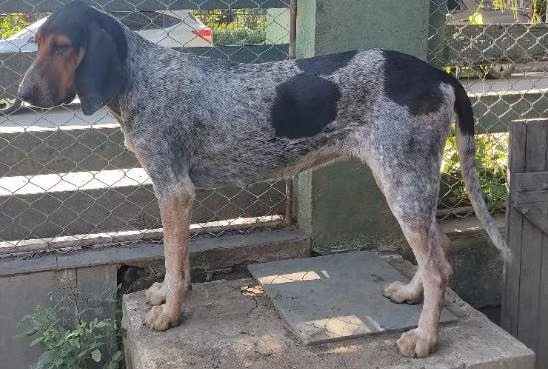
About the Rastreador Brasileiro
The Rastreador Brasileiro is a large Brazilian scenthound built for long-distance tracking, prized for stamina, focus, and a steady working drive.
The Rastreador Brasileiro is a large scenthound from Brazil, developed to track and trail game across difficult terrain. Its name is Portuguese for "Brazilian Tracker," and the breed was built around a single purpose: following scent for long stretches without losing concentration. These dogs are athletic and alert, built for endurance rather than short bursts of speed.
In temperament, the breed is hardworking and single-minded on a trail. It tends to stay even-tempered with its handler and household while remaining watchful of what goes on around it. The strong nose and high activity level mean this is a dog that needs a task and room to move. Owners often say that once it catches a scent, it does not let go easily.
This is a working hound before anything else, so it fits homes that can commit to real daily exercise. It is not the type of dog that settles for a short walk around the block. Given enough physical and mental work, it turns into a steady, cooperative companion.
| Attribute | Detail |
|---|---|
| Origin | Brazil |
| Size | Large |
| Lifespan | 11 to 13 years |
| Group / role | Scenthound, tracking and trailing |
| Good with | Families and handlers who can provide daily exercise; supervise around small pets given the hunting drive |
Who it suits
The Rastreador Brasileiro fits active owners, provincial households with space to run, and people who jog, hike, or work their dogs regularly. It does best with a securely fenced yard and a job to keep its mind occupied. Condominium living in the city and long hours left alone do not suit a hound with this much drive and stamina.
History and origin
Bred in twentieth-century Brazil from imported hound stock, the Rastreador Brasileiro nearly vanished before breeders rebuilt the line, which is why it stays rare even among hound enthusiasts.
The Rastreador Brasileiro traces back to Brazil, where breeders wanted a hound that could hunt and track game across the country's rough, varied terrain. Credit for developing the breed goes to Oswaldo Aranha Filho, who aimed to produce a dog with the nose, voice, and stamina to trail animals such as jaguar and peccary through difficult ground.
The program mixed several imported scenthound lines, including American foxhound stock and other trailing hounds, with local Brazilian dogs. The goal was a tracker that could handle heat, distance, and dense cover better than any of the parent breeds on their own, a combination that happens to suit tropical conditions like the Philippines' own. Breeders selected for scenting ability and working stamina rather than looks.
The breed earned recognition in Brazil through the Confederacao Brasileira de Cinofilia and, for a time, held international acknowledgment as well. A severe setback followed when disease and a tick-borne outbreak, worsened by pesticide exposure, wiped out a large share of the breeding population. Numbers dropped so low that the breed was considered effectively lost for years.
Later efforts tracked down surviving dogs and others of the original type, letting breeders rebuild the population from there. The Rastreador Brasileiro remains scarce today and is seldom seen outside Brazil. In the Philippines, where the Philippine Canine Club, Inc. (PCCI) oversees breed recognition and registration, it stays a breed known mostly through hound enthusiasts rather than one commonly kept as a house pet.
Appearance and breed standard
A large, athletic build, a short weather-ready coat, and a tricolor or patched pattern give the Rastreador Brasileiro the look of a working scenthound suited to hot climates.
The Rastreador Brasileiro carries the lean, athletic frame typical of a working scenthound. Its body runs longer than it stands tall, with a deep chest for lung capacity and strong, straight legs meant for covering long distances. The head carries long, drop ears common to trailing hounds, and the expression stays alert and attentive. On the whole, the dog looks functional and balanced rather than bulky.
| Trait | Description |
|---|---|
| Height | Roughly 62 to 72 cm (24 to 28 in) at the shoulder, males larger than females |
| Weight | About 25 to 35 kg (55 to 77 lb) |
| Coat | Short, smooth, and close-lying |
| Colors | White base with black and tan markings; ticked, patched, or tricolor patterns |
| Eyes | Medium, dark, with an alert expression |
Coat and colors
The coat is short and simple to maintain, a real advantage for a dog working in heat and thick brush, and one reason it adjusts well to Philippine weather. Common patterns show a white base broken by black and tan patches, often ticked across the body. The close coat gives little protection from cold, so the breed suits warm, humid climates far better than harsh winters, another point in its favor here.
What the Rastreador Brasileiro standard says, club by club
Height at the withers for the Rastreador Brasileiro: FCI 60-65 cm.
Each club words the Rastreador Brasileiro standard its own way, so the figures below are listed per club: FCI.
Size
- Height at the withers, male: FCI 60-65 cm
- Height at the withers, female: FCI 56-63 cm
- Weight, male: FCI 26-33 kg
- Weight, female: FCI 21-30 kg
- Height to length: FCI 0.9
- Skull to muzzle: FCI 1
Build and forms
At least one club accepts each of these:
- Skull type: Mesocephalic (medium)
- Stop: Moderate
- Bite: Scissors bite
- Dentition: Full dentition
- Eye shape: Almond
- Ear carriage: Drop (pendant)
- Ear set: Low
- Dewlap: Slight
- Tail length: Long
- Tail carriage: Sabre
Forms the clubs penalize
A fault or a disqualification is a judgment under a show standard. It can affect placings and, at some clubs, registration.
- Disqualifying: Stop: Pronounced (FCI); Bite: Undershot (FCI); Bite: Overshot (FCI); Tail shape: Curly (FCI)
- Fault: Ear carriage: Rose (FCI)
Markings
Each club's ruling on the breed's named marks:
- Tan points: Alternate (FCI)
See every point side by side: compare the clubs.
Rulings come from each club's published breed standard, and clubs revise their standards. Before a show or a registration, check the current text with the club.
What does each club give for Height at the withers in the Rastreador Brasileiro?
Height at the withers, male: FCI 60-65 cm; Height at the withers, female: FCI 56-63 cm.
Which forms do clubs penalize in the Rastreador Brasileiro?
Disqualifying: Stop: Pronounced (FCI); Bite: Undershot (FCI); Bite: Overshot (FCI); Tail shape: Curly (FCI). Fault: Ear carriage: Rose (FCI).
Which Rastreador Brasileiro colors the clubs accept
FCI lists Black, White, Blue, Fawn as standard for the Rastreador Brasileiro.
FCI is the only club we track for the Rastreador Brasileiro so far, and it accepts Black, White, Blue, Fawn.
Patterns listed as standard for the Rastreador Brasileiro: Bicolor, Tricolor, Roan, Tan point.
Beyond the main color
Standards rule on more than the main color. These are listed as standard:
- Eyes: Dark brown
- Nose: Black
Rulings come from each club's published breed standard, and clubs revise their standards. Before a show or a registration, check the current text with the club.
Temperament and personality
Focused and hardworking by nature, the Rastreador Brasileiro stays steady with its family at home but turns single-minded once its strong nose picks up a scent.
The Rastreador Brasileiro is even-tempered and cooperative with people it knows well. It bonds closely with its handler and generally settles down at home once its exercise needs are met for the day. Around strangers, it tends to stay alert and watchful rather than aggressive, and many dogs will bark to signal anything unfamiliar.
Drive is the defining trait. This is a hound bred to lock onto a scent and follow it for hours, so it can turn single-minded the moment it picks up a trail. That focus makes recall harder mid-track, which is the main reason secure fencing matters so much with this breed. Around other dogs, it is usually social, having been bred to work in packs.
The hunting instinct carries over into life with small pets. Cats, rabbits, and similar animals can trigger chase behavior, so introductions call for care and supervision. With children, the breed tends to be patient, though its size and energy level still call for sensible supervision around young kids, especially in a household where several generations and pets often share one compound.
| Trait | Rating |
|---|---|
| Affection | 4 |
| Energy | 5 |
| Trainability | 3 |
| Vocalness | 4 |
| Shedding | 2 |
Care and grooming
Grooming stays simple, but the Rastreador Brasileiro needs serious daily exercise and space to run, making it a better match for active households than city condos.
Grooming
- Brush the short coat once a week to clear loose hair and spread natural skin oils.
- Bathe only as needed, since frequent washing strips the coat, especially with humidity already doing enough work on the skin.
- Clean the long drop ears regularly and check for moisture, debris, and signs of infection, which can set in fast in humid weather.
- Trim nails every few weeks and check the feet after work on rough ground.
- Brush teeth several times a week to keep dental health in check.
Exercise
- Set aside at least 1 to 2 hours of vigorous activity daily.
- Provide long walks, running, hiking, or structured tracking work, ideally during the cooler hours of early morning or late afternoon.
- Add scent games and trailing tasks to work the nose, not only the legs.
- Keep the dog leashed or inside secure fencing in open areas, since a fresh scent can override recall completely.
Environment
This breed does best with room to roam and a securely fenced yard, the kind more common on provincial properties than in Metro Manila condominiums. Its short coat suits year-round tropical heat well, though it still needs shade and plenty of water during the hottest months. During typhoon season, keep bedding and shelter dry, since a damp coat and standing water raise the risk of skin and ear trouble. The breed is not suited to apartment life or to being left alone for long stretches.
Grooming a Rastreador Brasileiro
The Rastreador Brasileiro coat: Single coat, Smooth, Short, Moderate shedding.
Grooming a Rastreador Brasileiro comes down to its coat, so start there.
- Coat layers: Single coat
- Coat texture: Smooth
- Coat length: Short
- Shedding: Moderate shedding
What this coat asks of you
- A single coat has no dense undercoat, so there is less to brush out and less insulation against the cold.
- A smooth coat lies flat and is the easiest kind to keep. A soft brush or a grooming mitt lifts dust and loose hair.
- Short hair rarely tangles but it still sheds, so regular brushing keeps the loose hair down.
- Moderate shedding goes on through the year, and regular brushing catches most of it before it lands on the furniture.
A groomer who knows the breed can adapt all of this to the individual animal. Sore skin, mats pressed against the skin or a sudden change in the coat are worth showing to a vet.
What kind of coat does a Rastreador Brasileiro have?
On our records: Coat layers: Single coat; Coat texture: Smooth; Coat length: Short; Shedding: Moderate shedding.
How much does a Rastreador Brasileiro shed?
Moderate shedding goes on through the year, and regular brushing catches most of it before it lands on the furniture.
Nutrition and feeding
Being a large, high-energy working hound, the Rastreador Brasileiro needs quality food with enough protein and calories to match its activity level.
The Rastreador Brasileiro needs a complete, balanced diet built for a large, active dog. Working or hard-exercising dogs burn a lot of energy, so calorie intake should track actual activity rather than a fixed amount. Choose a food with quality animal protein to support muscle, and adjust portions to keep the dog lean rather than heavy, since extra weight puts strain on the joints. Keep fresh water on hand at all times, especially after exercise in the heat.
| Life stage | Amount per day | Meals |
|---|---|---|
| Puppy (2 to 6 months) | Per growth formula, divided across the day | 3 to 4 |
| Adolescent (6 to 12 months) | Adjusted as growth slows | 2 to 3 |
| Adult | About 3 to 4.5 cups of quality dry food, by weight and activity | 2 |
| Active or working adult | Increased to match energy use | 2 |
| Senior | Reduced calories, maintained protein | 2 |
Treats and supplements
Keep treats to around ten percent of daily calories so the overall diet stays balanced. A food formulated for large breeds usually covers what the dog needs, so add supplements only on a veterinarian's advice. Deep-chested dogs run a real risk of bloat, so skip heavy meals right before or after intense exercise.
Health and common conditions
Generally hardy with a lifespan of 11 to 13 years, the Rastreador Brasileiro can still face the joint, digestive, and ear issues common to large, active working breeds.
The Rastreador Brasileiro is a robust, athletic breed with a typical lifespan of 11 to 13 years. Because the population stays small and was rebuilt from limited stock, responsible breeding and health screening matter a great deal for keeping the line sound. As with most large, deep-chested working dogs, the main concerns center on the joints, the digestive system, and the ears.
| Condition | Signs | Note |
|---|---|---|
| Hip dysplasia | Stiffness, limping, trouble rising | Common in large breeds; screen breeding stock |
| Bloat (gastric torsion) | Swollen abdomen, retching, distress | Emergency; avoid heavy meals near hard exercise |
| Ear infections | Head shaking, odor, discharge | Drop ears trap moisture; clean and dry regularly |
| Tick-borne disease | Fever, lethargy, joint pain | A historic threat to the breed; maintain parasite control |
Preventive care
- Keep vaccinations and parasite prevention current, with strict tick control given the local climate.
- Schedule annual veterinary exams, moving to twice yearly once the dog reaches its senior years.
- Screen breeding dogs for hip and joint health.
- Keep up dental care and a lean body weight.
- Check and clean the ears on a routine basis.
Training
Intelligent and willing yet independent once a scent takes over, the Rastreador Brasileiro responds best to consistent, reward-based training started early.
The Rastreador Brasileiro is a capable learner with a strong work ethic, which helps a great deal in training. The catch is its independence: once the nose takes over, the dog can tune out commands entirely and follow the trail instead. Training works best when it starts in puppyhood, stays consistent, and gives the dog a clear job to do. Recall especially needs steady reinforcement, since a fresh scent competes hard against the handler's voice. Early socialization with people, other dogs, and different animals helps balance out the strong hunting drive.
Basics
- Start socialization and gentle handling early in puppyhood.
- Teach name response and attention before adding distractions.
- Build a reliable recall, rewarding it generously and practicing on a long line.
- Add leash manners early, before the dog grows into its full size and strength.
- Channel the nose into scent and tracking games to satisfy its instinct.
- Keep sessions short, varied, and frequent to hold its focus.
Breeding
Rare and rebuilt from limited stock, the Rastreador Brasileiro calls for careful selection, health screening, and real commitment to preserving the working line.
Breeding the Rastreador Brasileiro carries added responsibility, given how small the population stays and how it was reconstructed after a near collapse. Breeders work to preserve genetic diversity while holding on to the breed's scenting ability and working soundness. Females reach physical maturity at around 18 to 24 months, and responsible programs wait for full maturity before breeding rather than mating at the first cycle.
Gestation in dogs runs roughly 63 days. Litter sizes in large breeds vary widely, and the dam needs increased nutrition through late pregnancy and nursing. Whelping should be planned with veterinary support close at hand, especially given how scarce the breed remains and how much each litter counts.
Raising the pups centers on early socialization and gentle exposure to handling, sounds, and other animals. Puppies from a working line carry strong instincts from birth, so early scent enrichment and steady human contact help shape balanced adults. Health screening of both parents supports the longer-term goal of a sound, sustainable population, particularly important for a breed with so few founding lines.
| Metric | Value |
|---|---|
| Sexual maturity | About 6 to 12 months |
| Recommended breeding age | From around 18 to 24 months |
| Gestation | Roughly 63 days |
| Typical litter size | Around 5 to 8 puppies (varies) |
| Weaning | About 7 to 8 weeks |
Registering your Rastreador Brasileiro and its microchip in the Philippines
The city vet office handles the RA 9482 paperwork; a free United Pet Club record is what a finder anywhere can actually search for your Rastreador Brasileiro.
How to register a Rastreador Brasileiro in the Philippines
Type in your Rastreador Brasileiro's name, his birth date, and a clear photo, add your mobile number, and save. That is the entire process, and the profile stays free for his whole life. Dog registration works with or without a chip, so the vet visit can come later.
The clinic's part ended with the implant; the tracing part is yours. File your Rastreador Brasileiro's 15-digit number with United Pet Club and every scan leads to your phone: free for life, all brands accepted, updates free every time your details change. Microchip registration plus a free account finishes the job.
How do I register my Rastreador Brasileiro in the Philippines?
Open a free United Pet Club account, add your Rastreador Brasileiro's details and a photo, then save the profile. It stays free for his whole life and sits alongside the city vet office registration RA 9482 requires.
How do I register my Rastreador Brasileiro's microchip?
Type the 15-digit chip number into your free account together with your mobile number and address. The lifetime plan charges nothing for the registration or for any update, whatever brand the clinic used.
Is registration required for a Rastreador Brasileiro in the Philippines?
Yes, RA 9482 requires dog registration with your city or municipal veterinary office, along with current anti-rabies vaccination. The United Pet Club profile is the searchable half: free, worldwide, and tied to your current mobile.
How much does it cost to register a Rastreador Brasileiro?
Nothing. The free lifetime plan covers the profile, the microchip record, and every update, with no renewal fees at all.
Frequently asked questions
Common questions about the Rastreador Brasileiro cover its size, temperament, care needs, lifespan, suitability for local households, and how rare the breed really is.
How big does a Rastreador Brasileiro get?
It is a large breed, standing roughly 62 to 72 cm (24 to 28 in) at the shoulder and weighing about 25 to 35 kg (55 to 77 lb), with males generally bigger than females.
What is the Rastreador Brasileiro's temperament like?
It is hardworking, focused, and athletic. The breed stays steady and cooperative with its family, alert around strangers, and strongly driven by scent the moment it picks up a trail.
Is the Rastreador Brasileiro hard to take care of?
Grooming is easy thanks to the short coat, but exercise demands are high. The breed needs 1 to 2 hours of vigorous activity daily and secure fencing, which makes it a poor fit for inactive households or condo living.
How long does a Rastreador Brasileiro live?
The typical lifespan runs 11 to 13 years, supported by good nutrition, regular exercise, tick control, and consistent veterinary care.
Is the Rastreador Brasileiro good for families with kids?
It can be, in an active household that keeps up with its exercise needs. It is usually patient around children and social with other dogs, though its hunting drive calls for caution around small pets.
Is the Rastreador Brasileiro a rare breed?
Yes. It nearly disappeared after disease and pesticide losses devastated the population, and although breeders have rebuilt it since, the breed stays uncommon and is rarely found outside Brazil, let alone in the Philippines.
Does the Rastreador Brasileiro bark a lot?
As a scenthound, it is fairly vocal and will bark or bay when alert or on a trail, so it is not the best fit for a household with close neighbors who value quiet.
From the community
Ask about the Rastreador BrasileiroNo questions about the Rastreador Brasileiro yet. Be the first to ask.
Browse Dog breeds