
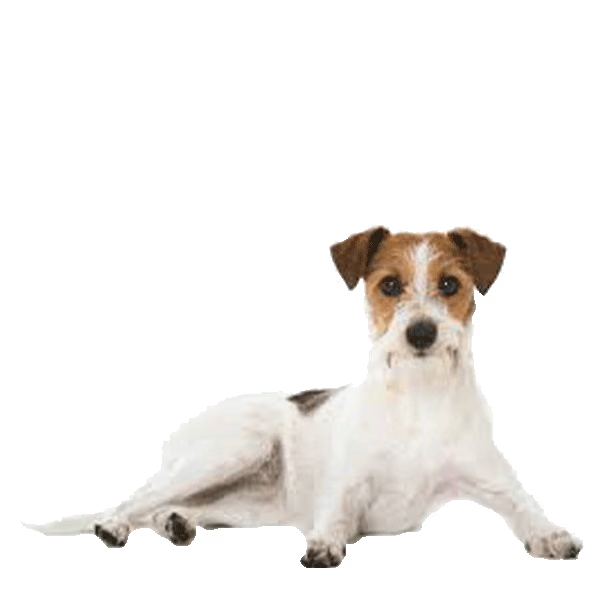
Kromfohrlander
The Kromfohrlander is a friendly, affectionate German companion breed that thrives as a devoted and good-natured family dog.
- Size
- Small
- Lifespan
- 13–15 years
- Origin
- Germany
- Temperament
- Friendly
- Standard colors
- White, Brown, and Tan
Characteristics
Coat and grooming
How the Kromfohrlander coat is built, and what that means when you groom it.
- Coat layers
- Double coat
- Coat texture
- Wire
- Coat length
- Medium
- Shedding
- Low shedding
Grooming guidance
Caution: A Kromfohrlander coat should be hand-stripped rather than clipped.
A wire coat is meant to be pulled out at the root once the hair is ready to release. Clippers cut it off part way instead, leaving the soft undercoat behind. The result is a coat that grows back limp and faded, and the weatherproof texture only returns after the hair is stripped out again.
Kromfohrlander colors and patterns
What each club's breed standard says about every Kromfohrlander color and pattern. Point at a ruling to see the club's own wording.
Breed standards describe the Kromfohrlander in White, Brown, and Tan. Standard patterns: Bicolor and Sable.
| Color or pattern | FCI | UKC | KUSA | AKC |
|---|---|---|---|---|
| White | Standard (“Basic colour white”) | Standard (“the basic color is white”) | Standard (“Basic colour white”) | Standard (“White & Brown”) |
| Brown | Standard (“light brown, tan to very dark brown markings”) | Standard (“tan or light to dark brown”) | Standard (“light brown, tan to very dark brown markings”) | Standard (“White & Brown”) |
| Tan | Standard (“light brown, tan to very dark brown markings”) | Standard (“tan or light to dark brown”) | Standard (“light brown, tan to very dark brown markings”) | Standard (“White & Tan”) |
| Black | Fault (“Black shaded patches without brown undercoat”) | Fault (“Black shaded patches without brown undercoat”) | Fault (“Black shaded patches without brown undercoat”) | No ruling |
| Patterns | ||||
| Bicolor | Standard (“Basic colour white with light brown, tan to very dark brown markings in shape of variously large patches or saddle”) | Standard (“the basic color is white, with patches or saddle of tan or light to dark brown”) | Standard (“Basic colour white with light brown, tan to very dark brown markings in shape of variously large patches or saddle”) | Standard (“White & Brown”) |
| Sable | Standard (“With a brown undercoat the tips of hairs may be black”) | Standard (“If the undercoat is brown, the tips of the hair may be black”) | Standard (“With a brown undercoat the tips of hairs may be black”) | No ruling |
| Solid | Fault (“Absence of markings on body”) | No ruling | Fault (“Absence of markings on body”) | No ruling |


| Color or pattern | FCI | UKC | KUSA |
|---|---|---|---|
| Brown | Standard (“medium brown permitted”) | No ruling | Standard (“medium brown permitted”) |
| Dark brown | Standard (“Dark brown, medium brown permitted”) | Standard (“Dark brown is preferred”) | Standard (“Dark brown, medium brown permitted”) |
| Light brown | Fault (“Light eyes”) | No ruling | Fault (“Light eyes”) |
| Blue | Disqualifying (“Blue eyes”) | Disqualifying (“Blue eyes”) | Disqualifying (“Blue eyes”) |
| Color or pattern | FCI | UKC | KUSA |
|---|---|---|---|
| Black | Standard (“preferably black, brown permitted”) | Standard (“preferably black, but brown is permitted”) | Standard (“preferably black, brown permitted”) |
| Liver | Standard (“preferably black, brown permitted”) | Standard (“preferably black, but brown is permitted”) | Standard (“preferably black, brown permitted”) |
What the rulings mean
- Standard
- Described by the club's breed standard.
- Fault
- Named by the club's breed standard as a fault: the animal can be shown but is penalized.
- Disqualifying
- The club's breed standard disqualifies an animal of this color or pattern.
Color changes
How a Kromfohrlander's colors can change over its life.
Blackchanges toRust
Coat · With body condition · can change back
Blackchanges toGray
Coat · Progressive
Blackchanges toBrown
Coat · In the sun · can change back
Whitechanges toRoan
Coat · With age · from 2 weeks
Blackchanges toSnow nose
Nose · With the season · can change back
Blackchanges toPink
Nose · With the season · can change back


Sources
Each ruling comes from the club's published breed standard or color list.
About the Kromfohrlander
The Kromfohrlander is a small German companion breed prized for its affectionate, home-loving nature and easy adjustment to condo or house living in the Philippines.
The Kromfohrlander is a small companion dog that started in Germany not long after World War II. It never worked as a hunting or herding breed. Instead it grew up as a family dog meant to live inside the house, which fits well with how most Filipino households already treat dogs as part of the family.
Build matters less than character here. Owners describe the breed as friendly, affectionate, playful, loyal, and easygoing. It sticks close to whoever it considers its person and follows that person from the sala to the kitchen without much prompting. Leave it alone in a cage or tied up in the yard for long hours and it does not cope well.
The breed stays rare outside continental Europe, and the Philippines is no exception. Most owners who bring one home value the companionship above anything else, plus a manageable size and an energy level that does not demand acreage to burn off.
| Attribute | Detail |
|---|---|
| Origin | Germany |
| Size | Small |
| Lifespan | 13 to 15 years |
| Group / role | Companion dog |
| Good with | Families, hands-on owners, homes with people around most of the day |
Who it suits
The Kromfohrlander fits a household that wants a small, people-focused dog and has someone around for most of the day, whether that is a stay-home parent, a retiree, or a family with a helper who is home. It works well with children who know how to handle a small dog gently. It is not the right pick for anyone who travels often or wants a pet content with being left on its own.
History and origin
The Kromfohrlander came together in Germany after World War II and takes its name from the Krumme Furche area near Siegen.
The Kromfohrlander's story begins in Germany in the years right after World War II. Credit for founding the breed usually goes to Ilse Schleifenbaum, who lived near Siegen. She took in a stray of mixed background, one some accounts link to dogs that had traveled with American or French troops during the war.
That stray was paired with a local female, and the puppies from the litter showed a look and character that repeated itself. Schleifenbaum kept selecting for those same traits over the following generations until the type held steady.
The name comes straight from the land around Siegen. "Kromfohr" points to a crooked furrow or stretch of terrain in that district, and "lander" simply means the dog that belongs to it. The Federation Cynologique Internationale (FCI) recognized the breed in the mid-1900s and filed it under the companion group. The Philippine Canine Club, Inc. (PCCI), as the country's FCI-affiliated registry, would recognize a Kromfohrlander's papers under that same international standard, though local owners should expect to import both the dog and its paperwork, since breeders on Philippine soil are essentially nonexistent.
Across its history the Kromfohrlander has stayed a house companion rather than a working dog. It was never bred to hunt, herd, or guard, and its numbers have remained modest, concentrated mostly in Germany and its neighbors.
Appearance and breed standard
The Kromfohrlander is a small, light-framed dog with two coat types, smooth or wire-haired, usually white with brown or tan patches.
The Kromfohrlander is small and lightly built, with proportions that stay balanced rather than exaggerated. The body runs a bit longer than the dog stands tall, the chest is moderate, and the whole picture reads as an agile companion, not a heavy or muscular animal. The head tapers in a wedge with a clear stop, the ears sit high and fold forward against the skull, and the tail carries in a soft curve.
Two coat types show up in the breed. The wire-haired type has a rough outer coat, a beard, and heavier furnishings on the face. The smooth-haired type carries a shorter, closer coat with a lighter beard. Both share the same frame and size regardless of coat.
| Trait | Standard |
|---|---|
| Height | Around 38 to 46 cm at the withers |
| Weight | Around 9 to 16 kg |
| Coat | Two varieties: wire-haired (rough, bearded) and smooth-haired (shorter, close) |
| Colors | White base with brown or tan patches; saddle or patched markings |
| Eyes | Dark, medium-sized, oval, giving an alert and friendly look |
Coat and colors
The usual pattern is white as the base, marked with patches that range from pale tan to deep brown, often across the head and as a saddle over the back, though how much marking a dog carries differs from one to the next. The coat handles normal time outdoors, but between the heat and the humidity here, it is not the kind of thick coat that shrugs off a Philippine afternoon just because it reads as weather-resistant on paper. The wire-haired coat grows longer furnishings on the muzzle and legs, while the smooth-haired coat lies flat and shows the body's outline more plainly.
Temperament and personality
The Kromfohrlander is friendly, affectionate, and devoted to its family, gentle at home but reserved with strangers until it warms up.
The Kromfohrlander bonds hard with its household and stays friendly and affectionate throughout its life. At home it is playful and good-natured, and it would rather join whatever the family is doing than watch from a corner. It reads mood and routine closely and picks up quickly when something in the house feels off.
Around family the dog is gentle and devoted, and it typically gets along with children who know to handle a small dog with care. With strangers or visitors, expect some initial reserve and a bit of barking to announce someone at the gate before it relaxes. It is alert, not aggressive, and it will not double as a guard dog.
The breed usually gets along with other household pets, especially when raised together or introduced slowly. Because it attaches so closely to its people, being left alone for long stretches, say during a full workday with no one around, can leave it unsettled. Socializing it early keeps it steady around new people, new places, and other animals it meets along the way.
| Trait | Rating |
|---|---|
| Affection | 5 |
| Energy | 3 |
| Trainability | 4 |
| Vocalness | 3 |
| Shedding | 2 |
Care and grooming
The Kromfohrlander needs moderate grooming depending on coat type, daily exercise timed to cooler hours, and a home life indoors rather than in a yard.
Everyday care for the Kromfohrlander runs moderate. It does not shed heavily, but between its coat and its need for company, it still asks for steady attention rather than none at all.
Grooming
- Brush the coat once or twice a week to clear loose hair and stop mats before they start; the wire-haired variety needs this more often.
- Have the wire-haired coat hand-stripped or trimmed on a schedule to keep its texture, rather than clipping it down.
- Check and clean the drop ears often. Philippine humidity makes ear infections more likely than in a drier climate, so this step matters more here than the label suggests.
- Trim nails every few weeks and brush teeth several times a week.
- Bathe only when the dog actually needs it. Frequent bathing during rainy season feels tempting but strips the coat's natural oils.
Exercise
- Walk the dog once or twice a day, timed for early morning or evening when the sun and heat index are lower.
- Add mental work such as scent games, short training drills, or puzzle feeders, which suits a mind this quick.
- Skip long, high-intensity runs at midday. Heat and humidity wear this breed down faster than distance does, and it prefers steady, varied activity with its people over a hard sprint.
Environment
The Kromfohrlander lives indoors with the family, not tied up outside or kept in a kennel. It adjusts to a condo unit or a house as long as it gets its daily walks and is not left on its own for long periods. During typhoon season, when walks get cut short or skipped for days at a stretch, make up for it with indoor play and training so the dog does not go stir-crazy. A gated garden helps but is no substitute for time with people.
Nutrition and feeding
The Kromfohrlander does well on a complete, balanced diet sized for a small dog, split into two meals a day, with weight watched closely.
The Kromfohrlander needs a complete and balanced diet built for a small breed. Pick a food matched to its life stage, with real protein and fat kept in check. Because the dog is small and only moderately active, measure portions rather than eyeballing them, since it puts on weight easily otherwise. Keep water available at all times, more so during the hot months when it drinks more than usual.
| Life stage | Amount per day | Meals |
|---|---|---|
| Puppy (2 to 6 months) | Per the food's label, split across the day | 3 to 4 |
| Junior (6 to 12 months) | Around 100 to 160 g of dry food | 2 to 3 |
| Adult | Around 90 to 150 g of dry food | 2 |
| Senior | Slightly less, on a lower-calorie formula | 2 |
Treats and supplements
Keep treats to around 10 percent of what the dog eats in a day, and break them into small pieces for training so they do not throw off the rest of the diet. A dog eating a complete commercial food generally does not need extra supplements; add vitamins or joint support only if the vet recommends it. Adjust the total amount up or down if the dog starts gaining or losing weight.
Health and lifespan
The Kromfohrlander is generally healthy and lives 13 to 15 years, though a handful of inherited conditions turn up in the breed.
The Kromfohrlander is a generally healthy breed with a lifespan of 13 to 15 years. Since the whole breed traces back to a small founding population, responsible breeders watch genetic diversity and run health screening closely. A handful of inherited conditions show up in the breed, so anyone buying a puppy, likely through import given how few are in the country, should ask for the parents' health test results before committing.
| Condition | Signs | Note |
|---|---|---|
| Patellar luxation | Skipping gait, occasional lameness in a hind leg | Affects the kneecap; ranges from mild to something needing surgery |
| Hyperkeratosis (foot pad and nose) | Thickened, cracked pads or nose | A skin condition tied to the breed, managed with care and moisturizer |
| Epilepsy | Seizures that vary in how often they happen | Manageable in many dogs with a vet's treatment plan |
| Eye conditions | Cloudiness, changes in vision | Screening helps catch affected lines early |
Preventive care
- Keep vaccinations and parasite control current, and factor in that ticks and fleas thrive year-round in a tropical climate.
- Book annual checkups, more often once the dog reaches its senior years.
- Keep the dog at a healthy weight to protect its joints.
- Look after teeth, ears, and foot pads on a set schedule.
- Buy only from breeders who screen for the conditions above and share the results honestly.
Training
The Kromfohrlander is intelligent and eager to please, and it responds best to calm, reward-based training rather than a heavy hand.
The Kromfohrlander is sharp and attentive, and it generally wants to please the people around it. Put those two traits together and training moves fast when it stays consistent. The breed is sensitive, so a harsh correction tends to backfire, leaving the dog anxious or withdrawn rather than obedient. Short, upbeat sessions hold its attention better than long ones. Socializing it early counts for a lot too, since the breed can turn reserved around strangers, and calm, early exposure to new people, dogs, and places heads that off.
Basics
- Start socialization and gentle handling from puppyhood.
- Teach the dog its name and a solid recall before anything else.
- Layer in sit, down, and stay through short sessions.
- Practice calm greetings so visitors do not set off a barking fit.
- Work up to walking politely on lead and settling on its own for short stretches at a time.
Breeding
Kromfohrlander breeding takes care because the breed comes from a small founding population, and litters, especially in the Philippines, stay few and far between.
Breeding the Kromfohrlander takes real care since the whole breed traces back to a handful of founding dogs. Keeping the gene pool diverse stays a constant concern, and breed clubs track pedigrees and health results to avoid pairing dogs too closely related. Any dog used for breeding should be health-screened, sound in temperament, and fully grown before anyone breeds it.
Females are usually bred once they are mature, not on their first heat. Once mating succeeds, a dog's pregnancy runs about 63 days. Litters in this breed run small. Puppies arrive helpless and depend fully on their mother for the first weeks, with eyes opening around two weeks old and weaning starting somewhere between four and six weeks.
Raising the litter well means keeping the puppies with their mother and littermates through the early socialization window, then adding gentle handling and new experiences before they leave for new homes. A responsible breeder will not place a puppy earlier than about eight weeks and will match each one to a household that fits.
| Metric | Value |
|---|---|
| Sexual maturity | Around 12 to 18 months |
| Gestation | About 63 days |
| Average litter size | Small, often around 3 to 5 puppies |
| Weaning age | About 4 to 6 weeks |
| Recommended placement age | From about 8 weeks |
Registering your Kromfohrlander and its microchip in the Philippines
The city vet office handles the RA 9482 paperwork; a free United Pet Club record is what a finder anywhere can actually search for your Kromfohrlander.
How to register a Kromfohrlander in the Philippines
A Kromfohrlander that gets loose during a storm is identified by whatever record answers the scan, not by the barangay it came from. Give it a record that answers: your mobile number, the dog's photo, and his details, free for life with United Pet Club. Register your dog today and it is done for good.
If a vet has already implanted a chip, the number still has to be filed where a scanner can trace it, because an unfiled chip points at nobody. Register the microchip free on the lifetime plan: any brand sold in the Philippines qualifies, updates after you move house or change SIM cost nothing, and the record stays searchable here and abroad. Create your free account and cover both in one go.
How do I register my Kromfohrlander in the Philippines?
Open a free United Pet Club account, add your Kromfohrlander's details and a photo, then save the profile. It stays free for his whole life and sits alongside the city vet office registration RA 9482 requires.
How do I register my Kromfohrlander's microchip?
Type the 15-digit chip number into your free account together with your mobile number and address. The lifetime plan charges nothing for the registration or for any update, whatever brand the clinic used.
Is registration required for a Kromfohrlander in the Philippines?
Yes, RA 9482 requires dog registration with your city or municipal veterinary office, along with current anti-rabies vaccination. The United Pet Club profile is the searchable half: free, worldwide, and tied to your current mobile.
How much does it cost to register a Kromfohrlander?
Nothing. The free lifetime plan covers the profile, the microchip record, and every update, with no renewal fees at all.
Frequently asked questions
Common questions about the Kromfohrlander cover its size, temperament, care needs, lifespan, suitability, and availability.
How big does a Kromfohrlander grow?
It stays small, standing around 38 to 46 cm at the shoulder and weighing about 9 to 16 kg.
What is a Kromfohrlander's temperament like?
Friendly, affectionate, playful, and devoted. It bonds tightly with its family and is usually gentle with kids, though it takes a while to warm up to strangers.
Is a Kromfohrlander hard to take care of?
Care stays moderate. It needs weekly brushing (more for the wire-haired type), daily walks, and someone around most of the time. Its biggest need is company, not being left alone for hours on end.
How long do Kromfohrlanders live?
Typically 13 to 15 years.
Is a Kromfohrlander good for a condo or a family with kids?
Yes. It fits families and adjusts fine to a condo unit or a house, as long as it gets daily exercise and regular company. It suits an owner who is home most of the day best.
Where can I get a Kromfohrlander in the Philippines?
It is hard to find. The breed stays uncommon even in Europe, let alone here, and litters are small, so expect a wait and possibly an import. Look for breeders who health-test their dogs rather than the first listing you find.
Do Kromfohrlanders shed a lot?
Not much. Regular brushing keeps loose hair manageable, and the wire-haired variety benefits from periodic hand-stripping on top of that.
From the community
Ask about the KromfohrlanderNo questions about the Kromfohrlander yet. Be the first to ask.
Browse Dog breeds