
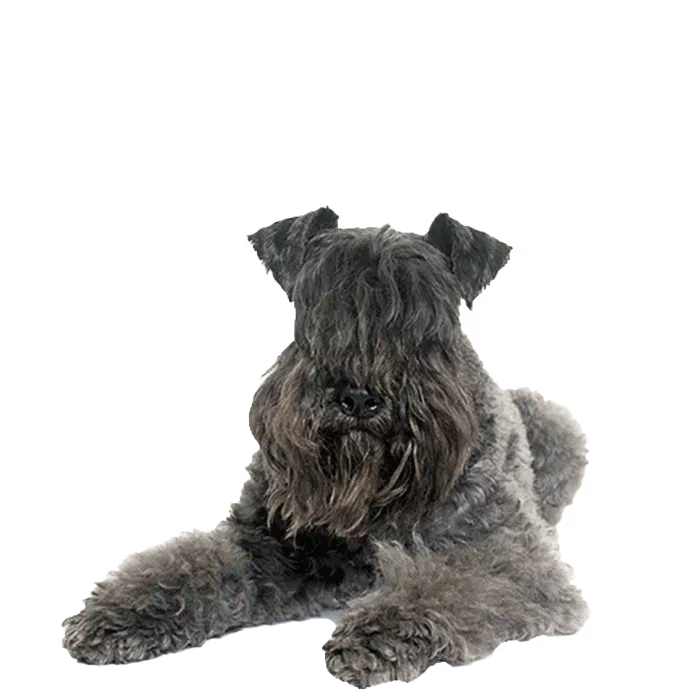
Kerry Blue Terrier
The Kerry Blue Terrier is a spirited, intelligent Irish breed known for its distinctive soft blue coat and devoted, alert nature.
- Size
- Medium
- Lifespan
- 12–15 years
- Origin
- Ireland
- Temperament
- Spirited
- Standard colors
- Black, Gray, and Blue and 3 more
Characteristics
Coat and grooming
How the Kerry Blue Terrier coat is built, and what that means when you groom it.
- Coat layers
- Single coat
- Coat texture
- Wavy, Curly
- Coat length
- Medium
- Shedding
- Low shedding
Grooming guidance
Caution: A Kerry Blue Terrier coat mats easily.
Fine or long hair tangles at the base of the coat, out of sight, where the mats tighten and pull on the skin. Brushing has to reach right down to the roots in sections, not just skim the surface.
Information: A Kerry Blue Terrier needs clipping every few weeks.
This coat keeps growing rather than shedding out, so it has to be trimmed every few weeks. Left to grow it mats down against the skin and traps moisture, dirt and heat.
Kerry Blue Terrier colors and patterns
What each club's breed standard says about every Kerry Blue Terrier color and pattern. Point at a ruling to see the club's own wording.
Breed standards describe the Kerry Blue Terrier in Black, Gray, Blue, Silver, Slate, and Tan. Standard patterns: Solid.
| Color or pattern | FCI | AKC | UKC | KC | KUSA |
|---|---|---|---|---|---|
| Black | Standard (“Black is permissible only up to the age of 18 months”) | Standard (“an apparent black at birth”) | Standard (“puppies are born black or nearly black”) | Standard (“Black”) | Standard (“a dark colour up to the age of 18 months”) |
| Gray | Standard (“Blue of any shade”) | Standard (“Gray”) | Standard (“Any shade of blue is permissible”) | Standard (“Any shade of blue”) | Standard (“Any shade of blue”) |
| Blue | Standard (“Blue of any shade”) | Standard (“Blue”) | Standard (“Any shade of blue is permissible”) | Standard (“Any shade of blue”) | Standard (“Any shade of blue”) |
| Silver | Standard (“Blue of any shade”) | Standard (“Silver”) | Standard (“Any shade of blue is permissible”) | Standard (“Any shade of blue”) | Standard (“Any shade of blue”) |
| Slate | Standard (“Blue of any shade”) | Standard (“Slate Blue”) | Standard (“Any shade of blue is permissible”) | Standard (“Any shade of blue”) | Standard (“Any shade of blue”) |
| Tan | Standard (“as is also a shade of tan”) | Standard (“shades or tinges of brown”) | Standard (“shades of brown”) | Standard (“Tan permissible in puppies”) | Standard (“Tan permissible in puppies”) |
| Albino | Fault | No ruling | Disqualifying (“Albinism”) | Not recognized | Not recognized |
| Patterns | |||||
| Solid | No ruling | Standard (“of a fairly uniform color throughout”) | Standard (“Color is fairly uniform”) | Not recognized | Not recognized |

| Color or pattern | FCI | AKC | UKC | KC | KUSA |
|---|---|---|---|---|---|
| Dark brown | Standard (“Dark”) | Standard (“Dark”) | Standard (“Dark”) | Standard (“Dark as possible”) | Standard (“Dark as possible”) |
| Hazel | Standard (“dark hazel”) | No ruling | Standard (“dark hazel”) | No ruling | No ruling |
| Light brown | Fault (“Yellow or light coloured eyes”) | No ruling | Fault (“light eyes”) | No ruling | No ruling |
| Yellow | Fault (“Yellow or light coloured eyes”) | Fault (“Anything approaching a yellow eye is very undesirable”) | Fault (“Yellow eyes”) | No ruling | No ruling |
| Color or pattern | FCI | AKC | UKC | KC | KUSA |
|---|---|---|---|---|---|
| Black | Standard (“Black”) | Standard (“Black”) | Standard (“Nose is black”) | Standard (“nose black”) | Standard (“nose black”) |
What the rulings mean
- Standard
- Described by the club's breed standard.
- Fault
- Named by the club's breed standard as a fault: the animal can be shown but is penalized.
- Disqualifying
- The club's breed standard disqualifies an animal of this color or pattern.
- Not recognized
- The club does not accept this color or pattern for the breed.
Color changes
How a Kerry Blue Terrier's colors can change over its life.
Blackchanges toRust
Coat · With body condition · can change back
Blackchanges toGray
Coat · Progressive
Blackchanges toBlue
Coat · Progressive · from 0 to 78 weeks
Blackchanges toBrown
Coat · In the sun · can change back
Blackchanges toSnow nose
Nose · With the season · can change back
Blackchanges toPink
Nose · With the season · can change back

Sources
Each ruling comes from the club's published breed standard or color list.
Meet some of our Kerry Blue Terrier
A few of the Kerry Blue Terrier profiles members have added to United Pet Club.


About the Kerry Blue Terrier
The Kerry Blue Terrier is a medium-sized Irish working terrier known for its soft blue-gray coat and its loyal, high-spirited, watchful temperament.
The Kerry Blue Terrier is a medium-sized terrier that came from the hilly countryside of County Kerry in Ireland. Farmers there bred it to do a bit of everything: catch rats and other vermin, herd cattle and sheep, guard the homestead, and retrieve game from water. That working background still shows today. The breed is energetic, quick to pick up new commands, and always alert to what is happening around it.
Its coat is the feature most owners notice first. Puppies are born black, and the coat gradually lightens over the first 12 to 18 months into the mature blue-gray that gives the breed its name. The coat is soft, dense, and wavy rather than wiry, and it sheds very little, which many Filipino pet owners appreciate in a tropical climate where a heavy-shedding dog means more cleaning around the house.
Kerry Blues form close bonds with their families and like being part of daily household activity. They are alert and protective, so they make dependable watchdogs, but they need consistent socialization from puppyhood to stay even-tempered around visitors, other dogs, and the everyday noise of life in a Philippine neighborhood.
| Attribute | Detail |
|---|---|
| Origin | Ireland (County Kerry) |
| Size | Medium |
| Lifespan | 12 to 15 years |
| Group / role | Terrier; historic farm and vermin dog |
| Good with | Committed families; older children; single-dog households with early socialization |
Which owners it suits
The Kerry Blue fits owners who can commit to daily exercise, regular grooming, and consistent training, even with Metro Manila traffic and unpredictable weather cutting into the day. It thrives with people who want an engaged, hands-on dog and who can manage its terrier instincts around smaller pets and unfamiliar dogs. It is not the right fit for a household looking for a low-maintenance, mostly indoor companion that needs little attention.
History and origin
The Kerry Blue Terrier developed as a farm and vermin dog in County Kerry, Ireland, and later became recognized as one of Ireland's national breeds.
The breed is named after County Kerry in southwestern Ireland, where it had already become a fixture on small farms by the 1800s. Local farmers relied on it for practically every job on the property: killing rats and other vermin, moving cattle and sheep, guarding the home, and retrieving game on land and in water. No one has firmly established its exact ancestry. Several theories about which breeds contributed exist, but none is conclusively proven.
For most of its early history, the Kerry Blue was a working farmer's dog rather than a show dog. It started drawing wider attention in Ireland in the early 1900s, and the first breed clubs formed around that time. The Dublin Irish Blue Terrier Club, founded in 1920, helped set breed standards and introduce the dog beyond County Kerry.
The Kerry Blue carries strong ties to Irish national identity and is sometimes mentioned in accounts of the Irish independence movement. The Kennel Club in Britain recognized it in the early 1920s, and the American Kennel Club followed in 1922.
From Ireland the breed made its way to Britain, the United States, and continental Europe, and eventually to Asia, including the Philippines, where it remains uncommon and is mostly kept by dedicated hobbyist breeders and show enthusiasts registered with the Philippine Canine Club, Inc. (PCCI). Today it works mainly as a companion, show, and sporting dog, though it has not lost the drive of its farm-dog origins.
Appearance and breed standard
The Kerry Blue Terrier is a compact, muscular medium-sized dog with a soft, wavy blue-gray coat, a long head, and a level topline.
The Kerry Blue Terrier is a well-balanced, muscular dog of medium build. It has a long head, small dark eyes, a strong jaw, and small to medium ears that fold forward toward the skull. The body is short-coupled and compact, the topline stays level, and the tail is carried upright. Overall, it looks like what it was bred to be: a sturdy working terrier, not a dog built purely for the show ring.
| Trait | Standard |
|---|---|
| Height | Males about 46 to 48 cm (18 to 19.5 in); females slightly smaller |
| Weight | About 15 to 18 kg (33 to 40 lb) |
| Coat | Soft, dense, wavy; non-shedding; single-layered |
| Colors | Any shade of blue-gray, with or without black points |
| Eyes | Small, dark, well placed |
Coat and colors
Kerry Blue puppies are born black. The coat clears gradually over the first 12 to 18 months and settles into the mature blue-gray the breed is known for. Acceptable shades range from deep slate to a lighter blue-gray, and some dogs keep black points on the muzzle, ears, feet, or tail. A coat that has not finished clearing to blue by around 18 months is considered a fault under most standards. The texture stays soft and wavy rather than harsh, and because it grows continuously rather than shedding out, it needs regular trimming, ideally with a groomer who understands how local heat and humidity affect coat condition.
Temperament and personality
The Kerry Blue Terrier is loyal, spirited, and intelligent, closely bonded to its family, alert toward strangers, and strong-willed around other animals.
The Kerry Blue is a lively, confident terrier that attaches strongly to its household. It is affectionate and playful with people it knows and usually wants to be wherever the family is, whether that is the sala or the backyard. Its intelligence makes it a fast learner, but that same intelligence means it gets bored or stubborn quickly if it does not get enough mental work.
Around strangers, the breed is naturally watchful and a bit reserved, which makes it a reliable watchdog for a home or compound. Early and ongoing socialization helps it learn the difference between an actual threat and the regular stream of visitors, delivery riders, and neighbors that come through a typical Filipino household. It usually gets along well with children when raised together, and it tends to suit older kids who already know how to handle an energetic dog.
The breed's terrier background comes out most clearly around other animals. Many Kerry Blues have a strong prey drive toward small pets and can be pushy with unfamiliar dogs, especially of the same sex, which matters in a country where street dogs and neighborhood pets are a common sight on daily walks. Careful, gradual introductions and consistent supervision are essential in multi-pet homes, and some Kerry Blues genuinely do better as the only dog in the house.
| Trait | Rating |
|---|---|
| Affection | 5 |
| Energy | 4 |
| Trainability | 4 |
| Vocalness | 3 |
| Shedding | 1 |
Care and daily needs
The Kerry Blue Terrier needs frequent grooming to manage its growing coat, daily exercise for its energy, and a securely fenced space to move around in.
Caring for a Kerry Blue in the Philippines comes down to two things: managing the coat and giving it enough exercise. The coat grows continuously and barely sheds, so loose hair stays trapped and mats quickly, especially in humid weather when the coat stays damp longer after a walk or a bath. Physical and mental activity matter just as much, because a Kerry Blue that is not getting enough exercise tends to become restless and destructive indoors.
Grooming
- Brush and comb the coat several times a week to stop matting before it starts, which happens faster in humid conditions.
- Have the coat trimmed or clipped roughly every four to six weeks to keep its shape.
- Clean the beard and muzzle area regularly, since food, water, and moisture from the humid air tend to collect there.
- Check and clean the ears, and trim the nails as needed.
Exercise
- Give the dog at least 45 to 60 minutes of activity daily, scheduled for the cooler early morning or evening hours to avoid the midday heat.
- Combine walks with play, fetch, or off-leash running in a secure, fenced area.
- Add training games, scent work, or puzzle toys to keep the dog mentally occupied, particularly during the rainy season when outdoor time is limited.
- Keep the dog leashed or fenced in open spaces because of its prey drive, and stay extra watchful around community dogs.
Environment
The Kerry Blue adjusts to condo or house living if it gets enough daily exercise, but it does best in a home with a securely fenced yard where it can move around and explore. It wants to stay close to its family indoors, ideally in an air-conditioned space during the hottest months, and it is not suited to being left outdoors for long stretches, whether under the sun or through a sudden downpour.
Nutrition and feeding
The Kerry Blue Terrier does well on a complete diet suited to its life stage, fed in measured meals to keep a lean, muscular build in the tropical heat.
A Kerry Blue should eat a complete, balanced diet formulated for its size and life stage. As an active, muscular breed, it benefits from good-quality protein, but portions need to be controlled to keep it lean, since carrying extra weight puts strain on the joints. Split the daily ration into two meals to keep its energy steady and lower the risk of an upset stomach, which can happen quickly in hot, humid weather if food is left out too long. Always keep fresh water available, and wipe down the dog's beard after meals to keep the muzzle area dry rather than damp.
| Life stage | Amount per day | Meals |
|---|---|---|
| Puppy (2 to 6 months) | Per puppy-food label, divided | 3 to 4 |
| Young dog (6 to 12 months) | Per puppy/junior label | 2 to 3 |
| Adult (1 to 7 years) | About 200 to 300 g dry food | 2 |
| Senior (7+ years) | Reduced calories, maintain weight | 2 |
Treats and supplements
Keep treats to no more than about 10 percent of daily calories and factor them into the total ration. Most Kerry Blues on a complete commercial diet do not need extra supplements, though a veterinarian may recommend joint support for older or highly active dogs. Introduce any diet change gradually over about a week to avoid stomach upset, especially when switching between imported dog food brands the dog is not used to.
Health and lifespan
The Kerry Blue Terrier is generally healthy with a lifespan of 12 to 15 years, though it has a few breed-associated conditions worth watching for.
The Kerry Blue Terrier is a generally sturdy breed with a typical lifespan of 12 to 15 years. As with any breed, certain conditions show up more often, and responsible breeders screen for the ones with a hereditary basis. Routine veterinary care, weight control, and attention to the coat and skin help keep most Kerry Blues healthy through their lives, alongside standard precautions against local parasites such as heartworm, ticks, and fleas, which stay active year-round in the Philippine climate.
| Condition | Signs | Note |
|---|---|---|
| Hip dysplasia | Stiffness, limping, reluctance to exercise | Screen breeding stock; keep dog lean |
| Progressive neuronal abiotrophy | Loss of coordination, head tremor in pups | Rare inherited neurological disorder |
| Eye disorders (e.g. cataracts, KCS) | Cloudiness, redness, excess tearing | Regular eye checks recommended |
| Skin and coat issues (cysts, dermatitis) | Lumps, itching, irritation | Common in the breed; monitor the coat |
| Hypothyroidism | Weight gain, lethargy, coat changes | Diagnosed by blood test; manageable |
Preventive care
- Keep vaccinations and parasite control up to date, including heartworm prevention, which matters year-round given the mosquito activity in a tropical climate.
- Maintain a lean body condition to protect the joints.
- Schedule annual veterinary checks, and twice yearly once the dog reaches its senior years.
- Examine the skin and coat regularly for lumps, cysts, or irritation, which can develop faster in heat and humidity.
- Get a puppy from a breeder who health-tests for hip and eye conditions rather than buying on impulse.
Training and socialization
The Kerry Blue Terrier is intelligent and trainable but independent, so it responds best to consistent, reward-based training started early.
The Kerry Blue picks things up quickly and likes having a job to do, which makes it capable in obedience, agility, and other dog sports gaining ground among Filipino hobbyists. Its terrier independence means it will also test limits, so training needs to stay consistent, fair, and interesting. Short, varied sessions hold its focus better than long, repetitive drills. Early socialization matters even more given the breed's watchfulness toward strangers and its drive around other animals, including the community dogs common in most neighborhoods.
Basics
- Start socialization during puppyhood, exposing the dog to different people, places, and other animals.
- Teach core cues (sit, stay, recall, leave it) through short daily sessions.
- Reward correct responses right away with food, praise, or play.
- Practice reliable recall before allowing any off-leash freedom, especially near busy streets.
- Keep training consistent across everyone in the household.
- Add advanced work such as agility or scent games to give the dog's mind something to do.
Breeding and raising young
Kerry Blue Terriers reach maturity around one to two years, have average-sized litters, and benefit from health screening of both parents before mating.
Kerry Blue Terriers reach physical maturity at around one to two years of age, though breeders generally wait until a dog is fully mature and health-tested before breeding it. Females cycle roughly twice a year. Gestation lasts about 63 days, and litter sizes are moderate for a medium breed.
Responsible breeding starts with screening both parents for hereditary hip, eye, and neurological conditions, along with a close look at temperament. Pregnant females need a quiet space, a complete diet adjusted for the demands of pregnancy and nursing, and veterinary monitoring through whelping, along with a cool, comfortable spot away from the heat during the later stages.
Newborn puppies are born black and depend fully on the mother for the first weeks. Weaning usually starts around three to four weeks, with puppies moving to solid food gradually. Socialization should begin early within the litter, since exposure to handling, sounds, and gentle new experiences in those first weeks shapes adult temperament. Puppies typically go to new homes from about eight weeks old, by which point the coat will not yet have cleared to its mature blue. In the Philippines, prospective buyers usually go through a breeder registered with the Philippine Canine Club, Inc. (PCCI) to confirm the puppy's pedigree and health background.
| Metric | Value |
|---|---|
| Sexual maturity | About 12 to 24 months |
| Heat cycles | About twice a year |
| Gestation | About 63 days |
| Average litter size | About 4 to 8 puppies |
| Weaning | About 3 to 6 weeks |
| Coat color at birth | Black, clearing to blue over 12 to 18 months |
Registering your Kerry Blue Terrier and its microchip in the Philippines
The city vet office handles the RA 9482 paperwork; a free United Pet Club record is what a finder anywhere can actually search for your Kerry Blue Terrier.
How to register a Kerry Blue Terrier in the Philippines
Type in your Kerry Blue Terrier's name, his birth date, and a clear photo, add your mobile number, and save. That is the entire process, and the profile stays free for his whole life. Dog registration works with or without a chip, so the vet visit can come later.
The clinic's part ended with the implant; the tracing part is yours. File your Kerry Blue Terrier's 15-digit number with United Pet Club and every scan leads to your phone: free for life, all brands accepted, updates free every time your details change. Microchip registration plus a free account finishes the job.
How do I register my Kerry Blue Terrier in the Philippines?
Open a free United Pet Club account, add your Kerry Blue Terrier's details and a photo, then save the profile. It stays free for his whole life and sits alongside the city vet office registration RA 9482 requires.
How do I register my Kerry Blue Terrier's microchip?
Type the 15-digit chip number into your free account together with your mobile number and address. The lifetime plan charges nothing for the registration or for any update, whatever brand the clinic used.
Is registration required for a Kerry Blue Terrier in the Philippines?
Yes, RA 9482 requires dog registration with your city or municipal veterinary office, along with current anti-rabies vaccination. The United Pet Club profile is the searchable half: free, worldwide, and tied to your current mobile.
How much does it cost to register a Kerry Blue Terrier?
Nothing. The free lifetime plan covers the profile, the microchip record, and every update, with no renewal fees at all.
Frequently asked questions
Common questions about the Kerry Blue Terrier's size, temperament, grooming needs, lifespan, suitability, and availability in the Philippines.
How big does a Kerry Blue Terrier get?
It is a medium breed. Males stand about 46 to 48 cm (18 to 19.5 in) at the shoulder, females a little less, and most weigh about 15 to 18 kg (33 to 40 lb).
What is the Kerry Blue Terrier's temperament like?
It is loyal, spirited, intelligent, and alert. It bonds closely with its family, stays watchful around strangers, and has a strong terrier drive around other animals that calls for early socialization.
Is the Kerry Blue Terrier hard to take care of?
It falls somewhere between moderate and demanding. The continuously growing coat needs brushing several times a week and trimming every four to six weeks, and the dog needs daily exercise plus consistent training to stay well-balanced, especially in a hot and humid climate.
How long do Kerry Blue Terriers live?
Most live 12 to 15 years with good care, regular veterinary checkups, and a healthy weight.
Does the Kerry Blue Terrier shed a lot?
It sheds very little. The soft, single-layered coat holds on to loose hair instead of dropping it, which is why regular brushing and trimming are needed to stop it from matting.
Is the Kerry Blue Terrier a good family dog?
It can be, in an active household that provides exercise, grooming, and training. It generally suits older children and does best with early socialization, and some individuals prefer being the only dog in the home.
Are Kerry Blue Terriers easy to find in the Philippines?
Not really. They are uncommon compared with mainstream breeds locally, and prospective owners usually join a waiting list with a reputable breeder registered with the Philippine Canine Club, Inc. (PCCI) that health-tests the parents.
From the community
Ask about the Kerry Blue TerrierNo questions about the Kerry Blue Terrier yet. Be the first to ask.
Browse Dog breeds