

Great Dane
The Great Dane is a friendly giant known as a gentle, devoted companion that combines towering size with a sweet, patient temperament.
- Size
- Giant
- Lifespan
- 7–10 years
- Origin
- Germany
- Temperament
- Friendly
- Standard colors
- Black, White, and Gray and 2 more
Characteristics
Coat and grooming
How the Great Dane coat is built, and what that means when you groom it.
- Coat layers
- Single coat
- Coat texture
- Smooth
- Coat length
- Short
- Shedding
- Moderate shedding
Great Dane colors and patterns
What each club's breed standard says about every Great Dane color and pattern. Point at a ruling to see the club's own wording.
Breed standards describe the Great Dane in Black, White, Gray, Blue, and Fawn. Standard patterns: Solid, Brindle, Merle, Harlequin, Piebald, Roan, Sable, Mantle, and Reverse brindle.
| Color or pattern | FCI | AKC | UKC | KC | KUSA |
|---|---|---|---|---|---|
| Black | Standard (“Black: Jet black”) | Standard (“Black”) | Standard (“Black: Glossy black”) | Standard (“Black is black”) | Standard (“Black: Jet black”) |
| White | Standard (“Harlequin: Basic colour pure white”) | Standard (“White”) | Standard (“Harlequin: Black torn patches ... over a white background”) | Standard (“Harlequins: pure white underground”) | Standard (“Harlequin: Basic colour pure white”) |
| Gray | Standard (“Merle: grey and black spotted”) | Standard (“Merle Color: A pale gray to dark gray merle base color”) | Standard (“Merle: A pale gray to dark gray base color”) | Not recognized | Standard (“Merle: grey and black spotted”) |
| Blue | Standard (“Blue: Pure steel blue”) | Standard (“Blue”) | Standard (“Blue: Pure steel blue”) | Standard (“Blues: colour varies from light grey to deep slate”) | Standard (“Blue: Pure steel blue”) |
| Fawn | Standard (“Fawn: Light gold fawn to deep gold fawn”) | Standard (“Fawn”) | Standard (“Fawn: Yellow gold with a black mask”) | Standard (“Fawns: colour varies from lightest buff to deepest orange”) | Standard (“Fawn: Light gold fawn to deep gold fawn”) |
| Albino | Disqualifying (“Harlequin Great Danes: White without any black (albinos)”) | Disqualifying | Disqualifying (“Albinism”) | Not recognized | Disqualifying (“Harlequin Great Danes: White without any black (albinos)”) |
| Silver | Not recognized | Disqualifying (“Silver”) | Disqualifying | Not recognized | Not recognized |
| Chocolate | Not recognized | Disqualifying (“Chocolate”) | Disqualifying | Not recognized | Not recognized |
| Isabella | Disqualifying (“Fawn and brindle: Silver blue or isabella-colored, with a white blaze”) | Disqualifying | Disqualifying | Not recognized | Disqualifying (“Fawn and brindle: Silver blue or isabella-coloured, with a white blaze”) |
| Patterns | |||||
| Solid | Standard (“Fawn: ... evenly shaded throughout the body”) | Standard (“Black”) | Standard (“Black: Glossy black”) | Standard (“Black is black”) | Standard (“Fawn: ... evenly shaded throughout the body”) |
| Brindle | Standard (“Brindle”) | Standard (“Brindle”) | Standard (“Brindle”) | Standard (“Brindles: must be striped”) | Standard (“Brindle”) |
| Merle | Standard (“Merle (grey-black splashed patches)”) | Standard (“Merle”) | Standard (“Merle”) | Not recognized (“Merle”) | Standard (“Merle (grey-black splashed patches)”) |
| Harlequin | Standard (“Harlequin (white with black splashed patches)”) | Standard (“Harlequin”) | Standard (“Harlequin”) | Standard (“Harlequins”) | Standard (“Harlequin (white with black splashed patches)”) |
| Piebald | Standard (“dogs with basic white colour and large black patches so called “Plattenhunde””) | Fault (“Piebald”) | Disqualifying | Not recognized | Standard (“dogs with basic white colour and large black patches so called “Plattenhunde””) |
| Roan | Fault (“blue-grey ticking in the white”) | Standard (“Eligible but less desirable, are black hairs showing through the white base coat”) | Standard (“single black hairs showing through the white background ... allowed but not preferred”) | Not recognized | Fault (“blue-grey ticking in the white”) |
| Sable | Fault (“Fawn Danes: grey, blue, or sooty fawn”) | Fault (“dirty colored Fawns; are not desirable”) | Fault (“black-fronted or dirty colored fawns”) | Standard (“dark shadings on head and ears acceptable”) | Fault (“Fawn Danes: grey, blue, or sooty fawn”) |
| Mantle | Standard (“Included here are “Mantel Great Danes””) | Standard (“Mantle”) | Standard (“Mantle”) | Standard (“Mantle: Black and white with a solid, black blanket”) | Standard (“Included here are “Mantel Great Danes””) |
| Reverse brindle | Standard (“Brindle”) | Standard (“Brindle”) | Standard (“Brindle”) | Standard (“Brindles: must be striped”) | Standard (“Brindle”) |
| Double merle | No ruling | No ruling | Disqualifying | Not recognized | No ruling |


| Color or pattern | FCI | AKC | UKC | KC | KUSA |
|---|---|---|---|---|---|
| Blue | Standard (“In harlequins ... pale (ice blue) eyes ... are to be tolerated”) | Standard (“In Harlequins and Merles ... blue eye(s) ... are permitted”) | Standard (“In Harlequins and Merles ... blue eye(s) ... are permitted”) | Standard (“Blues: ... the nose and eyes may be blue; in harlequins, wall eyes”) | Standard (“In harlequins ... pale (ice blue) eyes ... are to be tolerated”) |
| Dark brown | Standard (“As dark as possible”) | Standard (“dark”) | Standard (“dark brown”) | Standard (“eyes and nails preferably dark”) | Standard (“As dark as possible”) |
| Light brown | Standard (“in blue dogs slightly lighter eyes are tolerated”) | No ruling | Standard (“A slightly lighter shade of brown is acceptable, but not preferred, in the blue Danes”) | No ruling | Standard (“in blue dogs slightly lighter eyes are tolerated”) |
| Amber | Fault (“light piercing or amber coloured eyes are undesirable”) | No ruling | No ruling | No ruling | Fault (“light piercing or amber-coloured eyes are undesirable”) |
| Yellow | No ruling | No ruling | Fault (“yellow eyes”) | No ruling | No ruling |
| Patterns | |||||
| Odd-eyed | Standard (“In harlequins ... two differently coloured eyes are to be tolerated”) | Standard (“In Harlequins and Merles ... eyes of different colors are permitted”) | Standard (“In Harlequins and Merles ... eyes of different colors are permitted”) | Standard (“Wall, or odd eyes permissible in harlequins”) | Standard (“In harlequins ... two differently coloured eyes are to be tolerated”) |

| Color or pattern | FCI | AKC | UKC | KC | KUSA |
|---|---|---|---|---|---|
| Black | Standard (“Must be black with the exception of harlequins”) | Standard (“Nose shall be black”) | Standard (“The nose is black”) | Standard (“Nose always black, except in blues and harlequins”) | Standard (“Must be black with the exception of harlequins”) |
| Blue | Standard (“In blue dogs the colour of the nose is anthracite (diluted black)”) | Standard (“in the blue Dane, where it is a dark blue-black”) | Standard (“blue Danes where the nose is a dark blue-black”) | Standard (“Blues: ... the nose and eyes may be blue”) | Standard (“In blue dogs the colour of the nose is anthracite (diluted black)”) |
| Pink | Standard (“harlequins: ... flesh coloured nose is tolerated”) | Fault (“a solid pink color nose is not desirable”) | Fault (“Pink nose”) | Standard (“In harlequins, ... pink noses ... permissible”) | Standard (“harlequins: ... flesh coloured nose is tolerated”) |
| Liver | Disqualifying (“Nose: Liver coloured”) | No ruling | No ruling | No ruling | Disqualifying (“Nose: Liver coloured”) |
| Patterns | |||||
| Butterfly nose | Standard (“a butterfly nose (black with pink patches) ... is tolerated”) | Standard (“A black spotted nose is permitted on the Harlequins and Merles”) | Standard (“A black spotted nose is permitted on Harlequins and Merles”) | Standard (“In harlequins, ... butterfly noses permissible”) | Standard (“a butterfly nose (black with pink patches) ... is tolerated”) |

What the rulings mean
- Standard
- Described by the club's breed standard.
- Fault
- Named by the club's breed standard as a fault: the animal can be shown but is penalized.
- Disqualifying
- The club's breed standard disqualifies an animal of this color or pattern.
- Not recognized
- The club does not accept this color or pattern for the breed.
Color changes
How a Great Dane's colors can change over its life.
Blackchanges toRust
Coat · With body condition · can change back
Blackchanges toGray
Coat · Progressive
Blackchanges toBrown
Coat · In the sun · can change back
Whitechanges toRoan
Coat · With age · from 2 weeks
Bluechanges toDark brown
Eyes · With age · from 2 weeks
Bluechanges toBrown
Eyes · With age · from 2 weeks
Bluechanges toLight brown
Eyes · With age · from 2 weeks
Bluechanges toAmber
Eyes · With age · from 2 weeks
Bluechanges toHazel
Eyes · With age · from 2 weeks
Bluechanges toYellow
Eyes · With age · from 2 weeks
Blackchanges toSnow nose
Nose · With the season · can change back
Blackchanges toPink
Nose · With the season · can change back

Sources
Each ruling comes from the club's published breed standard or color list.
Health
Conditions recorded as more common in the Great Dane than in its species as a whole. A higher risk is not a diagnosis: many never develop any of them, and your vet can say which screening tests are worth doing.
High risk
- Gastrointestinal system
Gastric dilatation-volvulus
Strong evidence - Skeletal
Osteosarcoma
Strong evidence
Moderate risk
- Cardiovascular system
Dilated cardiomyopathy
Moderate evidenceHereditaryInheritance: Autosomal dominantGene: PDK4
This content is for educational purposes and is not a substitute for professional veterinary advice. If you are worried about your pet, contact your veterinarian.
All health conditionsMeet some of our Great Dane
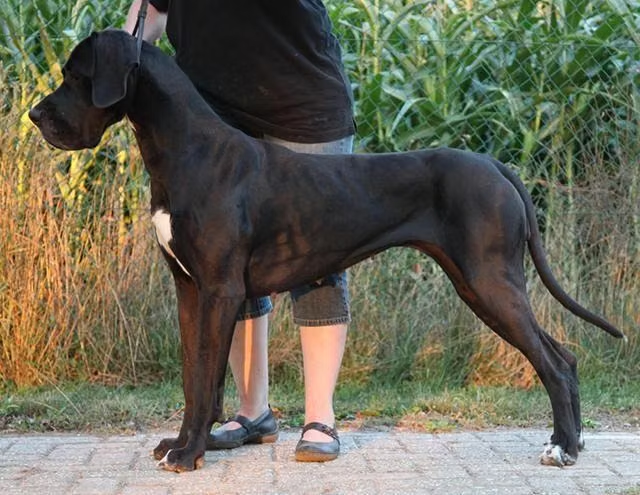
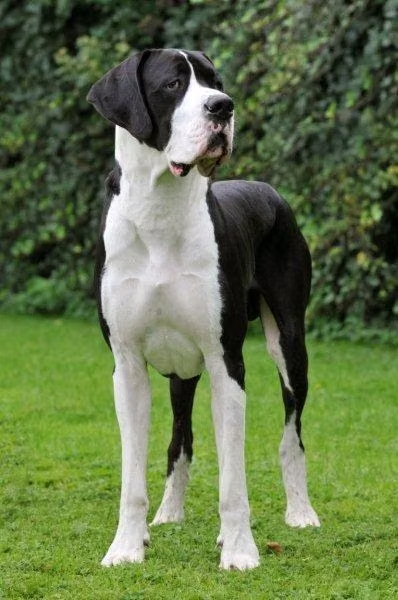
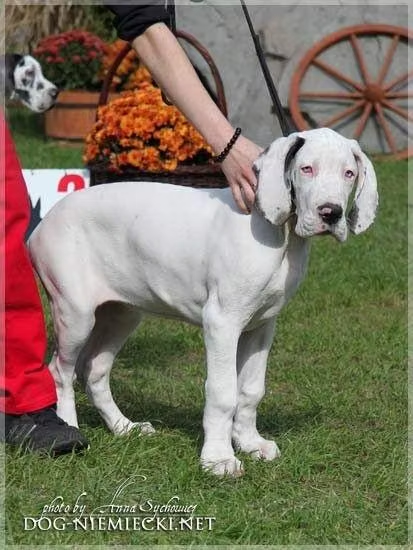
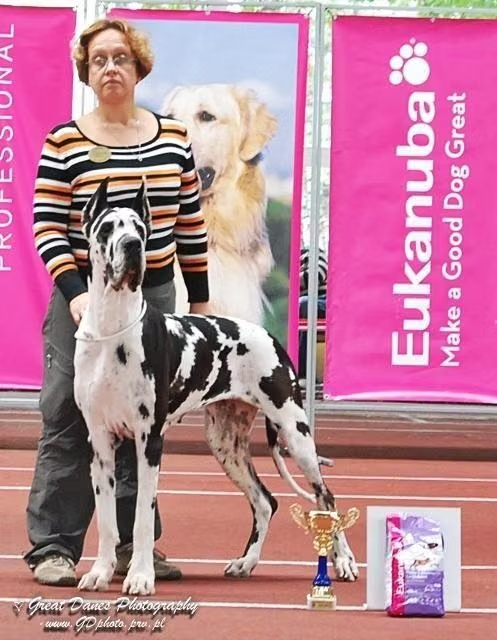
A few of the Great Dane profiles members have added to United Pet Club.





About the Great Dane
A giant breed from Germany, the Great Dane is prized as a calm, affectionate companion whose towering height belies a gentle, patient temperament at home.
The Great Dane ranks among the tallest dogs in the world, with many adults standing over 30 inches at the shoulder. For all that height, the breed's real hallmark is a mild, affectionate disposition. Owners often call it a gentle giant, since it tends to be relaxed indoors and unusually patient with people, children included.
Build-wise, the Great Dane blends the substance of a mastiff-type working dog with the clean lines of a sighthound. Males typically weigh 140 to 175 pounds and females 110 to 140 pounds. A household taking in a Great Dane needs enough room for a dog whose head can rest on a kitchen counter while it is simply standing still.
Above all, the Great Dane is a companion breed. It bonds closely with its family and prefers to stay near them, so long hours alone do not suit it well. Given proper socialization early on and consistent handling, it is typically welcoming toward strangers and gets along with other household pets.
| Attribute | Detail |
|---|---|
| Origin | Germany |
| Size | Giant |
| Lifespan | 7 to 10 years |
| Group/role | Working group, companion and former boar hound |
| Good with | Children, families, other pets when socialized |
Is the Great Dane right for you?
The Great Dane suits owners who have the space, a steady budget for food and vet bills, and time to spend at home each day. Its patient nature makes it a reasonable match for families with older children or young children under supervision, though its sheer size means it can bump a small child over without meaning to. First-time dog owners can manage a Great Dane well enough if they commit to training early, since the breed is not difficult once it has learned its manners. It is not the right dog for anyone who wants an aggressive guard dog or who travels frequently and cannot bring the dog along.
Great Dane history and origin
German breeders shaped the Great Dane from mastiff and sighthound lines for boar hunting, long before it settled into its modern role as a family companion.
Large mastiff-type dogs have roamed European estates for centuries, and dogs resembling today's Great Dane turn up in old German records tied to boar hunting. German nobility bred powerful hunting dogs that combined mastiff strength with sighthound speed, since boar were dangerous quarry that required a dog able to hold the animal until hunters caught up.
By the 1600s, refined versions of these dogs had moved indoors on German estates, kept as chamber dogs and guardians rather than purely as hunters. Breeders began selecting for a steadier temperament suited to life around people, alongside sheer size.
German breeders standardized the dog in the late 1800s and proposed the name Deutsche Dogge, or German mastiff. The breed took formal shape in Germany during this period, though English speakers kept calling it the Great Dane despite no documented link to Denmark.
As boar hunting declined, the Great Dane settled into its present role as a family companion. Breeders kept selecting for the calm, devoted temperament the breed is known for today, while its giant frame remained a defining trait. In the Philippines, the breed is registered through the Philippine Canine Club, Inc. (PCCI), the country's national kennel club, which oversees pedigree dogs bred and kept locally.
Great Dane appearance and breed standard
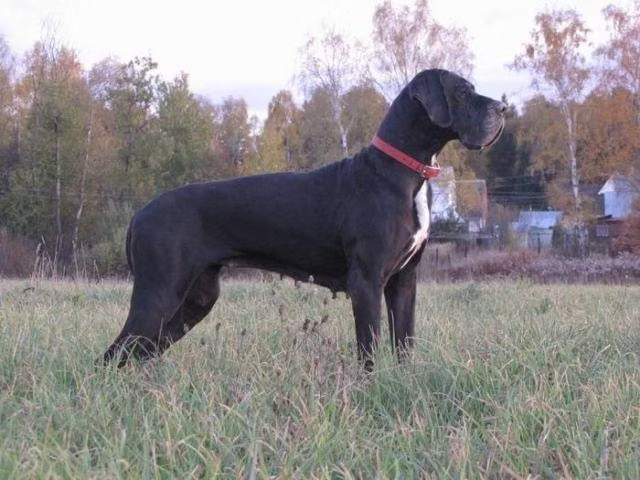
Bred for a square, balanced outline, the Great Dane has a long head, a deep chest, and a short coat that comes in several recognized colors.
The Great Dane carries a square, balanced outline that looks powerful and elegant in equal measure. The head is long and rectangular, the chest deep, and the legs straight with solid bone. Everything about the frame points to a dog built for strength as well as movement, and the long neck is carried high, with lean muscle rather than bulk showing through the coat.
| Trait | Standard |
|---|---|
| Height | Males 30 to 32 in, females 28 to 30 in at the shoulder |
| Weight | Males 140 to 175 lb, females 110 to 140 lb |
| Coat | Short, smooth, close lying |
| Colors | Fawn, brindle, blue, black, harlequin, mantle |
| Eyes | Medium, dark and deep set in most colors |
Coat and colors
The coat is short, smooth, and simple to maintain since it lies flat against the body. Recognized colors include fawn with a black mask, brindle, solid blue, solid black, harlequin (white with irregular black patches), and mantle (black and white in a defined pattern). Merle occurs in the breed too, though registries treat it differently from one another. Ear shape varies: many Great Danes keep their natural drop ears, while cropped ears were once common and remain, in practice, a matter of local regulation and owner preference. Natural ears are becoming the norm wherever cropping is restricted or discouraged.
Great Dane temperament and personality
Calm indoors and devoted to its family, the Great Dane is known for a friendly, gentle temperament and notable patience with children.
The Great Dane has earned its gentle giant reputation honestly: the breed standard itself calls for a friendly, dependable temperament. Most Great Danes are quiet at home, happy to lie near their people for much of the day, and the flip side of that closeness is that they can grow anxious when left alone too long.
Within the family, the breed is openly affectionate and will often lean its full weight against a person for contact, size notwithstanding. Many Great Danes are patient with children, though supervision still makes sense, since a tall dog can knock a small child over without any bad intent. Around strangers, a Great Dane that was properly socialized tends to be polite and reserved rather than hostile, and its size alone is usually enough to discourage intruders.
The breed generally settles well with other pets when raised alongside them, and early socialization keeps a Great Dane relaxed around unfamiliar dogs. It is not a high-drive working breed, so pushiness or hyperactivity is rare, but it still needs company and calm, consistent leadership to stay settled.
| Trait | Rating |
|---|---|
| Affection | 5 |
| Energy | 3 |
| Trainability | 4 |
| Vocalness | 2 |
| Shedding | 3 |
Great Dane care and grooming
Great Dane care calls for light grooming, moderate daily exercise, and a home with enough space and soft bedding to protect its joints.
Grooming
- Brush the short coat once or twice a week to clear out loose hair
- Give an occasional bath, roughly every six to eight weeks or whenever the dog gets dirty
- Trim the nails on a regular schedule, since overgrown nails are especially hard on a heavy dog
- Check and clean the ears, particularly on dogs with natural drop ears
- Brush the teeth several times a week to keep dental disease at bay
Exercise
- Give two moderate walks a day, adding up to roughly 30 to 60 minutes
- Allow free movement in a securely fenced yard
- Skip forced running, long hikes, and jumping for puppies and young dogs while their joints are still developing
- Keep activity light right after meals to lower the risk of bloat
Environment
The Great Dane needs more indoor space than most breeds simply to move around and lie down in comfort. A house with room to stretch out suits the breed better than a small unit, though a calm adult can manage in a condo or apartment with enough daily walks. Give it a large, well padded bed, since hard tile floors get uncomfortable fast for a heavy dog and can even contribute to pressure sores. With its short coat, the breed handles cold poorly and is best kept indoors with the family. The Philippines' hot, humid climate and long rainy and typhoon season bring the opposite problem: a giant, heavily built dog like the Great Dane overheats easily, so owners here should keep it in a cool, well ventilated space with shade and water always on hand, and limit outdoor time during the hottest, most humid stretches of the day.
Great Dane nutrition and feeding
Great Dane nutrition depends on a balanced giant breed diet, measured meals, controlled puppy growth, and feeding habits that guard against bloat.
A Great Dane needs a complete, balanced diet formulated specifically for large or giant breeds. Puppy nutrition matters more here than in most breeds, because growing too fast or too big can damage developing joints and bones. Most owners do best with a giant breed puppy food that controls calcium and energy levels, and many deliberately keep their puppies lean instead of letting them pack on weight as quickly as possible. Adults, meanwhile, do fine on a quality adult formula matched to how active the dog actually is.
| Life stage | Amount per day | Meals |
|---|---|---|
| Puppy (2 to 6 months) | 6 to 10 cups, growth formula | 3 to 4 |
| Adolescent (6 to 18 months) | 8 to 12 cups | 2 to 3 |
| Adult | 6 to 10 cups | 2 |
| Senior | 5 to 8 cups, adjusted for activity | 2 |
Treats and supplements
Keep treats to around 10 percent of daily calories so the overall diet stays balanced and the dog stays lean enough to protect its joints. Many owners ask their vet about joint support such as glucosamine or omega-3 fatty acids, since the breed carries a lot of weight on large joints. Fresh water should always be available, and any supplement is best discussed with a vet first rather than guessed at for a dog this size.
Great Dane health and common conditions
Great Dane health concerns center on a short 7 to 10 year lifespan and a giant breed's usual risks: bloat, heart disease, and joint problems.
For its size, the Great Dane is a fairly healthy breed, though giant dogs carry their own set of risks and simply do not live as long as smaller ones. Expected lifespan runs about 7 to 10 years. Most of the breed's serious health concerns trace back to its size, touching the heart, the digestive system, and the joints in particular. Responsible breeders screen their breeding stock for heart and orthopedic conditions, and routine vet visits go a long way toward catching problems while they are still manageable.
| Condition | Signs | Note |
|---|---|---|
| Gastric dilatation volvulus (bloat) | Swollen belly, retching, restlessness, collapse | A medical emergency; deep-chested breeds carry high risk |
| Dilated cardiomyopathy | Weakness, coughing, exercise intolerance, fainting | Heart muscle disease seen in the breed; screen breeding dogs for it |
| Hip and elbow dysplasia | Limping, stiffness, reluctance to get up | Joint malformation made worse by fast growth or excess weight |
| Wobbler syndrome | Unsteady gait, neck pain, weakness | Cervical spine condition more common in giant breeds |
| Bone cancer (osteosarcoma) | Lameness, swelling on a limb, pain | Occurs more often in large and giant breeds |
Preventive care
- Schedule routine vet exams, with closer monitoring as the dog gets older
- Keep vaccinations and parasite prevention up to date
- Feed to keep a lean body condition and ease strain on the joints and heart
- Use measured meals and let the dog rest after eating to lower bloat risk
- Ask a vet about gastropexy, a surgery that helps prevent bloat
- Keep up with regular dental care
Great Dane training and socialization
Great Dane training works best started early: the breed is smart and eager to please, and manners are far easier to teach while it is still small.
The Great Dane is intelligent and, as a rule, glad to cooperate, which makes it a responsive student. Because the breed grows so large so quickly, training and socialization should begin in puppyhood, while the dog is still small enough to manage without much effort. A Great Dane taught leash manners and basic control as a puppy is far easier to live with than an untrained adult that may end up outweighing the person holding the leash. The breed responds best to calm, consistent guidance rather than harsh correction, which tends to make a sensitive dog anxious instead of obedient.
Basics
- Start house training and a feeding routine from the first week at home
- Introduce a collar and leash early, along with gentle loose leash walking
- Socialize the puppy with people, places, surfaces, and other dogs
- Teach core cues such as sit, down, stay, and a reliable recall
- Practice calm greetings so the dog does not jump on visitors
- Fit short, frequent training sessions into everyday routines
Breeding and raising Great Dane puppies
Great Dane breeding involves slow maturity, litters of 8 to 10 puppies, health-screened parents, and careful nutrition for fast-growing puppies.
Great Danes mature slowly and are not fully grown until around 18 to 24 months of age, later than smaller breeds. Responsible breeding waits until a dog is mature and has been screened for the heart and orthopedic conditions the breed is prone to. Females are usually bred only once their bodies have finished developing, since carrying and raising a giant breed litter takes a real toll on the mother.
Gestation runs roughly 63 days, about the same as other dogs. Litters tend to be large, and a single litter can put considerable strain on the mother, so attentive care through pregnancy and whelping matters. Puppies grow fast in their first months, which is exactly why controlled giant breed nutrition matters so much for avoiding joint problems later.
Raising the litter means early socialization, a gradual weaning process, and keeping the puppies lean as they grow. Puppies should stay with their mother and littermates long enough to pick up normal dog behavior, typically until around eight weeks old before moving to new homes.
| Metric | Value |
|---|---|
| Sexual maturity | About 18 to 24 months before breeding |
| Gestation | Approximately 63 days |
| Average litter size | 8 to 10 puppies |
| Weaning age | About 6 to 8 weeks |
| Recommended placement age | Around 8 weeks or later |
Registering your Great Dane and its microchip in the Philippines
The city vet office handles the RA 9482 paperwork; a free United Pet Club record is what a finder anywhere can actually search for your Great Dane.
How to register a Great Dane in the Philippines
The Anti-Rabies Act, Republic Act 9482, tells every dog owner to register with the city or municipal veterinary office and keep the anti-rabies shots current, and that covers the local paperwork for your Great Dane. What the city record cannot do is tell a finder two provinces away how to reach you. A free United Pet Club profile fills that gap for life. Registering your dog costs nothing to start and nothing later.
If a vet has already implanted a chip, the number still has to be filed where a scanner can trace it, because an unfiled chip points at nobody. Register the microchip free on the lifetime plan: any brand sold in the Philippines qualifies, updates after you move house or change SIM cost nothing, and the record stays searchable here and abroad. Create your free account and cover both in one go.
How do I register my Great Dane in the Philippines?
Open a free United Pet Club account, add your Great Dane's details and a photo, then save the profile. It stays free for his whole life and sits alongside the city vet office registration RA 9482 requires.
How do I register my Great Dane's microchip?
Type the 15-digit chip number into your free account together with your mobile number and address. The lifetime plan charges nothing for the registration or for any update, whatever brand the clinic used.
Is registration required for a Great Dane in the Philippines?
Yes, RA 9482 requires dog registration with your city or municipal veterinary office, along with current anti-rabies vaccination. The United Pet Club profile is the searchable half: free, worldwide, and tied to your current mobile.
How much does it cost to register a Great Dane?
Nothing. The free lifetime plan covers the profile, the microchip record, and every update, with no renewal fees at all.
Frequently asked questions about the Great Dane
Answers to common questions Filipino owners ask about Great Dane size, temperament, everyday care, lifespan, and fit for the family.
How big does a Great Dane really get?
Great Danes are a giant breed. Males stand about 30 to 32 inches at the shoulder and weigh 140 to 175 pounds, while females stand about 28 to 30 inches and weigh 110 to 140 pounds.
Are Great Danes good with children and families?
Yes. The breed has a friendly, gentle, and patient temperament and generally does well with children. Because of its size, supervise time with small children so the dog does not knock them over by accident.
Are Great Danes hard to take care of?
Grooming and exercise needs are moderate, but the breed needs space, a soft place to rest, a sizable food budget, and careful feeding habits to reduce bloat risk. Most of the difficulty comes from the dog's size rather than its temperament.
How long do Great Danes live?
The typical lifespan is about 7 to 10 years, shorter than most smaller breeds. Good nutrition, a lean body condition, and routine vet care support a longer, healthier life.
Do Great Danes need a lot of exercise?
No. Adults need moderate daily exercise, roughly 30 to 60 minutes of walking plus free movement in a yard. Avoid heavy exercise for puppies and young dogs to protect their growing joints.
Are Great Danes a good choice for first-time owners?
They can be, for owners who commit to early training and socialization. The breed is calm and eager to please, but its size means manners need to be taught while it is still a puppy.
Do Great Danes bark a lot?
Generally, no. The breed tends to be quiet and is not especially vocal, though its size and presence alone are often enough to deter intruders.
From the community
Ask about the Great DaneNo questions about the Great Dane yet. Be the first to ask.
Browse Dog breeds