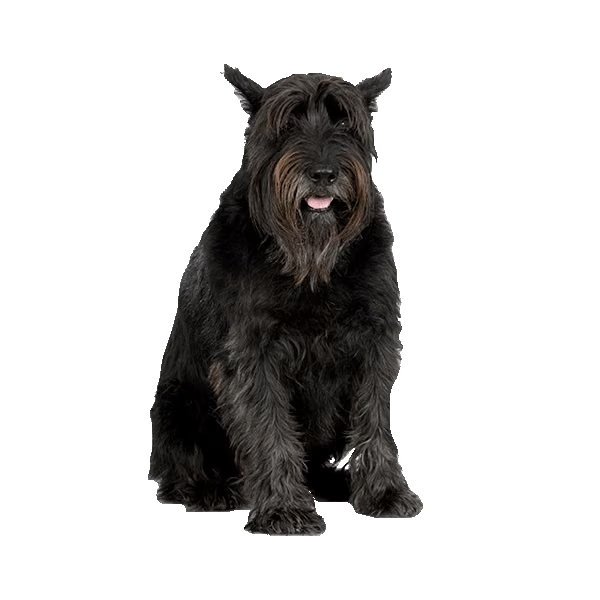
The Giant Schnauzer is a bold, intelligent working dog known for its loyalty, trainability, and powerful protective presence.
How the Giant Schnauzer coat is built, and what that means when you groom it.
Caution: A Giant Schnauzer coat should be hand-stripped rather than clipped.
A wire coat is meant to be pulled out at the root once the hair is ready to release. Clippers cut it off part way instead, leaving the soft undercoat behind. The result is a coat that grows back limp and faded, and the weatherproof texture only returns after the hair is stripped out again.
A few of the Giant Schnauzer profiles members have added to United Pet Club.
A large, watchful German working dog that needs secure space, daily exercise, and consistent training, best suited to experienced Filipino dog owners.
The Giant Schnauzer is the largest of the three Schnauzer breeds from Germany, taller than most adults' knee height and built like a scaled-up Standard Schnauzer. It has a square, muscular frame, a wiry coat, and the same bushy beard and eyebrows that mark the whole Schnauzer family, only bigger and stronger.
This is a watchful, loyal dog that bonds tightly with its own family and stays cautious around people it does not know. That wariness is not shyness. It comes from a strong guarding instinct, which is why the breed does well in Philippine homes that want an alert dog around the property, whether in a subdivision, a farm, or a house with its own yard.
The Giant Schnauzer is also sharp and eager to work. It picks up commands fast and needs a real outlet for that energy, such as obedience training, scent games, or a strict daily routine. Left with nothing to do, it gets bored quickly and can turn destructive or hard to manage indoors.
| Attribute | Detail |
|---|---|
| Origin | Germany |
| Size | Large |
| Lifespan | 10 to 12 years |
| Group/role | Working dog, guardian |
| Good with | Household members and children raised alongside it, with supervision |
The Giant Schnauzer suits an owner who already has dog experience and time for daily training and exercise, ideally in a house with a secure yard rather than a small condo unit. It is a poor choice for a first-time pet owner, a household that keeps unpredictable hours, or anyone who plans to leave the dog alone in a garage or on a rooftop for most of the day.
Farmers in southern Germany bred the Giant Schnauzer to drive cattle and guard property, long before it became a police dog and, later, a companion breed worldwide.
The Giant Schnauzer traces back to the southern German regions of Bavaria and Wurttemberg. Cattle farmers and traders there wanted something bigger than the Standard Schnauzer: a dog with the size and stamina to move herds to market and the temperament to guard a farm at night.
Breeders are thought to have crossed the Standard Schnauzer with larger rough and smooth coated farm dogs from the region, giving the new breed close ties to the wider family of European cattle and guard dogs. For decades it stayed a working animal on farms and at livestock markets, with little interest from show circles.
Once railways took over the job of moving cattle long distances, the breed found new work in towns and cities. It guarded breweries, stockyards, and butcher shops, tasks that suited its size and its instinct to protect territory. Dog fanciers in Germany began to take formal notice of the breed in the early 1900s.
Through both World Wars, the Giant Schnauzer served in police and military roles, which spread its name as a dependable working dog beyond its home region. From there it reached other countries, and today it is kept worldwide, including in the Philippines, as a guardian, a working partner, and a household companion recognized through kennel clubs affiliated with the FCI.
The Giant Schnauzer is a large, square-built dog with a wiry double coat, a bushy beard and eyebrows, and a solidly muscled frame.
The Giant Schnauzer looks like an enlarged, more powerful Standard Schnauzer. Its body is square: the length from chest to rump roughly equals its height at the shoulder. The frame is strong and well muscled without looking bulky, giving the impression of a dog built for real work rather than for show alone.
The head is rectangular and solid, framed by the breed's trademark heavy eyebrows and long beard. Ears may be left natural and folded over, or, where the practice is still allowed, cropped to stand upright. The eyes carry a sharp, alert expression that matches the dog's watchful nature.
| Trait | Standard |
|---|---|
| Height | Roughly 60 to 70 cm (23.5 to 27.5 in) at the shoulder |
| Weight | Roughly 25 to 48 kg (55 to 105 lb) |
| Coat | Dense, harsh, wiry double coat with a soft undercoat |
| Colors | Solid black, and pepper-and-salt |
| Eyes | Medium, oval, dark brown |
The outer coat is harsh and wiry, over a softer undercoat that helps regulate temperature, useful in the Philippines' humid climate as long as the coat stays clean and well brushed. Two colors are accepted: solid black and pepper-and-salt, a banded gray effect created by individual hairs carrying both light and dark sections. Show dogs are traditionally hand-stripped to keep the coat's harsh texture, though most companion dogs in the country are simply clipped by a groomer instead.
Loyal and protective, the Giant Schnauzer bonds closely with its family, stays wary of strangers, and needs firm, early socialization to stay level-headed.
The Giant Schnauzer is confident, strong-willed, and deeply attached to its own household. Around people it trusts, it is affectionate and playful, often staying close and following its owner from room to room. It can be gentle with children raised alongside it, though its size calls for supervision during rough play.
Toward strangers, the breed stays naturally reserved and watchful. That instinct makes it a capable guard dog, a trait many Filipino households value, but it also means the puppy needs steady exposure to new people and situations from an early age. A properly raised Giant Schnauzer reads a real threat correctly instead of reacting to every visitor or delivery rider at the gate.
Its record with other pets depends on how it was raised. A Giant Schnauzer that grows up with other dogs and cats can live peacefully with them, though the breed keeps a strong prey drive and may chase smaller animals such as an unfamiliar cat or free-roaming chickens common in provincial yards. Some dogs show aggression toward others of the same sex. Because the breed is highly intelligent, it learns bad habits just as fast as good ones, so house rules need to be consistent from day one.
| Trait | Rating |
|---|---|
| Affection | 4 |
| Energy | 5 |
| Trainability | 5 |
| Vocalness | 3 |
| Shedding | 2 |
The Giant Schnauzer needs regular coat upkeep, one to two hours of daily exercise, and a home with enough room and structure to keep an active mind occupied.
Owning a Giant Schnauzer means a steady time commitment. The wiry coat, high energy level, and sharp mind each need regular attention, and the country's heat and humidity add another factor to plan around.
A house with a secure yard suits the Giant Schnauzer better than a small condominium unit, though it can adapt to indoor living as long as its exercise needs are fully met. It wants to stay near its family and does not do well tied up or kept apart from the household outdoors.
A Giant Schnauzer needs a complete, balanced diet matched to its large frame and activity level, given in measured portions to protect its weight and joints.
Feed a complete and balanced diet formulated for large, active dogs. Protein and fat levels should match the dog's actual workload, and portions should be measured rather than left out all day, since extra weight puts direct strain on the joints. Puppies of large breeds do best on a growth formula built for controlled, steady development rather than rapid growth.
| Life stage | Amount per day | Meals |
|---|---|---|
| Puppy (2 to 6 months) | Per growth-formula label, divided | 3 to 4 |
| Puppy (6 to 12 months) | Per growth-formula label | 2 to 3 |
| Adult | Roughly 3 to 5 cups of quality dry food | 2 |
| Senior | Adjusted down for lower activity | 2 |
Keep treats to a small share of the daily calorie count and use them mainly for training rather than as free feeding. A dog on a complete diet usually needs no extra supplements, though a veterinarian may recommend joint support for a large, active breed as it ages. Keep fresh water available at all times, and a raised or slow-feeder bowl can help a dog that tends to gulp its food.
Generally sturdy with a 10 to 12 year lifespan, the Giant Schnauzer can still develop hip dysplasia, bloat, and certain eye and autoimmune conditions.
The Giant Schnauzer is a generally healthy large breed, with a typical lifespan of 10 to 12 years. As with most large dogs, the main risks involve the joints and bloat, along with a handful of inherited conditions. Choosing a breeder who health-tests its breeding stock lowers the odds of hereditary disease, and buyers should be wary of backyard breeders selling puppies without any health documentation, a common trap on local buy-and-sell pages.
| Condition | Signs | Note |
|---|---|---|
| Hip dysplasia | Stiffness, limping, trouble rising | Screen breeding dogs; manage weight and joint load |
| Gastric dilatation-volvulus (bloat) | Swollen abdomen, retching, distress | Medical emergency; act immediately |
| Hypothyroidism | Weight gain, lethargy, coat changes | Managed with daily medication |
| Eye disorders | Cloudiness, vision changes | Regular eye checks help with early detection |
| Autoimmune conditions | Varied, often skin or blood related | Diagnosed and managed by a vet |
Highly trainable and eager to work, the Giant Schnauzer needs early, consistent, reward-based training led by a confident, patient owner.
The Giant Schnauzer ranks among the more trainable breeds around. It picks up new skills fast, enjoys having a task, and does well in obedience, tracking, protection sport, and other working disciplines. That same intelligence means the dog tests boundaries and notices inconsistency right away, so training works best when it stays clear, fair, and starts early. A bored or under-led Giant Schnauzer turns stubborn or pushy fast.
Responsible Giant Schnauzer breeding pairs health-tested adults, runs a roughly nine-week pregnancy, and produces litters that need careful early socialization.
Breeding a Giant Schnauzer is a serious undertaking that should put health and temperament first. Both parents need to be physically mature, fully health-tested for conditions such as hip dysplasia and inherited eye disease, and sound in temperament before any mating takes place. A female generally should not be bred on her first heat, and a veterinarian can advise on the right timing for her.
Pregnancy in dogs runs about 63 days, or roughly nine weeks. As whelping nears, the dam needs a quiet, clean space and close attention, since a large breed can occasionally run into delivery complications that call for a veterinarian. Once the puppies arrive, they depend entirely on the dam for warmth and feeding through the first weeks.
Early socialization matters a great deal for a guardian breed like this one. From the first weeks of life, puppies should get gentle handling and exposure to everyday sights and sounds so they grow into stable, confident adults rather than nervous ones. Responsible breeders keep puppies with the dam and littermates until they are old enough to leave, and they screen prospective owners rather than sell to anyone who can pay, a step that separates them from the backyard breeders common on local online marketplaces.
| Metric | Value |
|---|---|
| Sexual maturity | Roughly 1 to 2 years for breeding readiness |
| Gestation | About 63 days (around 9 weeks) |
| Average litter size | Roughly 5 to 8 puppies |
| Weaning age | About 6 to 8 weeks |
| Recommended go-home age | Around 8 weeks or later |
The city vet office handles the RA 9482 paperwork; a free United Pet Club record is what a finder anywhere can actually search for your Giant Schnauzer.
A Giant Schnauzer that gets loose during a storm is identified by whatever record answers the scan, not by the barangay it came from. Give it a record that answers: your mobile number, the dog's photo, and his details, free for life with United Pet Club. Register your dog today and it is done for good.
The clinic's part ended with the implant; the tracing part is yours. File your Giant Schnauzer's 15-digit number with United Pet Club and every scan leads to your phone: free for life, all brands accepted, updates free every time your details change. Microchip registration plus a free account finishes the job.
Open a free United Pet Club account, add your Giant Schnauzer's details and a photo, then save the profile. It stays free for his whole life and sits alongside the city vet office registration RA 9482 requires.
Type the 15-digit chip number into your free account together with your mobile number and address. The lifetime plan charges nothing for the registration or for any update, whatever brand the clinic used.
Yes, RA 9482 requires dog registration with your city or municipal veterinary office, along with current anti-rabies vaccination. The United Pet Club profile is the searchable half: free, worldwide, and tied to your current mobile.
Nothing. The free lifetime plan covers the profile, the microchip record, and every update, with no renewal fees at all.
Common questions about the Giant Schnauzer cover its size, temperament, care needs, lifespan, fit for family life, and where to find one in the Philippines.
It is a large breed, standing roughly 60 to 70 cm (23.5 to 27.5 in) at the shoulder and weighing roughly 25 to 48 kg (55 to 105 lb), with males usually bigger than females.
It is loyal, intelligent, energetic, and protective. The breed bonds closely with its family, stays reserved around strangers, and makes a natural watchdog once it is properly socialized.
Yes, it is a demanding breed. It needs daily exercise and training, regular coat grooming, and an owner with time and experience. It does not suit a first-time pet owner or a household that keeps the dog mostly indoors and inactive.
The typical lifespan runs 10 to 12 years. Good weight management, preventive veterinary care, and choosing a puppy from health-tested lines all support a long, healthy life.
It can be a devoted family dog, gentle with children it grows up with in its own household. Its size means play needs supervision, and it needs early socialization to stay reliable around visitors and guests.
It is a relatively low-shedding breed thanks to its wiry double coat, though it still needs frequent brushing plus periodic clipping or hand-stripping to stay in good shape, especially in the local heat and humidity.
Since the breed is not native to the country, most puppies come through breeders who import from health-tested lines abroad or local breeders who follow the same standards; check with the Philippine Canine Club for reputable options. Waiting lists are common, and rescues for the breed are rare locally, since it is far less common than popular companion breeds.



