
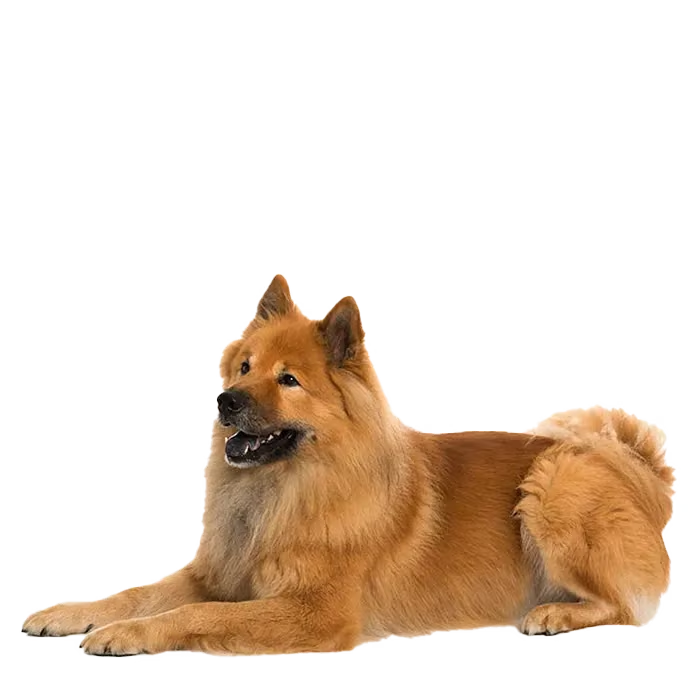
Eurasier
The Eurasier is a calm, dignified companion breed devoted to its family while remaining reserved and discerning with strangers.
- Size
- Medium
- Lifespan
- 11–13 years
- Origin
- Germany
- Temperament
- Calm
- Standard colors
- Black, Gray, and Liver and 4 more
Characteristics
Coat and grooming
How the Eurasier coat is built, and what that means when you groom it.
- Coat layers
- Double coat
- Coat texture
- Plush
- Coat length
- Medium
- Shedding
- Seasonal shedding
Grooming guidance
Critical: A Eurasier should not be shaved.
The undercoat keeps heat out as well as in, and the outer coat shields the skin from sun and insect bites. Clipping the whole coat off removes both. It often grows back patchy, soft or a different colour, and in some animals the guard hairs never return properly. Brush the undercoat out instead of cutting it off.
Information: A Eurasier drops its undercoat in heavy bursts.
The undercoat comes out in heavy bursts over a few weeks. An undercoat rake, or a bath followed by a proper blow-dry, clears it far faster than daily brushing. Clipping the coat down is not a shortcut for this.
Eurasier colors and patterns
What each club's breed standard says about every Eurasier color and pattern. Point at a ruling to see the club's own wording.
Breed standards describe the Eurasier in Black, Gray, Liver, Tan, Red, Cream, and Fawn. Standard patterns: Solid, Bicolor, Sable, Agouti, and Tan point.
| Color or pattern | FCI | AKC | UKC | KC |
|---|---|---|---|---|
| Black | Standard (“all colours”) | Standard (“Black”) | Standard (“all colors”) | Standard (“Black”) |
| Gray | Standard (“all colours”) | Standard (“Wolfgray”) | Standard (“all colors”) | Standard (“Grey”) |
| Liver | Standard (“all colours”) | Standard (“Liver”) | Not recognized (“with the exception of ... liver”) | Not recognized (“liver ... unacceptable”) |
| Tan | Standard (“all colours”) | Standard (“Black & Tan”) | Standard (“all colors”) | Standard (“Black & Tan”) |
| Red | Standard (“all colours”) | Standard (“Red”) | Standard (“all colors”) | Standard (“Red”) |
| Cream | Standard (“all colours”) | Standard (“Cream”) | Standard (“all colors”) | Standard (“Cream Black Mask”) |
| Fawn | Standard (“all colours”) | Standard (“all colours and colour combinations are permitted”) | Standard (“all colors”) | Standard (“Fawn”) |
| White | Disqualifying (“pure white”) | Disqualifying (“White”) | Not recognized (“with the exception of pure white”) | Not recognized (“pure white ... unacceptable”) |
| Albino | No ruling | No ruling | Disqualifying (“albinism”) | No ruling |
| Patterns | ||||
| Solid | Standard (“all colours”) | Standard (“Black”) | Standard (“all colors”) | Standard (“Black”) |
| Bicolor | Standard (“colour combinations”) | Standard (“colour combinations”) | Standard (“combinations of colors”) | Standard (“Red & Black”) |
| Sable | Standard (“colour combinations”) | Standard (“colour combinations”) | Standard (“combinations of colors”) | Standard (“Red Sable”) |
| Agouti | Standard (“colour combinations”) | Standard (“Wolf Sable”) | Standard (“combinations of colors”) | Standard (“colour combinations”) |
| Tan point | Standard (“colour combinations”) | Standard (“Black & Tan”) | Standard (“combinations of colors”) | Standard (“Black & Tan”) |
| Piebald | Disqualifying (“pied colouring”) | Disqualifying (“Pinto”) | Not recognized (“with the exception of ... white patches”) | Not recognized (“white patches on body ... unacceptable”) |
| Merle | No ruling | No ruling | No ruling | Not recognized (“merle, which are unacceptable”) |
| Double merle | No ruling | No ruling | No ruling | No ruling |


| Color or pattern | FCI | AKC | UKC | KC |
|---|---|---|---|---|
| Dark brown | Standard (“dark”) | Standard (“dark”) | Standard (“dark in color”) | Standard (“dark”) |
| Color or pattern | FCI | AKC | UKC | KC |
|---|---|---|---|---|
| Black | Standard (“black pigmentation”) | Standard (“black pigmentation”) | Standard (“black pigment”) | Standard (“black, medium sized nose”) |
What the rulings mean
- Standard
- Described by the club's breed standard.
- Disqualifying
- The club's breed standard disqualifies an animal of this color or pattern.
- Not recognized
- The club does not accept this color or pattern for the breed.
Color changes
How a Eurasier's colors can change over its life.
Blackchanges toRust
Coat · With body condition · can change back
Blackchanges toGray
Coat · Progressive
Blackchanges toBrown
Coat · In the sun · can change back
Tan pointchanges toSaddle
Coat · With age · from 6 to 156 weeks
Blackchanges toSnow nose
Nose · With the season · can change back
Blackchanges toPink
Nose · With the season · can change back
Pinkchanges toBlue-black
Tongue · With age · from 8 to 26 weeks


Sources
Each ruling comes from the club's published breed standard or color list.
About the Eurasier
The Eurasier is a medium-sized companion breed from Germany, gentle with its family and cautious around strangers. It typically lives 11 to 13 years.
Germany gave the dog fancy the Eurasier, a medium-sized Spitz-type breed built for one purpose: staying close to its family. The build carries the classic Spitz look, a wedge-shaped head, pricked ears, and a dense double coat, but the temperament is what most owners notice first. Bred only since the 1960s as a purpose-made companion, the Eurasier still lives up to that original brief. It shadows the people in the house from room to room and settles wherever the family gathers.
Temperament sets this breed apart. A properly bred Eurasier is steady and confident rather than reactive or excitable, warm with its own household yet naturally wary of people it has not met. Expect a new visitor to be studied quietly from a distance before the dog decides whether to come closer. This is normal breed behavior, not shyness and not aggression, and first-time owners should not mistake it for either.
For a Spitz breed, the Eurasier is notably quiet. It barks when there is a reason to, not as background noise, and it takes its cue from the mood of the house. Because it reads tone and tension so closely, socialization needs to start early and handling needs to stay calm and consistent from the puppy stage.
| Attribute | Detail |
|---|---|
| Origin | Germany |
| Size | Medium |
| Lifespan | 11 to 13 years |
| Group / role | Spitz-type companion dog |
| Good with | Family members, including children, once properly socialized |
Households that suit the Eurasier
This breed fits a household that wants a calm, steady companion and is ready to fold the dog into everyday life rather than leave it in a corner of the yard. It does best in a home where someone is around most of the day, since the Eurasier does not adjust well to being left alone for long hours, a real consideration for owners who work far from home in Metro Manila traffic. Because it stays reserved with strangers, it is not the dog that greets every neighbor at the gate, so anyone hoping for an outgoing, friendly-with-everyone pet should think again. Owners who are patient and gentle, and who skip harsh correction, tend to get the best out of this breed.
History and origin
Julius Wipfel developed the Eurasier in Germany during the 1960s, crossing the Keeshond with the Chow Chow and later the Samoyed to breed a calm, family-oriented companion.
Unlike breeds with centuries of uncertain history, the Eurasier has a documented one. Julius Wipfel developed it in Germany through the 1960s, working with a small circle of breeders and drawing on ideas from ethologist Konrad Lorenz, whose writing on dog behavior shaped the breeding goal. What they wanted was straightforward: a dog with Spitz looks and a temperament steady enough for ordinary family life.
The starting cross combined the Keeshond, also called the Wolfspitz, with the Chow Chow, producing dogs first known as Wolf-Chow. To widen the gene pool and refine both coat and temperament, breeders later added the Samoyed.
The name Eurasier arrived in 1973, chosen to reflect the breed's European and Asian ancestry, and the Fédération Cynologique Internationale accepted it that same decade under the Spitz and primitive types group. Local recognition generally follows FCI standards through the Philippine Canine Club, Inc. (PCCI), though the Eurasier remains far less common here than other Spitz-family dogs such as the Japanese Spitz.
The breed has stayed relatively rare worldwide and continues to be bred mainly as a companion rather than for work or competition. Most breed clubs still prioritize health testing and temperament above all else, staying close to what Wipfel originally intended.
Appearance and breed standard
The Eurasier is a medium-sized, well-proportioned Spitz with a wedge-shaped head, erect ears, a dense double coat, and a curled tail over the back, in a wide range of coat colors.
Balance defines the Eurasier's build: medium-sized, slightly rectangular, nothing overdone. The head tapers into a wedge with a moderate stop, the ears stand erect and well apart, and dark, alert eyes give the face its calm expression. Carried high, the tail curls or arcs over the back. A correctly built Eurasier reads as strong without looking bulky, and no single feature should stand out as exaggerated.
| Trait | Standard |
|---|---|
| Height | Males 52 to 60 cm; females 48 to 56 cm at the withers |
| Weight | Males 23 to 32 kg; females 18 to 26 kg |
| Coat | Medium-long double coat: dense undercoat with longer guard hair; shorter on muzzle, face, and front of legs |
| Colors | Wide range accepted, including fawn, red, wolf-gray, black, and black-and-tan; liver and pure white are faults |
| Eyes | Dark, medium-sized, and not bulging |
Coat and colors
The Eurasier's thick double coat suits cold weather, which is worth keeping in mind in a tropical climate where the temperature rarely drops. The undercoat is soft and dense, the outer guard hairs longer and looser, with feathering along the tail, the back of the legs, and around the neck. Rather than standing straight out from the body, the coat lies fairly flat.
Nearly every natural color is allowed under the standard except liver and pure white, and thanks to the Chow Chow in its background, a tongue that is partly or fully blue-black shows up often. White patches on the body count against a dog in the show ring, though they make no difference to a pet kept purely as a companion.
Temperament and personality
The Eurasier is calm, devoted, and even-tempered at home, but reserved and aloof with people outside the family. It is quiet, sensitive to mood, and bonds closely with its household.
Everything about the Eurasier's character runs through its family. It stays affectionate and constant with the people it lives with, often parking itself nearby and resting in whichever room the household is using. It is not needy or demanding about attention, but it does want to be part of what is happening rather than left out in the yard or on the balcony.
Strangers get a different response. A Eurasier typically studies a new face calmly from a short distance and holds back until it has decided the person is fine. It will not act as a guard dog and rarely turns aggressive, but earning its trust takes time. Guests who try to force a greeting usually make the dog more guarded, so the better approach is to let it come forward on its own terms.
Toward children in its own household, the Eurasier is usually gentle and patient, particularly if it grows up alongside them. Given early exposure, it generally gets along with other dogs and household pets too, an easy fit for the multi-pet households common in many Filipino homes. The breed picks up on harsh tones and tension quickly, so a noisy, high-stress household will show up in the dog's mood.
| Trait | Rating |
|---|---|
| Affection (with family) | 5 |
| Energy | 3 |
| Trainability | 3 |
| Vocalness | 2 |
| Shedding | 4 |
Care and grooming
The Eurasier needs regular brushing of its double coat, moderate daily exercise, and steady family contact. Long hours alone do not suit this breed.
Day to day, the Eurasier sits in the moderate-maintenance range: coat upkeep, steady daily exercise, and a real place in family life cover most of what it needs. That double coat is built for cold climates, so in the Philippine heat it works against the dog rather than for it. Exercise is best scheduled for early morning or evening, once the sun has lost its bite, and the dog should always have shade and water on hand outdoors, especially through the hot summer months from March to May.
Grooming
- Brush once or twice a week to clear loose undercoat and stop mats from forming, paying extra attention to the neck, behind the ears, and the back of the legs.
- Switch to daily brushing during the two major shedding seasons, when the undercoat comes out in large amounts.
- Bathe only when the dog actually needs it; the coat sheds dirt on its own, and washing too often strips the natural oils that help the skin cope with humid conditions.
- Trim nails every few weeks and keep the hair between the paw pads neat.
- Clean the ears and check the teeth on a regular schedule.
Exercise
- Aim for about 45 to 60 minutes of activity daily, split between walks and free movement.
- Add scent games or light training sessions so the dog has something to work out mentally, not just physically.
- Let the dog off-lead in secure, enclosed areas when the option is available.
- Skip hard or repetitive exercise for young puppies while the joints are still developing.
Living environment
A house with a secure yard suits the Eurasier well, but the breed can also manage in a smaller condo unit or townhouse as long as it gets proper daily exercise. What it cannot do without is company. Because it bonds tightly with its people, long stretches alone at home do not work for this breed, so it fits best in a household where someone is usually around, whether that is a family member or household help, or where the dog can simply come along for the day.
Nutrition and feeding
The Eurasier thrives on a complete, balanced diet matched to its life stage and activity level. Measure portions carefully to keep this moderately active breed at a healthy weight.
A Eurasier needs a complete, balanced diet matched to its age, weight, and activity level. Most owners rely on good-quality commercial dog food, widely available in pet shops and supermarkets across the country, though home-cooked or raw diets can also work when a veterinarian helps formulate them properly. Because the breed is only moderately active and puts on weight easily when overfed, measure each portion rather than leaving food out all day.
| Life stage | Amount per day | Meals |
|---|---|---|
| Puppy (2 to 6 months) | Per puppy-food label for projected adult weight | 3 to 4 |
| Junior (6 to 12 months) | Per label, tapering toward adult portion | 2 to 3 |
| Adult (1 to 7 years) | Roughly 200 to 350 g of quality dry food, by size and activity | 2 |
| Senior (7+ years) | Slightly reduced calories; monitor weight | 2 |
Treats and supplements
Keep treats to roughly 10 percent of daily calories and count them as part of the overall ration, not extra on top, so the dog's weight stays in check. A properly balanced complete diet already covers the nutrients a healthy dog needs, so most Eurasiers do not need supplements. A veterinarian may recommend joint supplements or omega-3 fatty acids for older dogs or those showing joint trouble. Clean, fresh water should be available at all times, particularly important given how much a dog can lose to heat through the day.
Health and common conditions
The Eurasier is generally a healthy breed with a lifespan of 11 to 13 years. Responsible breeders screen for hip and elbow dysplasia, eye conditions, and patellar luxation.
Health-wise, the Eurasier holds up well, partly because breed clubs put real weight on health testing. Typical lifespan runs 11 to 13 years. As with any purebred, a handful of conditions turn up more often than in the general dog population, and picking a breeder who screens their breeding stock cuts down the risk of passing on inherited problems.
| Condition | Signs | Note |
|---|---|---|
| Hip dysplasia | Stiffness, reduced activity, difficulty getting up | Breeding dogs should have their hips scored |
| Elbow dysplasia | Front-leg lameness, especially after exercise | Screened through formal grading schemes |
| Patellar luxation | Skipping or hopping on a hind leg | More common in smaller individuals |
| Hereditary eye conditions | Cloudiness, changes in vision | Eye testing is recommended for breeding stock |
| Hypothyroidism | Weight gain, low energy, coat changes | Diagnosed by blood test, managed with medication |
Preventive care
- Stay current on vaccinations and parasite control for fleas, ticks, and worms, which stay active year-round in the Philippine climate rather than easing off in a cold season.
- Book annual veterinary checkups, moving to twice a year once the dog reaches its senior years.
- Keep the dog at a healthy weight to ease strain on the joints.
- Brush the teeth regularly and keep up with dental care.
- Choose a breeder who can show hip, elbow, and eye test results for both parents.
Training and socialization
The Eurasier is intelligent and willing to learn, but sensitive and somewhat independent-minded. It responds best to calm, consistent, reward-based training and needs early socialization.
Intelligence is not the issue with a Eurasier; the breed learns well. What it will not do is respond to drilling or a heavy hand. It thinks before reacting, and a training session that turns repetitive or harsh will simply lose the dog's interest. Calm, patient handling, with sessions kept short and upbeat, gets the best results. Given the breed's natural reserve, early and varied socialization matters a great deal, so puppies should be introduced to different people, places, and situations, including the noise of tricycles, jeepneys, and crowded streets, in a relaxed, low-pressure way during their first months.
Training basics
- Start socialization early, gently exposing the puppy to new people, dogs, sounds, and surfaces.
- Teach the core cues: name response, sit, recall, and walking on a loose lead.
- Keep sessions short and end them while the dog is still engaged.
- Reward with food, praise, and play rather than relying on correction.
- Build a reliable recall before giving the dog any off-lead freedom.
- Practice in different locations so the behavior holds up outside the home, not just in the living room.
Breeding and raising young
Eurasiers reach breeding maturity around two years old. Litters average four to six puppies after about nine weeks of gestation, resting on health and temperament testing.
Physical and mental maturity comes later for Eurasiers than for many breeds, which is why responsible breeders typically hold off until a dog is around two years old, giving enough time to complete health screening first. Mating, pregnancy, and whelping otherwise follow the usual pattern for a medium-sized dog: gestation runs about 63 days, and litters commonly land between four and six puppies, though the number varies.
The puppy-raising stage is where the breed's temperament gets shaped. The dam typically raises the litter under close human contact, and consistent early handling builds the confident, even-keeled character the Eurasier is known for. Weaning usually happens around seven to eight weeks, with puppies going to new homes from about eight weeks old. Because the breed exists specifically to be a stable family companion, reputable breeders weigh temperament heavily alongside hip, elbow, and eye health in the parent dogs. Many breed clubs, including FCI-aligned registries, keep records to support planned, careful breeding rather than high-volume production, which also explains why puppies are not always easy to find locally.
| Metric | Value |
|---|---|
| Breeding maturity | Around 2 years |
| Gestation | About 63 days (roughly 9 weeks) |
| Average litter size | 4 to 6 puppies |
| Weaning | About 7 to 8 weeks |
| Typical age to new home | From about 8 weeks |
Registering your Eurasier and its microchip in the Philippines
The city vet office handles the RA 9482 paperwork; a free United Pet Club record is what a finder anywhere can actually search for your Eurasier.
How to register a Eurasier in the Philippines
Type in your Eurasier's name, his birth date, and a clear photo, add your mobile number, and save. That is the entire process, and the profile stays free for his whole life. Dog registration works with or without a chip, so the vet visit can come later.
The clinic's part ended with the implant; the tracing part is yours. File your Eurasier's 15-digit number with United Pet Club and every scan leads to your phone: free for life, all brands accepted, updates free every time your details change. Microchip registration plus a free account finishes the job.
How do I register my Eurasier in the Philippines?
Open a free United Pet Club account, add your Eurasier's details and a photo, then save the profile. It stays free for his whole life and sits alongside the city vet office registration RA 9482 requires.
How do I register my Eurasier's microchip?
Type the 15-digit chip number into your free account together with your mobile number and address. The lifetime plan charges nothing for the registration or for any update, whatever brand the clinic used.
Is registration required for a Eurasier in the Philippines?
Yes, RA 9482 requires dog registration with your city or municipal veterinary office, along with current anti-rabies vaccination. The United Pet Club profile is the searchable half: free, worldwide, and tied to your current mobile.
How much does it cost to register a Eurasier?
Nothing. The free lifetime plan covers the profile, the microchip record, and every update, with no renewal fees at all.
Frequently asked questions
Common questions about the Eurasier cover its size, temperament, grooming needs, lifespan, fit as a family dog, and how easy it is to find in the Philippines.
How big does a Eurasier grow?
It is a medium-sized dog. Males stand about 52 to 60 cm at the withers and weigh roughly 23 to 32 kg, while females run about 48 to 56 cm and 18 to 26 kg.
What is the temperament of a Eurasier?
Calm, devoted, and even-tempered at home, but reserved or aloof with people it does not know. It is a quiet, sensitive breed that bonds closely with its own household rather than being friendly with everyone it meets.
Is the Eurasier hard to take care of in hot weather?
Overall care is moderate, though the thick double coat needs extra attention in a tropical climate. Brush once or twice a week, and daily during the two seasonal shedding periods, and schedule exercise for the cooler parts of the day, typically early morning or evening. The breed also needs about an hour of activity daily and, above all, close contact with its family.
How long do Eurasiers live?
Typically 11 to 13 years. Choosing a breeder who health-tests the parents, and keeping the dog at a healthy weight, both support a long, comfortable life.
Is the Eurasier a good family dog?
Yes. It was bred specifically to be a family companion and is generally gentle and patient with children in its own household, especially when raised together from puppyhood. It suits homes where someone is usually around, whether that is a family member or household help, since it dislikes being left alone for long stretches.
Does the Eurasier bark a lot?
No. It is quiet for a Spitz breed and tends to bark for a reason rather than constantly, which makes it workable even for condo and townhouse living.
Are Eurasier puppies easy to find in the Philippines?
Not particularly. The breed remains uncommon locally, and puppies are usually available only through dedicated breeders connected to breed clubs, some linked to PCCI or FCI-aligned registries. Waiting lists are normal, since litters are planned carefully around health and temperament instead of being produced in volume.
From the community
Ask about the EurasierNo questions about the Eurasier yet. Be the first to ask.
Browse Dog breeds