
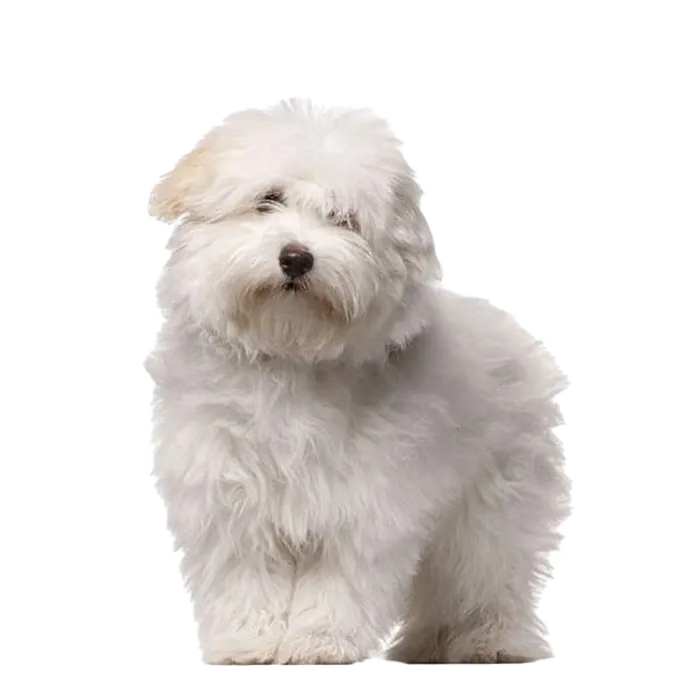
Coton de Tulear
The Coton de Tulear is an affectionate, playful companion breed from Madagascar with a soft cotton-like coat and a sunny, people-loving personality.
- Size
- Small
- Lifespan
- 15–19 years
- Origin
- Unknown
- Temperament
- Affectionate
- Standard colors
- White, Gray, and Brown and 4 more
Characteristics
Coat and grooming
How the Coton de Tulear coat is built, and what that means when you groom it.
- Coat layers
- Single coat
- Coat texture
- Silky, Wavy
- Coat length
- Long
- Shedding
- Low shedding
Grooming guidance
Caution: A Coton de Tulear coat mats easily.
Fine or long hair tangles at the base of the coat, out of sight, where the mats tighten and pull on the skin. Brushing has to reach right down to the roots in sections, not just skim the surface.
Information: A Coton de Tulear needs clipping every few weeks.
This coat keeps growing rather than shedding out, so it has to be trimmed every few weeks. Left to grow it mats down against the skin and traps moisture, dirt and heat.
Coton de Tulear colors and patterns
What each club's breed standard says about every Coton de Tulear color and pattern. Point at a ruling to see the club's own wording.
Breed standards describe the Coton de Tulear in White, Gray, Brown, Tan, Chestnut, Lemon, and Fawn. Standard patterns: Solid and Roan.
| Color or pattern | FCI | AKC | UKC | KC | KUSA |
|---|---|---|---|---|---|
| White | Standard (“Ground colour: White”) | Standard (“White”) | Standard (“Ground color: White”) | Standard (“Predominantly white”) | Standard (“Ground colour is white”) |
| Gray | Standard (“slight shadings of light grey colour (mixture of white and black hairs)”) | Standard (“Gray Markings”) | Standard (“slight shadings of light gray color (mixture of white and black hairs)”) | Standard (“slight shadings of light grey”) | Standard (“slight shadings of light grey (mixture of white and black hairs)”) |
| Brown | No ruling | Standard (“Puppies ... may have the acceptable colors of light tan, light brown, dark brown”) | No ruling | Standard (“White & Brown”) | No ruling |
| Tan | No ruling | Standard (“light tan (mixture of white and light tan hairs)”) | No ruling | Standard (“White & Tan”) | No ruling |
| Chestnut | No ruling | Standard (“Puppies ... may have the acceptable colors of ... chestnut or grey”) | No ruling | Not recognized | No ruling |
| Lemon | Standard (“red-roan appearance - lemon”) | Fault | No ruling | Standard (“White & Lemon”) | Standard (“red-roan appearance - lemon”) |
| Fawn | Standard (“red-roan (mixture of white and fawn hairs)”) | Fault | Standard (“red-roan (mixture of white & fawn hairs)”) | Standard (“slight shadings of ... fawn/apricot”) | Standard (“red-roan (mixture of white and fawn hairs)”) |
| Black | Disqualifying (“any marking of a definite black”) | Disqualifying (“Black”) | Disqualifying (“Any black marking on the coat”) | Not recognized | Disqualifying (“any marking of a definite black”) |
| Patterns | |||||
| Solid | Standard (“Ground colour: White”) | Standard (“Coat color is white”) | Standard (“Ground color: White”) | Standard (“Predominantly white”) | Standard (“Ground colour is white”) |
| Roan | Standard (“red-roan (mixture of white and fawn hairs)”) | No ruling | Standard (“red-roan (mixture of white & fawn hairs)”) | No ruling | Standard (“red-roan (mixture of white and fawn hairs)”) |


| Color or pattern | FCI | AKC | UKC | KC | KUSA |
|---|---|---|---|---|---|
| Black | No ruling | Standard (“dark brown or black”) | No ruling | No ruling | No ruling |
| Dark brown | Standard (“dark”) | Standard (“dark brown or black”) | Standard (“dark”) | Standard (“dark”) | Standard (“dark”) |
| Light brown | Fault (“Eyes: Light”) | Disqualifying | No ruling | No ruling | Fault (“Eyes: Light”) |
| Blue | Disqualifying (“wall eyes”) | Disqualifying | Disqualifying (“Wall eyes”) | No ruling | Disqualifying (“wall eyes”) |
| Color or pattern | FCI | AKC | UKC | KC | KUSA |
|---|---|---|---|---|---|
| Black | Standard (“black”) | Standard (“pigmented in black”) | Standard (“black”) | Standard (“Nose black”) | Standard (“black”) |
| Liver | Standard (“brown is tolerated”) | No ruling | Standard (“dark brown”) | No ruling | Standard (“brown is tolerated”) |
| Pink | Disqualifying (“Total lack of pigment on eyerims, nose or lips”) | Disqualifying (“Total lack of pigment on the nose”) | Disqualifying (“Lips, nose and eye rims completely lacking in pigmentation”) | No ruling | Disqualifying (“Total lack of pigment on eye rims, nose, or lips”) |
| Patterns | |||||
| Butterfly nose | Fault (“discoloured nose, with unpigmented areas”) | No ruling | Fault (“nose ... partially lacking in pigmentation”) | No ruling | Fault (“discoloured nose, with unpigmented areas”) |

What the rulings mean
- Standard
- Described by the club's breed standard.
- Fault
- Named by the club's breed standard as a fault: the animal can be shown but is penalized.
- Disqualifying
- The club's breed standard disqualifies an animal of this color or pattern.
- Not recognized
- The club does not accept this color or pattern for the breed.
Color changes
How a Coton de Tulear's colors can change over its life.
Whitechanges toRoan
Coat · With age · from 2 weeks
Blackchanges toSnow nose
Nose · With the season · can change back
Blackchanges toPink
Nose · With the season · can change back

Sources
Each ruling comes from the club's published breed standard or color list.
About the Coton de Tulear
A small, cotton-coated companion breed from Madagascar that adapts well to condo life in the Philippines and bonds closely with its family.
The Coton de Tulear is a small companion breed native to Madagascar, and its name nods to the port city of Tulear, now spelled Toliara. The first half of the name comes from the French word for cotton, describing the soft, fluffy texture of its coat.
Cotons were bred purely as companions, not for herding or hunting, and that history shows in their temperament. The breed is affectionate, sociable, and tends to stick close to its family. Most Cotons get along well with children, houseguests, and other pets, and they stay playful long after puppyhood.
Adults typically weigh only a few kilos, so the Coton works well in condominium units and smaller homes common in Metro Manila and other Philippine cities. The white coat calls for regular grooming, especially given the heat and humidity, but the breed does not need the long daily runs that working breeds do. With a reported lifespan of 15 to 19 years, the Coton de Tulear ranks among the longer-lived small breeds, and it is increasingly seen at shows sanctioned by the Philippine Canine Club, Inc. (PCCI).
| Attribute | Detail |
|---|---|
| Origin | Madagascar (exact origins unknown) |
| Size | Small |
| Lifespan | 15 to 19 years |
| Group/role | Companion dog |
| Good with | Children, families, other pets, visitors |
Who is this dog for
The Coton de Tulear fits households that can offer steady company throughout the day, not a dog kept mostly outdoors or left with the household help for long stretches. It suits families, single professionals, and retirees who want a small, affectionate dog and are willing to keep up with coat brushing. Because Cotons dislike being alone for long, the breed works best for owners who are home often, work from home, or can arrange for someone to stay with the dog during office hours. Anyone who finds daily brushing a chore should think twice, since the coat needs frequent attention to stay free of mats, particularly in humid weather.
History and origin
The Coton de Tulear developed on Madagascar as a small companion dog, though records of its earliest years no longer exist.
The Coton de Tulear takes its name from Madagascar, the large island off the southeast coast of Africa, and from Tulear, a port city on the island's southwest coast. No reliable written record explains exactly how the breed came about, and different accounts describe its arrival on the island differently.
One widely repeated account traces the breed to small white dogs carried aboard trading ships that landed on the Madagascan coast, where they interbred with local dogs already living there. Over generations, a small, white, soft-coated companion type took hold on the island. Because early records are scarce, much of this history has been pieced together rather than documented as it happened.
The Coton was kept mainly as a household companion and lapdog rather than for any working role. Interest from dog fanciers outside Madagascar eventually brought the breed to Europe and North America in the latter half of the 20th century, and from there it slowly reached other parts of the world, including Southeast Asia.
As the breed entered the wider purebred dog community, kennel clubs in several countries wrote standards describing its size, coat, and temperament. In the Philippines, the breed remains uncommon but is recognized among purebred companion dogs registered with the PCCI. Across every description, the cotton-textured white coat and the friendly disposition stay the two traits breeders and owners mention first.
Appearance
The Coton de Tulear is a small white dog with a soft, cotton-like coat, a compact build, and dark, round eyes.
The Coton de Tulear is a small, lightly built dog with a level back and a tail that curls over the back when the dog is alert or excited. The overall look is of a compact companion covered almost entirely in a soft, thick coat. The head is fairly broad, the muzzle short, and the eyes dark, round, and set well apart.
| Trait | Description |
|---|---|
| Height | Roughly 23 to 30 cm at the shoulder |
| Weight | About 3.5 to 6 kg |
| Coat | Long, soft, cotton-textured; not coarse or wiry |
| Colors | Mostly white; a few markings allowed in some spots |
| Eyes | Dark, round, set wide apart |
Coat and colors
The coat is what people notice first. It is soft and dense, often compared to cotton wool, and it stands slightly away from the body instead of lying flat. White is the standard color, and breeders and judges look for a clean white coat with minimal shading. Faint markings sometimes appear, especially around the ears or on puppies, and many of these fade as the dog grows older. Because the coat grows long, it mats quickly in humid conditions and needs consistent brushing to stay in good shape.
Temperament
The Coton de Tulear is friendly, affectionate, and playful. It bonds closely with its household and usually gets along with kids and other pets.
The Coton de Tulear is, first and foremost, a companion dog, and its temperament reflects that purpose. Dogs of this breed grow deeply attached to the people they live with and tend to trail their owners from room to room, wanting to be part of whatever is happening.
Around family, the Coton is gentle and playful, and that playful streak usually carries on well past puppyhood. With visitors and strangers, most Cotons are sociable rather than standoffish, though individual dogs vary and some take a little time to warm up. The breed is intelligent and reads its owner's mood well, so it picks up household routines fast.
Cotons generally do well with children who know how to handle a small dog gently, and they usually accept other dogs and household pets without much fuss. Because the bond runs deep, a Coton left alone for long hours, common in households where everyone works or studies away from home, can become anxious or unsettled. Early socialization helps the dog stay confident around new faces, new places, and other animals, including the neighborhood's aspin population.
| Trait | Rating |
|---|---|
| Affection | 5 |
| Energy | 3 |
| Trainability | 4 |
| Vocalness | 2 |
| Shedding | 2 |
Care and grooming
The Coton de Tulear needs regular coat care and moderate daily exercise, and does best indoors, close to its family, in the Philippine climate.
The main ongoing task with a Coton de Tulear is coat care. The soft coat tangles easily, more so in the Philippines' humidity, and needs frequent brushing to prevent mats. Apart from grooming, the breed's exercise needs are moderate, and it adapts easily to indoor, air-conditioned living.
Grooming
- Brush several times a week, and daily once the coat grows long, to prevent mats
- Bathe as needed, then dry thoroughly and brush the coat out fully, since damp coat and heat invite skin trouble
- Trim hair around the eyes and paws so the dog stays comfortable
- Check and clean the ears regularly, and keep the nails trimmed
- Some owners keep the coat clipped short in a puppy cut to cut down on daily brushing and help the dog manage the heat
Exercise
- Give a daily walk plus a couple of active play sessions
- Use indoor games and toys to keep the dog occupied, especially during the wet season when outdoor walks are cut short
- Skip strenuous exercise during the hottest part of the day given the dense coat
- Add short training games for mental stimulation
Environment
The Coton de Tulear suits condominium units and houses alike and does not need a big yard. What it needs most is company. The breed prefers staying close to its people and does not do well spending long days alone at home. A cool indoor space, regular access to the household, and steady handling keep the dog settled and content, particularly during the hot months from March to May.
Nutrition and feeding
The Coton de Tulear does well on a complete small-breed diet, fed in measured portions across two meals a day.
The Coton de Tulear does well on complete and balanced dog food suited to its size and life stage. Small breeds have small stomachs but relatively high energy needs for their weight, so a quality food fed in correctly measured portions matters. Because the breed is small and easy to overfeed, keep an eye on body condition and adjust portions to keep the dog lean, especially since premium imported kibble costs more locally and owners sometimes stretch it with extra rice or table scraps, a habit best avoided.
| Life stage | Amount per day | Meals |
|---|---|---|
| Puppy (2 to 6 months) | Per food label, split small | 3 to 4 |
| Junior (6 to 12 months) | About 70 to 110 g | 2 to 3 |
| Adult | About 60 to 100 g | 2 |
| Senior | Adult amount, adjusted for activity | 2 |
Treats and supplements
Keep treats to a small share of daily calories, around ten percent, so they do not throw off the diet or pack on extra weight. Plain options such as small pieces of carrot or cucumber work well for training and hold up better than store-bought treats in the heat. Fresh water should be available at all times, with bowls topped up more often once the weather turns hot. A dog on a complete commercial diet usually needs no extra supplements. Check with a veterinarian before adding any, particularly for puppies or senior dogs.
Health
The Coton de Tulear is a generally healthy, long-lived small breed, with a reported lifespan of 15 to 19 years and a few conditions worth watching.
The Coton de Tulear is generally a sturdy small breed and ranks among the longer-lived companion dogs, with a reported lifespan of 15 to 19 years. As with any breed, certain conditions turn up more often than in dogs generally, and responsible breeding together with routine veterinary care lowers the risk of several of them.
| Condition | Signs | Note |
|---|---|---|
| Patellar luxation | Skipping steps, intermittent hind-leg lameness | Kneecap slips out of place; common in small breeds |
| Hip dysplasia | Stiffness, reluctance to jump or run | Joint malformation; screened by responsible breeders |
| Progressive retinal atrophy | Night vision loss, eventual blindness | Inherited eye disease; DNA tests exist |
| Luxating patella related arthritis | Long-term joint stiffness with age | May follow untreated kneecap issues |
| Dental disease | Bad breath, tartar, sore gums | Small mouths are prone to crowding and buildup |
Preventive care
- Keep vaccinations and parasite control current, including protection against mosquito-borne heartworm, common given the climate
- Book annual veterinary checkups, more often for senior dogs
- Brush the teeth regularly and arrange dental cleanings as the vet advises
- Keep the dog at a lean weight to protect the joints
- Choose breeders who screen breeding stock for knee, hip, and eye conditions
Training
The Coton de Tulear is intelligent and eager to please, so it responds well to consistent, reward-based training.
The Coton de Tulear is intelligent and pays close attention to its owner, and it generally enjoys the back-and-forth that training provides. The breed responds best to reward-based methods and short, upbeat sessions rather than long drills. Harsh corrections tend to backfire with a sensitive companion breed and can make the dog timid. Consistency from everyone in the household, including household help who may also handle the dog, helps it learn faster what is expected.
Basics
- Start socialization early, introducing the puppy to different people, places, and other animals, including the usual sights and sounds of a Philippine household
- Teach a reliable name response and basic cues such as sit, down, and come
- Set up a house-training routine with frequent, scheduled trips outside or to a designated pee area
- Build up alone time gradually so the dog does not panic when left, even briefly
- Practice calm handling and grooming sessions so coat care becomes routine rather than a struggle
- Reinforce learned cues in new settings, such as the vet clinic or a relative's house, to make them stick
Breeding
The Coton de Tulear is a small breed with modest litter sizes, and breeding stock benefits from health screening beforehand.
Breeding the Coton de Tulear calls for the same care given to any small companion breed. Dogs should reach full physical maturity before being bred, and responsible programs screen breeding stock for the knee, hip, and eye conditions known in the breed before any pairing. Mating is timed around the female's heat cycle.
Gestation in dogs runs roughly two months. As a small breed, the Coton typically produces modest litters. Whelping should be supervised, and a veterinarian consulted at the first sign of trouble, since small dogs can run into complications during delivery.
Raising the litter comes down to warmth, proper nutrition for the nursing dam, and gradual weaning. Early, gentle handling and exposure to everyday household sights and sounds help the puppies grow into the confident, sociable adults the breed is known for. Puppies normally stay with the litter until they are old enough to move to new homes, and reputable breeders in the Philippines usually have puppies vet-checked and, where applicable, registered with the PCCI before release.
| Metric | Value |
|---|---|
| Sexual maturity | Around 6 to 12 months (breed when fully mature) |
| Gestation | Approximately 58 to 68 days |
| Average litter size | About 3 to 5 puppies |
| Weaning age | Around 6 to 8 weeks |
| Health screening | Knees, hips, and eyes recommended |
Registering your Coton de Tulear and its microchip in the Philippines
The city vet office handles the RA 9482 paperwork; a free United Pet Club record is what a finder anywhere can actually search for your Coton de Tulear.
How to register a Coton de Tulear in the Philippines
The Anti-Rabies Act, Republic Act 9482, tells every dog owner to register with the city or municipal veterinary office and keep the anti-rabies shots current, and that covers the local paperwork for your Coton de Tulear. What the city record cannot do is tell a finder two provinces away how to reach you. A free United Pet Club profile fills that gap for life. Registering your dog costs nothing to start and nothing later.
If a vet has already implanted a chip, the number still has to be filed where a scanner can trace it, because an unfiled chip points at nobody. Register the microchip free on the lifetime plan: any brand sold in the Philippines qualifies, updates after you move house or change SIM cost nothing, and the record stays searchable here and abroad. Create your free account and cover both in one go.
How do I register my Coton de Tulear in the Philippines?
Open a free United Pet Club account, add your Coton de Tulear's details and a photo, then save the profile. It stays free for his whole life and sits alongside the city vet office registration RA 9482 requires.
How do I register my Coton de Tulear's microchip?
Type the 15-digit chip number into your free account together with your mobile number and address. The lifetime plan charges nothing for the registration or for any update, whatever brand the clinic used.
Is registration required for a Coton de Tulear in the Philippines?
Yes, RA 9482 requires dog registration with your city or municipal veterinary office, along with current anti-rabies vaccination. The United Pet Club profile is the searchable half: free, worldwide, and tied to your current mobile.
How much does it cost to register a Coton de Tulear?
Nothing. The free lifetime plan covers the profile, the microchip record, and every update, with no renewal fees at all.
Frequently asked questions
Common questions about the Coton de Tulear cover its size, temperament, care needs, lifespan, and fit as a family pet in the Philippines.
How big does a Coton de Tulear get?
It is a small breed, usually around 23 to 30 cm at the shoulder and about 3.5 to 6 kg in weight.
What is the temperament of a Coton de Tulear like?
Friendly, affectionate, playful, and sociable. The breed bonds closely with its family and usually gets along well with children and other pets.
Is the Coton de Tulear hard to maintain?
Overall care is moderate, but the soft coat tangles easily and needs frequent brushing, more so in humid weather. Exercise needs are modest, and the breed adjusts well to indoor, air-conditioned living.
How long do Coton de Tulears live?
The reported lifespan is 15 to 19 years, which puts the breed among the longer-lived small companion dogs.
Is the Coton de Tulear a good family dog?
Yes. It is gentle and playful with children and visitors, and it suits families, single owners, and retirees who can offer regular company.
Can a Coton de Tulear be left alone at home the whole day?
Better not to. The breed bonds tightly with its household and can grow anxious when left alone for long stretches, so having someone around during the day helps a lot.
Where did the Coton de Tulear originally come from?
It is linked to Madagascar and the port city of Tulear, though its exact early history was never properly documented.
From the community
Ask about the Coton de TulearNo questions about the Coton de Tulear yet. Be the first to ask.
Browse Dog breeds