
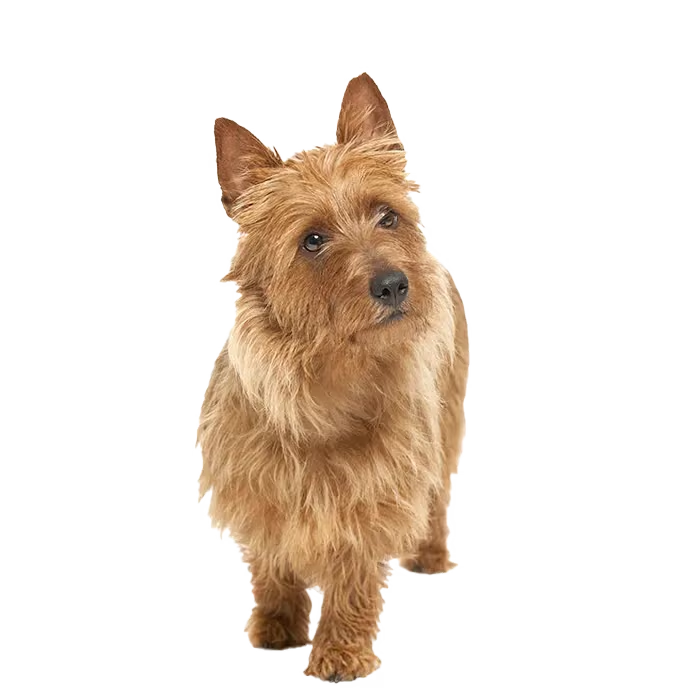
Australian Terrier
The Australian Terrier is a spirited, plucky little working terrier known for its bold confidence and devoted companionship.
- Size
- Small
- Lifespan
- 11–15 years
- Origin
- Australia
- Temperament
- Spirited
- Standard colors
- Blue, Tan, Red, and Sandy
Characteristics
Coat and grooming
How the Australian Terrier coat is built, and what that means when you groom it.
- Coat layers
- Double coat
- Coat texture
- Wire
- Coat length
- Medium
- Shedding
- Low shedding
Grooming guidance
Caution: A Australian Terrier coat should be hand-stripped rather than clipped.
A wire coat is meant to be pulled out at the root once the hair is ready to release. Clippers cut it off part way instead, leaving the soft undercoat behind. The result is a coat that grows back limp and faded, and the weatherproof texture only returns after the hair is stripped out again.
Australian Terrier colors and patterns
What each club's breed standard says about every Australian Terrier color and pattern. Point at a ruling to see the club's own wording.
Breed standards describe the Australian Terrier in Blue, Tan, Red, and Sandy. Standard patterns: Solid and Tan point.
| Color or pattern | FCI | AKC | UKC | KC | KUSA |
|---|---|---|---|---|---|
| Blue | Standard (“Blue, steel blue or dark grey blue”) | Standard (“Blue & Tan”) | Standard (“dark blue, steel blue, dark gray blue or silver blue”) | Standard (“Blue, steel blue or dark grey blue”) | Standard (“Blue, steel blue, or dark grey-blue”) |
| Tan | Standard (“rich tan (not sandy)”) | Standard (“Blue & Tan”) | Standard (“The tan markings are as rich as possible”) | Standard (“rich tan (not sandy)”) | Standard (“rich tan (not sandy)”) |
| Red | Standard (“red”) | Standard (“Red”) | Standard (“solid red”) | Standard (“red”) | Standard (“red”) |
| Sandy | Standard (“Clear sandy”) | Standard (“Sandy”) | Standard (“any shade of solid sandy”) | Standard (“Clear sandy”) | Standard (“Clear sandy”) |
| Black | Not recognized | Fault (“All black body coat in the adult dog”) | Fault (“All black coat (except in puppies)”) | Not recognized | Not recognized |
| Albino | Not recognized | Not recognized | Disqualifying (“Albinism”) | Not recognized | Not recognized |
| Patterns | |||||
| Solid | Standard (“Clear sandy or red”) | Standard (“solid sandy and solid red”) | Standard (“solid sandy or solid red”) | Standard (“Clear sandy or red”) | Standard (“Clear sandy or red”) |
| Tan point | Standard (“with rich tan (not sandy) on face, ears, under body, lower legs and feet”) | Standard (“Blue & Tan”) | Standard (“tan markings ... on the face, ears, underbody, lower legs and feet”) | Standard (“with rich tan (not sandy) on face, ears, under body, lower legs and feet”) | Standard (“with rich tan (not sandy) on face, ears, under body, lower legs, feet”) |
| Sable | Fault (“any smuttiness or dark shadings objectionable”) | Fault (“dark smut in sandy/red coated dogs”) | Fault (“Dark smut in Sandy or Red dogs”) | Fault (“smuttiness or dark shading undesirable”) | Fault (“any smuttiness or dark shadings objectionable”) |


| Color or pattern | FCI | AKC | UKC | KC | KUSA |
|---|---|---|---|---|---|
| Black | No ruling | Standard (“dark brown to black (the darker the better)”) | No ruling | No ruling | No ruling |
| Dark brown | Standard (“dark brown”) | Standard (“dark brown to black (the darker the better)”) | Standard (“dark brown”) | Standard (“dark brown”) | Standard (“dark brown”) |
| Light brown | No ruling | Fault (“Light-colored ... eyes”) | No ruling | No ruling | No ruling |
What the rulings mean
- Standard
- Described by the club's breed standard.
- Fault
- Named by the club's breed standard as a fault: the animal can be shown but is penalized.
- Disqualifying
- The club's breed standard disqualifies an animal of this color or pattern.
- Not recognized
- The club does not accept this color or pattern for the breed.
Color changes
How a Australian Terrier's colors can change over its life.
Blackchanges toRust
Coat · With body condition · can change back
Blackchanges toGray
Coat · Progressive
Blackchanges toBlue
Coat · Progressive
Blackchanges toBrown
Coat · In the sun · can change back
Tan pointchanges toSaddle
Coat · With age · from 6 to 156 weeks
Blackchanges toSnow nose
Nose · With the season · can change back
Blackchanges toPink
Nose · With the season · can change back


Sources
Each ruling comes from the club's published breed standard or color list.
Meet some of our Australian Terrier
A few of the Australian Terrier profiles members have added to United Pet Club.



About the Australian Terrier
The Australian Terrier is a small, gutsy working terrier from Australia that PCCI owners in the Philippines keep as an alert, tightly bonded house companion.
The Australian Terrier is one of the smallest working terriers around, standing roughly 25 to 28 cm at the shoulder and weighing about 5 to 7 kg. Australian settlers bred it to hunt rats and snakes near homes, farms, and mining camps, and to double as a watchdog and companion. What resulted is a low, sturdy dog with a wiry, weatherproof coat and a confidence that seems too big for its frame.
Size aside, this is a terrier through and through. It reacts fast to anything unusual in its territory, whether that is a gecko on the wall or a stranger at the gate, and it barks to let you know. It also latches onto its family hard, often choosing one person to shadow around the house and keep watch over.
In the Philippines the breed does well in condos, townhouses, and subdivision homes alike, provided it gets to move around and stay near people daily. Its rough coat handles the humidity better than a longer-coated breed would, though it still needs a cool spot to retreat to during the hottest part of the day. Owners recognized by the Philippine Canine Club, Inc. (PCCI) show the breed in the terrier group, though most Australian Terriers here simply live as house pets and yard sentries.
| Attribute | Detail |
|---|---|
| Origin | Australia |
| Size | Small (about 5 to 7 kg) |
| Lifespan | 11 to 15 years |
| Group/role | Terrier; ratter, watchdog, companion |
| Good with | Families and single owners who are home often; older kids; can get along with other dogs given proper introductions |
Who it suits
This breed fits owners who work from home, are around often, or can bring the dog along, since long stretches of isolation do not sit well with it. It also does best with owners who keep training consistent and give it something to do mentally, not just physically. Households with hamsters, rabbits, or other small pets should think twice, since the terrier instinct to chase stays strong even in a well-mannered adult.
History and origin
Settlers in colonial Australia bred the Australian Terrier from rough-coated British imports, and it became the first Australian breed formally recognized, PCCI included.
The breed goes back to the early 1800s, when British settlers brought several rough-coated terriers with them to the Australian colonies. These dogs were working stock first, crossed and selected for a hard life: killing rats and snakes around the house, guarding stores and homesteads, and keeping watch over sheep camps in tough, dry country.
A handful of British terrier types went into the mix, including small rough-coated dogs from Britain's highland and northern regions. Breeders wanted something low to the ground, hardy, with a coat that shrugged off dirt and weather, plus enough nerve to take on vermin far bigger than itself.
The breed was first exhibited in Australia toward the end of the 1800s, shown under names that referenced its rough, broken coat. It has the distinction of being the first breed developed in Australia to gain formal recognition and be shown there, and it later earned kennel club recognition in Britain and the United States through the 1900s. The Philippine Canine Club, Inc. lists it under the terrier group as well, following the same international breed standard, so Australian Terriers bred or imported here can be registered and shown locally.
Its close cousin, the Australian Silky Terrier, shares some of this same ancestry but was bred toward a longer, silkier coat and a purely companion role, while the Australian Terrier held onto its rougher coat and working instincts.
Appearance and breed standard
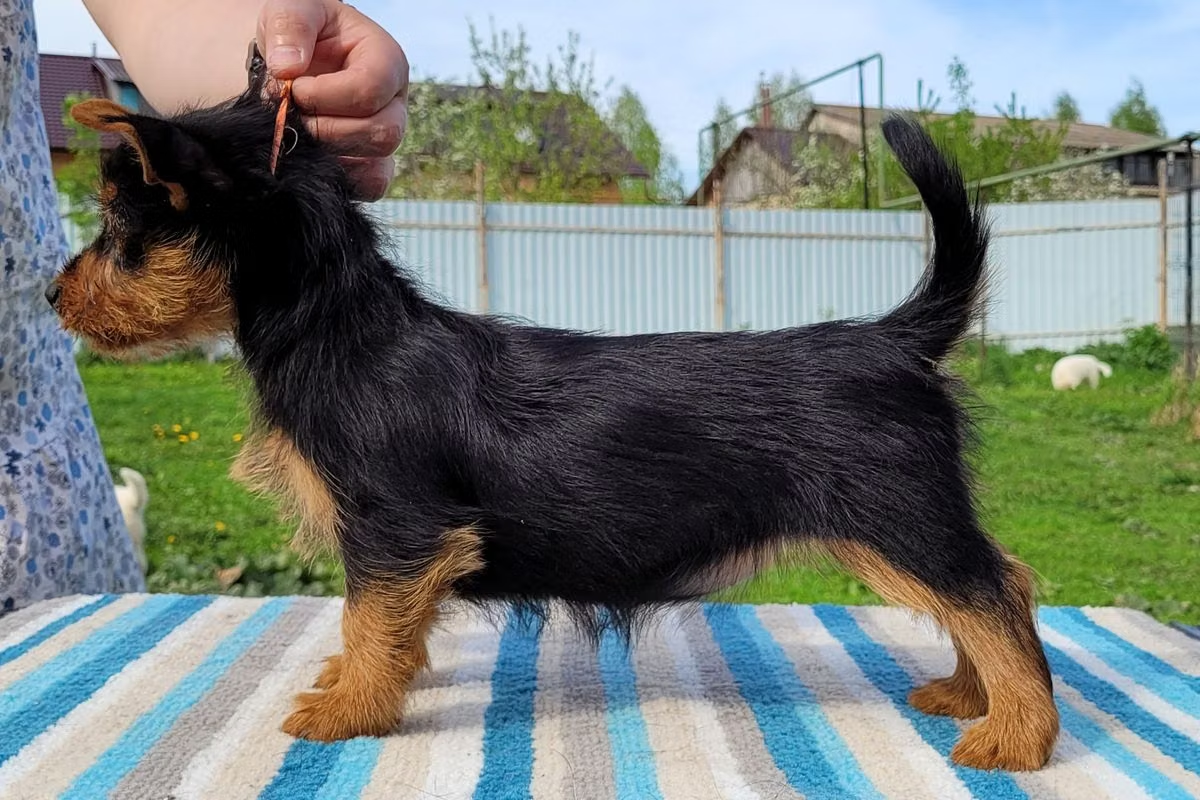
The Australian Terrier is small, low to the ground, and sturdily built, with a wiry coat, soft topknot, and pricked ears, longer in body than it is tall.
The Australian Terrier is longer in the body than it stands tall, which gives it a low, ground-hugging outline built for squeezing after vermin in tight spaces. The head is long, with small pricked ears and dark, oval eyes that give it a sharp, watchful look. A softer tuft of hair, the topknot, covers the skull and stands out against the coarser body coat. Tails were traditionally docked in some places, but many Australian Terriers in the Philippines now keep a natural tail, since docking is increasingly restricted or simply not practiced by local breeders.
| Trait | Standard |
|---|---|
| Height | About 25 to 28 cm at the withers |
| Weight | About 5 to 7 kg |
| Coat | Wiry, straight outer coat around 6 cm long over a short, soft undercoat; softer topknot |
| Colors | Blue and tan, solid sandy, or solid red |
| Eyes | Small, oval, dark brown |
Coat and colors
The outer coat is wiry and straight and lies flat against the body, backed by a short, soft undercoat for insulation. Recognized colors are blue and tan, where the blue ranges from dark steel to silver-blue with tan on the face, legs, and underside, along with solid sandy and solid red. The topknot usually comes out lighter and softer than the rest of the coat. That wiry texture earns its keep in the Philippines too: it sheds off mud during the rainy season and dries faster than a soft, fluffy coat would in our humidity, though it still mats if left ungroomed for too long.
Temperament and behavior
The Australian Terrier is confident, loyal, and alert. It sticks close to its family, works as a determined watchdog, and never loses its instinct to hunt small animals.
This is a self-assured, spirited dog that bonds tightly with its household. At home it tends to be affectionate and people-focused, often attaching most to a single person and staying close to them room to room. With children who know how to handle it gently, it is usually playful and patient, though its small size means play with very young kids should be watched.
Toward strangers the breed stays alert and watchful, the kind of dog that barks at the gate before the delivery rider even parks the motorcycle. That makes it a solid small watchdog for a subdivision home or a condo unit, though it is not typically aggressive once it has sniffed out the visitor. Early socialization helps it settle down faster around new people.
With other dogs it can get along fine, though some individuals show the usual terrier boldness toward same-sex dogs they do not know. Its hunting instinct stays sharp, so cats, house lizards, and small pets like hamsters or rabbits can set off a chase. It picks things up quickly and learns fast, but it is also independent enough to test how far the rules stretch.
| Trait | Rating |
|---|---|
| Affection | 4 |
| Energy | 4 |
| Trainability | 4 |
| Vocalness | 4 |
| Shedding | 2 |
Care and grooming
The Australian Terrier needs light coat upkeep, daily exercise, and steady company, and it settles well into both condo living and house-and-lot setups.
The wiry coat is fairly low-maintenance and does not shed much, but it still benefits from regular attention, especially in Philippine humidity where dead hair and dirt cling faster.
Grooming
- Brush the coat once or twice a week to clear loose hair and stop mats before they set in
- Hand-strip the coat a few times a year to keep its wiry texture; clipping softens it over time
- Bathe only when needed, since washing too often softens the coat and strips its natural oils, and frequent baths in our climate can also irritate the skin
- Trim nails every few weeks and check the ears for dirt or moisture, which builds up fast in humid weather
- Brush the teeth several times a week to keep dental disease away
Exercise
- Give the dog 30 to 60 minutes of activity daily through walks and play
- Schedule walks for early morning or early evening to avoid the midday heat, which this thick-coated breed feels more than a short-haired dog would
- Set up a securely fenced yard for off-leash time, since the breed digs and chases given the chance
- Add scent games, fetch, and a spot where digging is allowed to work off its terrier instincts
- Keep the leash on near roads and small animals, since prey drive beats recall almost every time
- During typhoon season or heavy habagat rains, fall back on indoor games or a covered garage space to keep the dog active
Environment
The breed lives happily in a condo, apartment, or house as long as it gets daily exercise and is not left alone too long. Its weather-resistant coat helps it manage the year-round heat and humidity, plus the wet months from around June to November, but it still belongs indoors as a family dog rather than tied up outside or kept in a garage full time.
Nutrition and feeding
The Australian Terrier does well on a complete diet made for small, active dogs, fed in measured meals since the breed packs on weight easily.
A complete, balanced diet made for small breeds suits the Australian Terrier well. Since it is small and active, portion control matters a lot: this breed gains weight fast if overfed or given too many treats, table scraps included. Pick a food suited to the dog's life stage, whether that is a local brand or an imported one sold in Philippine pet shops, and adjust the amount based on body condition and activity level rather than sticking to a fixed number on the bag. Clean water should be out at all times, topped up more often in hot weather.
| Life stage | Amount per day | Meals |
|---|---|---|
| Puppy (2 to 6 months) | About 80 to 130 g, by weight and food type | 3 to 4 |
| Junior (6 to 12 months) | About 90 to 130 g | 2 to 3 |
| Adult | About 75 to 110 g | 2 |
| Senior | About 65 to 95 g, adjusted for activity | 2 |
Treats and supplements
Keep treats to around 10 percent of daily calories at most, and count them as part of the day's total food. Most dogs on a complete diet do not need supplements. Talk to a veterinarian before adding anything for joints, skin, or coat, especially for a senior dog.
Health and lifespan
The Australian Terrier is generally sturdy and lives 11 to 15 years, though it can be prone to certain joint, hormonal, and eye conditions worth screening for.
The Australian Terrier is a hardy breed with a typical lifespan of 11 to 15 years. Most stay healthy with routine vet visits, good nutrition, and weight control. Like many small breeds, a handful of inherited and age-related conditions show up more often in this breed than in dogs generally, so knowing the signs and screening early both help.
| Condition | Signs | Note |
|---|---|---|
| Patellar luxation | Skipping gait, on-and-off hind leg limping | Common in small breeds; ranges from mild to needing surgery |
| Legg-Calve-Perthes disease | Hind limb limping and pain in young dogs | Affects the hip joint; often needs surgery |
| Diabetes mellitus | More thirst, more urination, more appetite, yet losing weight | Manageable with diet and insulin; needs lifelong care |
| Allergic skin disease | Itching, repeat skin or ear infections | Triggers can be environmental, such as dust or humidity, or dietary |
| Cataracts and other eye issues | Cloudy eye, poor vision | Regular eye checks help catch problems early |
Preventive care
- Keep vaccinations and parasite prevention on schedule, including heartworm prevention, since mosquitoes stay active year round in the Philippines
- Keep the dog lean to protect the joints and lower diabetes risk
- Book a yearly vet exam, more often once the dog reaches its senior years
- Keep up dental care to head off gum disease
- Ask breeders whether the parents were screened for patella, hip, and eye conditions before buying a puppy
Training
The Australian Terrier is smart and eager to please, yet independent, so it responds best to consistent, reward-based training that starts while it is young.
This breed is sharp and picks things up fast, which makes it capable at obedience and dog sports such as agility and earthdog trials, both of which have a small but active following among PCCI clubs. Its independent terrier streak means it can get stubborn and bored quickly with repetition, so keep sessions short, varied, and rewarding. Early exposure to people, dogs, and everyday situations, including the noise and crowds typical of Philippine streets and malls, helps take the edge off its alert, reactive side. Prey drive runs strong, so recall around small animals is unreliable and should never be trusted near roads or open lots.
Basics
- Start socialization and handling as a puppy, exposing it to different people, places, and sounds, including tricycles, jeepneys, and other everyday street noise
- Teach a solid name response and attention cue first
- Build up sit, down, stay, and come through short daily sessions
- Work on leash manners early, since the breed pulls hard toward an interesting scent
- Redirect excessive barking and digging toward acceptable outlets instead of just shutting it down
- Practice commands gradually in busier settings, like a barangay street or a pet-friendly mall, as the dog gets more reliable
Breeding
The Australian Terrier reaches breeding age within its first year or two and produces small litters that need careful, early socialization.
Responsible breeding of the Australian Terrier centers on temperament, coat quality, and health screening of both parents. Females are generally bred only once they reach full physical and behavioral maturity, usually after their first year and once health clearances are in hand. As with any small breed, breeding should aim to reduce the joint, hormonal, and eye conditions seen in the line rather than to push out more litters.
Gestation runs about 63 days. Litters are small, usually three to five puppies, in line with the breed's size. The dam typically whelps and raises the litter with little help needed, though breeders still watch closely for whelping trouble given how small the mother is.
Puppies need early, careful socialization. Since the breed is naturally alert and bold, exposure to different people, gentle handling, sounds, and new experiences during the first weeks shapes a confident, level-headed adult. Puppies usually go to their new homes at around eight weeks old, weaned and started on vaccinations and parasite control. Buyers in the Philippines should ask to see PCCI registration papers and health clearances before committing to a puppy.
| Metric | Value |
|---|---|
| Sexual maturity | About 6 to 12 months |
| Recommended first breeding | After full maturity, often after 12 months |
| Gestation | About 63 days |
| Typical litter size | 3 to 5 puppies |
| Weaning age | About 6 to 8 weeks |
| Age to new home | About 8 weeks or later |
Registering your Australian Terrier and its microchip in the Philippines
The city vet office handles the RA 9482 paperwork; a free United Pet Club record is what a finder anywhere can actually search for your Australian Terrier.
How to register an Australian Terrier in the Philippines
Type in your Australian Terrier's name, his birth date, and a clear photo, add your mobile number, and save. That is the entire process, and the profile stays free for his whole life. Dog registration works with or without a chip, so the vet visit can come later.
If a vet has already implanted a chip, the number still has to be filed where a scanner can trace it, because an unfiled chip points at nobody. Register the microchip free on the lifetime plan: any brand sold in the Philippines qualifies, updates after you move house or change SIM cost nothing, and the record stays searchable here and abroad. Create your free account and cover both in one go.
How do I register my Australian Terrier in the Philippines?
Open a free United Pet Club account, add your Australian Terrier's details and a photo, then save the profile. It stays free for his whole life and sits alongside the city vet office registration RA 9482 requires.
How do I register my Australian Terrier's microchip?
Type the 15-digit chip number into your free account together with your mobile number and address. The lifetime plan charges nothing for the registration or for any update, whatever brand the clinic used.
Is registration required for an Australian Terrier in the Philippines?
Yes, RA 9482 requires dog registration with your city or municipal veterinary office, along with current anti-rabies vaccination. The United Pet Club profile is the searchable half: free, worldwide, and tied to your current mobile.
How much does it cost to register an Australian Terrier?
Nothing. The free lifetime plan covers the profile, the microchip record, and every update, with no renewal fees at all.
Frequently asked questions
Common questions Filipino owners ask about the Australian Terrier's size, temperament, care, lifespan, suitability, and availability.
How big does an Australian Terrier really get?
It is a small breed, standing about 25 to 28 cm at the shoulder and weighing roughly 5 to 7 kg, with a body a little longer than it is tall.
What is the Australian Terrier's temperament like?
It is loyal, spirited, alert, and confident. It bonds tightly with its family and makes a solid small watchdog, all while keeping a strong urge to chase small animals.
Is the Australian Terrier easy to take care of?
Care is moderate. The wiry coat sheds little and needs brushing once or twice a week plus occasional hand-stripping, and the dog needs 30 to 60 minutes of daily exercise along with regular company, ideally scheduled around the midday heat.
How long do Australian Terriers live?
Most live 11 to 15 years. Keeping the dog lean, staying on top of dental and veterinary care, and choosing a breeder who screens for health conditions all support a longer life.
Is the Australian Terrier good for condo living and families?
Yes, it adapts well to a condo unit or a house as long as it gets daily activity and is not left alone for long stretches. It suits families with older kids who know how to handle it gently, and it works just as well for a committed single owner.
Does it get along with other pets?
It can live with other dogs once socialized, but its hunting drive makes it likely to chase rodents, rabbits, and sometimes cats, so small pets need careful management and separate spaces.
Is the Australian Terrier a rare breed in the Philippines?
It is recognized by PCCI and major kennel clubs abroad but stays less common here than popular small breeds like the Shih Tzu or the Pomeranian, so finding a reputable local breeder can take patience and a spot on a waiting list.
From the community
Ask about the Australian TerrierNo questions about the Australian Terrier yet. Be the first to ask.
Browse Dog breeds