
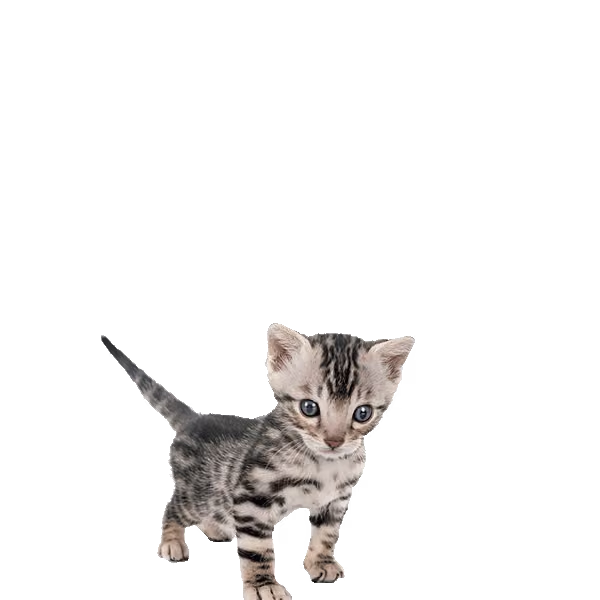
Munchkin
The Munchkin is a playful, curious short-legged cat that stays kitten-like and energetic throughout its life.
- Size
- Small
- Lifespan
- 12–15 years
- Origin
- United States
- Temperament
- Playful
- Standard colors
- Black, White, and Blue and 6 more
Characteristics
Coat and grooming
How the Munchkin coat is built, and what that means when you groom it.
- Coat layers
- Double coat
- Coat texture
- Plush
- Coat length
- Medium
- Shedding
- Moderate shedding
Grooming guidance
Critical: A Munchkin should not be shaved.
The undercoat keeps heat out as well as in, and the outer coat shields the skin from sun and insect bites. Clipping the whole coat off removes both. It often grows back patchy, soft or a different colour, and in some animals the guard hairs never return properly. Brush the undercoat out instead of cutting it off.
Munchkin colors and patterns
What each club's breed standard says about every Munchkin color and pattern. Point at a ruling to see the club's own wording.
Breed standards describe the Munchkin in Black, White, Blue, Lilac, Chocolate, Cinnamon, Red, Cream, and Fawn.
What the rulings mean
- Standard
- Described by the club's breed standard.
Color changes
How a Munchkin's colors can change over its life.
Blackchanges toRusset
Coat · Progressive
Whitechanges toShaded
Coat · With age
Whitechanges toChinchilla
Coat · With age
Bluechanges toTortoiseshell
Coat · With age
Blackchanges toBrown
Coat · With body condition · can change back
Blackchanges toBrown
Coat · In the sun · can change back
Blackchanges toBrown
Coat · Progressive
Whitechanges toPointed
Coat · With age · from 1 to 52 weeks


Sources
Each ruling comes from the club's published breed standard or color list.
About the Munchkin cat
The Munchkin is a small short-legged cat from the United States. It is friendly, playful, and curious, and it usually lives 12 to 15 years.
The Munchkin is a small house cat known for its short legs, a trait that comes from a natural genetic mutation shortening the long bones of the limbs. Its body, head, and tail match those of an ordinary cat, so the breed reads as a standard cat sitting low to the floor. Grown Munchkins usually weigh 2.7 to 4 kg (6 to 9 lb).
This is not a breed tied to one coat. Munchkins appear in shorthair and longhair forms and in almost every color and pattern, since the founding cats came from random-bred stock rather than one bloodline. The short legs are the single constant.
Munchkins are sociable, attached to their people, and lively. They hold on to a kitten-like curiosity long into adulthood and stay keen on toys, games, and whatever the household is doing. Even with those short legs, they run fast and hop onto furniture, and they often push up into a sitting, upright pose that people liken to a meerkat.
| Attribute | Detail |
|---|---|
| Origin | United States |
| Size | Small (2.7 to 4 kg / 6 to 9 lb) |
| Lifespan | 12 to 15 years |
| Group/role | Companion cat |
| Good with | Families, children, and other pets when socialized |
Who the Munchkin suits
The Munchkin fits a home that wants a lively, affectionate cat and can give it daily play and company. It settles well into families, including houses with children and other pets, because it is naturally sociable. Owners who travel a lot or are out for long stretches should arrange company or enrichment, since this cat looks for interaction. The short legs need no special setup, though easy reach to favorite resting spots does help.
History and origin
The modern Munchkin goes back to a short-legged cat found in Louisiana in 1983. The International Cat Association recognized the breed in the 1990s.
Short-legged cats have turned up here and there over the past hundred years, with reports from England, Russia, and the United States before the current breed took shape. Those early sightings stood alone and never produced a settled line, so they belong to the backstory rather than the direct ancestry of today's Munchkin.
The modern breed dates to the United States in 1983, when a pregnant short-legged cat named Blackberry was found in Rayville, Louisiana. Some of her kittens were short-legged too, which proved the trait passed down. Cats bred from this line became the foundation of the breed.
The Munchkin drew public notice in the United States in the early 1990s. The International Cat Association (TICA) took the breed into its New Breed development program in 1994 and gave it championship status in 2003. Recognition has been argued over, and a few other registries have declined the breed on welfare grounds tied to the short-legged trait.
Since the founding cats were random-bred, breeders keep outcrossing Munchkins to house cats to hold on to genetic variety. That is why the breed shows up in such a broad spread of coat lengths, colors, and patterns rather than one fixed look.
Appearance and breed standard
The Munchkin is a small to medium cat with a normally proportioned body on clearly short legs. It comes in shorthair and longhair coats and a wide range of colors.
The Munchkin's signature feature is its short legs, which give it a low, stretched-out outline. The body is well-rounded and of medium length, with a level back that lifts a little from shoulder to rump. The head is a modified wedge with rounded lines, medium to large ears set well apart, and walnut-shaped eyes that lend an open, alert look. The tail rides upright as the cat moves and narrows to a rounded tip.
| Trait | Standard |
|---|---|
| Height | About 13 to 18 cm (5 to 7 in) at the shoulder |
| Weight | 2.7 to 4 kg (6 to 9 lb) |
| Coat | Shorthair (plush) or longhair (semi-long, silky) |
| Colors | All colors and patterns accepted |
| Eyes | Walnut-shaped, all colors, not tied to coat color |
Coat and colors
The Munchkin comes in two coat lengths. The shorthair form carries a medium-plush, springy coat, while the longhair form has a semi-long, silky coat with a light ruff. Both keep a moderate undercoat. Because the breed is freely outcrossed, every recognized color and pattern shows up, including solid, tabby, tortoiseshell, colorpoint, and bicolor. Eye color runs separate from coat color and is not limited by the standard.
Temperament and personality
Munchkins are friendly, playful, and curious cats. They stay active and people-oriented for life and usually get on well with children and other pets.
Munchkins are outgoing and sociable. They bond tightly with their households and tend to trail after people from room to room, joining in on whatever is going on. The breed keeps a kitten-like playfulness into adulthood, staying keen on toys, puzzle feeders, and games of chase well past the usual kitten phase.
Around strangers, most Munchkins act confident rather than shy and often walk straight up to greet visitors. They generally put up with handling and settle into busy homes. With children they are patient and game to play, though time with young kids should be watched, as with any cat. With other pets, cats and dogs alike, they usually blend in when the introductions go slowly.
The breed is inquisitive and famous for gathering and stashing small objects, a habit that has earned it a magpie reputation. Despite the short legs, Munchkins are quick and nimble on the floor and climb and jump by using furniture as footholds, though the very highest perches may be tough to reach in one go.
| Trait | Rating |
|---|---|
| Affection | 5 |
| Energy | 4 |
| Trainability | 4 |
| Vocalness | 2 |
| Shedding | 3 |
Care and grooming
Munchkins need coat care matched to their length, daily play and exercise, and an indoor home with resting spots they can reach easily.
Caring for a Munchkin is simple and much like caring for any other house cat. Coat upkeep depends on whether the cat is shorthair or longhair, and the breed does better with regular activity to burn off its energy.
Grooming
- Brush shorthair Munchkins once a week to lift loose hair and keep shedding down.
- Brush longhair Munchkins two to three times a week to head off mats, watching the ruff and the area behind the legs.
- Trim nails every two to three weeks and check the ears for wax or dirt.
- Brush the teeth several times a week with cat-safe toothpaste to keep the gums and teeth in good shape.
Exercise
- Give two or more play sessions a day of 10 to 15 minutes with wand toys, balls, or chase games.
- Offer puzzle feeders and a rotation of toys to keep that curious mind busy.
- Use low, reachable cat furniture and ramps so the cat can climb in comfort on its short legs.
- Allow short, supervised roaming to feed the breed's habit of investigating.
Environment
Munchkins do best as indoor cats, which keeps them clear of traffic, predators, and disease. Because the legs are short, keep food, water, litter, and favored resting spots within easy reach and avoid making the cat take big vertical leaps. Steps or ramps up to higher perches are a big help. The breed handles apartments and smaller homes well, as long as it gets daily interaction and play.
Nutrition and feeding
Munchkins need a complete, balanced cat diet suited to their life stage, with measured portions and fresh water to hold a healthy weight on a small frame.
The Munchkin needs a complete and balanced diet made for cats, which are obligate carnivores and depend on animal-based protein. Pick a food that meets recognized nutritional standards for the cat's life stage. Since the breed is small, measure the portions to keep off extra weight, which loads the joints and spine. Fresh water should be on hand at all times, and wet food can help with hydration.
| Life stage | Amount per day | Meals |
|---|---|---|
| Kitten (up to 12 months) | Per package guidance, fed to appetite | 3 to 4 |
| Adult (1 to 7 years) | About 45 to 65 g dry, or equivalent wet | 2 |
| Senior (7+ years) | Adjusted to activity and body condition | 2 |
Treats and supplements
Treats should stay under about 10 percent of daily calories. A cat on a complete commercial diet usually needs no supplements; add them only on a vet's advice. Check body condition every few weeks and adjust portions, since small cats put on weight easily and extra weight is harder on short-legged frames.
Health and common conditions
Munchkins generally live 12 to 15 years and stay mostly healthy, though the short-legged trait links to a few skeletal concerns worth watching.
The Munchkin generally lives 12 to 15 years and counts as a fairly healthy cat. The short legs trace to a dominant gene affecting bone growth, and most Munchkins move, run, and play without trouble. The trait has stirred debate over possible skeletal effects, so careful breeding and regular vet checks matter. The embryonic form of the gene is thought to be lethal, which is why two short-legged cats are never bred together.
| Condition | Signs | Note |
|---|---|---|
| Lordosis | Inward curve of the spine, in severe cases breathing difficulty | Affects some lines; severity varies |
| Pectus excavatum | Sunken chest wall | Uncommon; usually spotted in kittens |
| Osteoarthritis | Stiffness, less jumping, reluctance to move | Watch in older cats; keep weight in check |
| Obesity | Weight gain, low activity | Preventable with measured feeding |
Preventive care
- Keep to yearly vet checkups, with twice-yearly visits for senior cats.
- Keep core vaccinations and parasite control current as advised.
- Hold the cat at a healthy weight to ease strain on the joints and spine.
- Provide dental care and routine teeth checks.
- Get kittens from breeders who screen for skeletal issues and avoid short-to-short pairings.
Training and enrichment
Munchkins are clever and food-motivated, which makes them quick to respond to positive reinforcement for tricks, recall, and litter and harness habits.
Munchkins are bright and curious, and their playful streak makes them more trainable than a lot of cats. They take well to short, reward-based sessions and can learn to come when called, sit, fetch, and walk on a harness. Their pull toward toys and treats keeps them tuned in, though sessions should stay brief to hold that attention.
Basics
- Start with litter training, which most Munchkins pick up fast once a clean, reachable box is set out.
- Use a clicker or a marker word paired with a small treat to flag the right behavior.
- Teach one cue at a time, such as coming to a name or sitting, in sessions of three to five minutes.
- Build toward tricks like fetch, tapping the breed's natural urge to retrieve and chase.
- Bring in a harness slowly indoors before any walking outside.
Breeding
Munchkin breeding pairs a short-legged cat with a normal-legged one, since two copies of the short-leg gene are lethal, and queens raise typical small litters.
Breeding the Munchkin calls for care, because the short-legged trait follows a dominant gene that is lethal when it turns up in two copies. For that reason a short-legged Munchkin is always paired with a normal-legged cat, which may be another Munchkin that carries normal legs or an outcross house cat. Around half the kittens in such a litter come out short-legged and half with normal-length legs; the normal-legged kittens are healthy cats often used to widen the gene pool.
Females reach sexual maturity at about 6 to 9 months, but careful breeders wait until the cat is fully grown and health-checked before breeding. Gestation runs roughly 63 to 67 days. Litters tend to be small, around two to four kittens. Queens raise their young much like any house cat, with the kittens nursing for several weeks before weaning onto solid food at about four to five weeks.
Kittens should stay with the mother until at least 12 weeks to finish socialization and early vaccinations. Breeders screen the lines for skeletal conditions and steer clear of mating two short-legged cats together.
| Metric | Value |
|---|---|
| Sexual maturity | 6 to 9 months |
| Gestation | 63 to 67 days |
| Average litter size | 2 to 4 kittens |
| Weaning age | 4 to 5 weeks |
| Recommended rehoming age | 12 weeks or older |
| Pairing rule | Short-legged x normal-legged only |
Registering a Munchkin in the Philippines, chip included
No law licenses cats here, so your Munchkin's only paper trail is the one you create: free for life with United Pet Club.
Munchkin registration and microchip registration in the Philippines
The profile takes five minutes and zero pesos: name, markings, photo, contact details, save. From then on any vet or shelter scan of your Munchkin has somewhere to land. Cat registration works chip or no chip, condo cat or free-roamer.
A microchip makes your Munchkin much harder to lose track of, but only after the number is registered, and the clinic that implants it does not do that part for you. Register the microchip free on the lifetime plan: any brand works, updating after you move or change SIM costs nothing, and the record can be searched from anywhere. Create your free account and be done with both.
How do I register my Munchkin in the Philippines?
Sign up for a free United Pet Club account, add your Munchkin's name, markings, and a photo, and save. The profile is free for life, no microchip required, and you can add the chip number after the vet visit.
How do I register my Munchkin's microchip?
Add the 15-digit number from the clinic's paperwork to your free account along with your current mobile number. The lifetime plan never charges for the registration or the updates, whatever the chip brand.
Do cats need to be registered in the Philippines?
No law requires it; RA 9482 covers dogs. That is exactly why a Munchkin's record matters: unless you create one, a found cat has no trail at all. United Pet Club keeps that trail free for life.
What does it cost to register a Munchkin?
Zero pesos. Profile, microchip registration, and unlimited updates are all free on the lifetime plan, with no renewal ever.
Frequently asked questions
Common questions about the Munchkin cat, covering size, temperament, care, lifespan, suitability, and availability.
How big does a Munchkin cat get?
The Munchkin is a small cat, usually weighing 2.7 to 4 kg (6 to 9 lb) and standing about 13 to 18 cm (5 to 7 in) at the shoulder. The body is normal-sized; only the legs are short.
What is the Munchkin's temperament like?
Munchkins are friendly, playful, curious, and sociable. They stay kitten-like and active all through life and generally get on well with children and other pets when introduced properly.
Are Munchkins hard to care for?
No. Care runs much like any other house cat: weekly brushing for shorthairs or a few times a week for longhairs, daily play, measured feeding, and routine vet visits. Low furniture and ramps help them reach high spots.
How long do Munchkin cats live?
Most Munchkins live 12 to 15 years with a good diet, weight control, and regular veterinary care.
Are Munchkins good for families and apartments?
Yes. Their sociable, playful nature suits families with children and other pets, and their small size and indoor preference make them a good match for apartments, as long as they get daily company and play.
Can Munchkins jump and run normally?
Yes. Despite short legs, Munchkins are quick and nimble and climb and jump using furniture, though the highest spots may take more than one leap. They often sit upright on their hind legs to look around.
Are Munchkin cats easy to find?
They are available through specialist breeders, but availability differs by region because some registries do not recognize the breed. Choose breeders who health-screen their lines and never pair two short-legged cats.
From the community
Ask about the MunchkinNo questions about the Munchkin yet. Be the first to ask.
Browse Cat breeds