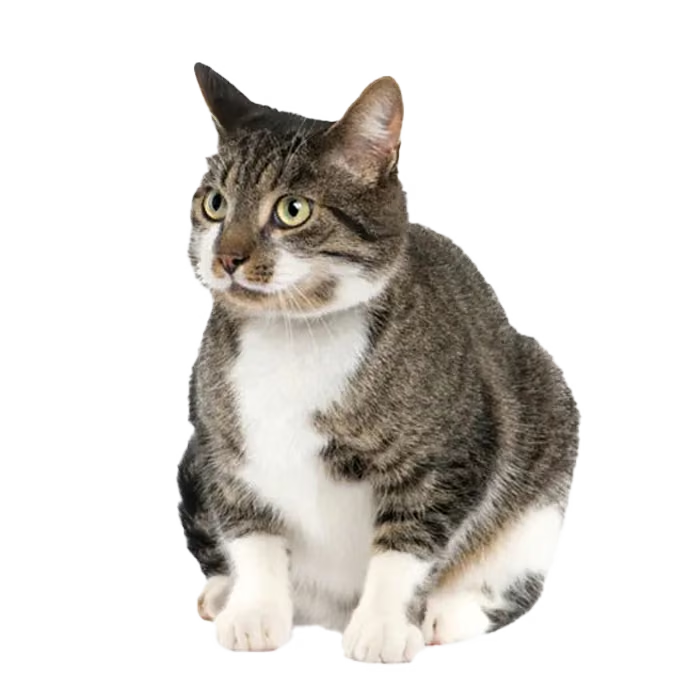
The Aegean is a friendly, water-loving native Greek cat known for its sociability and natural hardiness.
How the Aegean coat is built, and what that means when you groom it.
Critical: A Aegean should not be shaved.
The undercoat keeps heat out as well as in, and the outer coat shields the skin from sun and insect bites. Clipping the whole coat off removes both. It often grows back patchy, soft or a different colour, and in some animals the guard hairs never return properly. Brush the undercoat out instead of cutting it off.
Caution: A Aegean coat mats easily.
Fine or long hair tangles at the base of the coat, out of sight, where the mats tighten and pull on the skin. Brushing has to reach right down to the roots in sections, not just skim the surface.
Native to Greece, the Aegean is a medium-sized natural cat known for a warm, sociable disposition and a rare ease around water.
No breeding program produced the Aegean. It emerged on its own across the Cyclades islands of Greece, one of only a handful of cat breeds that trace back to that country. Even now, many still roam the fishing harbors and seaside villages as semi-feral cats. Recognition on paper arrived much later, once Greek breeders decided to safeguard the type that already existed instead of engineering something new.
Build-wise, these are medium cats, muscular and evenly proportioned. What tends to stand out, though, is how outgoing they are. An Aegean will look for people to be near, hold onto its playful streak long after kittenhood, and settle comfortably into a lively home. Because the breed grew up around fishing communities, its reputation for tolerating water and taking an interest in fish is often traced to that setting.
Beyond Greece, you will not run into the breed often. The Aegeans you can find today mostly come from Greek breeders, and since the cats have stayed near their free-roaming roots, that background is part of why they are so hardy.
| Attribute | Detail |
|---|---|
| Origin | Greece (Cyclades islands) |
| Size | Medium |
| Lifespan | 9 to 12 years |
| Group / role | Natural breed, companion cat |
| Good with | Families, children, other pets |
A home that can offer both company and stimulation is where the Aegean thrives. Families work well for it, children and resident animals included, thanks to how sociable it is. On the other hand, if what you are after is a calm, self-contained cat, the Aegean may prove too hands-on, because it wants a part in the household's daily rhythm and keeps that playfulness going for years.
The Aegean developed naturally on the Cyclades islands of Greece and was later organized into a recognized breed by Greek breeders during the late twentieth century.
Its name comes straight from the Aegean Sea and the Greek islands scattered across it. Where many breeds are the product of deliberate selection, the Aegean grew instead into a landrace over a long stretch of time, which is to say a local population shaped by its surroundings rather than by arranged matings. For centuries such cats have made their home around the Cyclades, very often in the company of fishing communities.
Through most of that span the breed carried no official standing. These were working, semi-feral animals that earned their keep by holding down the rodent population near houses, markets, and harbors. The steady daily contact with people that this way of life required is one reason commonly offered for why the cats turned out so sociable.
It was in the late twentieth century that structured work to document and standardize the Aegean got underway in Greece. Breeders set about recording the type and putting it forward as a national breed, all while leaving its natural traits untouched. Since free-living cats formed the foundation, the goal was to hold onto qualities that were already there rather than to add anything.
Within Greece the breed is recognized, and it is frequently called the country's first and foremost native cat. Elsewhere it stays scarce, with only limited populations abroad. Development still leans on the island cat population that already exists.
The Aegean is a medium, muscular cat with a semi-long coat, almost always bicolor or tricolor with white, and almond-shaped eyes in shades of green.
You can read the Aegean's working past in its balanced, athletic frame. Medium in length and muscular through the body, it stands on strong legs that end in rounded paws. Its head is moderate and carries a slightly rounded outline, while the ears sit medium-sized and fairly upright. The overall impression is of a cat that is sturdy and capable, never fragile.
| Feature | Standard |
|---|---|
| Height | About 23 to 25 cm at the shoulder |
| Weight | 3 to 5 kg |
| Coat | Semi-long, no thick undercoat |
| Colors | Bicolor or tricolor, always with white |
| Eyes | Almond shaped, shades of green |
Lying close to the body, the semi-long coat carries little to no dense undercoat. The result is a trim, low-bulk look, and shedding runs lighter than what you get from the heavy double-coated breeds. Come winter, the coat fills out somewhat.
Color is where the breed defines itself. Every Aegean is bicolor or tricolor and always wears white as one of those colors, with the white usually claiming a third to two thirds of the body. Alongside it you will find patches of black, red, blue, cream, or tabby markings. A solid single-color coat falls outside the type altogether. As for the eyes, green is the usual color.
The Aegean is friendly, playful, and intelligent, generally good with children and other pets and content to be part of an active household.
Interaction is what the Aegean is after, being a thoroughly sociable cat. It bonds closely with its household and trails family members from room to room, usually finding a way into whatever is going on. For that reason it is a poor fit wherever a cat would be left by itself for long stretches through the day.
Around its own family the breed shows plenty of affection and chattiness. Handled with ordinary care, it is generally patient with children, and it takes readily to other cats and dogs, a trait its history of living among assorted island animals helps explain. Faced with strangers, most Aegeans lean confident rather than timid, although you will see variation from one cat to the next.
Sharp wits and a busy nature are consistent here. Long past kittenhood the Aegean stays playful, enjoys hunting games, and takes to puzzle feeders and interactive toys. That noted interest in water means some will bat at faucets or fix their attention on fish. Let one grow bored or under-stimulated, however, and it can get loud or into mischief, so steady daily play is not optional.
| Trait | Rating |
|---|---|
| Affection | 4 |
| Energy | 4 |
| Trainability | 4 |
| Vocalness | 3 |
| Shedding | 2 |
The Aegean is a low-maintenance, hardy cat that needs weekly grooming, regular interactive play, and an enriched indoor or supervised outdoor environment.
Having come up from free-living stock, the Aegean is a robust breed, and its day-to-day care asks for little. Coat upkeep, activity, and attention are what it comes down to.
Given enough enrichment, Aegeans do fine indoors, and plenty of breeders keep them inside or on supervised outdoor access for their safety. A home with people present for part of the day suits them. Provided there is shade and fresh water, the breed copes comfortably with warm, humid tropical conditions.
The Aegean does well on a balanced, protein-led cat diet portioned to its medium size and activity level, with fresh water always available.
Nothing about the Aegean's diet goes beyond what any healthy medium cat requires. Feed a complete, balanced food matched to the cat's life stage and its needs are met. Being an obligate carnivore, it should draw the bulk of its energy from animal protein, with fat kept in check and carbohydrate held low. An active adult may want a bit more food than a sedentary cat of the same weight.
| Life stage | Amount per day | Meals |
|---|---|---|
| Kitten (2 to 12 months) | Per package, fed to appetite | 3 to 4 |
| Adult (1 to 7 years) | About 50 to 70 g dry, or equivalent wet | 2 |
| Senior (8 years and older) | Adjusted to weight and activity | 2 |
Hold treats to somewhere around ten percent of daily calories at most, or weight gain creeps in. A cat on a complete diet normally has no need for supplements, so add them only when a vet advises it. See to it that clean fresh water is on hand at all times, and bear in mind that some Aegeans go for running water from a fountain or faucet.
The Aegean is a naturally hardy breed with a typical lifespan of 9 to 12 years and no breed-specific genetic disorders, though general feline health care still applies.
Shaped by survival instead of selective breeding, the Aegean is a natural breed that comes through generally healthy, having sidestepped the inherited conditions that trouble some heavily bred cats. Figure on a lifespan of 9 to 12 years, with many reaching the top of that range under good care. Whatever turns up in Aegeans tends to be the ordinary feline complaints, not diseases tied to the breed.
| Condition | Signs | Note |
|---|---|---|
| Dental disease | Bad breath, drooling, reduced eating | Common in cats; prevent with dental care |
| Obesity | Weight gain, low activity | Manage with portion control and play |
| Parasites | Scratching, coat changes, digestive upset | More likely with outdoor access |
| Upper respiratory infection | Sneezing, eye or nasal discharge | Reduce risk with vaccination |
The Aegean is intelligent and food-motivated, which makes it responsive to reward-based training for litter habits, recall, and simple tricks.
Quick to learn and fond of a mental challenge, the Aegean takes to training more readily than most cats do. Its appetite for food and play hands you clear rewards to build on. Run sessions short, only a few minutes each, and stop while the cat is still into it. What counts more than how long a session lasts is staying consistent.
Aegean females reach maturity around five to ten months, carry litters for about nine weeks, and typically raise four to six kittens that are weaned by eight weeks.
Reproduction in the Aegean follows the same course as in any other domestic cat. A female generally comes into sexual maturity somewhere between five and ten months, though a responsible breeder holds off until she is fully grown before that first mating. Because cats are induced ovulators, it is the mating itself that sets off ovulation, and a queen in season will often call repeatedly to draw in a male.
Roughly nine weeks is how long gestation runs. A litter usually numbers four to six kittens. With the breed sitting so close to its natural origins, queens tend to be capable mothers and the births generally pass without trouble, but a vet should still be within reach should anything go wrong.
Kittens arrive blind and deaf, wholly dependent on their mother in those first days. Their eyes open somewhere around one to two weeks in. Weaning gets going close to four weeks and wraps up by roughly eight. Handling them early and letting them take in the sights and sounds of the household goes a long way toward raising the sociable, confident adult the breed is prized for. A reputable breeder keeps the kittens with their mother for at least twelve weeks and sees to health checks and vaccinations ahead of any rehoming.
| Metric | Value |
|---|---|
| Female maturity | 5 to 10 months |
| Gestation | About 63 days |
| Average litter | 4 to 6 kittens |
| Eyes open | 1 to 2 weeks |
| Weaning | About 8 weeks |
| Earliest rehoming | 12 weeks |
No law licenses cats here, so your Aegean's only paper trail is the one you create: free for life with United Pet Club.
The profile takes five minutes and zero pesos: name, markings, photo, contact details, save. From then on any vet or shelter scan of your Aegean has somewhere to land. Cat registration works chip or no chip, condo cat or free-roamer.
A microchip makes your Aegean much harder to lose track of, but only after the number is registered, and the clinic that implants it does not do that part for you. Register the microchip free on the lifetime plan: any brand works, updating after you move or change SIM costs nothing, and the record can be searched from anywhere. Create your free account and be done with both.
Sign up for a free United Pet Club account, add your Aegean's name, markings, and a photo, and save. The profile is free for life, no microchip required, and you can add the chip number after the vet visit.
Add the 15-digit number from the clinic's paperwork to your free account along with your current mobile number. The lifetime plan never charges for the registration or the updates, whatever the chip brand.
No law requires it; RA 9482 covers dogs. That is exactly why an Aegean's record matters: unless you create one, a found cat has no trail at all. United Pet Club keeps that trail free for life.
Zero pesos. Profile, microchip registration, and unlimited updates are all free on the lifetime plan, with no renewal ever.
Common questions about the Aegean cat cover its size, temperament, care needs, lifespan, suitability, and availability.
This is a medium cat. Grown adults typically fall between 3 and 5 kg and reach about 23 to 25 cm at the shoulder, carrying a muscular, balanced build.
Friendly, playful, intelligent, and sociable sums it up. They go looking for human company, hold their energy into adulthood, and usually get on well with children and other pets.
It is. Weekly brushing covers the coat, and the breed is hardy with nothing out of the ordinary to manage. Where it does ask something of you is daily play and attention, since the cat does not like being left alone for long stretches.
Count on 9 to 12 years as the norm. Being a natural breed free of any known breed-specific genetic disorders, many will reach the upper end of that span when well cared for.
An active family suits it well. Its sociable, patient streak leaves it at ease with children and other animals, so long as it gets regular interaction and play.
A good many do. Tied to the breed's background around fishing communities is an unusual comfort with water, and some will play with dripping faucets or watch fish closely.
Outside Greece the breed is scarce. Most Aegeans trace back to breeders inside the country, where the population stays close to its native island origins.
