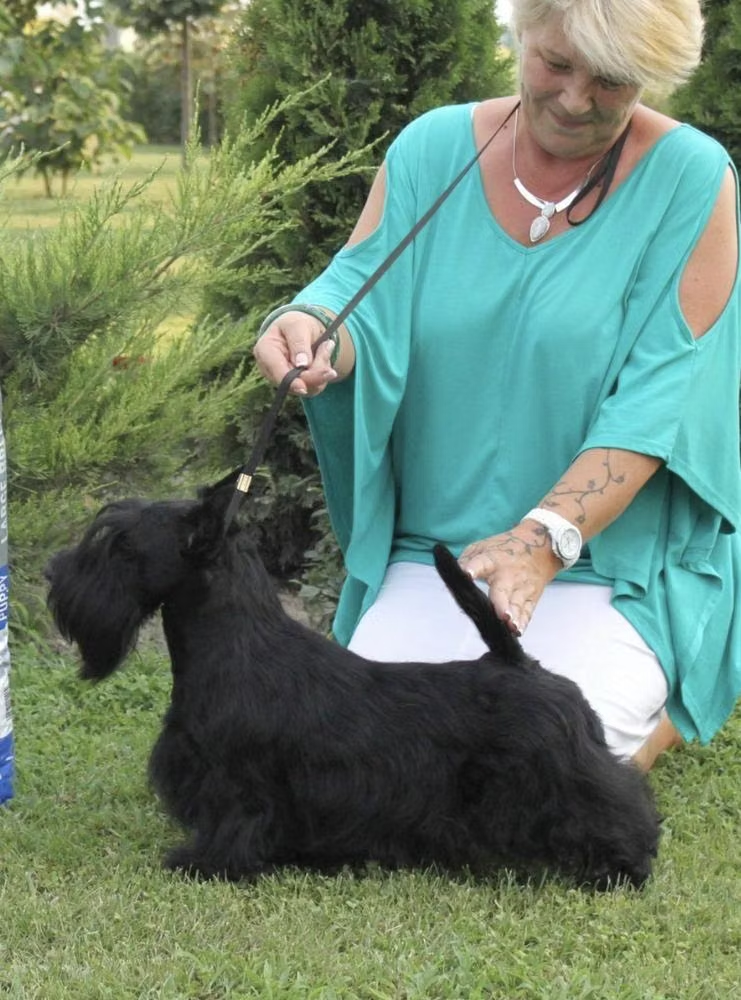
The Scottish Terrier is a dignified, independent Scottish breed with a distinctive silhouette, known for its confident and loyal character.
How the Scottish Terrier coat is built, and what that means when you groom it.
Caution: A Scottish Terrier coat should be hand-stripped rather than clipped.
A wire coat is meant to be pulled out at the root once the hair is ready to release. Clippers cut it off part way instead, leaving the soft undercoat behind. The result is a coat that grows back limp and faded, and the weatherproof texture only returns after the hair is stripped out again.
A few of the Scottish Terrier profiles members have added to United Pet Club.
The Scottish Terrier is a small, dignified terrier from Scotland with a distinctive silhouette, known for its confident and loyal character.
The Scottish Terrier is a small, compact terrier bred in the Scottish Highlands to hunt vermin and den-dwelling quarry such as rats, foxes, and badgers. Its short legs, long head, and harsh wiry coat give it a profile that is easy to recognise at a glance. Most people picture the black version, but the breed also comes in wheaten and brindle.
The character matches the build. A Scottish Terrier is confident, alert, and independent, with a strong opinion about how its day should go. It bonds closely with its family and tends to attach most firmly to one or two people. With strangers it is reserved rather than friendly, which is normal for the breed and not a fault.
This is a small dog with a large terrier personality. It is courageous, sometimes stubborn, and rarely clingy. Owners often describe living with a Scottish Terrier as living with a flatmate who has firm habits.
| Attribute | Detail |
|---|---|
| Origin | Scotland |
| Size | Small |
| Lifespan | 11 to 13 years |
| Group / role | Terrier, originally an earth-working ratter |
| Good with | Committed owners and older children; supervise with small pets |
The Scottish Terrier fits an owner who wants a small dog with backbone and does not expect constant cuddling. It adapts to flats and houses alike because its exercise needs are moderate. It does best with people who enjoy a dog with opinions and who will stay consistent with training. Households with very small pets such as rabbits or hamsters should plan carefully, since the breed retains a strong prey drive.
The Scottish Terrier developed in the Scottish Highlands as a working earth dog and was standardised as a distinct breed in the late 19th century.
The Scottish Terrier comes from the rugged terrier stock of the Scottish Highlands, where farmers and gamekeepers used hardy short-legged dogs to control rats and to bolt foxes and badgers from their dens. For much of its early history the name covered several rough-coated Highland terriers that were not yet separated into the breeds known today.
During the 19th century, breeders in Scotland began to distinguish the various local terriers from one another. The dogs that became the Scottish Terrier, the West Highland White, the Cairn, and the Skye Terrier all share roots in this same regional population. Disputes over type and naming were common as fanciers worked to settle a consistent standard.
A written breed standard for the Scottish Terrier was drawn up in the 1880s, and the breed was shown and recorded as a distinct type in Britain in that decade. It subsequently spread to North America, where it was registered by the American Kennel Club in 1885.
The Scottish Terrier became widely known in the 20th century, helped in part by its appearance in popular culture and as a companion to public figures. It remains a recognisable and established breed worldwide, though it is now kept far more often as a companion than as a working ratter.
The Scottish Terrier is a short-legged, compact terrier with a long head, erect ears, and a harsh wiry double coat most often seen in black.
The Scottish Terrier has a thickset, low-slung body on short, sturdy legs. The head looks long in proportion to the dog, with a flat skull, a strong muzzle, and a notable beard and eyebrows formed by the longer furnishings. The ears are small, pointed, and carried erect, and the tail is short and carried up. The overall outline is angular and unmistakable in silhouette.
| Feature | Standard |
|---|---|
| Height | About 25 cm at the shoulder |
| Weight | 8.5 to 10 kg |
| Coat | Double coat: harsh wiry outer coat over a soft dense undercoat |
| Colours | Black, wheaten, and brindle (various shades) |
| Eyes | Small, almond-shaped, dark brown, set well apart |
The coat is the defining feature. The outer layer is hard and weather-resistant, while the undercoat is soft and insulating, a combination that suited the breed's cold, damp homeland. Black is the most common colour and the one most people associate with the breed, but wheaten ranges from pale straw to light fawn, and brindle covers a mix of dark striping over a lighter base. Show coats are kept in condition by hand-stripping, which preserves the harsh texture; many pet owners clip instead, which softens the coat over time.
The Scottish Terrier is loyal, independent, and confident, affectionate with its own family but reserved toward strangers and other animals.
The Scottish Terrier is loyal and devoted to its household while keeping a dignified, self-contained manner. It tends to bond most strongly with one or two people and shows its affection in a steady rather than effusive way. Inside the family it can be playful and good-humoured, but it is not a dog that demands constant attention.
With strangers the breed is wary and watchful. This reserve makes it a capable alert dog, since it will announce visitors, but it is not indiscriminately suspicious. Early and ongoing socialisation helps a Scottish Terrier stay polite with new people rather than sharp.
With other animals the picture is mixed. Many Scottish Terriers tolerate dogs they have grown up with, but the breed can be assertive toward unfamiliar dogs and carries a strong prey drive toward small animals. It is independent and stubborn enough that it will test boundaries, so owners need patience and consistency rather than force.
| Trait | Rating |
|---|---|
| Affection | 3 |
| Energy | 3 |
| Trainability | 2 |
| Vocalness | 3 |
| Shedding | 2 |
The Scottish Terrier needs regular coat upkeep, moderate daily exercise, and a secure environment that accounts for its digging and prey instincts.
The Scottish Terrier adapts well to flats and houses as long as its exercise and grooming needs are met. It is an enthusiastic digger, so unsupervised garden time can damage flower beds and create escape routes under fences. The breed tolerates being alone better than many companion dogs but still needs company and mental engagement most of the day.
The Scottish Terrier needs a complete diet portioned to its small size and activity level, with care taken to avoid weight gain and toxic foods.
Feed a complete, balanced dog food suited to the Scottish Terrier's small size and life stage. Because the breed is compact and prone to gaining weight, portions should be measured rather than free-fed, and treats should be counted toward the daily total. Choose a food with quality protein to support muscle on its sturdy frame, and split the daily amount into meals to aid digestion and reduce begging.
| Life stage | Amount per day | Meals |
|---|---|---|
| Puppy (2 to 6 months) | Per puppy food label, divided | 3 to 4 |
| Junior (6 to 12 months) | About 3/4 to 1 cup | 2 to 3 |
| Adult | About 1 to 1.5 cups | 2 |
| Senior | Reduced to maintain weight | 2 |
Use treats for training in small pieces and keep them under about 10 percent of daily calories. Most Scottish Terriers on a complete diet need no extra supplements; add joint, skin, or other supplements only on a vet's advice. Provide fresh water at all times, and wipe the beard after drinking to keep the face clean.
The Scottish Terrier typically lives 11 to 13 years and is generally hardy, though it carries some breed-linked conditions that warrant monitoring.
The Scottish Terrier is a generally sturdy small breed with a typical lifespan of 11 to 13 years. Like many pedigree dogs it has a number of conditions that appear more often within the breed, several of them inherited. Buying from breeders who health-test their stock and keeping up with routine veterinary care are the most reliable ways to reduce risk.
| Condition | Signs | Note |
|---|---|---|
| Scottie cramp | Brief stiffening or arching of the back during excitement or exercise | A breed-specific movement disorder; usually mild and not painful |
| Von Willebrand disease | Excessive bleeding from minor cuts or surgery | An inherited clotting disorder; DNA testing is available |
| Bladder cancer (transitional cell carcinoma) | Blood in urine, straining, frequent urination | The breed has an elevated risk; report urinary changes early |
| Patellar luxation | Intermittent hind-leg skipping or lameness | Common in small breeds; ranges from mild to surgical |
| Craniomandibular osteopathy | Jaw swelling and pain in young puppies | A developmental bone condition usually outgrown by adulthood |
The Scottish Terrier is intelligent but independent and stubborn, so it trains best with short, consistent, reward-based sessions started early.
The Scottish Terrier is intelligent and learns quickly when it sees a reason to cooperate, but its independence and stubborn streak mean it will not work simply to please. Training takes patience and consistency. Harsh corrections tend to make the breed dig in, while clear rules and rewarding outcomes get far better results. Keep sessions short and varied, because a bored Scottie loses interest fast. Recall is a particular challenge once prey instinct takes over, so off-lead freedom should be limited to secure, enclosed areas.
Scottish Terriers reach maturity around one to two years, carry an average litter of three to five puppies, and benefit from health-tested parents.
Responsible breeding of Scottish Terriers starts with health-tested parents, since several conditions in the breed are inherited. Females are generally bred only after they are physically mature and have passed relevant screening, commonly from around two years of age. The gestation period in dogs is about 63 days. Litters are typically small, and newborn puppies depend entirely on the dam for warmth and feeding in the first weeks.
Weaning usually begins around three to four weeks as puppies move to solid food, and they stay with the dam and littermates until at least eight weeks so they learn early social skills. This window matters for a breed that can be reserved, so good breeders handle puppies often and expose them to normal household sights and sounds. Because of conditions such as von Willebrand disease and the breed's bladder cancer risk, breeding decisions should weigh DNA results and family health history, and prospective owners should ask breeders for documentation.
| Metric | Value |
|---|---|
| Sexual maturity | About 6 to 12 months (breeding usually deferred to maturity) |
| Recommended breeding age (female) | Around 2 years, after health screening |
| Gestation | About 63 days |
| Average litter size | 3 to 5 puppies |
| Weaning age | About 6 to 8 weeks |
| Earliest rehoming age | 8 weeks or later |
Your Scottish Terrier's details on a record that satisfies UK microchip law: free with United Pet Club, for life, with nothing to renew.
Microchipping has been compulsory for dogs in England, Scotland and Wales since 2016, and the rules are strict about keeping the details behind the chip current. A free United Pet Club profile holds your Scottish Terrier's record for the whole of its life, with your phone number and address sitting where a scan can reach them. Registering your dog is done in minutes and costs nothing, now or later.
A chip without a registration is a serial number and nothing more. File your Scottish Terrier's fifteen digit number with United Pet Club and it becomes a route back to you: free for life, open to every chip brand sold in Britain, and searchable whenever a scanner finds it. Microchip registration takes less time than the kettle, and a free account covers the profile too.
Set up a free United Pet Club account, add your Scottish Terrier's details and a photo, and save. The profile stays live for the whole of the dog's life at no charge, and the chip number can be added the moment you have it.
Key the fifteen digit number into your free United Pet Club account with your current address and phone number. The lifetime plan accepts any brand a British vet implants, and amendments after a house move are free.
Yes. Dogs in England, Scotland and Wales have had to be chipped since 2016, with the keeper's details kept current. The law covers the chip; keeping the record pointing at a live phone number is what United Pet Club handles, free.
Nothing at all. The United Pet Club lifetime plan covers the profile, the microchip record and every amendment without a fee, so there is no renewal to remember.
Common questions about the Scottish Terrier's size, temperament, care needs, lifespan, suitability, and availability.
It is a small breed. Adults stand about 25 cm at the shoulder and weigh roughly 8.5 to 10 kg.
Loyal, independent, dignified, alert, and confident. It is affectionate with its own family but reserved with strangers and can be assertive toward other dogs and small animals.
Care is moderate but specific. The wiry coat needs brushing several times a week and either hand-stripping or clipping a few times a year, and the dog needs 30 to 60 minutes of daily exercise. Its stubborn streak makes consistent training important.
The typical lifespan is 11 to 13 years with good care, a suitable diet, and regular veterinary checkups.
Yes for committed owners and homes with older children, and it adapts well to flat living. Households with very small pets should be cautious because of its strong prey drive.
They can be, but the breed's independence and stubbornness suit an owner who will stay patient and consistent. People wanting an eager-to-please dog may find it challenging.
The breed is established and available through reputable breeders who health-test their dogs, and individuals also appear with breed-specific rescues. Ask for health documentation and meet the parents where possible.