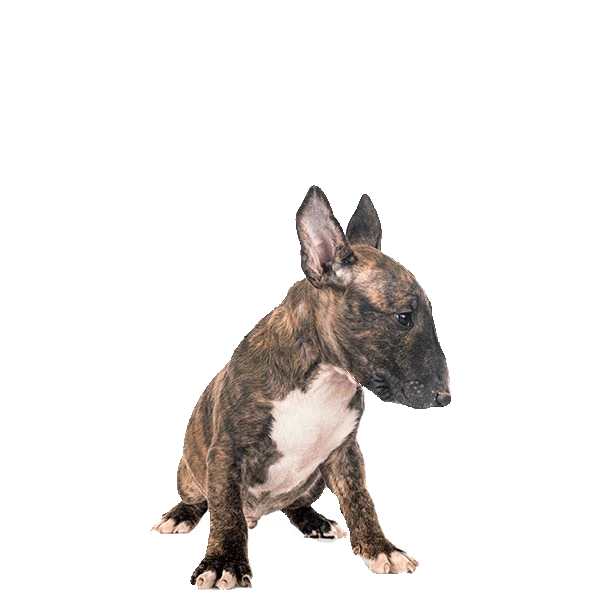
The Miniature Bull Terrier is a playful, spirited companion with the same comical charm and courage as its larger Bull Terrier cousin.
How the Miniature Bull Terrier coat is built, and what that means when you groom it.
A few of the Miniature Bull Terrier profiles members have added to United Pet Club.
The Miniature Bull Terrier is a small, muscular companion dog from England, known for a playful, spirited personality and the comical charm of its larger Bull Terrier cousin.
The Miniature Bull Terrier is a compact, sturdily built dog that carries the same egg-shaped head, triangular eyes, and upright ears as the standard Bull Terrier in a smaller frame. Despite the reduced size, the breed keeps the full dose of personality: it is playful, energetic, and confident, with a comical streak that owners often describe as clownish.
This is a dog bred for companionship and activity rather than a single working job. It bonds closely with its people and tends to attach to the whole household. Its courage and self-assurance can make it stubborn, so it does best with owners who enjoy an interactive, hands-on dog and are willing to set clear, consistent rules.
The Miniature Bull Terrier suits homes that want a small dog with a big presence. It is durable enough for active families yet small enough for flats, provided it gets daily exercise and mental work to keep it from inventing its own entertainment.
| Attribute | Detail |
|---|---|
| Origin | England |
| Size | Small |
| Lifespan | 11 to 13 years |
| Group / role | Terrier, companion |
| Good with | Families, active owners, older children |
The breed fits owners who want an affectionate, entertaining companion and can commit to daily walks, play, and training. It is a good match for first-time owners who do their homework on terrier temperament, and for households that prefer a small dog with stamina. It is less suited to people who are away for long stretches or who want a quiet, low-engagement pet.
The Miniature Bull Terrier descends from the same 19th-century English Bull Terrier stock and was developed as a smaller version of the breed in England.
The Miniature Bull Terrier traces back to the same English breeding that produced the standard Bull Terrier in the 1800s. Breeders in England crossed the old Bull and Terrier types, used for ratting and as general working terriers, with other breeds to refine appearance and temperament. From this work came the Bull Terrier, and smaller individuals within those litters formed the basis of the miniature variety.
Early small Bull Terriers varied a good deal in size, and some were quite tiny. Over time breeders worked to fix a smaller dog that kept the proportions and character of the standard whilst staying under a defined height. The aim was a true miniature, not a separate type: the same head, build, and personality at a reduced scale.
The two varieties have at times been registered together and at times separately, and the miniature has been recognised as its own breed by major kennel clubs. The Miniature Bull Terrier was admitted to the American Kennel Club Terrier Group in 1991, and in Britain it has long been registered separately with The Kennel Club.
Throughout its history the breed has been kept mainly as a companion and show dog rather than a working specialist. Its appeal has rested on the combination of small size, robust build, and the lively, humorous temperament shared with the standard Bull Terrier.
The Miniature Bull Terrier is a small, muscular dog with the breed's signature egg-shaped head, small triangular dark eyes, erect ears, and a short, flat coat.
The Miniature Bull Terrier looks like a scaled-down standard Bull Terrier. It is strongly built and muscular for its size, giving an impression of power without bulk. The most recognisable feature is the head, which has a smooth, egg-shaped curve from the top of the skull to the tip of the nose, with no stop. The eyes are small, dark, deep-set, and triangular, and the ears are small, thin, and carried erect. The body is well rounded with a deep chest, a short back, and a short tail carried horizontally.
| Trait | Standard |
|---|---|
| Height | 25 to 36 cm (10 to 14 in) at the shoulder |
| Weight | 8 to 13 kg (18 to 28 lb) |
| Coat | Short, flat, harsh to the touch with a slight gloss |
| Colours | White, or coloured (brindle, red, fawn, black) with or without white markings |
| Eyes | Small, dark, triangular, deep-set |
The coat is short and lies close to the body, with a harsh feel and a fine underlying gloss. It needs little maintenance. Colours fall into two groups: pure white, where small coloured markings on the head are allowed but markings on the body are not preferred, and coloured, which includes brindle, red, fawn, and black, often with white on the chest, face, or feet. In coloured dogs the standard prefers that colour predominate over white. The skin under a white coat can be pink, and white dogs are more prone to sunburn on exposed areas.
The Miniature Bull Terrier is playful, spirited, and courageous, an affectionate family dog with a comical streak and a stubborn, terrier independence.
The Miniature Bull Terrier is energetic, confident, and full of character. Owners often describe it as a clown, because it enjoys play, attention, and the chance to entertain its household. It forms strong bonds with its family and generally wants to be involved in whatever is happening at home.
With family it is affectionate and loyal. It usually does well with older children who understand how to play gently, though its sturdy, exuberant nature means very young children should be supervised. With strangers it tends to be friendly but alert, and its courage means it does not back down easily. With other pets it can be territorial or scrappy, especially toward dogs of the same sex, and its terrier instincts can make it inclined to chase smaller animals. Early socialisation and careful introductions help a great deal.
The breed is intelligent and curious but also independent and stubborn. It responds to firm, fair handling and can become bored or destructive if left alone too long or under-exercised. A Miniature Bull Terrier that gets enough activity and company is typically cheerful, devoted, and easy to live with.
| Trait | Rating |
|---|---|
| Affection | 5 |
| Energy | 5 |
| Trainability | 3 |
| Vocalness | 2 |
| Shedding | 2 |
The Miniature Bull Terrier is low-maintenance to groom but high-maintenance for exercise and attention, needing daily activity and company to stay balanced.
Day-to-day care centres on exercise and companionship rather than coat work. The short coat is easy to keep, but the breed's energy and need for engagement are the real commitments.
The Miniature Bull Terrier adapts to flats or houses as long as it gets daily exercise. It prefers to be indoors with its family and does not do well left alone for long periods. A securely fenced garden is helpful but not a substitute for interaction. The breed is sensitive to cold because of its single short coat, so a coat or jumper can help in winter.
The Miniature Bull Terrier needs a balanced diet matched to its small size and high energy, with portions controlled to prevent weight gain.
A complete, balanced dog food appropriate to the breed's life stage covers most needs. Choose a formula with named animal protein as the main ingredient and adjust the amount to the individual dog's age, weight, and activity. Because the breed is muscular and active, it benefits from quality protein, but it can also gain weight easily if overfed, so portions and treats need watching. Fresh water should always be available.
| Life stage | Amount per day | Meals |
|---|---|---|
| Puppy (2 to 6 months) | Per food label, growth formula | 3 to 4 |
| Junior (6 to 12 months) | Per food label, adjust to growth | 2 to 3 |
| Adult | About 85 to 170 g of dry food | 2 |
| Senior | Reduced calories, maintain protein | 2 |
Keep treats to about 10 percent of daily calories and use small, low-calorie rewards for training. Most dogs on a complete diet do not need supplements, but a vet may recommend joint or skin support for individual cases. Introduce any diet change gradually over a week to avoid stomach upset, and consult a veterinarian before adding supplements.
The Miniature Bull Terrier is generally hardy with a lifespan of 11 to 13 years, though it is prone to a few inherited conditions including deafness, eye, kidney, and heart problems.
The Miniature Bull Terrier is a generally robust breed with a typical lifespan of 11 to 13 years. Responsible breeders screen for several inherited conditions, and choosing a puppy from health-tested parents lowers the risk of the most serious problems. Routine veterinary care, weight control, and good dental hygiene support a long, healthy life.
| Condition | Signs | Note |
|---|---|---|
| Deafness (congenital) | No response to sound, often in one or both ears | More common in white dogs; BAER testing identifies it in puppies |
| Primary lens luxation | Cloudy or painful eye, vision change | Inherited eye disorder; DNA tests available for carriers |
| Kidney disease (hereditary nephritis / PKD) | Increased thirst, weight loss, poor appetite | Screening of breeding stock recommended |
| Heart disease (mitral valve, subaortic stenosis) | Murmur, tiring easily, cough | Detected by veterinary cardiac exam |
| Luxating patella | Skipping, intermittent lameness | Ranges from mild to surgical |
The Miniature Bull Terrier is intelligent but independent, so it trains best with early socialisation, short positive sessions, and patient, consistent handling.
The Miniature Bull Terrier is smart and quick to learn, but its strong will and terrier independence can make it selective about cooperating. It responds poorly to harsh methods and far better to reward-based training that keeps sessions short and interesting. Consistency matters: the breed will test boundaries, so rules should be set early and applied the same way by everyone in the household. Early and ongoing socialisation with people, other dogs, and everyday situations is important to temper its territorial and chasing instincts.
Miniature Bull Terriers reach maturity around 12 to 18 months, carry litters for about 63 days, and typically produce small litters that need careful health screening of the parents.
Responsible breeding of Miniature Bull Terriers depends on health-testing both parents before mating, since the breed carries inherited risks for deafness, eye disorders, kidney disease, and heart problems. Breeders commonly wait until a dog is physically and mentally mature, generally past 18 months, before breeding. Mating follows the bitch's season, and pregnancy lasts roughly nine weeks.
Litters tend to be small. Whelping should be monitored because the breed's broad head can complicate delivery, and a veterinarian should be on call. Puppies are born deaf and blind and rely fully on the dam in the first weeks. BAER hearing testing is usually done at around five to six weeks of age. Early handling, gentle socialisation, and exposure to household sounds from the first weeks help produce confident, well-adjusted puppies. Puppies generally go to new homes at about eight to ten weeks, after weaning, first vaccinations, and a veterinary check.
| Metric | Value |
|---|---|
| Sexual maturity | 6 to 12 months |
| Recommended breeding age | 18 months or older |
| Gestation | About 63 days |
| Average litter size | 1 to 5 puppies |
| Eyes and ears open | About 10 to 14 days |
| Weaning | About 6 to 8 weeks |
| Ready for new home | 8 to 10 weeks |
Your Miniature Bull Terrier's details on a record that satisfies UK microchip law: free with United Pet Club, for life, with nothing to renew.
Give your Miniature Bull Terrier five minutes of paperwork before it needs rescuing. The free profile takes a name, a date of birth, a photo and your contact details, and it lives on a registry that never charges for the privilege. Dog registration works whether the chip is already in or still on the to-do list.
The implant happens at the vet surgery; the record is your half of the bargain, and the 2016 regulations expect it kept up to date. Register the microchip free on the lifetime plan: any brand a British vet implants is accepted, amendments after moving house cost nothing, and the record stays searchable through the lookups rescue centres and wardens turn to first. Create your free account and square it away this evening.
Set up a free United Pet Club account, add your Miniature Bull Terrier's details and a photo, and save. The profile stays live for the whole of the dog's life at no charge, and the chip number can be added the moment you have it.
Key the fifteen digit number into your free United Pet Club account with your current address and phone number. The lifetime plan accepts any brand a British vet implants, and amendments after a house move are free.
Yes. Dogs in England, Scotland and Wales have had to be chipped since 2016, with the keeper's details kept current. The law covers the chip; keeping the record pointing at a live phone number is what United Pet Club handles, free.
Nothing at all. The United Pet Club lifetime plan covers the profile, the microchip record and every amendment without a fee, so there is no renewal to remember.
Common questions about the Miniature Bull Terrier cover its size, temperament, care needs, lifespan, suitability for families, and how to find one.
It is a small dog, standing about 25 to 36 cm (10 to 14 in) at the shoulder and weighing roughly 8 to 13 kg (18 to 28 lb). It is the same shape as a standard Bull Terrier but in a smaller, more compact frame.
Playful, spirited, energetic, courageous, and confident. The breed is affectionate with its family and often comical, but it is also stubborn and can be territorial with other dogs, so early socialisation is important.
Grooming is easy because of the short coat, but the breed needs daily exercise, mental stimulation, and company. It is best described as low-maintenance to groom and high-maintenance for activity and attention.
Typically 11 to 13 years. Choosing a puppy from health-tested parents and keeping the dog at a healthy weight supports a long life.
They generally do well with older children who play gently and are supervised. With other pets they can be scrappy, especially toward same-sex dogs, and may chase smaller animals, so introductions should be careful.
They are not especially vocal compared with many small breeds, but a bored or under-exercised dog may bark or become destructive. Enough exercise and engagement keeps noise down.
The breed is less common than the standard Bull Terrier, so expect a wait. Look for breeders listed with The Kennel Club who provide BAER hearing, eye, kidney, and cardiac test results for the parents, and check breed-specific rescues for dogs needing homes.


