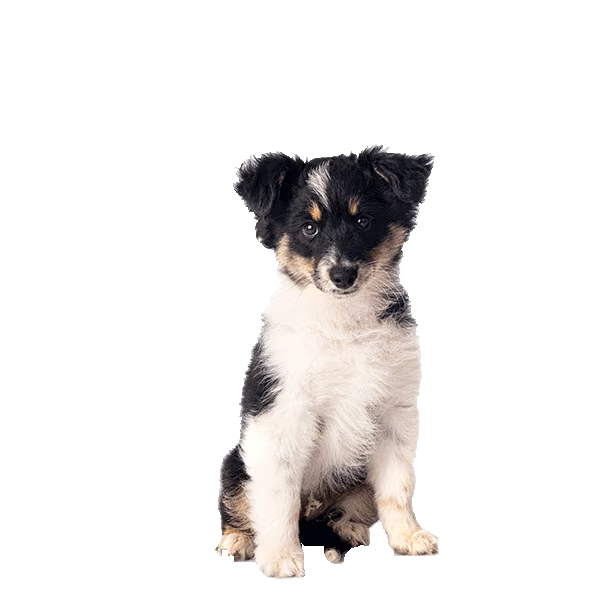
The Miniature American Shepherd is an intelligent, energetic herder that delivers the smarts and drive of its larger cousin in a compact frame.
How the Miniature American Shepherd coat is built, and what that means when you groom it.
Critical: A Miniature American Shepherd should not be shaved.
The undercoat keeps heat out as well as in, and the outer coat shields the skin from sun and insect bites. Clipping the whole coat off removes both. It often grows back patchy, soft or a different colour, and in some animals the guard hairs never return properly. Brush the undercoat out instead of cutting it off.
Caution: A Miniature American Shepherd coat mats easily.
Fine or long hair tangles at the base of the coat, out of sight, where the mats tighten and pull on the skin. Brushing has to reach right down to the roots in sections, not just skim the surface.
Information: A Miniature American Shepherd drops its undercoat in heavy bursts.
The undercoat comes out in heavy bursts over a few weeks. An undercoat rake, or a bath followed by a proper blow-dry, clears it far faster than daily brushing. Clipping the coat down is not a shortcut for this.
The Miniature American Shepherd is a small, intelligent herding dog from the United States that packs the drive and quick mind of a full-size shepherd into a compact frame.
The Miniature American Shepherd is a small herding dog developed in the United States. It stands well under the height of a standard herding dog yet retains the working instinct, stamina, and alert mind those larger dogs possess. Many owners describe it as a big dog in a small body.
This is an active, people-centred breed. It bonds closely with its family, monitors the household with a watchful eye, and needs a job to do. Without sufficient mental and physical work it grows bored and will find its own occupation, which seldom suits the owner.
The breed fits homes that can provide daily exercise and training. It performs well in dog sports such as agility, obedience, and herding trials, and its manageable size makes travel straightforward. Its loyalty and trainability make it a rewarding choice for an engaged owner.
| Attribute | Detail |
|---|---|
| Origin | United States |
| Size | Small |
| Lifespan | 12 to 13 years |
| Group / role | Herding dog, companion |
| Good with | Active families, children, other dogs when socialised |
This breed fits people who want an involved, trainable companion and can commit to regular activity. It suits active individuals, couples, and families alike. It is a poor match for households that are away for long hours or prefer a quiet, low-energy dog, as an under-exercised dog of this type tends to become restless and vocal.
The Miniature American Shepherd was bred down from small Australian Shepherds in California during the late 1960s and gained American Kennel Club recognition in 2015.
The breed traces to California in the late 1960s. Breeders selected the smaller individuals found within the Australian Shepherd population, aiming to preserve herding ability and temperament whilst reducing size. The result was a compact dog capable of working stock and travelling easily.
Through the 1970s and 1980s these small dogs were shown and registered under several names, including 'Miniature Australian Shepherd', and were popular on the horse-show circuit where their portable size proved an advantage. Dedicated breeders kept records and worked to establish a consistent type.
To distinguish the smaller dog as its own breed rather than a reduced form of the Australian Shepherd, the name was changed to Miniature American Shepherd. The American Kennel Club recorded the breed in its Foundation Stock Service and then granted full recognition in the Herding Group in 2015.
Since recognition the breed has grown in popularity as both a companion and a competitor in dog sports. It remains closely related to the Australian Shepherd in appearance and working style, differing principally in size.
The Miniature American Shepherd is a small, balanced dog with a medium-length double coat in black, blue merle, red, and red merle, often with white and copper markings.
The Miniature American Shepherd is slightly longer than it is tall, with a level topline and a moderate, athletic build. It resembles a smaller version of the Australian Shepherd. The tail is either naturally short, docked where permitted, or left at natural length. Ears are triangular and set high, tipping forward or to the side when the dog is attentive.
| Trait | Detail |
|---|---|
| Height | Males 36 to 46 cm (14 to 18 in); females 33 to 43 cm (13 to 17 in) |
| Weight | 9 to 18 kg (20 to 40 lb) |
| Coat | Medium-length double coat, weather resistant, moderate feathering |
| Colours | Black, blue merle, red, red merle, with or without white and copper trim |
| Eyes | Brown, blue, amber, or any combination, including flecks and marbling |
The double coat has a coarser outer layer and a softer undercoat that thickens in cold weather. Four base colours are accepted: black, blue merle, red (liver), and red merle. White and copper points may appear on the face, chest, legs, and underside. Eye colour varies considerably and the two eyes may differ. Merle-to-merle pairings carry known health risks, so eye and ear checks are important in merle lines.
The Miniature American Shepherd is loyal, smart, and energetic, devoted to its family, watchful with strangers, and happiest when it has work to do.
This breed is intelligent, alert, and strongly attached to its people. It tends to follow family members from room to room and thrives on being included in daily life. With children it is usually playful and gentle, though its herding instinct can lead it to nip at heels or circle running youngsters. That behaviour responds well to early training.
With strangers the breed is often reserved rather than immediately friendly. It tends to observe and assess before warming up, which makes it a capable watchdog. Early and continued socialisation helps keep that reserve from tipping into shyness or suspicion.
With other pets the breed generally does well, particularly when raised alongside them. The same herding drive that makes it watchful can prompt chasing of cats or small animals, so introductions should be supervised. Its energy and need for engagement are the defining traits of ownership: a bored Miniature American Shepherd will invent its own jobs.
| Trait | Rating |
|---|---|
| Affection | 5 |
| Energy | 5 |
| Trainability | 5 |
| Vocalness | 3 |
| Shedding | 3 |
The Miniature American Shepherd needs weekly brushing, daily exercise, and steady mental work, and it adapts to most homes that keep it active.
Day-to-day care centres on coat maintenance, exercise, and mental engagement. The breed is healthy and active and does not need elaborate upkeep, but it does need consistent attention to both its energy and its coat.
The breed adapts to flats or houses as long as its exercise requirements are met, though a securely fenced garden is a genuine advantage. Its double coat provides tolerance across a range of climates, but shade and fresh water are essential in warm weather. It does best as part of daily family life rather than left alone outside.
Feed a complete diet suited to the dog's life stage and activity, typically 75 to 150 g of quality dry food a day split into two meals.
A complete and balanced diet formulated for the dog's life stage keeps this active breed in good condition. Quantities depend on age, size within the standard, and activity level, so adjust to maintain a visible waist and easily felt ribs. Dogs in regular sport or working activity may need more than the figures below; less active dogs may need less.
| Life stage | Amount per day | Meals |
|---|---|---|
| Puppy (2 to 6 months) | Per label, fed to growth needs | 3 to 4 |
| Puppy (6 to 12 months) | 0.75 to 1.5 cups | 2 to 3 |
| Adult | 0.75 to 1.5 cups | 2 |
| Senior | 0.5 to 1.25 cups, adjusted for activity | 2 |
Keep treats to roughly 10 per cent of daily calories, which matters given how frequently this breed benefits from training rewards. Use small, low-calorie pieces for repetition work. A dog on a complete commercial diet generally requires no supplements; consult a vet before adding any, including joint or skin products.
The Miniature American Shepherd is generally healthy with a 12 to 13 year lifespan, though it can inherit eye disorders, hip dysplasia, and a drug sensitivity linked to the MDR1 gene.
The breed is generally healthy and typically lives 12 to 13 years. Responsible breeders screen for inherited conditions, so health-tested parents reduce the risk for puppies. As with all breeds, routine veterinary care and weight control support a long life.
| Condition | Signs | Note |
|---|---|---|
| MDR1 drug sensitivity | Adverse reaction to certain medications | Genetic test available; inform every vet of the result |
| Hip dysplasia | Stiffness, limping, difficulty rising | Screen breeding stock; keep the dog lean |
| Progressive retinal atrophy | Night blindness, gradual vision loss | DNA test available for carriers |
| Collie eye anomaly | Usually no signs; found on eye examination | Screen puppies and breeding dogs |
| Cataracts | Cloudy eye, reduced vision | Detected on routine eye examination |
The Miniature American Shepherd is highly trainable and eager to please, responding best to short, positive, varied sessions that channel its energy and herding drive.
Few breeds are more straightforward to train when an owner stays consistent. This dog learns quickly, watches its handler closely, and wants to work. That same intelligence means it picks up unwanted habits just as fast, so clear rules and early structure are essential. Sessions should be kept short and varied to hold its attention, and a regular job through obedience, trick training, or a dog sport helps absorb its energy. The herding instinct is best managed early before circling and heel-nipping become established habits.
Responsible breeding pairs health-tested adults, avoids merle-to-merle crosses, and produces small litters of typically three to seven puppies after about a nine-week pregnancy.
Breeding this dog requires planning and health screening rather than opportunistic pairings. Females reach sexual maturity within their first year, but responsible breeders wait until full physical and mental maturity, generally around two years of age, before proceeding. Both parents should be cleared for hip, eye, and MDR1 status before a mating is planned.
Mating follows the female's season, which occurs roughly twice a year. Pregnancy lasts approximately 63 days. Litters tend to be small for the dog's size. The principal genetic concern is merle colouring: pairing two merle dogs can produce 'double merle' puppies with serious eye and hearing defects, and such a cross is avoided.
Raising the young requires attentive care of the dam and puppies through weaning, with early handling and socialisation from the first weeks to establish steady adult temperament. Puppies usually move to new homes at eight weeks or older.
| Metric | Value |
|---|---|
| Sexual maturity | Within first year |
| Recommended breeding age | Around 2 years |
| Heat cycle | About twice per year |
| Gestation | About 63 days (9 weeks) |
| Average litter size | 3 to 7 puppies |
| Weaning age | About 6 to 8 weeks |
Your Miniature American Shepherd's details on a record that satisfies UK microchip law: free with United Pet Club, for life, with nothing to renew.
Give your Miniature American Shepherd five minutes of paperwork before it needs rescuing. The free profile takes a name, a date of birth, a photo and your contact details, and it lives on a registry that never charges for the privilege. Dog registration works whether the chip is already in or still on the to-do list.
The implant happens at the vet surgery; the record is your half of the bargain, and the 2016 regulations expect it kept up to date. Register the microchip free on the lifetime plan: any brand a British vet implants is accepted, amendments after moving house cost nothing, and the record stays searchable through the lookups rescue centres and wardens turn to first. Create your free account and square it away this evening.
Set up a free United Pet Club account, add your Miniature American Shepherd's details and a photo, and save. The profile stays live for the whole of the dog's life at no charge, and the chip number can be added the moment you have it.
Key the fifteen digit number into your free United Pet Club account with your current address and phone number. The lifetime plan accepts any brand a British vet implants, and amendments after a house move are free.
Yes. Dogs in England, Scotland and Wales have had to be chipped since 2016, with the keeper's details kept current. The law covers the chip; keeping the record pointing at a live phone number is what United Pet Club handles, free.
Nothing at all. The United Pet Club lifetime plan covers the profile, the microchip record and every amendment without a fee, so there is no renewal to remember.
Common questions about the Miniature American Shepherd cover its size, temperament, care needs, lifespan, suitability, and availability.
It is a small breed. Males stand approximately 36 to 46 cm (14 to 18 in) and females approximately 33 to 43 cm (13 to 17 in) at the shoulder, with most dogs weighing 9 to 18 kg (20 to 40 lb).
It is loyal, intelligent, alert, and energetic. It bonds closely with its family, is often reserved with strangers, and needs daily activity and mental stimulation to remain settled.
Grooming demands are moderate, with weekly brushing and more attention during seasonal moults. The greater commitment is meeting its exercise and training requirements, which are high relative to its size.
The typical lifespan is 12 to 13 years. Health screening of the parents and sound preventive care support a full life.
It can suit an active first-time owner who is prepared to commit to daily exercise and consistent training. It is not a good fit for people who are away for long hours or who prefer a calm, low-energy dog.
Generally yes. The breed is usually playful with children and gets on well with other animals, though its herding instinct can lead to nipping or chasing. Early training and supervision help considerably.
The breed is recognised and has grown in popularity, so puppies are available through dedicated breeders, and adults occasionally come through breed-specific rescue organisations. Health-tested litters may have waiting lists.
